In brief
| Question | In brief |
|---|---|
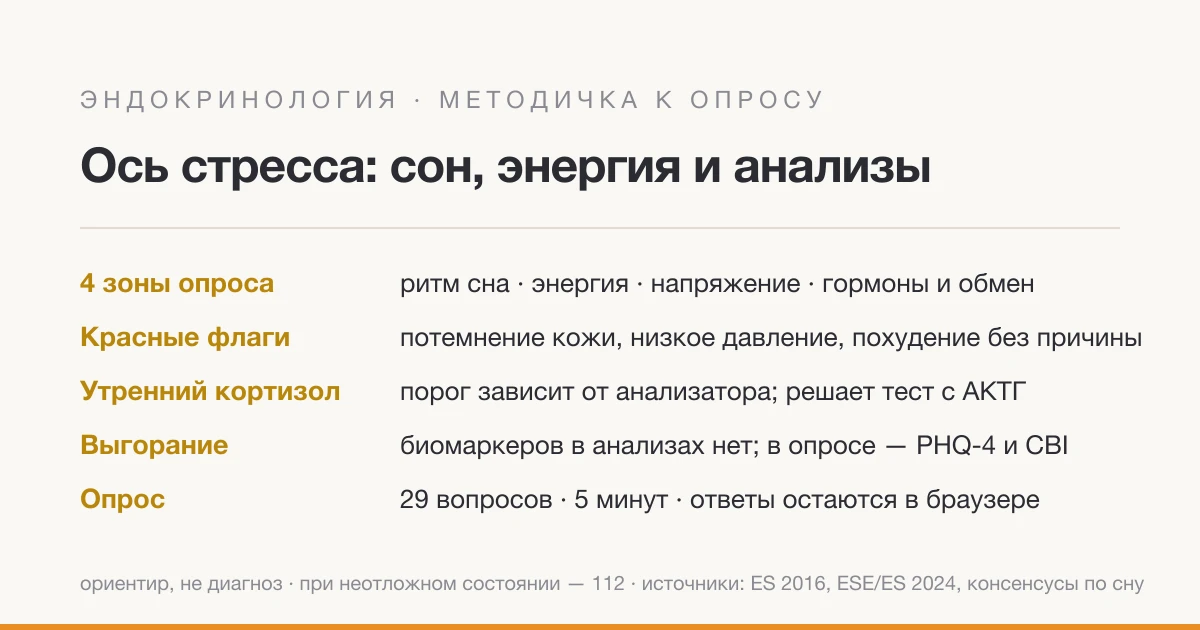
| What the questionnaire shows | How stress affects your sleep, energy, and well-being (four areas) and what to discuss at a consultation |
| What it does not show | A diagnosis or your cortisol level: no validated “stress typology by cortisol” exists |
| When to call 112 | Severe weakness, vomiting, abdominal pain, confusion, feeling about to faint, chest pain, or shortness of breath right now |
| Thoughts of harming yourself | Right now — 112 or your local emergency services, and don’t stay alone; if you are not in danger — a psychotherapist or psychiatrist in the next few days |
| When to see an endocrinologist | Signs of adrenal insufficiency — an in-person exam in the next few days; a combination of Cushing’s signs — an in-person exam |
| What to discuss at a consultation | Morning cortisol with ACTH, sodium and potassium, TSH and free T4, a complete blood count, ferritin with CRP, glucose and HbA1c, vitamin B12 |
Abbreviations: ACTH is the pituitary hormone that controls the adrenal glands; TSH is the pituitary hormone that controls the thyroid; free T4 is the thyroid’s own hormone, thyroxine. HbA1c is glycated hemoglobin, the average blood sugar over 3 months; C-reactive protein (CRP) is a marker of inflammation; CBI is the Copenhagen Burnout Inventory.
How stress is linked to sleep and energy
The stress axis is the questionnaire’s name for the HPA axis (hypothalamic–pituitary–adrenal): the hypothalamus and the pituitary, through the hormone ACTH, control the production of cortisol by the adrenal glands. How this system works is covered in the article on cortisol and the adrenal glands. Normally, cortisol is already high on waking and keeps rising for the first 30–45 minutes: this is the cortisol awakening response (CAR), a 50–156% increase in healthy adults (Stalder T, Psychoneuroendocrinology 2016). It then drops rapidly, and more slowly toward evening, reaching its lowest point around bedtime (Adam EK, Psychoneuroendocrinology 2017).
How steeply cortisol falls from morning to evening is called the diurnal slope. A meta-analysis (a pooled calculation across many studies) of 80 studies found that a flatter slope is associated with poorer health, with an average effect size of r = 0.147 (r is the correlation coefficient: 0 means no association, 1 a perfect one). The association was found for 10 of 12 types of outcome (Adam EK, Psychoneuroendocrinology 2017). The authors caution that most of the data are cross-sectional, that is, taken at a single point in time, and a flatter slope may be a consequence of disease rather than its cause. These are differences between groups of people, not a rule for reading one person’s test result.
Sleep loss itself shifts cortisol. In healthy young men, partial and total sleep deprivation raised the next day’s evening (6–11 p.m.) plasma cortisol by 37% and 45%, respectively. The onset of the nightly decline in secretion was delayed by at least an hour (Leproult R, Sleep 1997). This is why an evening “second wind” and taking a long time to fall asleep are assigned in the questionnaire to the Sleep–wake rhythm area: sleep is looked at first, not the adrenal glands.
In experiments, evening light and screens suppressed melatonin, the hormone that prepares the body for sleep. In 116 healthy people aged 18–30, ordinary room light (under 200 lux) for 8 hours before bedtime delayed the onset of melatonin production in 99% of participants (Gooley JJ, J Clin Endocrinol Metab 2011). In 12 young adults, reading on a light-emitting screen for about 4 hours on five consecutive evenings shifted the internal clock more than 1.5 hours later compared with a printed book. Falling asleep took about 10 minutes longer (Chang AM, Proc Natl Acad Sci U S A 2015); a brief glance at a phone was not studied there.
Caffeine and alcohol. In a meta-analysis of 24 studies in healthy adults aged 18–65, caffeine shortened total sleep time by an average of 45 minutes and lengthened the time to fall asleep by 9 minutes (Gardiner C, Sleep Med Rev 2023). In a meta-analysis of 27 studies in healthy people, even a low dose of alcohol (0.5 g/kg or less, about two standard drinks) delayed the first episode of REM sleep (the rapid-eye-movement phase, when dreaming occurs) and reduced the amount of REM sleep. The larger the dose, the stronger the effect; falling asleep was faster only after a high dose (0.85 g/kg or more), and the effect on total sleep time could not be determined (Gardiner C, Sleep Med Rev 2025).
The questionnaire’s four areas
The questionnaire does not calculate a “cortisol level” and does not make a diagnosis. It sorts your answers into four areas and shows how pronounced each one is. The percentage next to an area is the share of its items you checked: 50% or more is “Pronounced”, 25% or more “Moderate”, less than 25% “Mild”; this is the questionnaire’s rule, not a clinical threshold. “Adrenal fatigue” is not recognized by any endocrinology society: a systematic review of 58 studies found no substantiation that it is an actual medical condition (Cadegiani FA, BMC Endocr Disord 2016). True adrenal insufficiency does exist, and it is ruled out first — the next section covers it.
| Area | What we check | Why |
|---|---|---|
| Sleep–wake rhythm | Hard to wake up, taking more than 30 minutes to fall asleep, sleeping 7 hours or less, night shifts, screens before bed, coffee after 2 p.m. | A disrupted rhythm alters evening cortisol and melatonin |
| Energy and recovery | An afternoon crash, craving sweets and coffee, apathy, frequent illness, little exercise, personal burnout of 50 or more on the CBI scale | Sleep loss, sleep apnea, depression, anemia, iron or B12 deficiency, hypothyroidism |
| Tension and anxiety | Anxiety, irritability, palpitations, blood pressure swings, stress of 7 out of 10 or more, work over 50 hours a week, GAD-2 (two anxiety questions) of 3 or more | Sleep and a lighter load; GAD-2 of 3 or more — a psychotherapist or psychiatrist |
| Hormones and metabolism | Craving salty food, dizziness on standing up, weight gain around the belly, unexplained weight loss, an irregular cycle | Lab tests: thyroid, adrenal glands, sex hormones, glucose |
The cut-offs in the questions about sleep, exercise, and work are the questionnaire’s working cut-offs; the data do not match them everywhere. The American Academy of Sleep Medicine and the Sleep Research Society recommend that healthy adults aged 18–60 sleep 7 or more hours per night on a regular basis. Sleeping less than 7 hours on a regular basis is associated with obesity, diabetes, hypertension, heart disease, stroke, depression, and an increased risk of death (Watson NF, Sleep 2015); these are associations, not proven causation. According to the National Sleep Foundation consensus, falling asleep within 30 minutes is good sleep, 46–60 minutes is poor (except in older adults), and more than 60 minutes is poor at all ages. The 31–45-minute range was not assigned to either category (Ohayon M, Sleep Health 2017).
For the exercise question, the World Health Organization (WHO) recommends that adults do 150–300 minutes of moderate-intensity or 75–150 minutes of vigorous-intensity aerobic activity per week, or an equivalent combination, plus muscle-strengthening exercise (Bull FC, Br J Sports Med 2020). On working hours: according to WHO and International Labour Organization estimates, working 55 hours a week or more, compared with 35–40 hours, is associated with a higher risk of death from ischemic heart disease and of developing a stroke. The data are observational; for 41–48 hours the evidence of harm is insufficient, and for 49–54 hours it is limited for stroke (Pega F, Environ Int 2021). The questionnaire’s cut-off — more than 50 hours — is below the level for which these estimates exist.
Why does the Energy and recovery area lead to blood tests and a conversation about mood rather than to cortisol? In a systematic review of primary-care studies, among people presenting with tiredness, depression as diagnosed by the general practitioner was found in 18.5% (6 studies). Anemia was found in 2.8%, malignancy in 0.6%, and serious somatic disease in 4.3% (3 studies each). The authors consider extensive investigation warranted only in case of specific findings from the history or examination (Stadje R, BMC Fam Pract 2016). These are data on everyone presenting with tiredness; when warning signs are present, investigation is needed in any case — the next section covers it.
When it isn’t stress: red flags
The red flags in the questionnaire are the block “Signs that shouldn’t be missed”. The main groups are the signs of adrenal insufficiency (too little cortisol) and of Cushing’s syndrome (too much). Two more items — episodes of palpitations with headache and sweating, and shaky hands with poor heat tolerance — lead to tests of the thyroid and for pheochromocytoma and excess aldosterone. So does the item “High blood pressure that doesn’t come down well with medication”, which also belongs to the Cushing’s group. Both diseases are rare: primary adrenal insufficiency affects about 100–140 people per million (Bornstein SR, J Clin Endocrinol Metab 2016). New cases of Cushing’s disease in Denmark number 1.2–1.7 per million per year (Lindholm J, J Clin Endocrinol Metab 2001). Rarity is no reason to miss them: because the symptoms are nonspecific, the diagnosis of adrenal insufficiency is frequently delayed until an adrenal crisis (Bornstein SR, J Clin Endocrinol Metab 2016).
Adrenal insufficiency
Except for salt craving, the symptoms of primary adrenal insufficiency are nonspecific: weakness, fatigue, muscle and joint pain, weight loss, abdominal pain, depression, anxiety (Bornstein SR, J Clin Endocrinol Metab 2016). The 2016 guideline of the US-based Endocrine Society (ES) recommends ruling it out in acutely ill patients with otherwise unexplained signs: dehydration, low blood pressure, low sodium, high potassium, fever, abdominal pain, hyperpigmentation. Darkening of the skin (palm creases, scars, mucous membranes) occurs only in the primary form and is not always present: its absence does not rule out insufficiency. DHEA-S (an adrenal hormone) well below the normal range for age and sex is a useful initial sign, but it cannot make the diagnosis on its own: levels can be low without insufficiency, especially in older people (Bornstein SR, J Clin Endocrinol Metab 2016).
The questionnaire advises an in-person exam by an endocrinologist in the next few days under any one of three conditions. First — darkening of the skin without tanning, losing more than 5% of body weight over 6–12 months without trying, or abnormal results in tests you have already had: sodium below normal, potassium above normal, morning cortisol below the lab’s normal range. Second — nausea, vomiting, or abdominal pain without a clear cause together with dizziness on standing up, a drop in blood pressure, or fainting. Third — two of three signs: craving salty food, dizziness on standing up, losing weight for no obvious reason. Until the exam, the questionnaire asks you not to start adaptogens, licorice, or DHEA (a hormone supplement): when insufficiency is suspected, ES 2016 suggests a test with synthetic ACTH, not herbs. Why licorice is no substitute for cortisol is explained in the companion article.
A separate block of the questionnaire covers glucocorticoids in any form. Any route of administration has the potential to suppress the axis: pills, inhalers, nasal sprays, creams and ointments, injections, including joint injections in the previous 2 months (Beuschlein F, J Clin Endocrinol Metab 2024). Supraphysiologic doses (more than the adrenal glands produce on their own) always suppress the axis. While the dose is being reduced but remains above physiologic levels, a withdrawal syndrome can develop that clinically resembles adrenal insufficiency. The 2024 joint guideline of the European Society of Endocrinology (ESE) and the ES speaks of “current or recent” use and does not define that period with a number (Beuschlein F, J Clin Endocrinol Metab 2024). The questionnaire’s “past 12 months” window is a working cut-off, not a threshold from the guideline.
Two more items from the same block. In people who take opioids regularly, a meta-analysis found hypocortisolism (cortisol deficiency) in 15% (95% confidence interval [CI] 6–28%; 5 studies, 205 patients). This is an association, and the frequency varies between studies (de Vries F, J Clin Endocrinol Metab 2020). In someone taking opioids, low cortisol is not a lab error but a reason to discuss it with an endocrinologist. Oral estrogens — combined contraceptives and hormone therapy in pill form — raise corticosteroid-binding globulin (the carrier protein for cortisol) and may increase total serum cortisol (Bornstein SR, J Clin Endocrinol Metab 2016; Fleseriu M, Lancet Diabetes Endocrinol 2021). Pregnancy also raises corticosteroid-binding globulin (Fleseriu M, Lancet Diabetes Endocrinol 2021).
Cushing’s syndrome
Cortisol excess is rarer still, but its signs are in the questionnaire. According to the ES 2008 guideline, the features that best discriminate Cushing’s syndrome are easy bruising, facial plethora (a red face), proximal muscle weakness — difficulty getting up from a chair without using the arms — and reddish-purple striae (stretch marks) wider than 1 cm. Many patients do not have these signs: most of them do not have a high sensitivity; weight gain, obesity, and hypertension are common but poorly discriminating features (Nieman LK, J Clin Endocrinol Metab 2008). The same guideline advises testing people with features unusual for their age (osteoporosis, hypertension), with multiple and progressive features, and with an incidentally found adrenal mass; widespread testing of other groups is not recommended. Before testing, a thorough drug history is needed to exclude glucocorticoids as the cause.
The initial test is one with high diagnostic accuracy: 24-hour urine free cortisol, late-night salivary cortisol, the 1 mg overnight or the 2 mg 48-hour dexamethasone suppression test. If the result is abnormal — an endocrinologist and a second test. Random serum cortisol and ACTH are not recommended for this purpose, and it follows from the same list that a normal morning cortisol does not rule out Cushing’s syndrome (Nieman LK, J Clin Endocrinol Metab 2008). According to the 2021 Pituitary Society consensus, the dexamethasone test is unreliable in women taking oral estrogens (Fleseriu M, Lancet Diabetes Endocrinol 2021). In the questionnaire, a single such sign is something to discuss at your appointment. A combination of two or more means an in-person exam by an endocrinologist; this also covers rapid weight gain in the belly and face, a round red face, and high blood pressure that doesn’t come down well with medication.
Palpitations, blood pressure swings, tremor
Palpitations and blood pressure swings in the questionnaire lead to investigation, not to supplements. The initial evaluation is the history, physical examination, and a 12-lead ECG (a recording of the heart’s activity); in a good proportion of patients this is enough for a provisional diagnosis and risk assessment (Giada F, Card Electrophysiol Clin 2018). According to a systematic review (mostly single small studies), the history and examination are not accurate enough to exclude a clinically significant arrhythmia in most patients. So for recurrent palpitations, most people need prolonged ECG monitoring with demonstration of symptom–rhythm correlation to diagnose an arrhythmia (Thavendiranathan P, JAMA 2009). In the questionnaire, palpitations together with weight loss, or shaky hands or poor heat tolerance, lead to a check of TSH and free T4 in the next few days.
Pheochromocytoma is a rare tumor with a highly variable presentation; most commonly it presents with episodes of headache, sweating, palpitations, and high blood pressure (Lenders JW, Lancet 2005). The initial test is plasma free metanephrines (breakdown products of adrenaline) or urinary fractionated metanephrines; the result is affected by exertion, stress, body position, food, and medicines: false-positive and false-negative results occur, and a positive result requires confirmation. This was the recommendation of the 2014 Endocrine Society guideline (retired in 2022 without replacement) and is confirmed by the 2025 Japanese guideline (Lenders JW, J Clin Endocrinol Metab 2014; Tanabe A, Endocr J 2026). The 2025 Endocrine Society guideline suggests (conditional recommendation) screening all people with hypertension for primary aldosteronism (aldosterone excess) — aldosterone, renin, and their ratio (Adler GK, J Clin Endocrinol Metab 2025). For the items “Episodes of palpitations with headache and sweating” and “High blood pressure that doesn’t come down well with medication”, the questionnaire advises an exam by an endocrinologist and tests: metanephrines in blood or urine, aldosterone and renin.
Dizziness on standing up: how it is checked at the appointment
Dizziness on standing up is checked with an orthostatic test. Classic orthostatic hypotension is a sustained fall in systolic (upper) blood pressure of 20 mmHg or more, or in diastolic (lower) pressure of 10 or more. That is how the consensus of the European and American autonomic societies and the European Academy of Neurology defines it. It is measured within 3 minutes of standing after at least 5 minutes lying down; if blood pressure is high when lying down, the systolic threshold is 30. Orthostatic hypotension is nonspecific: it can be caused by medicines, autonomic failure, or dehydration, and assessing the adrenal glands is only one of the branches (Thijs RD, Clin Auton Res 2021). In primary adrenal insufficiency, renin and aldosterone are measured at the same time: high renin with normal or low aldosterone points to mineralocorticoid deficiency, which may be an early and the only sign (Bornstein SR, J Clin Endocrinol Metab 2016).
Which tests to discuss and how to read them
Below is what the questionnaire suggests discussing at a consultation; it is not a prescription: what you need is decided by your answers and the examination. The tables give the essentials; below them are the thresholds with the test method and the group — without these, a number means nothing. If your cycle has become irregular or has stopped, the questionnaire adds a pregnancy test and prolactin.
| Test | Why | How to read it | Pitfalls |
|---|---|---|---|
| Morning cortisol + ACTH | To rule out adrenal insufficiency | Serum at 8–9 a.m., paired with ACTH; the threshold depends on the analyzer | Glucocorticoids by any route, estrogens, opioids, time of sampling |
| Sodium | A sign of cortisol and aldosterone deficiency | Below 135 mmol/L (ESE 2014; Spasovski G, Eur J Endocrinol 2014) | Read together with cortisol and blood pressure |
| Potassium | High — a sign of adrenal insufficiency | Below 3.5 or at least 5.0 mmol/L (KDIGO, the kidney disease guidelines; Villalvazo P, Diagnostics (Basel) 2026) | Same as for sodium |
| Renin, aldosterone | Low blood pressure, dizziness on standing up; hypertension | Taken at the same time; with low blood pressure — high renin with low or normal aldosterone, with hypertension — the ratio (ES 2025) | Sampling conditions are set by the doctor |
| Test | Why | How to read it | Pitfalls |
|---|---|---|---|
| DHEA-S | An initial sign of primary insufficiency | Only against age- and sex-specific ranges; intervals depend on the method | Can be low without disease, especially in older people |
| TSH, free T4 | Thyroid function | Against the lab’s reference range | An “optimum” of 1.0–2.5 mIU/L is not supported by data |
| Complete blood count | Anemia | Against the lab’s reference range | Iron or B12 deficiency is possible without anemia |
| Ferritin + CRP | Iron stores, adjusted for inflammation | Deficiency: WHO — below 15 µg/L without inflammation, below 70 with it; NICE (UK) — below 30; US gastroenterologists (AGA) — below 45 with anemia | High — more often inflammation, but overload can’t be ruled out without transferrin saturation |
| Test | Why | How to read it | Pitfalls |
|---|---|---|---|
| Fasting plasma glucose, HbA1c | Glucose metabolism | Non-pregnant: diabetes — fasting 7.0 mmol/L or higher or HbA1c 6.5% or higher; prediabetes — 5.6–6.9 or 5.7–6.4% (American Diabetes Association, 2026) | Without unequivocal hyperglycemia, two abnormal results are needed |
| Vitamin B12 | Deficiency without anemia occurs | No definitive thresholds; low-normal — methylmalonic acid | A target of “500 pg/mL or more” is not in the guidelines we found |
| Vitamin D (25(OH)D) | If indicated | ES 2024: no routine testing | ES 2024 sets no target level |
Morning cortisol is measured in serum in the 6–10 a.m. window (usually 8–9 a.m.), paired with ACTH. ES 2016 suggests the standard test with 250 µg of synthetic ACTH (corticotropin) as the preferred way to establish the diagnosis of insufficiency (weak recommendation). If the test is not feasible, a morning serum cortisol below 140 nmol/L in combination with ACTH is considered a preliminary sign. With confirmed cortisol deficiency, ACTH more than twice the upper limit of normal is consistent with the primary form. The threshold that rules out insufficiency with 100% sensitivity is called controversial by the guideline itself: different studies argue for levels from 285 to 480 nmol/L (Bornstein SR, J Clin Endocrinol Metab 2016). For an 8–9 a.m. cortisol below 150 nmol/L, the 2024 UK NICE guideline recommends recognizing that the person may have adrenal insufficiency (NICE guideline NG243, 2024). For the axis after glucocorticoids, the ESE/ES 2024 guideline treats 150–300 nmol/L as a gray zone and a value above 300 as a sign of recovery (Beuschlein F, J Clin Endocrinol Metab 2024).
In a retrospective study of 835 patients referred for an ACTH stimulation test, no one with insufficiency had a morning cortisol above 262 nmol/L on the Roche Elecsys Cortisol II analyzer. That is a threshold for this cohort, not a general cut-off (Symonds CJ, Clin Endocrinol (Oxf) 2026). In healthy people on the same analyzer, the morning interval is 166–507 nmol/L (Vogeser M, Clin Chem Lab Med 2017). The lower limit on modern analyzers, according to ES 2016, is 113–131 nmol/L (Bornstein SR, J Clin Endocrinol Metab 2016). When signs of insufficiency are present, a morning cortisol below roughly 300 nmol/L (on polyclonal immunoassays, up to 350–480) does not rule it out — a synthetic ACTH test with an endocrinologist is needed. There are no data supporting an “optimum” of 350–500 nmol/L, either in the guidelines or in the studies we found.
TSH is read against the lab’s reference range (its normal range). A narrow “optimum” of 1.0–2.5 mIU/L is not supported by data. In a double-blind randomized controlled trial (RCT) in people on levothyroxine, keeping TSH at 0.34–2.50 mIU/L did not improve quality of life, mood, or cognition compared with 2.51–5.60 (Samuels MH, J Clin Endocrinol Metab 2018). In the TRUST trial, 737 people aged 65 and older with persistent subclinical hypothyroidism (TSH 4.60–19.99 mIU/L) received levothyroxine or placebo for a year. Levothyroxine changed neither the hypothyroid symptoms score nor the tiredness score (Stott DJ, N Engl J Med 2017). These are data on older people with mildly raised TSH, not on younger people and not on TSH above 10. Do not change your levothyroxine dose on your own on the basis of these data — that is your treating doctor’s decision.
Ferritin is read together with C-reactive protein. WHO 2020 defines iron deficiency as ferritin below 15 µg/L in healthy people and below 70 with inflammation; US gastroenterologists (AGA, 2020) — below 45 in people with anemia; NICE — below 30. A single cut-off of 30 misses deficiency when inflammation is present (Roemer MGM, PLoS One 2025). High ferritin is linked to iron overload in only about 10% of cases, but overload cannot be ruled out without transferrin saturation (Sandnes M, J Clin Med 2021); more in the article on ferritin and iron overload.
Does iron help with fatigue when there is no anemia? In an RCT in France, 198 menstruating women aged 18–53 with unexplained fatigue, ferritin below 50 µg/L, and hemoglobin above 12.0 g/dL received ferrous sulfate (80 mg of elemental iron a day) or placebo for 12 weeks. The fatigue score decreased by 47.7% versus 28.8% (p = 0.02 — a statistically significant difference); no significant effect on quality of life, depression, or anxiety was found, and the placebo response was large (Vaucher P, CMAJ 2012).
For B12 there are no definitive deficiency thresholds. The British Society for Haematology considers serum B12 the first-line test and, for a low-normal result, recommends a second-line test — plasma methylmalonic acid. When the test result is discordant with strong clinical features, treatment is not delayed, to avoid neurological damage (Devalia V, Br J Haematol 2014). A target of “500 pg/mL or more” appears in none of the guidelines we found — it is a convention, not a threshold. Deficiency without anemia is real: of 141 patients with neuropsychiatric abnormalities due to B12 deficiency, 40 (28%) had neither anemia nor macrocytosis. The data are from 1988, with no control group; the manifestations were neurological and psychiatric, not fatigue (Lindenbaum J, N Engl J Med 1988).
Vitamin D — if indicated: the 2024 Endocrine Society guideline sets no target level of 25(OH)D (the form of vitamin D measured in blood) and advises against routine testing in any of the populations considered. The “40–60 ng/mL” benchmark is not supported by it (Demay MB, J Clin Endocrinol Metab 2024). More in the article on vitamin D. Glucose and HbA1c are read by the 2026 criteria of the American Diabetes Association (ADA) for non-pregnant people and only from plasma glucose, not from glucose meter readings. Diabetes — fasting glucose 7.0 mmol/L or higher, or HbA1c 6.5% or higher (in a laboratory, by a certified method); prediabetes — fasting 5.6–6.9 mmol/L or HbA1c 5.7–6.4%. Without unequivocal hyperglycemia, two abnormal results are needed: from two different tests (which may be done at the same time) or from the same test at two different time points (American Diabetes Association, Diabetes Care 2026).
A daily salivary cortisol profile: when it is needed
Late-night salivary cortisol is a validated screening test for Cushing’s syndrome: with cortisol excess, the normal nighttime low point is lost (Fleseriu M, Lancet Diabetes Endocrinol 2021). ES 2008 recommends it as one of the initial tests — two measurements (Nieman LK, J Clin Endocrinol Metab 2008), and the 2021 Pituitary Society consensus — at least two or three tests (Fleseriu M, Lancet Diabetes Endocrinol 2021). The threshold is the reference value of the specific method; cut-offs vary significantly between laboratories. With mass spectrometry (LC-MS/MS), a cut-off of 2.4 nmol/L gave a sensitivity of 100% and a specificity of 98% (Antonelli G, Clin Chim Acta 2015). On the Roche Elecsys Cortisol II analyzer, the 95th percentile of midnight saliva in healthy people is 7.56 nmol/L (Vogeser M, Clin Chem Lab Med 2017). A single threshold of “below 5 nmol/L” does not exist.
Morning salivary cortisol in patients with Cushing’s syndrome and in healthy people overlaps heavily and is of little diagnostic use (Raff H, J Clin Endocrinol Metab 1998). What is validated is late-night cortisol over two or more evenings, not a “curve” of four or five points. One elevated value means little: the majority of people with at least one elevated result did not have Cushing’s syndrome, so a single elevated level has poor specificity. A result close to the upper limit is repeated and, if suspicion is significant, supplemented with a low-dose dexamethasone test. False elevations without a tumor can be caused by recent stress, an abnormal sleep–wake cycle, inappropriate sampling time, aging, and smoking (Kannankeril J, J Endocr Soc 2020).
What this test does not do. Late-night salivary cortisol is not validated for detecting adrenal insufficiency. The authors of a systematic review recommend neither it, nor the CAR, nor a “salivary rhythm” for deciding whether a person has adrenal insufficiency, nor HPA axis tests as markers of burnout. In fatigued people, the daily salivary cortisol rhythm did not differ from controls in 16 of 26 studies, while 7 showed an impaired decline (Cadegiani FA, BMC Endocr Disord 2016). Salivary cortisol is unable to discriminate between people with and without depression (Knorr U, Psychoneuroendocrinology 2010). A low morning rise in a “curve” diagnoses nothing on its own. According to preliminary data, with objectively verified sampling times, no rise or only a minor one (less than 1.5–2.5 nmol/L) occurs in healthy adults too, on roughly 15–20% of days — possibly as the lower edge of normal (Stalder T, Psychoneuroendocrinology 2016).
Two tests people often ask about. The first is the four-spot dried urine test for cortisol and its metabolites. The only validation found in PubMed was performed and funded by the manufacturing laboratory, partly on its clients’ data. Dried urine agreed with liquid urine (n = 20), and the sum of four spots with 24-hour urine (n = 28). People with adrenal insufficiency and Cushing’s disease were excluded, there was no comparison with serum, and diagnostic accuracy was not studied (Newman M, J Clin Transl Endocrinol 2020). The second is hair cortisol: in a meta-analysis of 66 studies, stress-exposed groups had on average 22% higher levels — mainly when stress was still ongoing at the time of the study (+43%). With past stress it was not raised (−9%, not significant) (Stalder T, Psychoneuroendocrinology 2017). These are differences between groups, not a threshold for one person.
| Condition | What and why |
|---|---|
| An ordinary day | Not during night shifts or a disrupted day/night cycle (Fleseriu M, Lancet Diabetes Endocrinol 2021) |
| Not right after a flight | Two days after a 10-time-zone westward flight, the salivary cortisol rhythm had shifted by almost 4 hours (Härmä M, Ergonomics 1994) |
| No licorice for a week | Licorice raised evening salivary cortisol 49–97% (medium/high dose); authors advise a week without it (Imamovic M, Endocr Connect 2023) |
| Hormonal medicines — tell the doctor in advance | Glucocorticoids in any form, contraceptives, other estrogens — tell the doctor beforehand (Nieman LK, J Clin Endocrinol Metab 2008) |
| Condition | What and why |
|---|---|
| In the morning — at once, before getting up | Kit by the bed the night before; first sample right after waking, a delay distorts the rise (Stalder T, Psychoneuroendocrinology 2016) |
| Until the last morning sample | Nothing by mouth other than water, no smoking, no brushing your teeth (Stalder T, Psychoneuroendocrinology 2016) |
| Evening sample — at your usual bedtime | Not strictly midnight; no food, drink, smoking or tooth-brushing for 15 minutes before (Fleseriu M, Lancet Diabetes Endocrinol 2021) |
Mood and burnout in the questionnaire
Tiredness and poor sleep are among the most common manifestations of depression: in a European survey of people with depression, 73% named tiredness and 63% sleep problems (Tylee A, Int Clin Psychopharmacol 1999). This is why the questionnaire includes the four PHQ-4 questions: two about depression (PHQ-2) and two about anxiety (GAD-2) — validated screening scales (Kroenke K, Psychosomatics 2009). A score of 3 on the PHQ-2 and on the GAD-2 corresponds to the 93.4th and 95.2nd percentiles, respectively, in a nationally representative sample of the German population (5,030 people) (Löwe B, J Affect Disord 2010). In an individual participant data meta-analysis of studies using semistructured interviews, a PHQ-2 score of 3 or more had a sensitivity of 72% and a specificity of 85% for major depression (Levis B, JAMA 2020).
The PHQ-2 is a first step: a positive result is a reason to complete the full PHQ-9 (a 9-item questionnaire), not a diagnosis. For a GAD-2 score of 3 or more, pooled sensitivity for generalized anxiety disorder is 76% (95% CI 55–89) and specificity 81% (60–92), based on few samples (Plummer F, Gen Hosp Psychiatry 2016). So at a score of 3 or more, the result says “Anxiety is above the normal range — we’ll discuss it at your consultation” (or the same about mood) and advises discussing it with a psychotherapist or psychiatrist. This is not a diagnosis.
The personal burnout scale is part of the three-scale Copenhagen Burnout Inventory (CBI). In the Danish PUMA cohort, all three scales predicted future sickness absence, sleep problems, use of painkillers, and intention to quit (Kristensen TS, Work & Stress 2005). In a representative sample of Danish adults aged 20–59, the mean personal burnout score was 32.7; a “high degree of burnout” in PUMA was defined as 50 points or more — found in 22.2% (CBI normative data, NFA 2004). The levels in the questionnaire (moderate — 50–74, high — 75–99, severe — 100) are a convention from a later study, not the authors’ own (Creedy DK, BMC Pregnancy Childbirth 2017). The design of the PUMA study — Borritz M, Scand J Public Health 2006. This is a level on the scale, not a diagnosis; HPA axis tests should not be used as markers of burnout (Cadegiani FA, BMC Endocr Disord 2016).
The fifth question of the block is about thoughts of death or self-harm (item 9 of the PHQ-9). Among 84,418 US outpatients who completed the PHQ-9 at visits for depression, the answer to this item predicted risk. A suicide attempt within a year occurred in about 0.4% of those answering “not at all” versus 4% of those answering “nearly every day”. About a fifth of the attempts were by people who always answered “not at all”, so that answer is no guarantee; whether the figures carry over to self-screening outside a clinic, the authors cannot say (Simon GE, Psychiatr Serv 2013). No harm from the question itself has been shown: a meta-analysis of 13 prospective studies found no significant iatrogenic effect, and the authors consider universal screening appropriate (DeCou CR, Suicide Life Threat Behav 2018).
What you can start right now
“Daylight in the first hour after getting up” and “Put screens away an hour before bed” rest on a single document — an expert consensus for healthy adults aged 18–55 with a regular daytime schedule (not for night shifts). During the day it advises a minimum of 250 lux of melanopic equivalent daylight illuminance at the eye (these are not ordinary lux), using daylight in the first instance where possible. In the evening, starting at least 3 hours before bedtime — no more than 10 lux (Brown TM, PLoS Biol 2022). The rules “in the first hour”, “by a window”, and “screens an hour before” are not in the document — they are the questionnaire’s wording; the document sets light levels, not screen rules.
“Coffee only before 2 p.m.” For a cup of coffee (107 mg) not to shorten sleep to a statistically significant degree, according to the meta-analysis model, it should be drunk no later than 8.8 h before bedtime. The authors call this a starting point: the half-life of caffeine ranges from 2 to 10 hours between people. The conclusions may not carry over to adolescents, people over 65, people who do not drink coffee, or those who drink a lot of it (Gardiner C, Sleep Med Rev 2023). For 400 mg (about four cups), the data contain no hour after which coffee no longer disturbs sleep. That dose, even 6 hours before bedtime, significantly worsened sleep in 12 healthy people (Drake C, J Clin Sleep Med 2013). For one cup and a bedtime around 11 p.m., the “before 2 p.m.” rule fits within these bounds; with an earlier bedtime the cut-off moves earlier.
“Sleep 7–8 hours, at the same time every night” and “Physical activity at least 3 times a week”. In the UK Biobank cohort (60,977 people, mean age 63, sleep regularity measured by accelerometer), the more regular four-fifths of participants had a 20–30% lower risk of death from all causes. The comparison is with the least regular fifth; the analysis was fully adjusted for lifestyle, socioeconomic factors, shift work, and medicines; this is an observational association, not proof of causation (Windred DP, Sleep 2024). The consensus of the American Academy of Sleep Medicine and the Sleep Research Society has no upper limit of 8 hours: 7 hours or more is recommended. In a meta-analysis of 66 studies, regular physical activity gives small improvements in total sleep time and sleep efficiency and moderate improvements in sleep quality (Kredlow MA, J Behav Med 2015). “3 times” is the questionnaire’s wording; the WHO counts minutes per week.
If insomnia persists, routine alone is not enough. The 2023 European insomnia guideline names cognitive behavioral therapy for insomnia (CBT-I) the first-line treatment for chronic insomnia in adults of any age (level A). Fast-release melatonin and phytotherapeutics (herbal preparations) are not recommended for treating insomnia (A) (Riemann D, J Sleep Res 2023). The American Academy of Sleep Medicine recommends multicomponent CBT-I (strong recommendation) and advises against sleep hygiene as the sole treatment for chronic insomnia (conditional) (Edinger JD, J Clin Sleep Med 2021). More in the article on insomnia; on a new type of sleeping pill, in the article on daridorexant.
Snoring or pauses in breathing during sleep, according to people close to you, are a reason to check for sleep apnea; its typical symptoms are unrefreshing sleep, daytime sleepiness, fatigue or insomnia, and waking up gasping or choking. Under the American Academy of Sleep Medicine (AASM) guideline, polysomnography or an adequate home sleep apnea test is appropriate for uncomplicated adults with excessive daytime sleepiness and two of three criteria (habitual loud snoring, witnessed pauses in breathing or gasping or choking, hypertension). With serious comorbid conditions — polysomnography only; when apnea is clinically suspected, the AASM recommends it even outside these criteria. Questionnaires are not used for diagnosis without polysomnography or home sleep apnea testing (Kapur VK, J Clin Sleep Med 2017). Sleep apnea heads the list of conditions mistaken for “adrenal fatigue” (Cadegiani FA, BMC Endocr Disord 2016); on the link between apnea and atrial fibrillation, see the article on sleep apnea.
How to use the questionnaire and what happens to your answers
The Stress Axis questionnaire takes about 5 minutes: 29 questions about complaints over the last 1–3 months, warning signs, medicines, sleep, mood, and exhaustion. The result is a profile across four areas, what you can start right now, and which tests to discuss at a consultation; it is a guide, not a diagnosis. Your answers stay in your browser. They go to the doctor only if you tick the consent box and press “Send my answers for review”: then the answers and your contact details arrive in his Telegram, are kept on the website for 12 months, and are then deleted. You can have them deleted earlier, including from Telegram, by sending a request to the address in the privacy policy; they are not shared with other people — only with the technical storage and delivery services (Google Firebase, Telegram). Contact details — name, phone, or Telegram — are optional.
The questionnaire is designed for adults: if you are under 18 and having a hard time right now — call 112 or a mental health crisis line in your country. In pregnancy, normal cortisol ranges are different — cortisol tests are interpreted by the doctor managing your pregnancy. In pregnancy and breastfeeding, the monographs of the HMPC (the European Medicines Agency’s Committee on Herbal Medicinal Products) do not recommend rhodiola, ginseng, eleuthero, valerian, or passionflower: safety has not been established. Licorice — also because of reproductive toxicity in animal studies. Under 18, the HMPC does not recommend rhodiola, ginseng, or licorice: use in children and adolescents is not justified for lack of data. On your “stress type” from the second questionnaire and on the data on adaptogens and their limitations, see the companion article.
This material is for information only and does not replace a consultation with a doctor. The questionnaire result is a guide, not a diagnosis. Signs of adrenal insufficiency call for an in-person exam by an endocrinologist in the next few days; a combination of Cushing’s syndrome signs — an in-person exam by an endocrinologist. If right now you have severe weakness, vomiting, abdominal pain, confusion, a feeling that you are about to faint, chest pain, or shortness of breath — call 112 or your local emergency number.
References
- Stalder T, Psychoneuroendocrinology 2016. PMID 26563991
- Adam EK, Psychoneuroendocrinology 2017. PMID 28578301
- Leproult R, Sleep 1997. PMID 9415946
- Gooley JJ, J Clin Endocrinol Metab 2011. PMID 21193540
- Chang AM, Proc Natl Acad Sci U S A 2015. PMID 25535358
- Gardiner C, Sleep Med Rev 2023. PMID 36870101
- Gardiner C, Sleep Med Rev 2025. PMID 39631226
- Cadegiani FA, BMC Endocr Disord 2016. PMID 27557747
- Watson NF, Sleep 2015. PMID 26039963
- Ohayon M, Sleep Health 2017. PMID 28346153
- Bull FC, Br J Sports Med 2020. PMID 33239350
- Pega F, Environ Int 2021. PMID 34011457
- Stadje R, BMC Fam Pract 2016. PMID 27765009
- Bornstein SR, J Clin Endocrinol Metab 2016. PMID 26760044
- Lindholm J, J Clin Endocrinol Metab 2001. PMID 11231987
- Beuschlein F, J Clin Endocrinol Metab 2024. PMID 38724043
- de Vries F, J Clin Endocrinol Metab 2020. PMID 31511863
- Fleseriu M, Lancet Diabetes Endocrinol 2021. PMID 34687601
- Nieman LK, J Clin Endocrinol Metab 2008. PMID 18334580
- Giada F, Card Electrophysiol Clin 2018. PMID 29784490
- Thavendiranathan P, JAMA 2009. PMID 19920238
- Lenders JW, Lancet 2005. PMID 16112304
- Lenders JW, J Clin Endocrinol Metab 2014. PMID 24893135
- Tanabe A, Endocr J 2026. PMID 41083371
- Adler GK, J Clin Endocrinol Metab 2025. PMID 40658480
- Thijs RD, Clin Auton Res 2021. PMID 33740206
- Spasovski G, Eur J Endocrinol 2014. PMID 24569125
- Villalvazo P, Diagnostics (Basel) 2026. PMID 42122012
- Symonds CJ, Clin Endocrinol (Oxf) 2026. PMID 41601360
- Vogeser M, Clin Chem Lab Med 2017. PMID 27898397
- Samuels MH, J Clin Endocrinol Metab 2018. PMID 29509918
- Stott DJ, N Engl J Med 2017. PMID 28402245
- Roemer MGM, PLoS One 2025. PMID 41042767
- Sandnes M, J Clin Med 2021. PMID 34067164
- Vaucher P, CMAJ 2012. PMID 22777991
- Devalia V, Br J Haematol 2014. PMID 24942828
- Lindenbaum J, N Engl J Med 1988. PMID 3374544
- Demay MB, J Clin Endocrinol Metab 2024. PMID 38828931
- American Diabetes Association, Diabetes Care 2026. PMID 41358893
- Antonelli G, Clin Chim Acta 2015. PMID 26449783
- Raff H, J Clin Endocrinol Metab 1998. PMID 9709931
- Kannankeril J, J Endocr Soc 2020. PMID 32935666
- Knorr U, Psychoneuroendocrinology 2010. PMID 20447770
- Newman M, J Clin Transl Endocrinol 2020. PMID 33354516
- Stalder T, Psychoneuroendocrinology 2017. PMID 28135674
- Härmä M, Ergonomics 1994. PMID 7957025
- Imamovic M, Endocr Connect 2023. PMID 36383173
- Tylee A, Int Clin Psychopharmacol 1999. PMID 10435767
- Kroenke K, Psychosomatics 2009. PMID 19996233
- Löwe B, J Affect Disord 2010. PMID 19616305
- Levis B, JAMA 2020. PMID 32515813
- Plummer F, Gen Hosp Psychiatry 2016. PMID 26719105
- Creedy DK, BMC Pregnancy Childbirth 2017. PMID 28068942
- Borritz M, Scand J Public Health 2006. PMID 16449044
- Simon GE, Psychiatr Serv 2013. PMID 24036589
- DeCou CR, Suicide Life Threat Behav 2018. PMID 28678380
- Brown TM, PLoS Biol 2022. PMID 35298459
- Drake C, J Clin Sleep Med 2013. PMID 24235903
- Windred DP, Sleep 2024. PMID 37738616
- Kredlow MA, J Behav Med 2015. PMID 25596964
- Riemann D, J Sleep Res 2023. PMID 38016484
- Edinger JD, J Clin Sleep Med 2021. PMID 33164742
- Kapur VK, J Clin Sleep Med 2017. PMID 28162150
Key facts
- The Stress Axis questionnaire is a guide, not a diagnosis: a review of 58 studies (Cadegiani and Kater, 2016) found no substantiation that “adrenal fatigue” is real. When signs of adrenal insufficiency are present (darkening of the skin without tanning, unexplained weight loss, low blood pressure, low sodium, high potassium), it is ruled out first; fatigue alone is not enough.
- Primary adrenal insufficiency is rare (100–140 per million; Endocrine Society, 2016), its symptoms other than salt craving are nonspecific, and the diagnosis is frequently delayed until a crisis. Darkening of the skin without tanning, low sodium, high potassium — an endocrinologist in the next few days; severe weakness, vomiting, confusion, or feeling about to faint right now — call 112.
- Glucocorticoids by any route — pills, inhalers, nasal sprays, creams, injections — can suppress the stress axis (European Society of Endocrinology and Endocrine Society, 2024). Do not stop them on your own; during an illness with fever, an injury, or surgery, tell the doctor that you take them. Vomiting that will not stop, falling blood pressure, fainting — call 112.
- The threshold for morning cortisol depends on the analyzer. When signs of adrenal insufficiency are present (darkening of the skin, low blood pressure and sodium, high potassium), a value below ≈300 nmol/L (on polyclonal assays, up to 350–480) does not rule it out. A test with synthetic ACTH (a pituitary hormone) is needed (Endocrine Society, 2016); fatigue alone is not enough.
- Ferritin is read together with C-reactive protein. According to the World Health Organization (WHO, 2020), iron deficiency is ferritin below 15 µg/L in healthy people and below 70 with inflammation. The UK NICE guideline — below 30; US gastroenterologists (AGA, 2020) — below 45 in people with anemia; a single cut-off of 30 misses deficiency when inflammation is present (Roemer, 2025).
- The features that best discriminate Cushing’s syndrome (Endocrine Society, 2008) are bruising from a light touch, a red face, weakness of the hip and shoulder muscles, and reddish-purple stretch marks wider than 1 cm; most do not have a high sensitivity. One of the initial tests is late-night salivary cortisol on two evenings, with the threshold set by the laboratory’s method.
- A score of 3 on the PHQ-2 (two questions about depression) and the GAD-2 (two questions about anxiety) corresponds to the 93.4th and 95.2nd percentiles, respectively, of the German population (5,030 people; Löwe, 2010). The questionnaire’s cut-off is 3 or more; this is screening, not a diagnosis. On the personal burnout scale of the Copenhagen Burnout Inventory (CBI), the developers consider 50 points or more a “high degree of burnout”.
- Light (Brown consensus, 2022; healthy adults aged 18–55 on a daytime schedule): during the day, 250 lux or more of melanopic illuminance at the eye (not ordinary lux); in the evening, starting at least 3 h before bedtime, up to 10 lux. Caffeine: according to the meta-analysis model (Gardiner, 2023; healthy adults 18–65), a cup of coffee (107 mg) 8.8 h before bedtime does not shorten sleep to a statistically significant degree; this is a starting point.