In brief
| Question | In brief |
|---|---|
| What the questionnaire shows | The primary type — 1 · “on edge”, 2 · “low energy” or 3 · “immune system” — and scenarios A (mind), B (menstrual cycle), C (heart and blood pressure) |
| What you get | Your type, scenarios and restrictions based on your answers — without advice on what to take, and without doses |
| What happens at the consultation | A review of tests and restrictions, then the choice: what, at what dose, and for how long |
| The main rule | First rule out adrenal insufficiency, Cushing’s syndrome, thyroid disease and depression; in an emergency — call 112 |
| What this article does not contain | Dosing schedules. Doses appear only as “the study used…” and as safety limits |
Where the types come from and what they mean
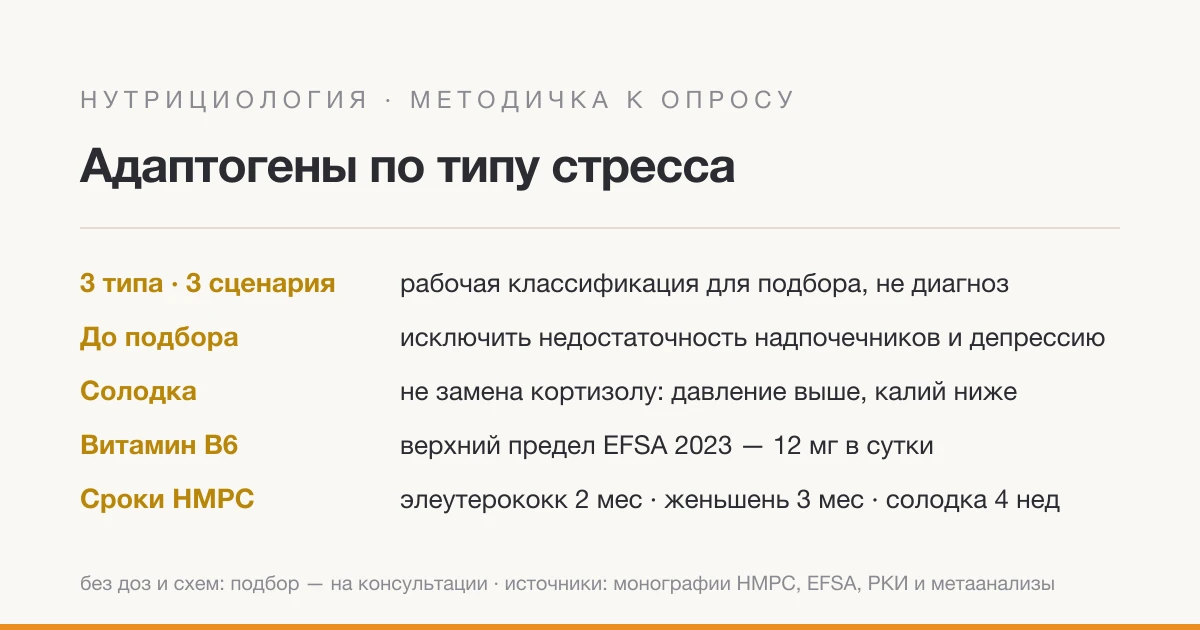
The “Stress Type” questionnaire divides complaints into three groups: tension and poor sleep, lack of energy, frequent infections. The questionnaire itself calls this a working classification for choosing remedies, not a diagnosis. There is no validated typology of stress based on cortisol levels. A systematic review of 58 studies found no substantiation that “adrenal fatigue” is an actual medical condition; no endocrinology society recognizes such a diagnosis (Cadegiani FA, BMC Endocr Disord 2016).
That is why “cortisol is high” or “cortisol is low” in a conversation about types is a hypothesis to be checked with tests. Studies of chronic stress find sometimes increased, sometimes decreased activity of the HPA axis (hypothalamic–pituitary–adrenal). According to a meta-analysis, the discrepancies are largely explained by features of the stressor and of the person, timing in particular: hormonal activity is elevated at stressor onset and reduces as time passes (Miller GE, Psychol Bull 2007). Tests are covered in the article on the stress axis; the physiology of the axis in the article on cortisol.
Type 2 · “low energy” is a special case: morning weakness occurs both in depression and in adrenal insufficiency. Among people presenting with tiredness in primary care, doctor-diagnosed depression was found in 18.5% and anemia in 2.8%; the estimates come from the few high-quality studies. The review’s authors advise extensive investigations only in case of specific findings and say attention should focus on depression (Stadje R, BMC Fam Pract 2016). That is why the questionnaire asks the two PHQ-2 questions about mood and a question about thoughts of self-harm (from the PHQ-9 questionnaire). With a PHQ-2 score of 3 or more, the result notes that mood is worth discussing with a psychotherapist or psychiatrist, and energizing remedies are chosen only after that. Adrenal insufficiency is rare (primary — about 100–140 cases per million in Western countries; Bornstein SR, J Clin Endocrinol Metab 2016), but it is ruled out first: see the red flags.
A note on the term “adaptogen”. The HMPC is the European Medicines Agency (EMA) Committee on Herbal Medicinal Products. In 2008 it concluded that the term is not accepted in the terminology used in the EU and is not appropriate as a basis for a marketing authorization. The concept is allowed only in the assessment of traditional herbal medicinal products (HMPC reflection paper on the adaptogenic concept). No study of eleuthero — examined there as the example — confirmed efficacy in a well-defined clinical condition. HMPC monographs describe traditional doses, durations and risks; “traditional use” is registration based on long-standing use, not on efficacy studies.
Before choosing remedies: red flags
The first red flag is signs of adrenal insufficiency. According to the Endocrine Society’s 2016 guideline, these are hypotension, low sodium and high potassium, hyperpigmentation of the skin and mucous membranes, dehydration, and weight loss (Bornstein SR, J Clin Endocrinol Metab 2016). Darkening of the skin occurs only in primary insufficiency and not in everyone, so its absence does not rule it out. With such signs, an in-person exam by an endocrinologist is needed in the next few days; adaptogens, licorice and DHEA (dehydroepiandrosterone, a hormone supplement) are not started before the exam. If right now there is severe weakness, vomiting, abdominal pain, confusion, or fainting, this is an emergency: call 112.
The second red flag is signs of cortisol excess (Cushing’s syndrome). Weight gain and high blood pressure are common with it but poorly discriminating; the features that best distinguish it are easy bruising, a flushed reddish face (facial plethora), weakness of the thigh and shoulder muscles, and reddish-purple stretch marks wider than 1 cm. If several such features are present and progressing — see an endocrinologist urgently. A single morning cortisol is not recommended for detecting excess, and a normal result does not rule it out (Nieman LK, J Clin Endocrinol Metab 2008).
Pregnancy, breastfeeding and age under 18. The HMPC monographs on rhodiola, ginseng, eleuthero, valerian and passionflower contain the same section: safety during pregnancy and lactation has not been established, and use is not recommended (HMPC monograph on rhodiola). This is a precaution because of the absence of data, not evidence of harm. The HMPC does not recommend rhodiola, ginseng and licorice under 18, or eleuthero, valerian and passionflower under 12 (HMPC monograph on ginseng).
The requirements for licorice are stricter: studies in animals have shown reproductive toxicity. It is not recommended during pregnancy, in women of childbearing potential not using contraception, or during breastfeeding — glycyrrhizin is detectable in the breast milk of some women taking licorice (HMPC monograph, linked in the Type 2 section). Ashwagandha has no HMPC monograph; the Dutch institute RIVM advises, as a precaution, not to use ashwagandha supplements, particularly in pregnancy (RIVM report 2024).
Bipolar disorder and depression. One case report of mania temporally associated with taking rhodiola has been published (Whig R, Prim Care Companion CNS Disord 2022); a single report does not prove causation. For ginseng there are case reports of mania: in a woman with a history of affective disorder (Vázquez I, Acta Psychiatr Scand 2002) and in two men with prolonged use of high doses together with cannabis and yohimbine. Their authors say the available data prevent a clear determination of causation (Norelli LJ, J Diet Suppl 2015). In depression, rauwolfia is unsuitable: in the prescribing information for a reserpine product (Renese-R), a history of depression is a contraindication (Renese-R prescribing information, DailyMed).
Autoimmune disease, immunosuppression, surgery. The HMPC monograph on echinacea does not recommend it in progressive systemic disorders, autoimmune diseases, immunodeficiencies, immunosuppression and diseases of the white blood cell system, and limits a course to 10 days. For astragalus the basis is mechanism: a review includes it among the 15 herbs with the best-documented immunostimulation, capable of flaring autoimmune skin diseases (Weiner JD, Lupus Sci Med 2025); cordyceps is not among them. There are no clinical data on flares, so this restriction is a convention.
Before surgery: a review in JAMA lists herbs that complicate the perioperative period — bleeding (garlic, ginkgo, ginseng), hypoglycemia (ginseng), potentiation of the sedative effect of anesthetics (kava, valerian) — and calls for herbal use to be documented before surgery (Ang-Lee MK, JAMA 2001). The HMPC monograph on ginkgo advises stopping it 3–4 days before surgery; do not stop rauwolfia (reserpine) on your own — the timing is set by the doctor who prescribed it.
Below are all 29 restriction rows of the questionnaire and what each one rests on; where there is no direct source — “questionnaire rule” or “convention”.
| Checked in the questionnaire | What to take into account when choosing remedies | What it rests on |
|---|---|---|
| High blood pressure | licorice is not suitable; use energizing remedies with caution | licorice — HMPC monograph and meta-analysis; energizing remedies — questionnaire rule |
| Low blood pressure | we’ll discuss the cause of low blood pressure at your appointment | hypotension is a sign of adrenal insufficiency; with its other signs the questionnaire refers you straight to an endocrinologist |
| Fast pulse, heart rhythm problems | first, we rule out the causes of palpitations; use energizing remedies with caution | HMPC monographs (hawthorn, eleuthero) |
| Slow pulse; stomach or duodenal ulcer | rauwolfia is not suitable | Renese-R (reserpine) prescribing information: ulcer is a contraindication, bradycardia a side effect |
| Swelling (edema) or low potassium | licorice is not suitable | HMPC monograph; meta-analysis |
| Checked in the questionnaire | What to take into account when choosing remedies | What it rests on |
|---|---|---|
| Kidney disease; heart failure | licorice is not suitable; potassium supplements only based on lab results | HMPC monograph on licorice; potassium supplements — questionnaire rule |
| Liver disease or elevated liver enzymes (ALT, AST) | kava, ashwagandha, and Baikal skullcap are not suitable; rhodiola only after a consultation, with liver tests monitored | LiverTox reference; case series and Germany’s BfR 2024; case reports; rhodiola — a possible causative agent along with ashwagandha in one case |
| Overactive thyroid | ashwagandha is not suitable | cases of thyrotoxicosis; rise in thyroxine (T4) in an RCT — randomized controlled trial; RIVM 2024 |
| Autoimmune thyroiditis (Hashimoto’s) | echinacea is not suitable; ashwagandha, astragalus, cordyceps only after a consultation | HMPC monograph; mechanism; questionnaire rule; effect on T4 |
| Checked in the questionnaire | What to take into account when choosing remedies | What it rests on |
|---|---|---|
| Pregnancy, planning a pregnancy, breastfeeding | adaptogens, herbs, DHEA, 5-HTP are not used — safety not established; vitamins, minerals: in pregnancy, with the doctor managing it; planning or breastfeeding — at the consultation | HMPC monographs; Endocrine Society 2014 (DHEA); 5-hydroxytryptophan (5-HTP) — questionnaire rule |
| Bipolar disorder | rhodiola is not suitable; energizing remedies only as agreed with your psychiatrist | rhodiola — a convention based on one case report; ginseng — case reports of mania |
| Depression | rauwolfia is not suitable; energizing remedies after a consultation | Renese-R prescribing information; the rest — questionnaire rule |
| Psychosis in the past; melanoma | mucuna is not suitable | levodopa prescribing information |
| Checked in the questionnaire | What to take into account when choosing remedies | What it rests on |
|---|---|---|
| Hormone-sensitive tumor; polycystic ovary syndrome with excess male hormones | DHEA (a hormone supplement) is not suitable | Endocrine Society 2014; the contraindication itself is a convention |
| An autoimmune disease that is flaring or being treated | astragalus, cordyceps, and echinacea are not suitable | echinacea — HMPC monograph; astragalus — mechanism; cordyceps — questionnaire rule |
| Planned surgery within the next month | tell your surgeon and anesthesiologist about all herbs and supplements; stop ginkgo at least 3–4 days before; don’t stop rauwolfia on your own — its prescriber sets the timing | Ang-Lee 2001; HMPC monograph on ginkgo; Renese-R prescribing information |
| Intolerance to nightshades | ashwagandha is not suitable | questionnaire rule, no direct data |
| Taking | What to take into account when choosing remedies | What it rests on |
|---|---|---|
| Glucocorticoids now or in the past 12 months, any route | licorice is not suitable; don’t stop steroids on your own; in an illness with fever, injury or surgery tell your doctor about them; vomiting, sudden weakness, fainting — call 112 | HMPC monograph; 2024 guideline |
| Medicines that suppress the immune system | echinacea, astragalus, and cordyceps are not suitable | as in the row on autoimmune disease |
| Levothyroxine | with ashwagandha, TSH (the pituitary hormone that controls the thyroid) and free T4 need to be checked after 6–8 weeks | rise in T4 in an RCT; the timing — questionnaire rule |
| Blood thinners | ginkgo, dong quai, and coenzyme Q10 only after a consultation | HMPC monograph; a case of the INR (a clotting measure) doubling; case reports, with the INR unchanged in an RCT |
| Taking | What to take into account when choosing remedies | What it rests on |
|---|---|---|
| Antidepressants, tramadol, triptans, linezolid | 5-hydroxytryptophan (5-HTP) is not suitable | mechanism of serotonin syndrome; almost no clinical data — questionnaire rule |
| MAO inhibitors (MAOIs: moclobemide, selegiline, rasagiline) | mucuna and 5-hydroxytryptophan (5-HTP) are not suitable | levodopa prescribing information; selective MAOIs — questionnaire rule; 5-HTP — a single case |
| Levodopa or antipsychotics | mucuna and vitex (chasteberry) are not suitable | mucuna contains levodopa; vitex — HMPC monograph: an interaction cannot be excluded |
| Diuretics that flush out potassium, or digoxin | licorice is not suitable | HMPC monograph: not with diuretics or cardiac glycosides |
| Taking | What to take into account when choosing remedies | What it rests on |
|---|---|---|
| Blood pressure medicines that keep potassium in the body | potassium supplements only based on lab results | risk of hyperkalemia — case reports and small studies |
| Sleeping pills or sedatives; alcohol more than once a week | kava is not suitable | Ang-Lee 2001; sleeping pills and alcohol — convention |
| Blood sugar–lowering medicines | tulsi (holy basil) can lower blood sugar further — I’ll take this into account when choosing remedies | RCT in type 2 diabetes: fasting glucose 21 mg/dL lower (Agrawal 1996) |
| Cabergoline or bromocriptine; estrogen-containing medicines | vitex (chasteberry) is not suitable | HMPC monograph: interactions cannot be excluded |
With anticoagulants, ginseng is also taken into account: in an RCT in 20 healthy volunteers, American ginseng over 2 weeks slightly reduced warfarin’s effect as measured by the INR (Yuan CS, Ann Intern Med 2004). Tulsi (holy basil) in an RCT in patients with type 2 diabetes lowered fasting glucose by 21 mg/dL, about 1.2 mmol/L (Agrawal P, Int J Clin Pharmacol Ther 1996).
Type 1 · “on edge”: tension and insomnia
This is how the questionnaire describes a nervous system that has been running in overdrive for a long time: tension, trouble switching off in the evening, difficulty falling asleep. Before remedies are chosen, the questionnaire reminds you to check TSH and free T4: a rapid heartbeat, irritability and poor sleep can be signs of an overactive thyroid.
Ashwagandha. A meta-analysis of 12 RCTs showed a favorable effect on stress scores at 300–600 mg a day, but with low certainty of evidence (Akhgarjand C, Phytother Res 2022). On sleep, a meta-analysis of 5 RCTs (about 400 adults) describes the effect as small but statistically significant. Its pooled estimate combines different scales from the same participants, so the confidence interval is probably too narrow. On the PSQI sleep quality index the difference was not significant, and data on serious adverse effects are limited (Cheah KL, PLoS One 2021).
Drug-induced liver injury has been described with ashwagandha: in a case series, jaundice, nausea, itching and abdominal discomfort appeared after 2–12 weeks of use. The injury was cholestatic or mixed (Björnsson HK, Liver Int 2020). There are case reports of thyrotoxicosis; in an RCT in subclinical hypothyroidism the extract raised T4 (Sharma AK, J Altern Complement Med 2018). Hence the questionnaire row about checking TSH and free T4 on levothyroxine after 6–8 weeks; the timing itself is a convention.
Passionflower has only traditional-use status with the HMPC, for relief of mild symptoms of mental stress and to aid sleep; if symptoms persist longer than 2 weeks, see a doctor (HMPC monograph on passionflower). Clinical data are scarce: a systematic review found 9 small studies lasting from one to 30 days, in 8 of the 9 in healthy people, most often before anesthesia or surgery; no meta-analysis was performed (Janda K, Nutrients 2020). These data transfer poorly to chronic stress.
Valerian. The HMPC monograph does not tie it to the evening: evening dosing is described only for sleep; for nervous tension it is taken during the day. In a 2020 meta-analysis (10 RCTs, 1,065 people), the pooled effect on subjective sleep quality was not statistically significant, with high heterogeneity between studies, and the funnel plot indicated missing data (Shinjyo N, J Evid Based Integr Med 2020). In persistent insomnia, working out the causes matters more than the remedy — see the article on insomnia.
Baikal skullcap has been implicated as a possible hepatotoxic agent in case reports (Yang L, World J Hepatol 2012); it has no HMPC monograph. Kava: according to the reference work LiverTox, 2012, liver injury can be severe and even fatal. A 2003 Cochrane review allowed that kava is relatively safe for short-term treatment of anxiety (1–24 weeks), but noted that more information is required, particularly on long-term safety (Pittler MH, Cochrane Database Syst Rev 2003). Avoiding alcohol and checking ALT and AST at baseline with kava are a practical convention.
L-theanine has been studied at a single dose of 200 mg and at daily doses up to 400 mg. According to a meta-analysis of 31 RCTs, acute stress is reduced slightly, and this result rests on studies at high risk of bias. Anxiety effects were inconsistent and non-significant except for one study on psychotic anxiety (Gerolymos C, Mol Psychiatry 2026). The indication “anxious stress type” is not supported by evidence.
Magnesium and vitamin B6. First, the limits. In 2023 EFSA (the European Food Safety Authority) established a UL — tolerable upper intake level — for vitamin B6 of 12 mg a day for adults, including pregnant and lactating women (EFSA NDA Panel, EFSA J 2023 (B6)). Doses of 20–50 mg exceed it 1.7- to 4-fold. For magnesium from supplements, water and fortified foods, EFSA and the SCF (the EU Scientific Committee on Food) set a UL of 250 mg a day from the age of 4, including pregnant and lactating women. Magnesium naturally present in food is not counted (EFSA overview of upper levels). The IOM (US Institute of Medicine) UL for supplemental magnesium is 350 mg a day.
Now the data. In an RCT without a placebo group, in healthy adults with marked stress and low blood magnesium, magnesium 300 mg + B6 30 mg was compared with magnesium alone for 8 weeks. In the overall sample, adding B6 was not superior to magnesium alone; in a pre-planned subgroup with severe stress, the improvement was 24% greater. B6 there was given at 30 mg a day — 2.5 times the EFSA UL (Pouteau E, PLoS One 2018). A systematic review of 18 studies of magnesium for anxiety: 4 of 8 studies in anxious samples reported benefit, and all the positive ones gave magnesium in combination with other agents. No study measured stress with a validated scale; the quality of the evidence is poor (Boyle NB, Nutrients 2017). Magnesium forms are covered in a separate article.
Phosphatidylserine. In an RCT (75 healthy men, 6 weeks), 200 mg of phosphatidylserine with 200 mg of phosphatidic acid did not differ significantly from placebo in the ACTH (the pituitary hormone that controls the adrenal glands) and cortisol response to a stress test. The 400 + 400 mg complex normalized the hormonal response only in people with high chronic stress, without a significant effect on the psychological response (Hellhammer J, Lipids Health Dis 2014). Evening dosing has not been studied anywhere.
Type 2 · “low energy”: apathy and morning weakness
This is how the questionnaire describes not having enough energy from the morning on, falling motivation and slow recovery. Here the order of steps matters more than the choice of remedy: first rule out what is treated differently — depression, anemia, reduced thyroid function, sleep apnea, vitamin deficiencies and adrenal insufficiency. The gold standard when adrenal insufficiency is suspected, according to the Endocrine Society (2016), is the short stimulation test with 250 µg of ACTH, not herbs. Type 2 is a reason to get examined, not a reason for licorice. Snoring and pauses in breathing during sleep are a separate reason: see the article on sleep apnea.
| What to check | Why | Pitfall |
|---|---|---|
| Morning cortisol together with ACTH | to rule out adrenal insufficiency | threshold depends on the analyzer; “normal” with symptoms does not rule it out; estrogen pills raise total cortisol; tell your doctor about glucocorticoids and opioids beforehand |
| Sodium and potassium | low sodium and high potassium are signs of adrenal insufficiency | the questionnaire asks about results outside the lab’s normal range |
| TSH and free T4 | reduced thyroid function | a narrow “target” TSH is not justified — see below |
| What to check | Why | Pitfall |
|---|---|---|
| Complete blood count | anemia | among people presenting with tiredness, anemia is found in 2.8%; iron deficiency also occurs without anemia |
| Ferritin and CRP (a marker of inflammation) | iron stores | threshold depends on inflammation: WHO — below 15 µg/L in healthy people, below 70 µg/L with inflammation (Roemer MGM, PLoS One 2025) |
| Vitamin B12 | B12 deficiency | no definitive cut-offs exist; in the gray zone — methylmalonic acid (Devalia V, Br J Haematol 2014) |
| The two PHQ-2 questions | depression screening | a score of 3 or more is a reason for the full questionnaire and a conversation, not a diagnosis (Levis B, JAMA 2020) |
Reading the results in detail is covered in the article on the stress axis; iron in a separate article. A narrow “target” TSH is not justified: on levothyroxine, a TSH of 0.34–2.50 mIU/L did not improve quality of life, mood or cognition compared with 2.51–5.60 in an RCT (Samuels MH, J Clin Endocrinol Metab 2018). According to the Endocrine Society (2016), a morning serum cortisol below 140 nmol/L (5 µg/dL) together with ACTH above twice the upper limit of normal makes primary adrenal insufficiency highly likely. Which level reliably rules it out is controversial: studies argue for levels from 285 to 480 nmol/L, and it depends on the analyzer. With clinical signs, the ACTH stimulation test is indicated (Bornstein SR, J Clin Endocrinol Metab 2016).
Ginseng. The HMPC monograph (linked above) describes a standardized extract with 4% ginsenosides at 40–200 mg a day for up to 3 months; the traditional indication is asthenia. A meta-analysis of 12 RCTs (630 participants): across 4 RCTs, fatigue decreased statistically significantly (in a fixed-effect model); across 8 RCTs, no improvement in physical performance was found. The authors consider the evidence insufficient — the trials are few and small (Bach HV, J Korean Med Sci 2016). In a meta-analysis of 70 RCTs, no significant effect of ginseng on blood pressure or heart rate was found (Jafari A, Br J Nutr 2025); hypertension is not listed as a contraindication in the monographs. Case reports of mania — above.
Eleuthero: under the HMPC monograph — not for more than 2 months. The dose in it differs for each preparation — for the 1:1 liquid extract it is about 5 times lower than for the 1:5 tincture — so the figures for one preparation do not transfer to another. Its side effects include insomnia and tachycardia. It was eleuthero that the HMPC examined as the example of an adaptogen, and it found no study confirming efficacy in a well-defined clinical condition.
Rhodiola: the HMPC monograph (linked above) — 144–400 mg a day, a single dose of no more than 200 mg, traditional indication; if symptoms persist longer than 2 weeks, see a doctor. A systematic review of 11 studies in fatigue calls the results contradictory: only some of the studies reported an effect, and all of them had a high or unclear risk of bias. The authors allow that rhodiola may be helpful, but methodological flaws limit accurate assessment of efficacy (Ishaque S, BMC Complement Altern Med 2012). On the liver: in a series of 5 cases on ashwagandha, rhodiola was named a possible causative agent along with ashwagandha in one case; there are no cases with rhodiola alone (Björnsson 2020, linked above) — hence the row “only after a consultation, with liver tests monitored”. Schisandra: no HMPC monograph could be found; the sources found contain no doses tested in studies.
L-tyrosine for stress and cognitive load has been studied at single doses of about 150 mg/kg — roughly 10 g — an hour before the task (Thomas JR, Pharmacol Biochem Behav 1999). Doses of 500–1,000 mg have not been studied. A review finds an effect only in brief acute stress; this does not apply to taking it as a course (Jongkees BJ, J Psychiatr Res 2015). Vitamin B5 (pantothenic acid): there are no data in humans on its effect on stress, cortisol or “adrenal support” — adrenal damage has been described only in B5-deficient rats. No UL has been set, but a case of life-threatening eosinophilic pleuropericarditis has been described with 300 mg of B5 plus 10 mg of biotin a day for 2 months (Linus Pauling Institute on pantothenic acid).
Coenzyme Q10. According to a Cochrane review, it has no clinically significant effect on blood pressure (Ho MJ, Cochrane Database Syst Rev 2016). For fatigue, a meta-analysis of 13 RCTs showed a moderate reduction (effect size g −0.40) (Tsai IC, Front Pharmacol 2022). With warfarin: in a crossover RCT in 24 patients, Q10 100 mg a day for 4 weeks did not change the INR or the warfarin dose (Engelsen J, Ugeskr Laeger 2003). But there are case reports of a reduced response to warfarin (Heck AM, Am J Health Syst Pharm 2000) — hence “only after a consultation”.
Mucuna pruriens contains levodopa, and its content varies (Cilia R, Neurology 2017). Under the levodopa prescribing information, non-selective MAO inhibitors are contraindicated, the drug is usually not prescribed in psychosis, and melanoma is monitored (levodopa/carbidopa prescribing information, DailyMed). DHEA is converted in tissues to androgens and estrogens; the Endocrine Society recommends against its routine use in healthy women and in women with adrenal insufficiency — data on effectiveness and safety are limited (Wierman ME, J Clin Endocrinol Metab 2014). The contraindications in hormone-sensitive tumors and PCOS (polycystic ovary syndrome) are a reasoned convention without direct RCTs.
Type 3 · “immune system”: frequent infections
This is how the questionnaire describes frequent, lingering colds and flare-ups under stress. It starts not with supplements but with looking for causes: a complete blood count with differential, glucose, ferritin, zinc; vitamin D if indicated. If infections are severe, need antibiotics several times a year, or are unusual, you need to see an immunologist.
Vitamin C. According to a Cochrane review, regular intake of 200 mg a day or more does not reduce the incidence of colds in the general population (relative risk 0.97). Colds became half as frequent only in people under heavy physical exertion (Hemilä H, Cochrane Database Syst Rev 2013). There are no data on psychological stress.
Vitamin D. In 2024 the Endocrine Society (a conditional recommendation) advised healthy adults under 75 not to have routine 25(OH)D testing — the blood marker of vitamin D stores — and not to take doses above the daily reference intake for prevention. No target level has been defined (Demay MB, J Clin Endocrinol Metab 2024). The UL — 4,000 IU (100 µg) a day for adults — is the same at the IOM and at EFSA 2023 (EFSA NDA Panel, EFSA J 2023 (vitamin D)); 5,000 IU a day exceeds it.
On infections: in a meta-analysis of 43 RCTs (48,488 participants), vitamin D slightly but statistically significantly reduced the proportion of people with a respiratory infection — 61.3% versus 62.3%, odds ratio 0.92 across 37 RCTs. Protective effects were observed in the subgroups with daily dosing, with daily dose equivalents of 400–1,000 IU, and in participants aged 1 to under 16 years, but the interaction with dose, regimen and age was not significant. No significant effect was seen in any subgroup defined by baseline vitamin D level. The authors themselves call the risk reduction small (Jolliffe DA, Lancet Diabetes Endocrinol 2021). More in the article on vitamin D.
Zinc. Signs of copper deficiency have been described with total zinc intakes of 60 mg a day for up to 10 weeks. The IOM UL is 40 mg a day (Linus Pauling Institute on zinc); for EFSA/SCF it is 25 mg of total intake in adults. There are no direct data on whether copper is needed with long-term zinc intake; this is a convention. A 2024 Cochrane review: for prevention, zinc may result in little or no reduction in the risk of developing a cold (low-certainty evidence). For treatment, it may shorten a cold by about 2.4 days (low-certainty evidence) but probably increases the rate of non-serious adverse events. Zinc gluconate lozenges were given at 45–276 mg a day for 4.5–21 days; these data do not apply to long-term daily intake (Nault D, Cochrane Database Syst Rev 2024).
Astragalus and reishi. A meta-analysis of 19 human studies of astragalus (1,094 participants) reports shifts in surrogate immune markers; the abstract contains no clinical outcomes (Zhang X, Complement Med Res 2023). The Cochrane review of reishi concerns only cancer patients, and these data do not transfer to healthy people under stress (Jin X, Cochrane Database Syst Rev 2016). In sum: human data under stress are limited for astragalus and reishi. Cordyceps is covered in separate articles: immunity and arrhythmias; its restriction in autoimmune diseases is a questionnaire rule.
Scenarios A, B, C
Scenario A · mind
The questionnaire: with mental workload, the choice shifts toward remedies that have been studied under demands on attention and memory; the benefit in healthy people is small or unproven. Bacopa: an RCT in older adults used 300 mg a day for 12 weeks (Calabrese C, J Altern Complement Med 2008). A meta-analysis included only courses of 12 weeks or longer and found mainly an improvement in speed of attention (Kongkeaw C, J Ethnopharmacol 2014). Ginkgo: in healthy people, a meta-analysis found no positive effects on memory and attention (Laws KR, Hum Psychopharmacol 2012). The HMPC monograph allows ginkgo only for age-related cognitive decline and mild dementia; with anticoagulants, ginkgo only after consulting a doctor, and it is stopped 3–4 days before surgery.
B vitamins and omega-3. In a meta-analysis of 11 RCTs (22,000 older adults), B vitamins lowered homocysteine by 26–28% but had no significant effect on cognitive function (Clarke R, Am J Clin Nutr 2014). There are no data on “cognitive stress” in younger people without deficiency. The target omega-3 index of 8% or more was derived from the risk of death from coronary heart disease, not from cognitive outcomes (Harris WS, Prev Med 2004).
Scenario B · menstrual cycle
The questionnaire: the choice takes into account the phases of the cycle and hormonal status; if the cycle is irregular or has stopped, pregnancy is ruled out first and prolactin is checked. Vitex has one indication in the HMPC monograph — premenstrual syndrome (PMS): 20 mg of dry extract, for at least 3 months. A systematic review considers that vitex “may be effective”, and found good-quality evidence for PMS only for calcium (Whelan AM, Can J Clin Pharmacol 2009). Vitex can mask the symptoms of a prolactin-secreting pituitary tumor, so with an irregular cycle prolactin and an examination come first; interactions with dopamine agonists and antagonists and with estrogens cannot be excluded.
Maca: a systematic review of 4 RCTs in menopausal symptoms — all showed a favorable effect, but the number of trials, the sample sizes and the quality were too limited to draw firm conclusions, and safety has not been proved (Lee MS, Maturitas 2011). Dong quai in a double-blind RCT in postmenopausal women was not superior to placebo (Hirata JD, Fertil Steril 1997); on warfarin, a case has been described in which the INR more than doubled (Page RL, Pharmacotherapy 1999). Shatavari: no RCTs in PMS were among the studies found, and no data on stress were found either.
Vitamin E for PMS: the only positive RCT (41 women) used 400 IU a day (London RS, J Reprod Med 1987). At 100 mg a day, the difference from placebo was not significant (Dadkhah H, Iran J Nurs Midwifery Res 2016). Magnesium for PMS: 4 of 7 studies reported benefit for subjective anxiety; the quality of the evidence is poor (Boyle 2017 review, linked above).
Scenario C · heart and blood pressure
The questionnaire: first, serious causes of blood pressure swings and palpitations are ruled out; for skipped beats, an ECG; if you faint or have chest pain or shortness of breath — call an ambulance: 112. Before remedies are chosen, the questionnaire asks to rule out an overactive thyroid (TSH and free T4) and pheochromocytoma. This is a rare tumor with a highly variable presentation; most commonly there are episodes of headaches, sweating, palpitations and rises in blood pressure (Lenders JW, Lancet 2005). Plasma or urinary metanephrines are measured; a positive result requires confirmation — it is affected by exertion, stress, body position, food and medicines (Tanabe A, Endocr J 2026). The rest is in the article on the stress axis.
The remedies of Scenario C are gentle calming remedies, and their status is modest. Hawthorn and motherwort have only traditional-use status in the HMPC monographs, for temporary nervous cardiac complaints — provided that serious conditions have first been excluded by a medical doctor. Studies of hawthorn mostly concern heart failure, not “labile blood pressure” (Pittler MH, Cochrane Database Syst Rev 2008). In an RCT in 79 patients with type 2 diabetes, hawthorn 1,200 mg a day for 16 weeks lowered only diastolic blood pressure, by about 3 mm Hg compared with placebo. Other small RCTs on blood pressure point in different directions (Walker AF, Br J Gen Pract 2006). Rauwolfia contains reserpine — a prescription blood pressure drug with contraindications (a history of depression, ulcer) — and is used only as prescribed by a doctor.
Omega-3, magnesium, potassium. According to a dose-response meta-analysis of 71 RCTs, the optimal intake of the omega-3 fatty acids EPA and DHA for lowering blood pressure is 2–3 g a day (Zhang X, J Am Heart Assoc 2022). Magnesium in a meta-analysis of RCTs, at a median of 368 mg a day, lowered systolic blood pressure by 2.0 mm Hg (Zhang X, Hypertension 2016). That dose is above the UL, so only with a doctor. The blood pressure drugs ACE inhibitors and ARBs (angiotensin-converting enzyme inhibitors and angiotensin receptor blockers) keep potassium in the body. Potassium supplements together with them and with potassium-sparing diuretics may increase the risk of hyperkalemia — according to case reports and small studies (Mohamed Pakkir Maideen N, Curr Cardiol Rev 2022). Korean red ginseng lowered blood pressure in RCTs (Lee HW, Curr Vasc Pharmacol 2017); for rhodiola and schisandra no blood pressure data were found — their restriction remains a convention.
Duration, courses and monitoring
Limits under the HMPC monographs: eleuthero — not for more than 2 months, ginseng — up to 3 months, licorice — up to 4 weeks, echinacea — not for more than 10 days; with rhodiola and passionflower, symptoms lasting longer than 2 weeks are a reason to see a doctor. The regimen “a course, then 5 days on and 2 days off” is found in practice, but no data on it were found, and continuous courses longer than these limits go beyond the monographs.
| Remedy | HMPC limit | What to monitor | What it rests on |
|---|---|---|---|
| Licorice | up to 4 weeks | blood pressure and potassium — after 2 weeks | meta-analysis; the timing — convention |
| Ginseng | up to 3 months | sleep; INR on warfarin | monograph; RCT in healthy volunteers |
| Eleuthero | not more than 2 months | sleep, pulse | monograph: insomnia, tachycardia |
| Echinacea | not more than 10 days | no data | HMPC monograph |
| Rhodiola, passionflower | symptoms longer than 2 weeks — see a doctor | liver tests with rhodiola — after a consultation | monographs; a possible co-causative agent (with ashwagandha) in one case |
| Kava, ashwagandha, skullcap | no HMPC monographs | ALT and AST at baseline; with jaundice, nausea or itching — stop and see a doctor | LiverTox; case series; the tests — convention |
| Ashwagandha on levothyroxine | no HMPC monograph | TSH and free T4 after 6–8 weeks | RCT: rise in T4; the timing — convention |
| Ginkgo | a course of at least 8 weeks, only for age-related cognitive decline and mild dementia | stopped 3–4 days before surgery | HMPC monograph |
Product quality is a separate risk, invisible on the label. A pooled analysis of DNA authentication of 5,957 herbal products from 37 countries: 27% did not match their labeled species composition. In Europe the share of mismatches was 47% (Ichim MC, Front Pharmacol 2019). DNA methods verify the plant species, not the potency. Hence the rule: list all herbs and supplements to your doctor by name, not as “something for stress”.
How to use the questionnaire
The “Stress Type” questionnaire takes about 4 minutes. The result gives your primary type, scenarios A, B or C, and those of the 29 restriction rows that apply to your answers. It does not say what to take or at what dose — deliberately: remedies are chosen at a consultation, taking into account your tests and restrictions. The result is a guide, not a diagnosis; signs of adrenal insufficiency are shown by the questionnaire right away, before types and scenarios.
The questionnaire includes a question about thoughts of death or self-harm (item 9 of the PHQ-9): if the answer is positive, it immediately shows where to turn — 112 (or your local emergency number) and the crisis lines in your country. The doctor does not read the answers right away, so there is no need to wait for a call. Your answers stay in your browser and are sent for review only when you choose to send them; on the website they are kept for 12 months. Which tests to discuss is covered in the article on the stress axis; the stress axis questionnaire is there too.
Bottom line
The types in the questionnaire are a way of grouping complaints for choosing remedies, not a diagnosis: there is no validated cortisol-based typology of stress, and “adrenal fatigue” is not recognized by any endocrinology society. In the EU, under the HMPC monographs, rhodiola, ginseng, eleuthero, passionflower, licorice and hawthorn have traditional-use status; ashwagandha and skullcap have no monograph. The safety limits for adults are better known. The UL for vitamin B6 is 12 mg a day (EFSA), for vitamin D 4,000 IU a day (IOM, EFSA). The UL for magnesium from supplements, water and fortified foods is 250 mg a day (EFSA); from supplements only, 350 mg a day (IOM). The order of steps is always the same: first the red flags and tests, then the choice of remedies — at a consultation. You can discuss your results at a consultation.
Herbs and dietary supplements are not a treatment and not a substitute for examination. Adaptogens and herbs are not used during pregnancy or breastfeeding or under the age of 18. With signs of adrenal insufficiency or cortisol excess (Cushing’s syndrome), see an endocrinologist urgently; in an emergency, call 112. This material is for information only and does not replace a consultation with a doctor.
References
- Cadegiani FA, BMC Endocr Disord 2016. PMID 27557747
- Miller GE, Psychol Bull 2007. PMID 17201569
- Stadje R, BMC Fam Pract 2016. PMID 27765009
- Bornstein SR, J Clin Endocrinol Metab 2016. PMID 26760044
- Nieman LK, J Clin Endocrinol Metab 2008. PMID 18334580
- Beuschlein F, J Clin Endocrinol Metab 2024. PMID 38724043
- de Vries F, J Clin Endocrinol Metab 2020. PMID 31511863
- Whig R, Prim Care Companion CNS Disord 2022. PMID 35303403
- Vázquez I, Acta Psychiatr Scand 2002. PMID 12086230
- Norelli LJ, J Diet Suppl 2015. PMID 24689505
- Weiner JD, Lupus Sci Med 2025. PMID 41475897
- Ang-Lee MK, JAMA 2001. PMID 11448284
- Yuan CS, Ann Intern Med 2004. PMID 15238367
- Agrawal P, Int J Clin Pharmacol Ther 1996. PMID 8880292
- Akhgarjand C, Phytother Res 2022. PMID 36017529
- Cheah KL, PLoS One 2021. PMID 34559859
- Björnsson HK, Liver Int 2020. PMID 31991029
- Sharma AK, J Altern Complement Med 2018. PMID 28829155
- Janda K, Nutrients 2020. PMID 33352740
- Shinjyo N, J Evid Based Integr Med 2020. PMID 33086877
- Yang L, World J Hepatol 2012. PMID 22855699
- LiverTox, 2012. PMID 31643949
- Pittler MH, Cochrane Database Syst Rev 2003. PMID 12535473
- Gerolymos C, Mol Psychiatry 2026. PMID 42410082
- EFSA NDA Panel, EFSA J 2023 (B6). PMID 37207271
- Pouteau E, PLoS One 2018. PMID 30562392
- Boyle NB, Nutrients 2017. PMID 28445426
- Hellhammer J, Lipids Health Dis 2014. PMID 25081826
- Roemer MGM, PLoS One 2025. PMID 41042767
- Devalia V, Br J Haematol 2014. PMID 24942828
- Levis B, JAMA 2020. PMID 32515813
- Samuels MH, J Clin Endocrinol Metab 2018. PMID 29509918
- Bach HV, J Korean Med Sci 2016. PMID 27822924
- Jafari A, Br J Nutr 2025. PMID 40923100
- Ishaque S, BMC Complement Altern Med 2012. PMID 22643043
- Penninkilampi R, J Hum Hypertens 2017. PMID 28660884
- Thomas JR, Pharmacol Biochem Behav 1999. PMID 10548261
- Jongkees BJ, J Psychiatr Res 2015. PMID 26424423
- Ho MJ, Cochrane Database Syst Rev 2016. PMID 26935713
- Tsai IC, Front Pharmacol 2022. PMID 36091835
- Engelsen J, Ugeskr Laeger 2003. PMID 12772396
- Heck AM, Am J Health Syst Pharm 2000. PMID 10902065
- Cilia R, Neurology 2017. PMID 28679598
- Wierman ME, J Clin Endocrinol Metab 2014. PMID 25279570
- Hemilä H, Cochrane Database Syst Rev 2013. PMID 23440782
- Demay MB, J Clin Endocrinol Metab 2024. PMID 38828931
- EFSA NDA Panel, EFSA J 2023 (vitamin D). PMID 37560437
- Jolliffe DA, Lancet Diabetes Endocrinol 2021. PMID 33798465
- Nault D, Cochrane Database Syst Rev 2024. PMID 38719213
- Karsch-Völk M, Cochrane Database Syst Rev 2014. PMID 24554461
- Zhang X, Complement Med Res 2023. PMID 37952511
- Jin X, Cochrane Database Syst Rev 2016. PMID 27045603
- Calabrese C, J Altern Complement Med 2008. PMID 18611150
- Kongkeaw C, J Ethnopharmacol 2014. PMID 24252493
- Laws KR, Hum Psychopharmacol 2012. PMID 23001963
- Clarke R, Am J Clin Nutr 2014. PMID 24965307
- Harris WS, Prev Med 2004. PMID 15208005
- Whelan AM, Can J Clin Pharmacol 2009. PMID 19923637
- Lee MS, Maturitas 2011. PMID 21840656
- Hirata JD, Fertil Steril 1997. PMID 9418683
- Page RL, Pharmacotherapy 1999. PMID 10417036
- London RS, J Reprod Med 1987. PMID 3302248
- Dadkhah H, Iran J Nurs Midwifery Res 2016. PMID 27095989
- Lenders JW, Lancet 2005. PMID 16112304
- Tanabe A, Endocr J 2026. PMID 41083371
- Pittler MH, Cochrane Database Syst Rev 2008. PMID 18254076
- Walker AF, Br J Gen Pract 2006. PMID 16762125
- Zhang X, J Am Heart Assoc 2022. PMID 35647665
- Zhang X, Hypertension 2016. PMID 27402922
- Mohamed Pakkir Maideen N, Curr Cardiol Rev 2022. PMID 35546745
- Lee HW, Curr Vasc Pharmacol 2017. PMID 28707603
- Ichim MC, Front Pharmacol 2019. PMID 31708772
Key facts
- There is no validated cortisol-based typology of stress: a systematic review of 58 studies (Cadegiani, BMC Endocr Disord 2016) found no substantiation that “adrenal fatigue” is an actual medical condition, and no endocrinology society recognizes it. The three types of the “Stress Type” questionnaire are a grouping of complaints for choosing remedies, not a diagnosis.
- Adrenal insufficiency is real, though rare. The Endocrine Society (2016) advises ruling it out when there is low blood pressure, low sodium and high potassium, darkening of the skin, or weight loss; this calls for an in-person exam by an endocrinologist within the next few days. If right now there is severe weakness, vomiting, abdominal pain, confusion, or fainting, this is an emergency: call 112.
- The term “adaptogen” is not accepted in EU terminology and is not appropriate as a basis for a marketing authorization — the conclusion of the HMPC (the European Medicines Agency’s Committee on Herbal Medicinal Products), 2008. Under HMPC monographs, rhodiola, ginseng, eleuthero, passionflower, licorice and hawthorn have traditional-use status; ashwagandha has no monograph.
- Type 2 · “low energy” is a reason to get examined, not a reason for licorice. Under the HMPC monograph (the EMA Committee on Herbal Medicinal Products), licorice is indicated only for dyspepsia and cough, for up to 4 weeks. At 100 mg or more of glycyrrhizic acid a day, systolic blood pressure is 5.45 mm Hg higher and potassium 0.33 mmol/L lower (meta-analysis of 18 studies, Penninkilampi 2017).
- Ashwagandha: a meta-analysis of 12 RCTs (randomized controlled trials; Akhgarjand 2022) found a favorable effect on stress at 300–600 mg a day, with low certainty of evidence. In a case series, liver injury appeared after 2–12 weeks of use (Björnsson 2020); cases of thyrotoxicosis have been described, and in an RCT in subclinical hypothyroidism the extract raised thyroxine (T4) (Sharma 2018).
- EU national agencies on ashwagandha, 2024: the Dutch RIVM advises, as a precaution, not to use such supplements, particularly in pregnancy. Germany’s BfR advises that especially children, pregnant and breastfeeding women and people with liver disease should not take them. France’s ANSES advises abstaining in thyroid, liver and heart disease, in pregnancy and when taking sedatives.
- Tolerable upper intake levels (ULs) for adults: vitamin B6 — 12 mg a day (EFSA 2023, the European Food Safety Authority). Vitamin D — 4,000 IU a day (EFSA and the IOM, the US Institute of Medicine). Magnesium from supplements, water and fortified foods — 250 mg a day (EFSA); from supplements only — 350 mg a day (IOM).
- For frequent infections the data are modest: vitamin C at 200 mg a day or more does not reduce the incidence of colds in the general population (Cochrane 2013). Vitamin D in 37 RCTs: a respiratory infection in 61.3% versus 62.3% on placebo — an effect the authors call small (Jolliffe 2021). For prevention, zinc may result in little or no reduction in the risk of developing a cold (Cochrane 2024, low-certainty evidence).