In brief
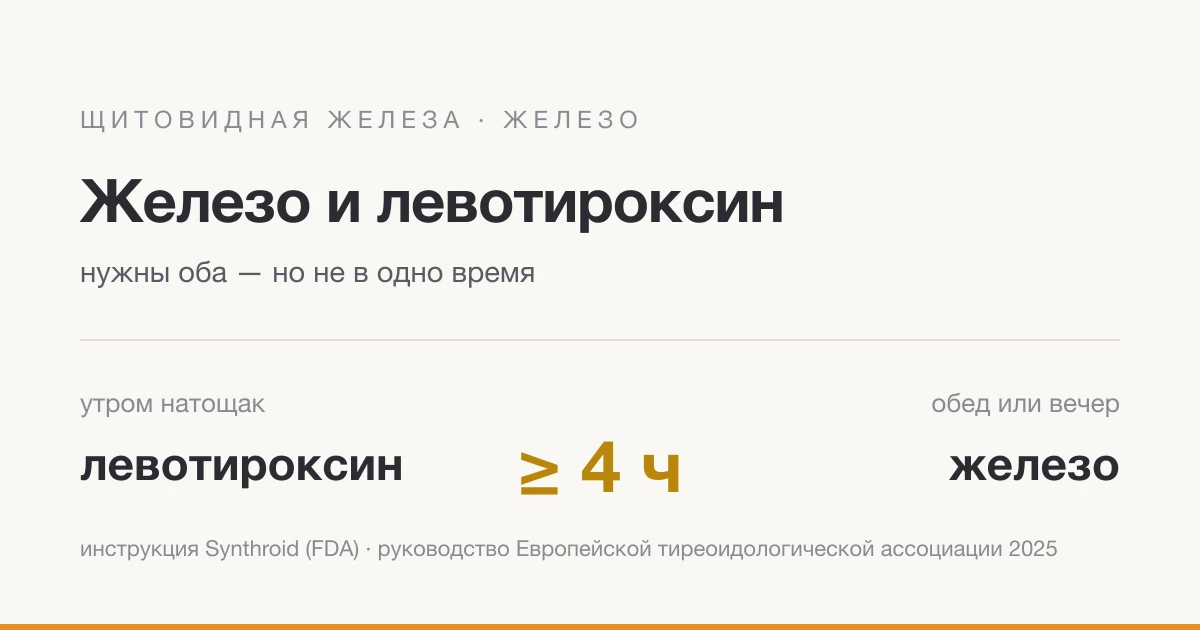
| Interval | At least 4 hours between levothyroxine and iron |
| Order | Levothyroxine in the morning on an empty stomach, iron at lunch or in the evening |
| Why | Iron probably binds levothyroxine, and the tablet works less well |
| If levothyroxine is taken at bedtime | Iron in the first half of the day, so that at least 4 hours remain before the evening tablet; the timing of levothyroxine is changed with the doctor |
| Whether to stop iron | No, if it was prescribed for a deficiency: the deficiency needs treating |
| What to test | Ferritin together with transferrin saturation |
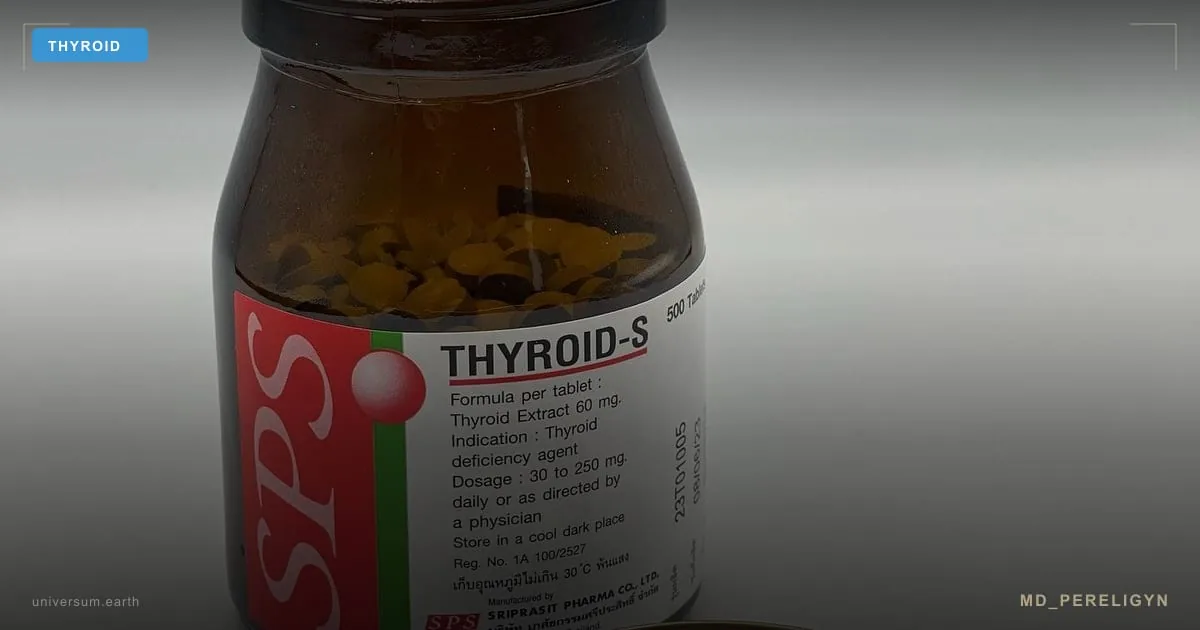
Thyroid tablets and iron are often prescribed to the same person, and both medicines are needed. They get in each other's way when taken at the same time. Let us look at how long to wait, where that number came from, and why it differs from one leaflet to another.
How long to wait: 4 hours
Keep at least 4 hours between the levothyroxine tablet and iron. That is what the US prescribing information for the levothyroxine brand Synthroid says: iron preparations, calcium and antacids (heartburn remedies) can reduce the absorption of levothyroxine, and the tablet should not be taken within 4 hours of them (Synthroid prescribing information, DailyMed). The dosing section specifies: at least 4 hours before or after. And in the table of drug interactions, ferrous sulfate is listed among the phosphate binders — with the same 4-hour interval.
Why some leaflets say 2 hours
If you have a Euthyrox leaflet to hand, it may show a different number. The Austrian package leaflet tells you to take Euthyrox at least 2 hours before iron preparations, otherwise its effect may be weakened (Euthyrox package leaflet, BASG). The direction matters too: the 2 hours run one way, levothyroxine first, then iron. For the reverse order this leaflet gives no figure, and the newer European Thyroid Association guideline (more on it below) requires at least 4 hours for the same order, levothyroxine first.
There is no single rule even within Europe. The Belgian Euthyrox package leaflet puts the interval before iron at no less than 4 hours (Euthyrox package leaflet, Belgium). The UK levothyroxine prescribing information gives 4–5 hours without specifying the direction, and there absorption is described only as "possibly reduced" (levothyroxine prescribing information, eMC).
The documents themselves do not explain why the numbers differ. A clue is in the American Thyroid Association (ATA) guideline: there the 4-hour interval is called traditional, but untested (Jonklaas J, Thyroid 2014). We could not find a controlled study of how iron changes levothyroxine absorption; a 2021 systematic review calls the evidence on iron limited (Wiesner A, Pharmaceuticals 2021). Our explanation: where no one has measured the exact number, each document wrote down its own degree of caution.
The newest guideline — from the European Thyroid Association (ETA), 2025 — settles on both the order and the 4 hours: levothyroxine at least 4 hours before iron preparations (Centanni M, Eur Thyroid J 2025).
What happens if you take them together
We found one direct test of taking them together, and it is small. Fourteen people with hypothyroidism on a stable dose of levothyroxine took a 300 mg ferrous sulfate tablet at the same time as levothyroxine for 12 weeks. Thyroid-stimulating hormone (TSH) rose on average from 1.6 to 5.4 mU/L — more than threefold, and in 9 of the 14 the symptoms of hypothyroidism worsened (Campbell NR, Ann Intern Med 1992).
When iron and thyroxine were mixed in a test tube, a poorly soluble complex formed. Hence the authors' conclusion: the interaction is probably caused by iron binding thyroxine. The binding was shown in a test tube; in people, what was seen was its possible consequence — a rise in TSH.
The limitations matter. There was no control group: each person was compared with themselves before and after. The effect varied from person to person, and the authors call it clinically significant in some patients. The free thyroxine index did not change significantly.
In everyday life the picture is milder. In a Scottish study, 10,999 people on levothyroxine started one of several medicines; after iron was started, TSH rose on average by 0.22 mU/L, but by more than 5 mU/L in 7.5% (Irving SA, Clin Endocrinol 2015). These are observational data: each person was compared with themselves before and after starting the medicine, there was no group without the medicine, and whether people kept to the interval is unknown. On average the shift is small; without a comparison group, it is impossible to tell how much of the large rises in that 7.5% was caused by iron itself.
A schedule for the day
| When | What |
|---|---|
| Morning, on an empty stomach | Levothyroxine, with water |
| 30–60 minutes later | Breakfast |
| Lunch or evening, no sooner than 4 hours after levothyroxine | Iron |
| Also no closer than 4 hours to levothyroxine | Calcium, antacids |
If the morning dose is inconvenient, there is another option: the ETA guideline considers taking it at bedtime — no sooner than 3 hours after the evening meal — an equivalent alternative to the morning dose 60 minutes before breakfast (Centanni M, Eur Thyroid J 2025). Iron is then more conveniently moved to the first half of the day, so that at least 4 hours also remain between it and the evening tablet. The timing of levothyroxine is changed together with your doctor.
Do not stop iron when there is a deficiency
Spacing the doses apart does not mean giving iron up. The thyroid itself needs iron too: its hormones are assembled by the enzyme thyroid peroxidase (TPO), and that enzyme needs haem — the iron-containing part of the molecule. A 2002 review puts it this way: iron deficiency impairs thyroid hormone synthesis by reducing the activity of haem-dependent TPO (Zimmermann MB, Thyroid 2002).
Now to the strength of the evidence. TPO activity in iron deficiency was measured directly in rats: in anaemic animals it was lower, although part of the effect came from undernutrition — such rats eat less (Hess SY, J Nutr 2002). In the human studies we found, the enzyme's activity was not measured.
The human data are indirect. In children with goitre and iron deficiency from an area of endemic goitre who were receiving iodised salt, an iron supplement shrank the thyroid almost twice as much as placebo, but there were no significant differences in TSH or thyroxine between the groups (Hess SY, Am J Clin Nutr 2002). In another study of children with goitre, salt fortified with both iodine and iron, compared with iodised salt alone, was accompanied by higher thyroxine and a lower proportion of hypothyroidism (Zimmermann MB, Eur J Endocrinol 2002). These are children from iodine-deficient areas, not adults on levothyroxine.
The ETA guideline advises stopping the interfering medicine where possible, and if that is not possible, keeping an interval (Centanni M, Eur Thyroid J 2025). But if iron was prescribed for a deficiency, stopping it would leave the deficiency untreated. So with a deficiency the interval is the choice, and the question of stopping is decided by the doctor.
When it is worth testing ferritin
- Tired on the tablets despite a normal TSH. In a randomised trial of 198 menstruating women aged 18–53 with unexplained fatigue, no anaemia and ferritin below 50 µg/L, fatigue fell by 47.7% over 12 weeks of iron versus 28.8% on placebo (Vaucher P, CMAJ 2012). Women with known thyroid disease were not included in the study, so applying this to people on levothyroxine is an extrapolation.
- Hashimoto's thyroiditis. Iron deficiency is common in autoimmune thyroid disease: coexisting autoimmune gastritis reduces iron absorption, and coeliac disease leads to iron loss (Rayman MP, Proc Nutr Soc 2019). In non-pregnant women with iron deficiency, TPO antibodies were found more often: odds ratio (OR) 1.89 across two cross-sectional studies — an association, not a cause. No differences in TSH or free thyroxine were shown in this group (Luo J, Front Endocrinol 2021). For more on coeliac disease in Hashimoto's, see the article on the gluten-free diet.
- Pregnancy or planning one. In pregnant women with iron deficiency, hypothyroidism was more common; the section below covers what that means and where the data diverge.
For those who feel tired on levothyroxine, there is also a hypothesis. In a conference abstract known from its summary in a review, 25 Finnish women with persistent symptoms of hypothyroidism on levothyroxine, no anaemia and ferritin below 60 µg/L took iron for 6–12 months; in two thirds, symptoms eased once ferritin rose above 100 µg/L (Rayman MP, Proc Nutr Soc 2019). No control group is described in the summary, and the abstract is not in PubMed — this is a hypothesis, not a proven treatment target. Other causes of tiredness with a normal TSH are worth going through with your doctor separately.
Pregnancy: an association exists, but which way TSH moves is disputed
In a meta-analysis of eight cross-sectional studies, mostly from China, overt hypothyroidism was more common in pregnant women with iron deficiency: OR 1.60, 95% confidence interval (CI) 1.17 to 2.19. Subclinical hypothyroidism too: OR 1.37, 95% CI 1.13–1.66 (Luo J, Front Endocrinol 2021). Overt hypothyroidism in pregnancy was examined by two studies, subclinical by three. This is an association; causation has not been proven.
Other meta-analyses are more reassuring or contradict it. In a systematic review of 47 studies (53,152 pregnant women), splitting by ferritin with a threshold of 30 µg/L did not show a difference in TSH or thyroxine; TSH was higher and free thyroxine lower only when splitting by haemoglobin, that is, with anaemia (Parsaei M, Front Endocrinol 2025). In yet another meta-analysis, TSH in pregnant women with iron deficiency turned out, on the contrary, to be lower, with extreme heterogeneity of the data (Garofalo V, Nutrients 2023).
An honest summary: the association between iron deficiency and hypothyroidism in pregnancy is visible in cross-sectional data, while the meta-analyses disagree on which way TSH shifts. That is enough to check ferritin in pregnancy, but not to promise that iron will prevent hypothyroidism. Checking it in advance, when planning a pregnancy, is our practical conclusion from the data on pregnant women, not the result of a dedicated study. Discuss TSH targets for each trimester with your doctor.
Ferritin — together with transferrin saturation
Ferritin alone can mislead. Ferritin is an acute-phase protein: during inflammation it rises and can hide iron deficiency. That is why transferrin saturation (TSAT) is added to it — a measure of how much iron is available right now (Dignass A, Int J Chronic Dis 2018). For why this number cannot be read on its own either, see the guide on transferrin saturation. The deficiency threshold depends on who we are talking about; this is how it is given by the World Health Organization (WHO) (WHO ferritin guideline, 2020) and by a 2018 review for three chronic diseases (ferritin in µg/L, which is the same as ng/mL on some lab reports):
| Who | Iron deficiency |
|---|---|
| Apparently healthy non-pregnant people aged 5 and over (WHO) | Ferritin below 15 µg/L |
| Adults with infection or inflammation (WHO) | Ferritin below 70 µg/L may indicate deficiency (conditional recommendation) |
| Heart failure, chronic kidney disease, inflammatory bowel disease | Ferritin below 100 µg/L; with ferritin 100–300 µg/L — if transferrin saturation is below 20% |
There is no separate threshold for Hashimoto's thyroiditis in these documents. The "aged 5 and over" row does not fit pregnant women either: the WHO gives the 15 µg/L threshold only for the first trimester, and the meta-analysis of pregnant women mentioned above used a threshold of 30 µg/L. Which reference point applies to you is decided by the doctor; for how to read the WHO thresholds themselves, see the article on ferritin. And a practical detail: blood for iron tests is drawn in the morning, following your usual routine, without a twelve-hour fast and no sooner than 12 hours after an iron tablet. The basis is a study of a single 65 mg dose of iron in 27 people with haemochromatosis and 13 people in a control group: serum iron and transferrin saturation returned to baseline within 8–12 hours in all groups except people with haemochromatosis after venesection, in whom the rise was higher and lasted longer (Girelli D, Haematologica 2011). There were no people with iron deficiency in that study, so with iron deficiency the required interval is confirmed with the doctor. If you take iron in the evening and have blood drawn in the morning, 12 hours may not have passed: decide with your doctor how to shift the dose the day before the test. For more detail, see the article on haemochromatosis.
When to recheck TSH
The Synthroid prescribing information has no specific requirement to check TSH after iron is started or stopped. There is a general rule — TSH 6–8 weeks after any dose change — and the prescribing information lists drug interactions among the explanations for persistent hypothyroidism on an apparently adequate dose (Synthroid prescribing information, DailyMed). The authors of the Scottish study advise monitoring TSH carefully in those who start iron and a number of other medicines (Irving SA, Clin Endocrinol 2015).
What follows is clinical reasoning, not a clause of the prescribing information. If iron is prescribed long term, it is sensible to check TSH by analogy with a dose change, after 6–8 weeks. If the levothyroxine dose was raised for the duration of the course, it is reviewed after iron is stopped: the ETA guideline allows the dose to be adjusted when the interfering medicine is prescribed for more than 2 weeks (Centanni M, Eur Thyroid J 2025).
Sometimes the interval is kept and TSH is still high. One case has been described: a 44-year-old woman took levothyroxine in the morning and iron in the evening; despite the levothyroxine dose being raised to 250 µg over nine months, her TSH was above 100 mU/L. After the iron tablets were stopped and she was switched to intravenous iron, TSH normalised within 6 weeks (Ei ZP, Cureus 2026). This is a single observation; causation has not been proven. But it is worth telling your doctor about every supplement containing iron, even if the doses are spaced apart.
The bottom line
Levothyroxine and iron can be taken within one regimen if they are separated in time; for some people even that is not enough, so it is worth telling your doctor about iron. Levothyroxine in the morning on an empty stomach, iron at lunch or in the evening, at least 4 hours between them: this schedule fits the US prescribing information, the Euthyrox leaflet and the ETA guideline. If you take levothyroxine at bedtime, iron is moved to the first half of the day. Iron is not stopped when there is a deficiency: the thyroid itself needs it too, although the direct measurements of this were made in animals. The order worth carrying away: space the doses → with tiredness, Hashimoto's or pregnancy, check ferritin together with transferrin saturation → choose the dose and form of iron with your doctor.
This material is for information only. The dose and form of iron, like the schedule for taking medicines, are chosen by the treating physician.
References
- Jonklaas J, Thyroid 2014. PMID 25266247
- Wiesner A, Pharmaceuticals 2021. PMID 33801406
- Centanni M, Eur Thyroid J 2025. PMID 40622204
- Campbell NR, Ann Intern Med 1992. PMID 1443969
- Irving SA, Clin Endocrinol 2015. PMID 25040647
- Zimmermann MB, Thyroid 2002. PMID 12487769
- Hess SY, J Nutr 2002. PMID 12097675
- Hess SY, Am J Clin Nutr 2002. PMID 11916762
- Zimmermann MB, Eur J Endocrinol 2002. PMID 12457449
- Vaucher P, CMAJ 2012. PMID 22777991
- Rayman MP, Proc Nutr Soc 2019. PMID 30208979
- Luo J, Front Endocrinol 2021. PMID 33716980
- Parsaei M, Front Endocrinol 2025. PMID 39944206
- Garofalo V, Nutrients 2023. PMID 38004184
- Dignass A, Int J Chronic Dis 2018. PMID 29744352
- Girelli D, Haematologica 2011. PMID 21173098
- Ei ZP, Cureus 2026. PMID 42438581
Key facts
- Keep levothyroxine and iron at least 4 hours apart: that is what the US Synthroid prescribing information says. The same rule there applies to calcium and to heartburn remedies (antacids).
- The Austrian Euthyrox package leaflet says 2 hours, but in one direction only: levothyroxine first, then iron. The schedule "levothyroxine in the morning, iron at lunch or in the evening, no sooner than 4 hours later" satisfies both this leaflet and the US prescribing information.
- In a 1992 study, 14 people took iron together with levothyroxine for 12 weeks: thyroid-stimulating hormone (TSH) rose on average from 1.6 to 5.4 mU/L. There was no control group, and the effect varied from person to person.
- Iron is not stopped when there is a deficiency: stopping would leave the deficiency untreated, and the gap between doses removes the interference. Iron is also needed by thyroid peroxidase — the enzyme that assembles thyroid hormones — but direct measurements of its activity were made in rats; the human data are indirect.
- In pregnant women with iron deficiency, overt hypothyroidism was more common (odds ratio 1.60) — an association from cross-sectional studies. Another meta-analysis, splitting pregnant women by ferritin, did not show a difference in hormones.
- Ferritin is an acute-phase protein and is pushed up by inflammation, so it is tested together with transferrin saturation. Deficiency according to the World Health Organization (WHO): ferritin below 15 µg/L in apparently healthy, non-pregnant people aged 5 and over; in adults with infection or inflammation, ferritin below 70 µg/L may indicate deficiency. There is no separate threshold for Hashimoto's thyroiditis, and for pregnancy the WHO gives a threshold only for the first trimester — the doctor chooses the reference point.
- The prescribing information does not specifically require a TSH check after iron is started. But in Scottish data on people taking levothyroxine, TSH rose by more than 5 mU/L in 7.5% after starting iron (there was no comparison group) — so it is worth telling your doctor about any supplement containing iron.