In brief
| How common | In UK Biobank, 1 in 156 participants of European ancestry was homozygous for C282Y |
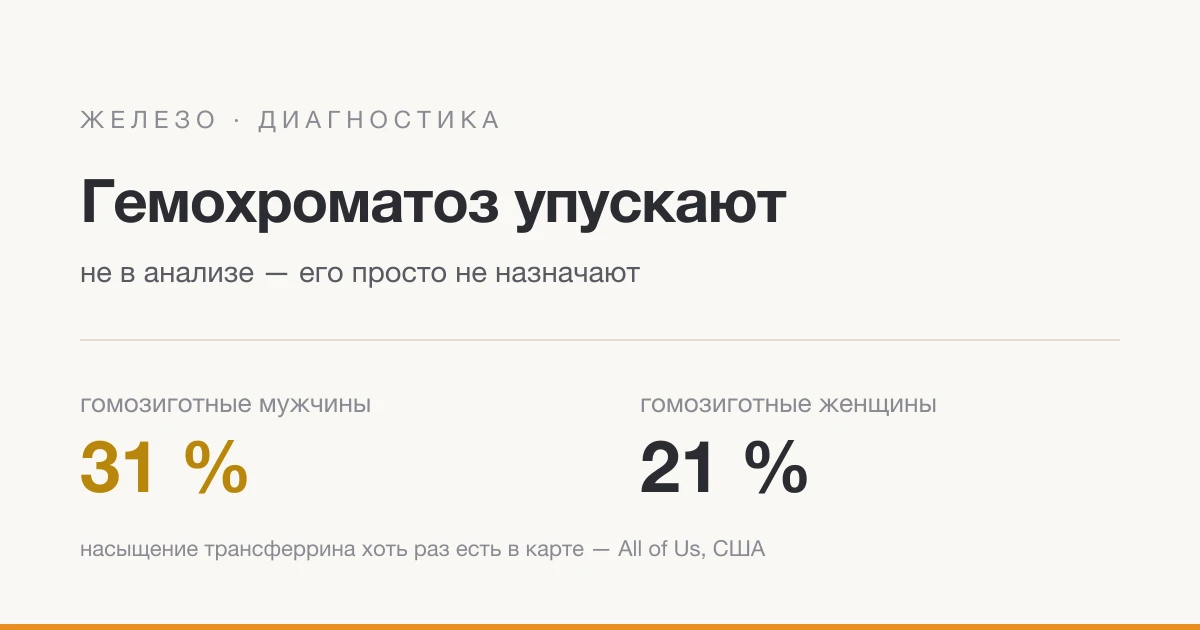
| How often it is checked | A transferrin saturation result was found at least once in the records of 31% of homozygous men and 21% of women (All of Us, USA) |
| How it is found | Transferrin saturation and ferritin |
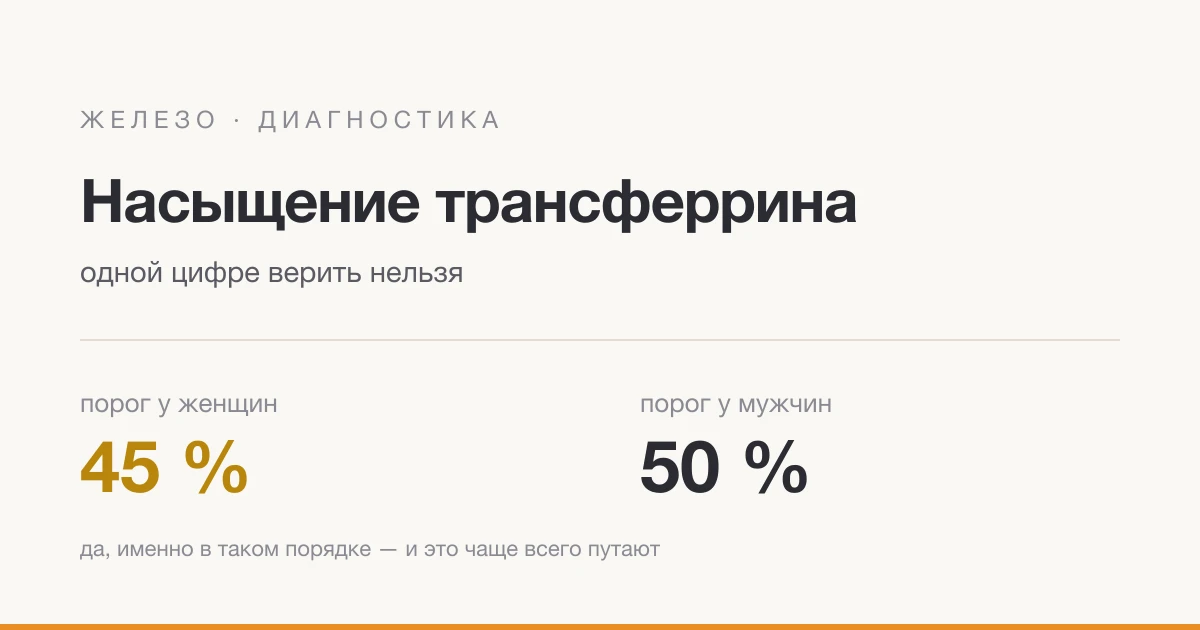
| Threshold for suspicion | TSAT > 45% and ferritin > 200 — premenopausal women; TSAT > 50% and ferritin > 300 — men and postmenopausal women |
| Where it is lost | Most often at the «order the test» step |
Hereditary haemochromatosis is neither rare nor a mystery. Its genetic basis is common in people of European ancestry, and two blood tests plus a genetic test are enough to find it. And yet it is found late. Let us look at the step at which it is lost.
It is not looked for
The most honest data on how often haemochromatosis goes unnoticed come from biobanks: the genotype of every participant is known there, and it can be compared with what is recorded in their medical documents.
In the British UK Biobank, among 451,243 volunteers aged 40–70 of European ancestry, there were 2,890 C282Y homozygotes — 1 in 156. By the end of follow-up, which averaged seven years, a diagnosis of haemochromatosis in hospital records and self-reports was present in only 21.7% of homozygous men and 9.8% of women (Pilling LC, BMJ 2019, PMID 30651232[1]). Diagnoses made by family doctors were not included in this count, so the true proportion is higher — but by how much is unknown.
In the US All of Us programme, genotypes were matched against participants' electronic health records. A diagnosis code was present for 22.6% of homozygous men and 15.6% of women. And a transferrin saturation result — the test with which case-finding begins — was found at least once for only 31.4% of men and 21.1% of women. Tests done outside this system may not have made it into the records (Rao ND, Genet Med Open 2025, PMID 40034140[2]).
The third source is the Geisinger MyCode biobank in the USA, which returns genetic results to its participants. Of 201 homozygotes, only 57 (28%) had a clinical diagnosis beforehand. The remaining 144 learned of their genotype through research screening, and 37% of them were found to have iron overload. This is a lower bound: not everyone had the recommended tests (Savatt JM, JAMA Netw Open 2023, PMID 37870835[3]).
And when the diagnosis is made, it is made late. In a French survey of 374 patients, the mean age at diagnosis was 48.6 years, and in 53% ferritin was already above 1000 μg/L by that point (Gasser B, Rev Med Interne 2014, PMID 23566434[4]).
What this leads to
Homozygosity is not yet disease, and this is important to remember. Raised iron markers are often found in homozygotes, but only a minority go on to overload-related disease: in an Australian population cohort, such disease was documented in 28% of homozygous men and roughly 1% of women (Allen KJ, NEJM 2008, PMID 18199861[5]). But when the disease does develop, its cost is evident.
In UK Biobank, homozygous men aged 40–70, compared with men without the C282Y variant, more often already had a diagnosis of liver disease (odds ratio 4.3), rheumatoid arthritis (2.2), osteoarthritis (2.0) and diabetes mellitus (1.5) (Pilling LC, BMJ 2019, PMID 30651232[1]).
Over a median follow-up of 8.9 years, the risk of primary liver cancer in homozygous men was 10.5 times higher than in men without HFE variants (hazard ratio). In absolute terms, the estimated risk by age 75 was 7.2% versus 0.6%. Half of the cases, 10 of 21, occurred in men who had not been diagnosed with haemochromatosis at the start of the study. In women, the associations with liver cancer and with mortality were not statistically significant (Atkins JL, JAMA 2020, PMID 33231665[6]).
Estimates to age 80 from the same cohort give, for homozygous men: death — 33.1% versus 25.4% in men without HFE variants; joint replacement — 27.9% versus 17.1%; liver disease — 20.3% versus 8.3%. In women, an excess is seen for liver disease (8.9% versus 6.8%) and joint replacement, and the authors found no excess mortality (Lucas MR, BMJ Open 2024, PMID 38479735[7]).
Two tests decide it, two do not
A standard iron panel has four lines: serum iron, TIBC, transferrin saturation and ferritin. For finding haemochromatosis they are not equal. The European guideline names only two as the first step — transferrin saturation and ferritin; iron and TIBC are needed to calculate saturation, and on their own provide additional information for differential diagnosis (EASL, J Hepatol 2022, PMID 35662478[8]).
| Test | What it contributes to finding haemochromatosis |
|---|---|
| Transferrin saturation | First step. In the HEIRS screening study, above 50% in 84% of homozygous men, above 45% in 73% of women |
| Ferritin | First step. In HEIRS, above 300 μg/L in 88% of homozygous men, above 200 μg/L in only 57% of women |
| TIBC | The denominator of saturation. We found no data on the accuracy of TIBC itself against genotype; a closely related measure — unsaturated iron-binding capacity — performed roughly as saturation did in HEIRS |
| Serum iron | The numerator of saturation. In a Danish cohort, it was normal at the first draw in 76 of 89 homozygotes |
The HEIRS figures come from a large primary-care screening study in North America, as cited by the European guideline; the thresholds for women there are not split by menopausal status. The data on unsaturated iron-binding capacity come from the same programme (Adams PC, Am J Med 2007, PMID 17976429[9]). The Danish data come from a population cohort with repeat draws (Mottelson M, BMJ 2024, PMID 39653412[10]).
Hence a practical consequence. A normal serum iron says almost nothing about haemochromatosis. In men, ferritin and transferrin saturation are close in sensitivity, while in women saturation is noticeably more sensitive: in four homozygous women out of ten, ferritin is below the threshold. Often this means they do not yet have overload — but the genotype cannot be guessed from ferritin.
High saturation is a reason to look further, not a diagnosis
There is a flip side. In the same HEIRS screening study, a single saturation above 45% in women and above 50% in men gave a specificity of 94.8%, but roughly 1 in 29 people with such a result turned out to be homozygous (Adams PC, Am J Med 2007, PMID 17976429[9]). A fasting draw did not add accuracy: specificity and predictive value were even lower.
The reverse is also true: a normal saturation does not exclude haemochromatosis. Among 917 previously untreated homozygotes referred to a specialist, 6.3% had a normal saturation with a raised ferritin — and all 14 who had a biopsy were found to have marked liver iron overload (Adams PC, Can Liver J 2020, PMID 35991852[11]).
Who should ask for an iron test
Since the disease is lost at the «order the test» step, the most useful thing is to know the reasons for which it is worth asking for the test yourself. The European guideline names them directly: adults with any of the conditions listed below are recommended to be tested for haemochromatosis — transferrin saturation, ferritin and a full blood count (EASL, J Hepatol 2022, PMID 35662478[8]).
- A relative with haemochromatosis. More on this below.
- Chronic liver disease, liver cancer or any abnormality in liver tests. The guideline recommends measuring ferritin and iron markers in any abnormality of liver tests.
- Arthritis and osteoporosis. The arthropathy of haemochromatosis resembles osteoarthritis but begins earlier. Typically affected are the second and third metacarpophalangeal joints — at the base of the index and middle fingers — and the ankles, and chondrocalcinosis is found on imaging in roughly half. In two British cohorts, joint symptoms were present in three quarters of patients with haemochromatosis and had lasted on average about eight years; the authors conclude that unexplained arthropathy of these joints should prompt investigation (Richardson A, Scand J Rheumatol 2017, PMID 27187562[12]).
- Diabetes mellitus. Here the data are more restrained. In an Irish study that assessed 556 newly referred patients with diabetes, only two new homozygotes were found, and the authors judged routine screening of all such patients to be of little use. However, genotyping there was done only when saturation was markedly raised — above 50% in women and 55% in men — so some homozygotes may have been missed (Lockhart M, Am J Med Open 2023, PMID 39035246[13]).
- Fatigue and joint pain. These are on the guideline's list too.
If the result is high
| Who | Threshold for suspicion |
|---|---|
| Premenopausal women | TSAT > 45% and ferritin > 200 μg/L |
| Men and postmenopausal women | TSAT > 50% and ferritin > 300 μg/L |
Each threshold is a pair, and the next step depends on which of the two numbers is above the threshold for your group.
- Both above threshold. If there is no obvious cause — intravenous iron in recent weeks, an iron tablet before the draw, acute liver injury — this is already an indication for a genetic test; there is no need to repeat the blood test. Homozygosity for C282Y confirms HFE haemochromatosis. If it is absent and iron stays high, the investigation does not end there: liver iron overload is assessed on MRI, and a specialist looks for the cause.
- Only saturation above threshold. Here the indication is a persistent and unexplained rise, so the first step is a repeat: in the morning, on your usual routine — without a twelve-hour fast and no sooner than 12 hours after an iron tablet. If saturation is high again — a genetic test. If it is normal but there is haemochromatosis in the family, the question is not closed: a genetic test is worth discussing with a doctor.
- Only ferritin above threshold. Most often this is not haemochromatosis: first the common causes are looked for — metabolic factors, alcohol, inflammation, liver disease (more on them below). If no cause is found or there is haemochromatosis in the family, a normal saturation is no reason to stop: further investigation, including a genetic test and liver MRI, is for the doctor to decide.
There is no need to fast strictly: the guideline advises drawing blood in the morning, but states plainly that fasting does not improve diagnostic value (EASL, J Hepatol 2022, PMID 35662478[8]). Why a twelve-hour fast can even inflate the result is explained in the guide on transferrin saturation.
Sex-specific thresholds are the position of the European guideline. There is also a single threshold: the authors of a 2025 Australian article for clinicians consider overload unlikely with saturation below 45% — in everyone (Zhang GD, Med J Aust 2025, PMID 40013463[14]). So for a man with saturation between 45 and 50%, the approaches diverge: by the European one it is still below threshold, while by the Australian one overload can no longer be called unlikely.
When high ferritin is not haemochromatosis
Most often, high ferritin is not related to haemochromatosis. In a population cohort from Salzburg, after excluding people with raised transferrin saturation and other obvious causes, 81% of cases of high ferritin met the criteria for metabolic hyperferritinaemia (Gensluckner S, Biomedicines 2024, PMID 38255312[15]). In this condition ferritin is high while transferrin saturation is usually normal (Valenti L, Nat Rev Endocrinol 2023, PMID 36805052[16]).
Ferritin is also raised by alcohol, inflammation and acute liver injury, and saturation does not always stay normal in these settings. With alcohol it can be raised (Ferrao K, J Mol Med 2022, PMID 36214835[17]), and in acute liver failure it can be very high (Spivak I, Hepatology 2019, PMID 30582749[18]).
Iron preparations are a separate matter. After a single iron tablet, serum iron and saturation rise by four hours and in most people return to baseline within 8–12 hours; the rise is highest and lasts longest in people with haemochromatosis after phlebotomy (Girelli D, Haematologica 2011, PMID 21173098[19]). After intravenous iron in people with iron deficiency, saturation rose almost to its ceiling and had not returned to baseline within the two weeks of follow-up (Garbowski MW, Haematologica 2021, PMID 33054113[20]). The prescribing information for a number of these products warns that in the first 24–48 hours tests may overestimate iron, and after iron dextran serum iron may be uninformative for up to three weeks.
A full breakdown of the causes of high ferritin, and of how to tell overload from inflammation and fatty liver disease, is in the article on ferritin and the liver.
Family
Haemochromatosis is inherited. The European guideline recommends that adult first-degree relatives of a person homozygous for C282Y have a genetic test: overload develops more often in relatives of patients than in the population on average (EASL, J Hepatol 2022, PMID 35662478[8]).
- Brother or sister. The probability of inheriting the same genotype is 25%.
- Children of a homozygous person. If there are two or more children, it is more efficient to test the other parent first. If that parent does not carry the C282Y variant, the children cannot be homozygous — only carriers. If the variant is present, the children are offered a genetic test once they reach adulthood.
- Age. Only adults are tested for HFE haemochromatosis: its manifestations increase with age.
The bottom line
Haemochromatosis is more often missed not because the test is poorly read, but because it is not ordered. And when it is ordered, too much weight is given to a single number.
The order worth carrying away: a reason from the list above → ferritin and transferrin saturation → both above threshold — genetic test; only saturation — repeat, and genetics if the rise persists; only ferritin — look for the common causes, and if there are none — see a doctor.
If you have a reason, have ferritin, transferrin saturation (or iron and TIBC, from which it is calculated) and a full blood count done at any laboratory, plus C-reactive protein — it shows whether inflammation is pushing ferritin up — and send the results for review.
A disease that is suspected from two blood tests is confirmed with a genetic test and treated with phlebotomy. The hardest part is remembering it exists.
This material is for information only. Interpreting test results and deciding on genetic testing rest with the treating physician.
References
Key facts
- In UK Biobank, 1 in 156 participants of European ancestry was homozygous for C282Y. A diagnosis of haemochromatosis in hospital records and self-reports was present in only 21.7% of homozygous men and 9.8% of women; diagnoses made by family doctors were not counted, so the true proportion is higher.
- In the US All of Us programme, a transferrin saturation result was found at least once in the records of only 31% of homozygous men and 21% of women.
- The first step of case-finding under EASL 2022 is transferrin saturation and ferritin. Serum iron and TIBC are needed to calculate saturation, and as separate markers provide only additional information for differential diagnosis.
- Thresholds for suspicion (EASL 2022): TSAT > 45% and ferritin > 200 μg/L in premenopausal women; TSAT > 50% and ferritin > 300 μg/L in men and postmenopausal women.
- In the general population, a single transferrin saturation above 45% in women and above 50% in men is a reason to look further, not a diagnosis: in the multi-ethnic HEIRS screening study (USA and Canada), roughly 1 in 29 people with such a result turned out to be homozygous.
- EASL recommends testing for haemochromatosis in chronic liver disease, liver cancer or abnormal liver tests, arthritis, osteoporosis, diabetes, fatigue and joint pain, and haemochromatosis in relatives. For adult first-degree relatives of a person homozygous for C282Y, it recommends a genetic test.