In brief
"Check your ferritin" is the standard advice for hair loss. The advice is right; the result is almost always misread, for three reasons.
▸Ferritin is not only an iron store. It is an acute-phase protein that rises with inflammation, infection, obesity, fatty liver disease and alcohol. A "normal" figure alongside inflammation does not exclude deficiency. ▸There is no official "hair threshold". The WHO defines deficiency as ferritin below 15 µg/L, or below 70 µg/L when inflammation is present [1]. The 30, 40 and 70 figures quoted in clinic come from separate hair studies that contradict one another. ▸Iron is a factor, not a diagnosis. It is decisive in one type of hair loss, contributory in a second and largely irrelevant in a third.
What follows: what iron does inside the follicle, which lab panel answers the question honestly, how to restore stores faster, and why at three months you should be reading a number rather than your hairbrush.
Why hair needs iron
The hair matrix — the region at the base of the follicle where cells divide to build the hair shaft — is among the fastest-dividing tissues in the body, comparable in turnover to intestinal epithelium and bone marrow.
Rapid division means continuous DNA synthesis, and the key enzyme of that synthesis, ribonucleotide reductase, carries iron in its active site. When stores fall the body sets priorities: haematopoiesis and the brain are served first, while second-tier tissues — nails, skin, hair — receive what is left. Some follicles leave the growth phase early and enter rest.
Hence the characteristic pattern: hair does not shed at the moment of deficiency but 2–3 months later. A follicle switched into rest holds its hair for roughly three more months before releasing it. The same explains why shedding continues during the first weeks of treatment — it reflects events from three months ago.
What ferritin actually measures
Ferritin is the protein that stores iron inside cells, mainly in liver, spleen and bone marrow. A small fraction reaches the bloodstream and is used to estimate the size of the store. It is the best single marker of iron reserves — and the most misinterpreted test in the panel.
The problem is that inflammatory signalling increases ferritin synthesis. It therefore rises with:
▸acute infection — even a common respiratory one, and it stays elevated for weeks; ▸obesity and metabolic syndrome, where adipose tissue sustains low-grade inflammation; ▸fatty liver disease — one of the commonest causes of a "high ferritin" in an otherwise healthy person, covered in detail in ferritin and the liver; ▸regular alcohol intake; ▸autoimmune disease and any chronic inflammatory process.
The practical rule: ferritin cannot be read alone. At minimum it goes with CRP. If CRP is raised, ferritin overstates the true store and other markers must guide the decision.
| Test | What it shows | When it especially matters |
|---|---|---|
| Ferritin | Size of the iron store | Always — the baseline marker |
| CRP | Presence of inflammation | Always, alongside ferritin |
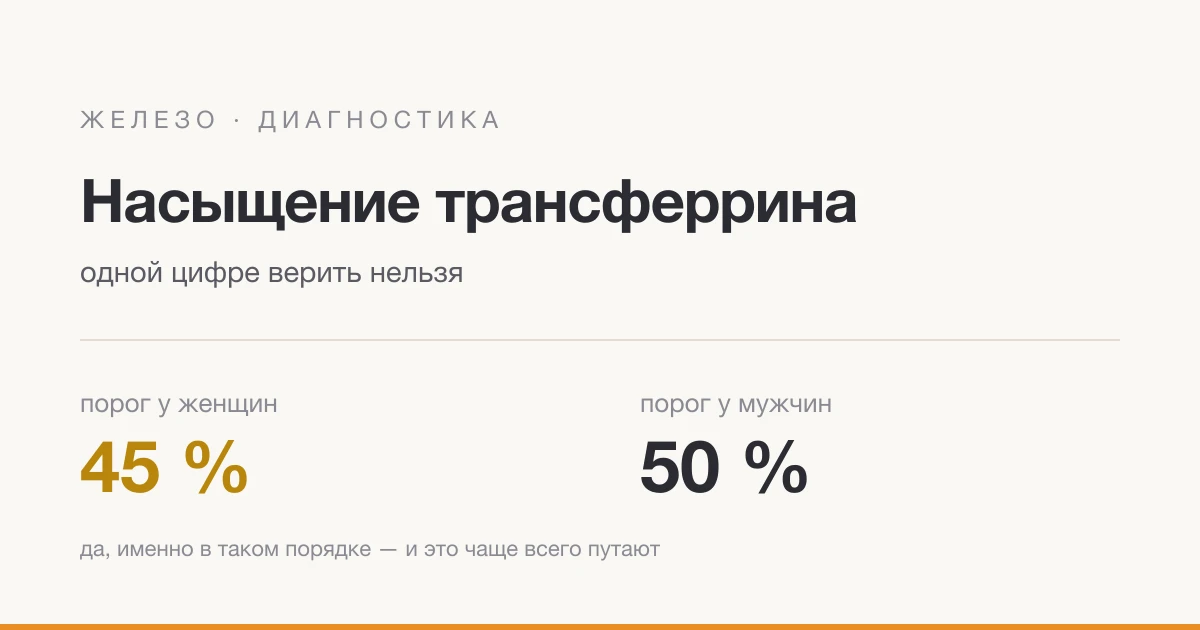
| Transferrin saturation (TSAT) | How much iron is actually available to tissues now | When ferritin looks "normal" but symptoms persist |
| Complete blood count | Haemoglobin, red cell size (MCV) and content (MCH) | Always — shows whether anaemia has developed |
| Soluble transferrin receptor (sTfR) | Iron deficiency independent of inflammation | When inflammation clouds interpretation |
The threshold argument: 15, 30, 40 or 70
Here honesty is required: no proven "ferritin level for hair" exists, and anyone quoting one as established fact is simplifying.
What the literature actually holds:
▸WHO, 2020. Iron deficiency in adults is ferritin below 15 µg/L; with inflammation the threshold rises to 70 µg/L [1]. This concerns health broadly, not hair. ▸Kantor et al., 2003. Women with hair loss had statistically lower ferritin than controls; this study underpins the widely quoted 30 µg/L threshold [2]. ▸Olsen et al., 2010. A controlled study comparing women with female pattern hair loss, chronic telogen effluvium and healthy controls found no significant difference in iron status [3]. This is the principal counter-argument and it is usually omitted. ▸Trost et al., 2006. A JAAD review: a link between iron deficiency and hair loss is plausible, but the evidence is weak and no treatment threshold is established [4]. ▸Park et al., 2013. Women with female pattern hair loss had lower iron indices than controls, supporting iron as a modifier [5].
How I put it to patients: with active shedding it is worth aiming for a ferritin above 40–50 µg/L with a normal CRP. That is a compromise between conflicting data and safety, not an established standard. Pushing beyond 100 is pointless: no benefit for hair has been demonstrated and the risk of iron accumulation is real.
Which types of hair loss iron actually drives
| Type of hair loss | Role of iron | What to do |
|---|---|---|
| Telogen effluvium (diffuse, 2–3 months after a trigger) | Direct: deficiency is a leading cause | Test and replete; hair returns |
| Female pattern hair loss | Modifier: not the cause, but worsens course and response | Replete, but treat the primary problem separately |
| Alopecia areata (autoimmune) | Not causal: the disease develops independently | Replete so it does not obstruct regrowth once the attack is suppressed — see the alopecia areata guide |
| Scarring alopecias | No role | Treat the underlying disease |
| Hair loss in thyroid disease | They frequently coexist and aggravate each other | Check both, see treating hypothyroidism |
Postpartum shedding deserves a separate note: iron deficiency is very common there — pregnancy and delivery drain the stores — but the shedding itself is driven mainly by the hormonal shift. Iron should certainly be repleted, but it will not resolve the whole picture on its own.
Deficiency without anaemia: why a "normal blood count" excludes nothing
Iron deficiency develops in three stages. Hair responds at the first; the routine blood count only registers the third.
▸Stage 1. Store depletion. Ferritin falls, haemoglobin is normal. Fatigue, reduced exercise tolerance and hair shedding are already possible. ▸Stage 2. Iron-deficient erythropoiesis. Stores are empty, blood counts still hold; transferrin saturation falls and soluble transferrin receptor rises. ▸Stage 3. Iron deficiency anaemia. Haemoglobin drops and red cells become small and pale (low MCV and MCH).
Months separate the first stage from the third. Throughout that time a person with a "normal blood count" has a genuine deficiency — a state recognised in the literature in its own right, with its own symptoms and treatment indications [6]. There is no need to wait for anaemia before repleting.
Where the deficiency comes from — always look
In an adult, iron deficiency is a symptom rather than a diagnosis. Supplementing without investigation corrects the number but not the problem, and sometimes conceals something dangerous.
Losses:
▸heavy or prolonged menstrual bleeding — the commonest cause in women of reproductive age; ▸occult gastrointestinal blood loss — ulcer, erosions, polyps, tumour; in men and postmenopausal women, iron deficiency warrants gastrointestinal investigation until proven otherwise; ▸regular blood donation; ▸long-term non-steroidal anti-inflammatory drugs.
Impaired absorption:
▸coeliac disease — common and frequently unrecognised, screened by a blood test; ▸Helicobacter pylori infection and atrophic gastritis; ▸long-term proton pump inhibitors — iron absorption requires an acidic environment; ▸previous bariatric surgery or gastric resection; ▸inflammatory bowel disease.
How to restore iron properly
Every other day, not every day
This is the main practical update of recent years and it is still not widely known. Each dose of iron raises hepcidin, the hormone that shuts down intestinal absorption for more than a day. As a result the second dose the same day, and the dose the following morning, are absorbed less well than the first.
In the trials by Stoffel and colleagues, iron given every other day as a single morning dose produced greater total absorption than daily dosing or twice-daily split dosing [7]. Gastrointestinal side effects were also fewer — and those are what usually cause people to abandon treatment.
What blocks absorption and what does not
| Impairs absorption | Neutral or helpful |
|---|---|
| Tea and coffee (tannins) — leave at least an hour | Taking on an empty stomach |
| Dairy products and calcium supplements | Gastric acidity |
| Proton pump inhibitors, antacids | Vitamin C alongside — a smaller effect than commonly claimed, but no harm |
| Phytates from grains and legumes in the same meal | Meat, fish and poultry — haem iron, absorbed better than plant iron |
Which form of iron to choose
The form determines tolerability more than efficacy — and tolerability is exactly why people abandon treatment.
| Form | Characteristics | Note |
|---|---|---|
| Ferrous sulfate | Cheap, best studied, the comparator in trials | Causes nausea, heaviness, constipation and dark stools more often than the alternatives |
| Bisglycinate (chelate) | Gentler tolerability at comparable efficacy [11] | More expensive; less data than for sulfate |
| Iron polymaltose complex | Mild tolerability | Absorption regarded as slower |
| Sucrosomal (liposomal) iron | Iron within a phospholipid and sucrester envelope is absorbed by an alternative route, so it barely irritates the mucosa | Studied in patients intolerant of sulfate: in coeliac disease [9] and in chemotherapy-related anaemia [10]. The evidence base is smaller than for classical forms — a sensible option for intolerance rather than automatically the "best" form |
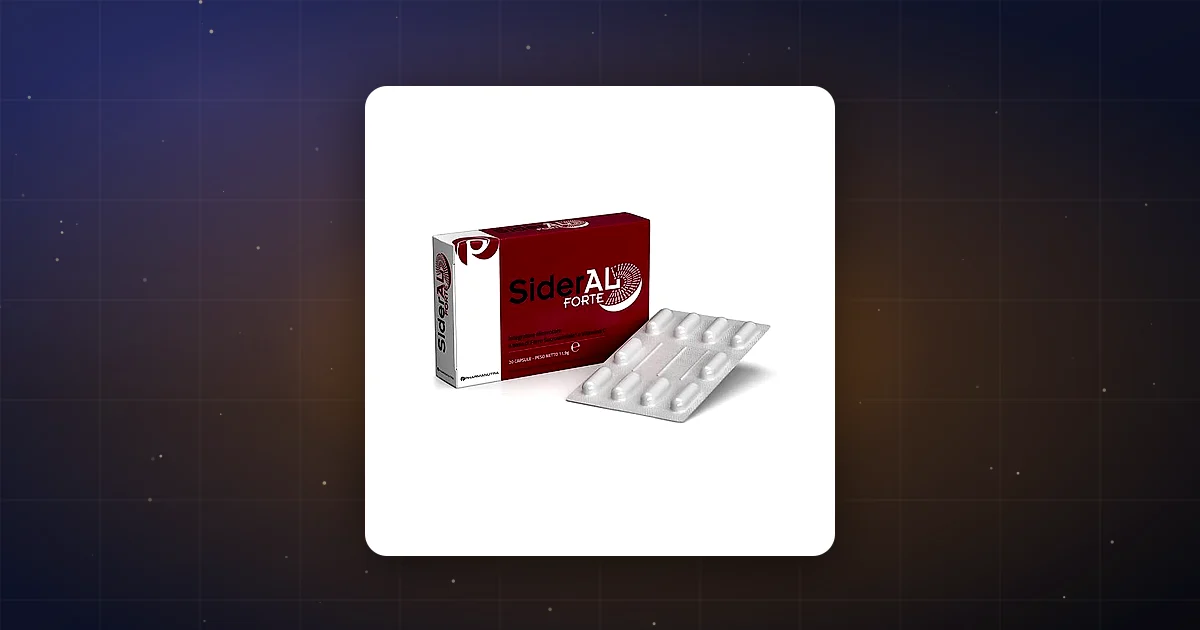
My shop carries two sucrosomal preparations: SIDERAL Forte — capsules with 30 mg of iron plus vitamin C, the everyday option, and SIDERAL ferro gocce — drops for those who struggle with capsules. The choice of form still belongs with your clinician: it depends on the depth of the deficiency, the state of the gut and what you have already tried.
When intravenous iron is warranted
The intravenous route is not "for those in a hurry" but for defined situations: intolerance of oral forms, documented malabsorption (coeliac disease, post-bariatric states, inflammatory bowel disease), ongoing losses exceeding what oral intake can replace, severe anaemia, or the need for rapid repletion before surgery. The decision belongs to a clinician, and infusion takes place where rare infusion reactions can be managed.
Intravenous preparations differ in the dose deliverable per infusion and in their side-effect profile. Modern formulations — ferric derisomaltose (brand name Monoferric, up to 1000 mg in a single infusion) and ferric carboxymaltose — can close the deficit in one or two administrations instead of a long course of infusions. One important difference: carboxymaltose causes hypophosphataemia — a fall in serum phosphate presenting as weakness and bone or muscle pain — considerably more often, while with derisomaltose the effect is weaker [12]. Both carry rare but genuine hypersensitivity reactions, so they are given where those can be managed, and never self-administered.
In the shop, Monoferric 1000 mg/10 ml is ordered only on a physician's prescription and infused in a medical setting. It is a prescription infusion product, not a "stronger supplement": the indication, the dose and the procedure itself are decided by a clinician after testing.
Timelines: when to look for results
| Time | What is happening | What to do |
|---|---|---|
| 2–4 weeks | Haematopoiesis recovers; wellbeing may improve | Continue; do not retest — too early |
| 4–8 weeks | Stores begin to refill; shedding still continues | Continue; do not abandon over "no effect" |
| 3 months | The main checkpoint | Ferritin + CRP + complete blood count |
| 3–6 months | A visible fringe of regrowth appears along the hairline | Continue to target values |
| 6–12 months | Hair reaches visible length | Maintenance, recheck every 6–12 months |
Two rules that save a great deal of anxiety. First, judge by the number, not the hairbrush — subjective impressions of shedding are unreliable. Second, do not quit in month two. Shedding in the early weeks reflects events from three months ago and says nothing about whether treatment is working.
When ferritin is high and hair still falls
This happens more often than expected and is almost always misread. A high ferritin does not mean "enough iron", and certainly not "take more". There are four explanations.
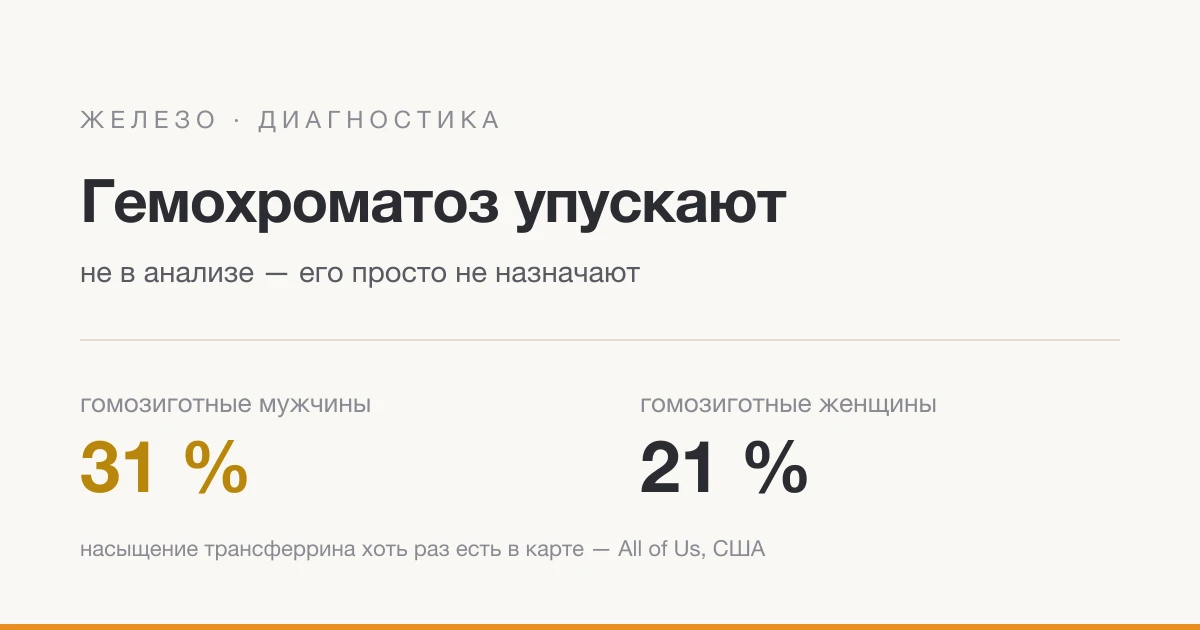
▸Inflammation. Any active process — from a recent infection to autoimmune disease — raises ferritin while the real store may be empty. The giveaway: elevated CRP and low transferrin saturation alongside a "good" ferritin. ▸Fatty liver disease and metabolic syndrome. The commonest cause of an isolated high ferritin in an outwardly healthy person; regular alcohol belongs here too. ▸Genuine iron overload, including hereditary haemochromatosis. Here both ferritin and transferrin saturation are high — a combination requiring separate assessment; see ferritin and the liver. ▸It simply is not the iron. Then the cause lies elsewhere: thyroid disease, alopecia areata, medication (retinoids, anticoagulants, some antidepressants, chemotherapy), rapid weight loss, the postpartum period, protein deficiency on severe diets.
Taking iron "just in case" with a normal or high ferritin is unnecessary and unsafe. The body has no active route to excrete excess iron, and it accumulates in liver, heart and pancreas.
Common mistakes
▸Ordering ferritin without CRP. Half of all falsely reassuring results come from this. ▸Testing during or straight after an illness. Wait 2–4 weeks after an infection resolves, or the number will be inflated. ▸Treating the lab's reference range as sufficiency. The lower limit printed on the form (often 10–13 µg/L) is the point below which deficiency is beyond dispute — not a target. ▸Taking iron daily and in divided doses. Absorbed less, tolerated worse. ▸Stopping after a month. Stores refill over months; one month is barely the start. ▸Not looking for the cause. Especially in men and postmenopausal women, in whom iron deficiency is grounds to investigate the gastrointestinal tract. ▸Relying on "hair vitamins". Their iron content is usually token, while high-dose biotin distorts thyroid and troponin immunoassays — stop it at least 2–3 days before blood tests. ▸Treating the number rather than the person. If ferritin is repleted and shedding continues, the cause is different and more iron will not fix it.
Summary
▸Ferritin is read together with CRP, and where doubt remains, with transferrin saturation and a complete blood count. ▸The formal deficiency threshold is 15 µg/L (70 with inflammation); no "hair norm" exists, and a reasonable target with active shedding is above 40–50 with a normal CRP. ▸The evidence conflicts: some studies find a link between iron and shedding, others do not. Iron is a factor worth correcting, not a universal explanation. ▸Deficiency without anaemia is real and should be treated without waiting for haemoglobin to fall. ▸The cause is always sought: in men and postmenopausal women, the gastrointestinal tract comes first. ▸Dose every other day, one morning dose — better absorbed, better tolerated. ▸Choose the form by tolerability: ferrous sulfate is cheap and effective but often hard on the stomach; sucrosomal and chelated forms are gentler. ▸Recheck at three months and judge by the number; visible change in hair from months 3–6. ▸A high ferritin is not a reason to supplement but a reason to find out why.
This article does not replace a consultation: choosing the preparation and dose, and identifying the cause of the deficiency, is clinical work — and when hair falls with normal iron, the diagnostic search is only beginning.
References
1. WHO guideline on use of ferritin concentrations to assess iron status in individuals and populations. World Health Organization, 2020. PMID 33909381
2. Kantor J, et al. Decreased serum ferritin is associated with alopecia in women. J Invest Dermatol. 2003;121(5):985–988. PMID 14708596
3. Olsen EA, et al. Iron deficiency in female pattern hair loss, chronic telogen effluvium, and control groups. J Am Acad Dermatol. 2010;63(6):991–999. PMID 20947203
4. Trost LB, et al. The diagnosis and treatment of iron deficiency and its potential relationship to hair loss. J Am Acad Dermatol. 2006;54(5):824–844. PMID 16635664
5. Park SY, et al. Iron plays a certain role in patterned hair loss. J Korean Med Sci. 2013;28(6):934–938. PMID 23772161
6. Raja NP, et al. Iron deficiency without anemia: an underrecognized and undertreated clinical condition. Clin Hematol Int. 2026. PMID 42569155
7. Stoffel NU, et al. Iron absorption from oral iron supplements given on consecutive versus alternate days and as single morning doses versus twice-daily split dosing in iron-depleted women: two open-label, randomised controlled trials. Lancet Haematol. 2017;4(11):e524–e533. PMID 29032957
8. Durusu Turkoglu IN, et al. A comprehensive investigation of biochemical status in patients with telogen effluvium. J Cosmet Dermatol. 2024. PMID 39107936
9. Elli L, et al. Sucrosomial iron supplementation in anemic patients with celiac disease not tolerating oral ferrous sulfate: a prospective study. Nutrients. 2018;10(3):330. PMID 29522446
10. Zuccarini A, et al. Randomized trial of sucrosomial iron supplementation in patients with chemotherapy-related anemia. Support Care Cancer. 2022. PMID 35678882
11. Abbas AM, et al. Efficacy of ferrous bis-glycinate versus ferrous glycine sulfate in the treatment of iron deficiency anemia. J Matern Fetal Neonatal Med. 2019. PMID 29843553
12. Boots JMM, et al. High-dose intravenous iron with either ferric carboxymaltose or ferric derisomaltose: a benefit-risk assessment. Drug Saf. 2022;45(10):1019–1036. PMID 36068430
Key facts
- Ferritin is both an iron store and an acute-phase protein: it rises with infection, obesity, fatty liver disease, alcohol and autoimmune inflammation regardless of actual stores. A "normal" ferritin in the presence of inflammation therefore does not exclude deficiency — it must be read alongside CRP and transferrin saturation.
- The WHO threshold for deficiency is ferritin below 15 µg/L in adults, rising to below 70 µg/L when inflammation is present. The 30, 40 and 70 figures quoted by hair clinicians come from separate hair studies, and no accepted "hair threshold" exists.
- The evidence conflicts: Kantor 2003 found lower ferritin in women with hair loss than in controls, while the controlled study by Olsen 2010 found no difference between women with female pattern hair loss, chronic telogen effluvium and controls. Iron is a contributing factor, not the sole cause.
- The hair matrix is among the fastest-dividing tissues in the body, and iron is required by ribonucleotide reductase, the enzyme of DNA synthesis. When stores fall, division slows and some follicles enter the resting phase early — hence diffuse shedding 2–3 months after the triggering event.
- Iron matters in telogen effluvium and acts as a modifier in female pattern hair loss. In alopecia areata it does not cause the disease — but it does obstruct regrowth once the autoimmune attack has been suppressed.
- The minimum honest panel: ferritin plus a complete blood count plus CRP plus serum iron and transferrin saturation. Ferritin alone, without CRP, routinely produces a falsely reassuring picture in anyone with excess weight, fatty liver disease or a recent infection.
- Alternate-day iron is absorbed better than daily dosing: each dose raises hepcidin, which blunts absorption of the next one. A single morning dose every other day yields greater total absorption with fewer gastrointestinal side effects.
- Ferritin rises slowly: recheck at three months, not three weeks, and judge by the number rather than by whether shedding "feels" reduced. Hair responds later than stores — visible improvement usually falls between months 3 and 6.
- Iron deficiency in an adult is a symptom, not a diagnosis. The cause must be sought: heavy menstrual bleeding, occult gastrointestinal blood loss, coeliac disease, H. pylori infection, vegetarian diets, blood donation, long-term proton pump inhibitors, bariatric surgery.
- A high ferritin does not mean "enough iron" and certainly does not mean "take more". It may reflect inflammation, fatty liver disease, alcohol or genuine iron overload, including hereditary haemochromatosis.