When "Normal Labs" Don't Mean Healthy
Maria, 42. Five years on levothyroxine. TSH at 2.1 mIU/L — textbook-perfect compensation. But Maria keeps gaining weight, can't focus, wakes up exhausted, her hair is falling out, and her skin is dry.
"Your labs are normal," says her endocrinologist. "Maybe you should see a therapist?"
This conversation repeats itself in clinics around the world. And the problem isn't Maria. The problem is how we treat hypothyroidism.
How the Thyroid Works
The thyroid gland produces two main hormones:
- T4 (thyroxine) — the "storage" form, relatively inactive. Makes up ~80% of thyroid output
- T3 (triiodothyronine) — the active form that actually works inside your cells. ~20% of output
Your cells cannot use T4 directly. It must be converted to T3 by specialized enzymes called deiodinases. This conversion happens in the liver, kidneys, muscles, and other tissues.
| Form/drug | What it is |
|---|---|
| T4 (thyroxine) | storage form, inactive, ~80% of output |
| T3 (triiodothyronine) | active form, works in cells, ~20% |
| Levothyroxine | synthetic T4 only |
| NDT | T4 and T3 ≈ 4:1 |
The Problem with Levothyroxine
Levothyroxine (Synthroid, Euthyrox) is synthetic T4. Only T4. The logic is simple: give the body T4 and it will convert it to T3 on its own.
For most patients, this works. But for 15-20%, it doesn't. Why?
- Impaired T4-to-T3 conversion: selenium, zinc, or iron deficiency; chronic inflammation; stress; liver disease
- DIO2 gene polymorphism: approximately 16% of people carry the rs225014 variant, which reduces type 2 deiodinase activity. A study by Panicker et al. (2009, Journal of Clinical Endocrinology & Metabolism) showed these patients feel better on combination T4+T3 therapy
- Ignoring T3: standard practice monitors only TSH and sometimes free T4. Free T3 — the hormone that actually does the work — is often never checked
What Is NDT (Natural Desiccated Thyroid)
NDT (Natural Desiccated Thyroid) is made from desiccated porcine thyroid glands. It contains:
- T4 and T3 in an approximately 4:1 ratio
- T2 and T1 — minor thyroid hormones whose roles are still being studied
- Calcitonin — in trace amounts
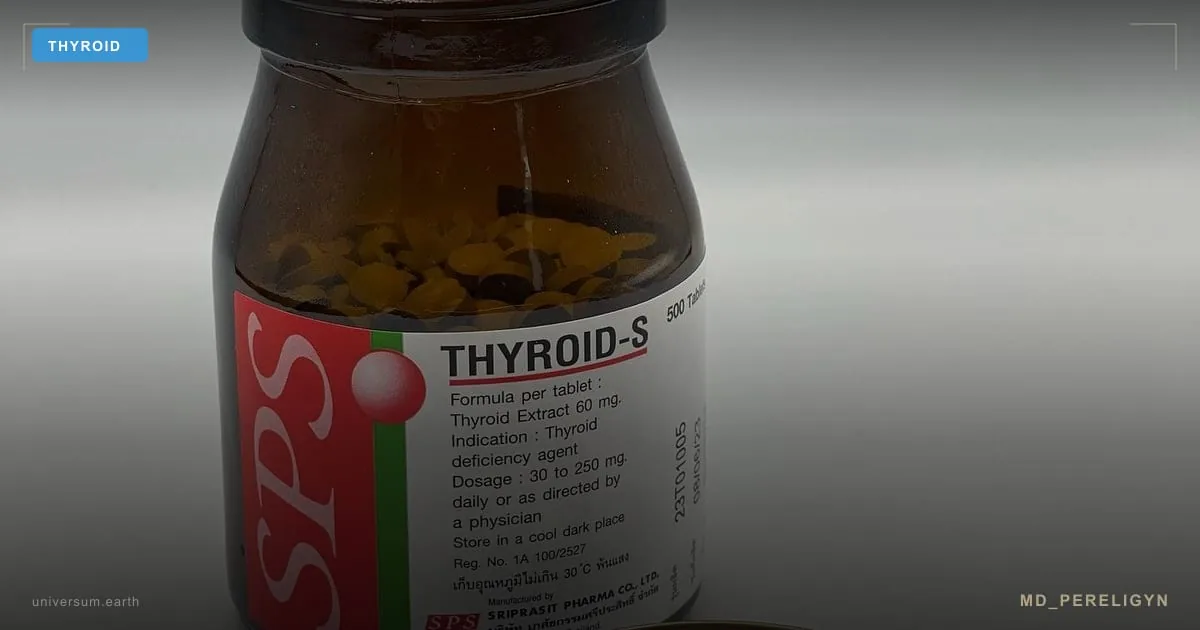
NDT has been in use since the 1890s — it is one of the oldest endocrine medications in medical history. Brand names include Armour Thyroid, NP Thyroid, Nature-Throid (US), and Thyroid-S (Thailand).
The Scientific Evidence
NDT is not alternative medicine. The evidence base includes:
- Hoang et al. (2013, Journal of Clinical Endocrinology & Metabolism): a randomized, double-blind, crossover trial. 70 patients. NDT led to greater weight loss and was preferred by patients (49% vs 19% in favor of NDT vs levothyroxine)
- Panicker et al. (2009): patients with DIO2 polymorphism show better cognitive outcomes and wellbeing on combination T4+T3 therapy
- Peterson et al. (2018, Thyroid): systematic review — a subset of patients consistently prefer NDT or combination therapy with comparable safety profiles
- Wiersinga et al. (2012, European Thyroid Journal): even with normal TSH, 10-15% of patients on T4 monotherapy have persistent complaints
Who May Benefit from NDT
NDT is not for everyone. It may be the optimal choice for:
- Persistent symptoms on levothyroxine despite normal TSH (fatigue, weight gain, cognitive issues)
- Low free T3 with normal T4 — a sign of impaired conversion
- DIO2 polymorphism (genetic testing is available)
- Patients who "feel the difference" — subjective improvement on NDT is reproducible in studies
How I Prescribe NDT in Practice
My approach includes a full thyroid panel — not just TSH:
- TSH, free T4, free T3 — the essential triad
- Antibodies (anti-TPO, anti-TG) — to identify autoimmune thyroiditis
- Reverse T3 (rT3) — a marker of impaired conversion
- Selenium, zinc, ferritin, vitamin D — cofactors for T4-to-T3 conversion
The transition to NDT is done gradually, with labs rechecked at 6 weeks. Dosing is individualized — the goal is symptom resolution with safe hormone levels, not a TSH number.
Important Caveats
- NDT does not replace levothyroxine for everyone — most patients do fine on T4 alone
- Self-treatment is dangerous: excess thyroid hormones cause tachycardia, osteoporosis, and atrial fibrillation
- Monitoring is mandatory: regular TSH, fT3, fT4 checks
- NDT does not treat the root cause of autoimmune thyroiditis — that requires a comprehensive approach (selenium, vitamin D, anti-inflammatory nutrition)
Your Next Step
If you've been on levothyroxine for years and symptoms persist, don't accept "your labs are normal, so everything is fine." Ask your doctor to check free T3, not just TSH — much like the HOMA-IR diagnostic test for metabolic health, it's a single inexpensive marker that routine practice skips. That single test may explain why you're not getting better.
In a consultation, we review your full thyroid panel, assess conversion efficiency, check cofactors, and determine whether a therapy change is warranted. Persistent weight gain and brain fog can also be driven by insulin resistance as a root cause, which is why metabolic markers belong in the same workup. For many patients, switching to NDT or combination therapy is the difference between "living in fog" and feeling normal again.
Key facts
- The thyroid makes mostly inactive T4 (~80%) and active T3 (~20%); cells cannot use T4 directly.
- T4 is converted to T3 by deiodinases in liver, kidneys, and muscle; selenium/zinc/iron deficiency and inflammation impair it.
- Levothyroxine is T4 only; for 15-20% of patients symptoms persist despite a normal TSH.
- The DIO2 gene polymorphism (rs225014) lowers type 2 deiodinase activity; these patients feel better on T4+T3 therapy.
- NDT is made from desiccated porcine thyroid, contains T4 and T3 at roughly 4:1, and has been used since the 1890s.