Introduction: Iodine Does Not Work in Isolation
The standard approach to thyroid health — "take some iodine" — ignores a key principle of endocrinology: iodine acts not on its own, but within a system of cofactors. Without a properly tuned system, iodine does not heal — it fuels inflammation, especially in patients with pre-existing autoimmune thyroiditis (Hashimoto).
This article breaks down five levels through which iodine passes from absorption to active T3 hormone production — and how each can become a bottleneck.
🌀
Stage 1: Cellular Uptake (NIS)
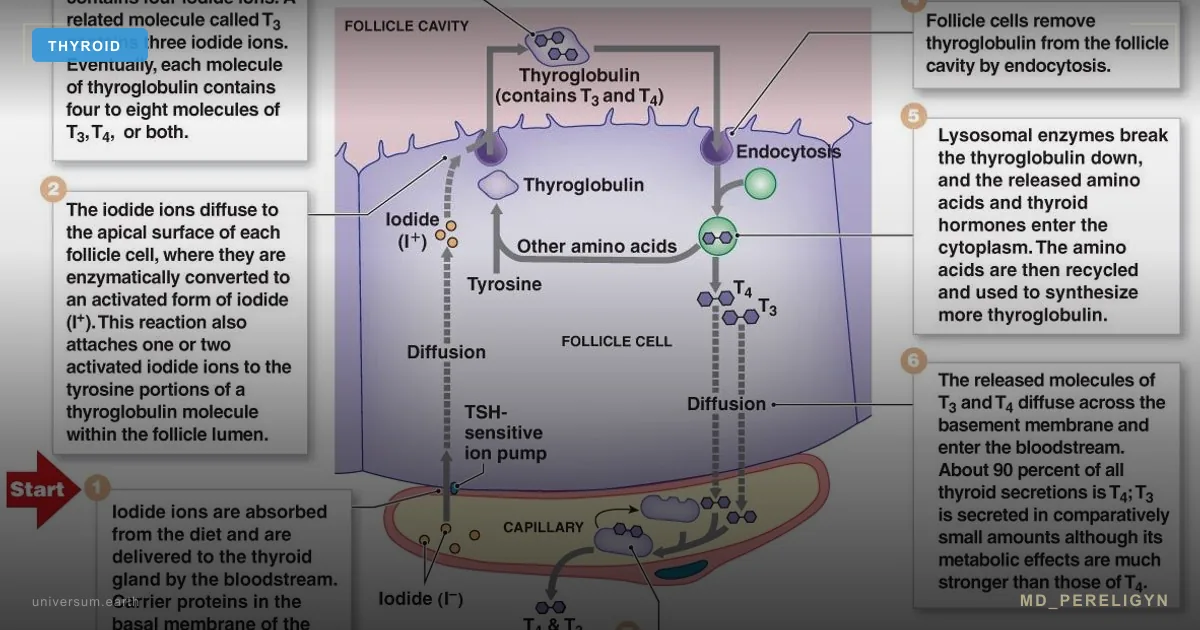
Iodine must not just enter the body — it must enter the thyroid cell via the sodium-iodide symporter (NIS), a thyrocyte membrane protein.
This requires:
▸Normal sodium-potassium gradient — basis of symporter function ▸Cellular energy — ATP for active transport ▸Living, non-inflamed tissue — NIS is dysfunctional in thyroiditis
What helps:
Avoid burnout, chronic stress, and starvation. Maintain nutrition and cellular energy. Fasting — especially prolonged — reduces NIS expression, explaining why women on aggressive diets often develop functional "hypothyroidism" with normal thyroids.
🌀
Stage 2: Thyroid Peroxidase (TPO)
Without thyroid peroxidase (TPO), iodine will not oxidize and incorporate into hormones. This enzyme converts iodide (I⁻) into the active form ready for inclusion in thyroglobulin.
Two common bottlenecks here: autoimmune thyroiditis (Hashimoto) and iron deficiency:
▸TPO antibodies (anti-TPO) in Hashimoto block the enzyme ▸Iron is a TPO cofactor. Without iron-dependent synthesis, TPO does not function
What helps:
▸Check ferritin (target 70–100 ng/mL, not "normal range") ▸Do not give iodine blindly with positive anti-TPO — this pours fuel on fire
🌀
Stage 3: Peroxide Protection
This is the most underestimated stage. When iodine is processed, the thyroid generates hydrogen peroxide (H₂O₂) — needed for iodine oxidation. But peroxide is toxic to the tissue itself.
This explains a common phenomenon: Hashimoto patients take "iodine" and 6 months later return with higher antibodies and nodules. Their "treatment" works against them.
What helps:
▸Do not start iodine during active inflammation or burnout ▸First restore the antioxidant system
🌀
Stage 4: Iodine + Iodide (Form Balance)
Iodine exists in two forms:
▸Iodide (I⁻) — simple ionic form, absorbs in GI, goes to thyroid ▸Molecular iodine (I₂) — complex form, predominantly used by mammary gland and other tissues
Supplements contain different ratios. Lugol's solution — classic combination. Potassium iodide (KI) — iodide only.
Iodine is needed, but if poured in without selenium, iron, and proper environment, it can do harm. Iodine + iodide work in the context of the whole system. Without cofactor preparation, even "correct" Lugol can worsen autoimmune thyroiditis.
md_pereligyn principle:
1. Labs first (TSH, fT4, fT3, anti-TPO, anti-Tg, ferritin, RBC selenium, vitamin D) 2. Cofactor preparation (selenium, iron, antioxidants) for 4–8 weeks 3. Only then iodine — starting with microdoses and gradually increasing 4. Recheck at 8–12 weeks: antibodies, TSH, fT3
🌀
Stage 5: T4 → T3 Conversion
This is where it is decided whether you have energy or just "normal T4" in labs. The final and most important stage.
T4 is a "prohormone", weak on its own. T3 is active, powerful. T4 → T3 conversion happens in tissues via deiodinase enzymes (D1, D2) which require selenium.
Conversion is broken by:
▸Starvation (prolonged caloric deficit) ▸Inflammation (elevated CRP) ▸Liver — most conversion happens in liver; fatty liver disease kills it ▸Gut — 20% of conversion happens in gut, requires healthy microbiome ▸Deficiencies of selenium, zinc, iron
When conversion is broken, labs show "normal T4 + low fT3 + high reverse T3 (rT3)" — clinical hypothyroidism with "normal labs". This is missed if fT3 is not checked. Detailed breakdown of the rT3 trap and survival mode — in Weight loss and reverse T3.
What helps:
▸Stop fasting (prolonged deficit breaks D2) ▸Sleep 7–9 hours ▸Adequate protein (1.2–1.5 g/kg) ▸Support bile (ox bile, taurine) ▸Restore gut (butyrate, probiotics) ▸Reduce chronic stress (cortisol suppresses D2)
🌀
Summary: Five-Stage Check Before Iodine
Before starting iodine-containing supplements — especially in patients with autoimmune thyroiditis — verify all five stages:
| Stage | What is needed | Marker |
|---|---|---|
| 1. Cellular uptake (NIS) | Energy, no burnout | Cortisol, nutrition, protein |
| 2. TPO | Iron, no active autoimmunity | Ferritin 70–100, anti-TPO |
| 3. Peroxide protection | Selenium, antioxidants | RBC selenium, GSH |
| 4. Iodine+iodide balance | Cofactor preparation | Full panel |
| 5. T4→T3 conversion | Selenium, zinc, liver, gut | fT3, rT3, liver panel |
If even one stage is dysfunctional — iodine will not help. Worst case: a Hashimoto patient starts iodine without selenium and triggers autoimmune flare.
🌀
Principle
Iodine is raw material — but very important raw material. Without a protective system (selenium + iron + antioxidants), you are not treating — you are feeding autoimmunity, nodules, and hyperfunction.
Modern endocrinology (American Thyroid Association, 2017) recommends a differentiated approach: iodine indicated for confirmed deficiency (urinary iodine, regional epidemiology) and not indicated for Hashimoto without deficiency. Global iodine prophylaxis via iodized salt is a population-level measure, not individual.
Individual therapy requires diagnostics and preparation. "Everyone takes iodine — so should you" is not clinical medicine.
🌀
Conclusion
Iodine is an essential element for thyroid hormone synthesis. But isolated supplementation without assessing the cofactor system often worsens autoimmune inflammation and nodular changes, especially in Hashimoto.
The correct approach: full diagnostics → system preparation (selenium, iron, antioxidants) → gradual iodine introduction with antibody and function monitoring → reassessment at 8–12 weeks. This is the path from "protocol-based treatment" to personalized endocrinology.
---
References:
- Köhrle J. Selenium and the thyroid. Curr Opin Endocrinol Diabetes Obes 2015. PMID 26313901[1] (selenium-thyroid interaction)
- Toulis KA et al. Selenium supplementation in autoimmune thyroiditis. PMID 20883174[2] (meta-analysis)
- Alexander EK et al. 2017 Guidelines of the American Thyroid Association for Diagnosis and Management of Thyroid Disease During Pregnancy. PMID 28056690[3]
References
Key facts
- Iodine works not in isolation but within a system of cofactors; without selenium and iron it fuels inflammation and autoimmunity.
- Cellular uptake of iodine goes through the sodium-iodide symporter (NIS); fasting reduces its expression.
- Thyroid peroxidase (TPO) oxidizes iodide; iron is its cofactor, and anti-TPO antibodies in Hashimoto block the enzyme.
- Oxidizing iodine makes the thyroid generate hydrogen peroxide; selenium in glutathione peroxidase quenches the excess.
- T4→T3 conversion runs through selenium-dependent deiodinases (D1, D2) in tissues, liver, and gut.