Introduction: Starvation Is Not Weight Loss
When you aggressively cut calories, fast, and live in stress, the body does not turn on fat burning — it turns on survival mode. This is not "weak willpower" or "bad genetics" — this is a normal physiological response to threat.
First water leaves and it seems to work. Then reverse T3 (rT3) rises — an inhibitory metabolite that slows energy expenditure. Active T3 falls, mitochondria slow, you feel cold, swollen, foggy. Weight stalls or creeps up.
Then comes the classic complaint: "I barely eat — why am I not losing weight?" Because starvation is a signal to the body to conserve, not spend.
This article breaks down the mechanism of this trap and the five-step thyroid work to restore active metabolism.
🌀
Mechanism: Reverse T3 as the Brake Pedal
T4 (thyroxine) is a "prohormone" that tissues convert into active T3 or inactive reverse T3 (rT3). The T3/rT3 ratio is determined by deiodinase enzymes:
▸Deiodinase 1 and 2 (D1, D2) — convert T4 to T3 (active) ▸Deiodinase 3 (D3) — converts T4 to rT3 (brake)
Normally the balance is shifted toward T3. Under stress — fasting, illness, inflammation, surgery, sleep deprivation — balance shifts sharply toward rT3. This is evolutionary: the body conserves energy to survive famine.
Labs show:
▸TSH — normal or slightly elevated ▸T4 — normal ▸fT3 — low-normal or below range ▸rT3 — elevated ▸fT3/rT3 ratio < 0.2 (normal > 0.2)
A standard endocrinologist looks at TSH and T4, says "all good". But clinically the patient has hypothyroidism: fatigue, cold intolerance, edema, hair loss, weight gain.
| Marker | Survival-mode pattern |
|---|---|
| TSH | normal or slightly elevated |
| T4 | normal |
| fT3 | low-normal or below range |
| rT3 | elevated |
| fT3/rT3 | < 0.2 (normal > 0.2) |
🌀
What Causes rT3 to Rise
▸Prolonged caloric deficit (more than 4–6 weeks at significant deficit) ▸Very low-carbohydrate diets without adjustment ▸Chronic stress — high cortisol suppresses D2 ▸Inflammation (elevated CRP, TNF-α) ▸Sleep deprivation less than 6 hours ▸Selenium deficiency — critical for D2 ▸Iron deficiency — ferritin < 70 ng/mL ▸Heavy training without recovery ▸Fatty liver disease — liver does 60% of conversion
Each factor raises rT3 by 20–40%. In combination the effect is multiplicative.
🌀
Five Stages of Thyroid Work for Weight Loss
This is the key idea of the md_pereligyn protocol: before "going on a diet", verify thyroid functionality at five levels. This works both ways: prevents loss of thyroid function during deficit, and helps recover if the trap has already triggered.
1. Iodine Cellular Uptake (NIS Symporter)
Full breakdown of all 5 iodine stages — in Iodine and Thyroid: 5-Step Protocol. Here — brief overview in weight-loss context.
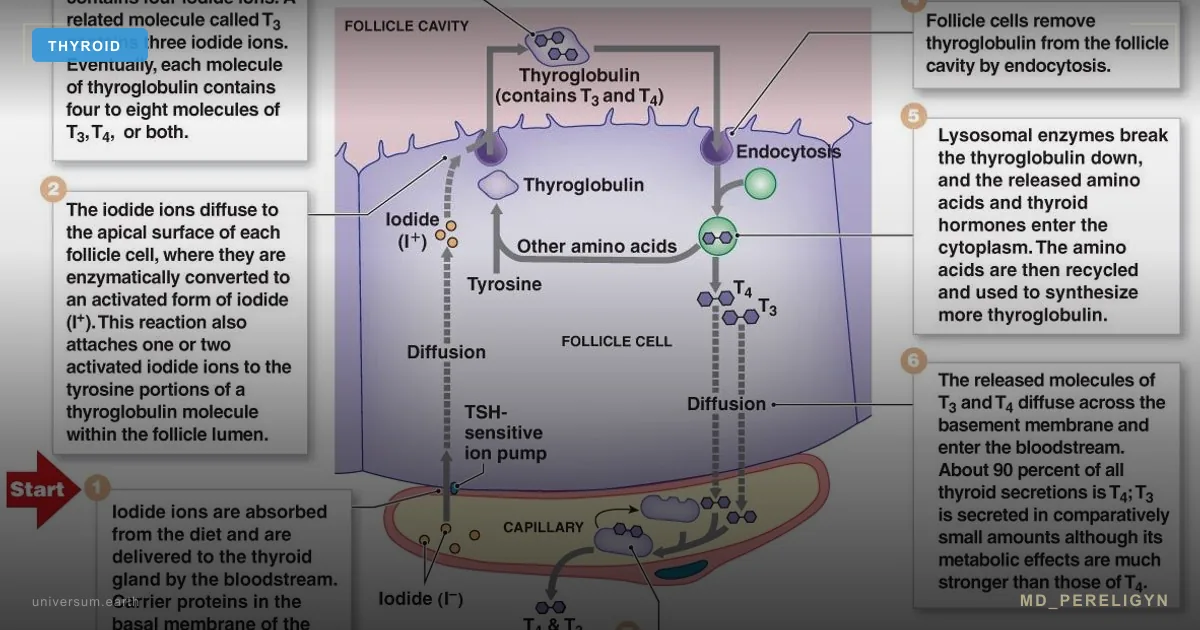
Iodine must enter the thyroid cell via the sodium-iodide symporter. This requires:
▸Normal sodium-potassium gradient ▸Cellular energy ▸Living, non-inflamed tissue
2. Thyroid Peroxidase (TPO)
Without TPO, iodine will not oxidize and incorporate into hormones. Critical here are ferritin (target 70–100, not "normal range") and anti-TPO status.
3. Peroxide Protection
During thyroid hormone synthesis the gland generates hydrogen peroxide. Without selenium, peroxide damages tissue from within. This is critical in Hashimoto patients.
4. Iodine + Iodide (Systemic Context)
Iodine is needed, but without selenium, iron, and proper environment, it can do harm. Blind iodine with cofactor deficiencies worsens Hashimoto. md_pereligyn principle:
1. Labs first (full panel + ferritin + selenium) 2. Cofactor preparation 4–8 weeks 3. Only then iodine, starting with microdoses 4. Recheck at 8–12 weeks
5. T4 → T3 Conversion
This is where it is decided whether you have energy or just "normal T4" in labs. Conversion is broken by:
▸Fasting (prolonged deficit) ▸Inflammation ▸Liver (fatty liver disease) ▸Gut (20% of conversion) ▸Selenium, zinc, iron deficiencies
🌀
How to Escape the rT3 Trap
If rT3 is already elevated and you are in survival mode, you cannot continue aggressive deficit — this deepens the problem. Recovery plan:
Step 1: Reverse-diet 4–8 weeks
Gradually increase calories by 100–200 kcal/week up to maintenance. The body stops perceiving the situation as famine. Metabolism recovers. Paradox: to lose weight, you first have to start eating normally.
Step 2: Cofactor Recovery
Selenium 200 µg + zinc 25 mg + magnesium 400 mg + iron if ferritin < 70 + vitamin D to 60–80 ng/mL + omega-3 EPA/DHA 1–2 g.
Step 3: Sleep and Stress
7–9 hours of sleep. Cortisol elevated — that is a conversion blocker. Adaptogens (rhodiola, ashwagandha) can help, but primary focus is regimen.
Step 4: Liver and Gut
60% of conversion in liver, 20% in gut. Bile support (ox bile, milk thistle), butyrate, probiotics, protein 1.2–1.5 g/kg.
Step 5: Recheck and Continue
At 8–12 weeks recheck: TSH, fT4, fT3, rT3, fT3/rT3 ratio. If ratio > 0.2 — system is recovering, can enter moderate deficit for fat loss.
🌀
What DOES NOT Work (and Why)
▸Pure caloric deficit without cofactor support — deepens survival mode ▸T3 supplementation bypassing the system — short-term improvement followed by crash ▸"I just won't eat" — after 14 days of significant deficit, rT3 rises 30–50% ▸Cardio + deficit — powerfully amplifies cortisol and rT3 when applied together ▸Aggressive keto without adjustment — in some patients spikes rT3 in first 4 weeks
🌀
What DOES Work
▸Reverse-diet to escape survival mode ▸Resistance training (raises T3 via muscle mass), not cardio ▸Full endocrine diagnostics before any diet ▸Cofactor preparation 4–8 weeks before deficit ▸Moderate deficit 10–20% below maintenance, no more ▸Adequate protein (minimum 1.2 g/kg) ▸Sleep 7–9 h — sleep loss raises rT3 in 2 nights ▸Stress management — cortisol and rT3 are directly linked
🌀
Principle
"I barely eat — why am I not losing weight?" is not a psychology or motivation question. It is a physiology question.
The body does not distinguish between "diet for weight loss" and "famine during war". The response is the same: conserve energy, accumulate reserves, slow metabolism. And rT3 is the primary molecular instrument of this response.
Modern endocrinology (Bauer M. & Whybrow PC., Thyroid, 2014) recognizes rT3 as a functional antagonist of active T3 and proposes it as a marker of "untreated functional hypothyroidism". Most clinics do not run this panel — explaining why millions of women diet for years without results.
🌀
Conclusion
Before going on yet another diet — verify whether you are already in survival mode. Full thyroid panel (TSH + fT4 + fT3 + rT3 + anti-TPO) + ferritin + vitamin D + selenium gives the complete picture.
Weight loss is not a question of "eat less, move more". It is a question of maintaining metabolism in active state during moderate deficit. Without this foundation, any diet is a trap.
---
References:
- Bauer M, Whybrow PC. Thyroid Hormones and Mood: A Reappraisal of the Reverse T3 Syndrome. Thyroid 2014
🌀
Resistance training protocol for thyroid recovery
The article recommends resistance training over cardio for rT3 reduction without specifying volume, intensity, or frequency. This section provides the evidence-based parameters.
Resistance training raises peripheral T3 via three mechanisms: increased skeletal muscle mass expands the largest D2-expressing tissue compartment; mechanical loading upregulates DIO2 expression in trained muscle; and exercise-induced lactate increases hepatic D1 activity. The net effect is a higher fT3 and lower fT3/rT3 ratio impairment at any given caloric intake.
Protocol parameters supported by randomized data:
- Frequency: 3 sessions per week, non-consecutive days. Higher frequency (5–6 sessions) is counterproductive in the rT3-elevated patient because it increases cortisol exposure without proportional anabolic benefit. - Volume: 10–15 working sets per major muscle group per week, distributed across sessions. Total session duration 45–60 minutes including warm-up. - Intensity: compound movements at 70–85% of one-repetition maximum, 6–10 repetitions per set, 2–3 minutes rest between sets. This intensity range maximizes growth hormone and IGF-1 response, which independently support T3 conversion. - Exercise selection: squat or leg press, deadlift or hip hinge, horizontal press (bench press or dumbbell press), vertical pull (pull-up or pulldown), horizontal pull (row), and one or two accessory movements per session. - Progression: linear progression in load by 2.5–5% per week as tolerated, with deload week every 4–6 weeks (50% volume) to limit cortisol accumulation.
Cardiovascular work is not contraindicated but should be capped at 60–90 minutes per week of zone-2 intensity (60–70% maximum heart rate). Higher-intensity interval training and steady-state cardio above 70% maximum heart rate exceeding 2 hours per week elevates cortisol enough to attenuate the resistance-training benefit on T3 conversion.
Sleep timing matters as much as training timing. Training within 4 hours of intended bedtime delays sleep onset in many patients and blunts the nocturnal cortisol nadir. Morning or early-afternoon sessions are preferred. Post-workout protein intake of 0.3 g/kg within 90 minutes supports muscle protein synthesis without producing the cortisol response seen with prolonged post-exercise fasting.
Expected timeline: measurable lean mass gain of 0.5–1 kg per month in deficit-controlled patients, with fT3/rT3 ratio improvement detectable at 8–12 weeks. The protocol is not optional adjunct — in patients refractory to nutritional repletion alone, structured resistance training is frequently the variable that finally normalizes the conversion ratio.
Key facts
- Reverse T3 (rT3) is an inhibitory metabolite: under stress, deiodinase D3 shifts T4 conversion from active T3 to rT3, slowing metabolism.
- An fT3/rT3 ratio < 0.2 with normal TSH and T4 marks "untreated functional hypothyroidism with normal labs".
- Each factor — caloric deficit, stress, inflammation, sleep loss, selenium or iron deficiency — raises rT3 by 20–40%.
- The liver performs 60% of T4→T3 conversion and the gut 20%; fasting, inflammation and fatty liver break it.
- Escape via reverse-diet: +100–200 kcal/week to maintenance; after 14 days of significant deficit rT3 rises 30–50%.