In brief
| What it is | The share of transferrin occupied by iron |
| How it is derived | Iron ÷ TIBC × 100% |
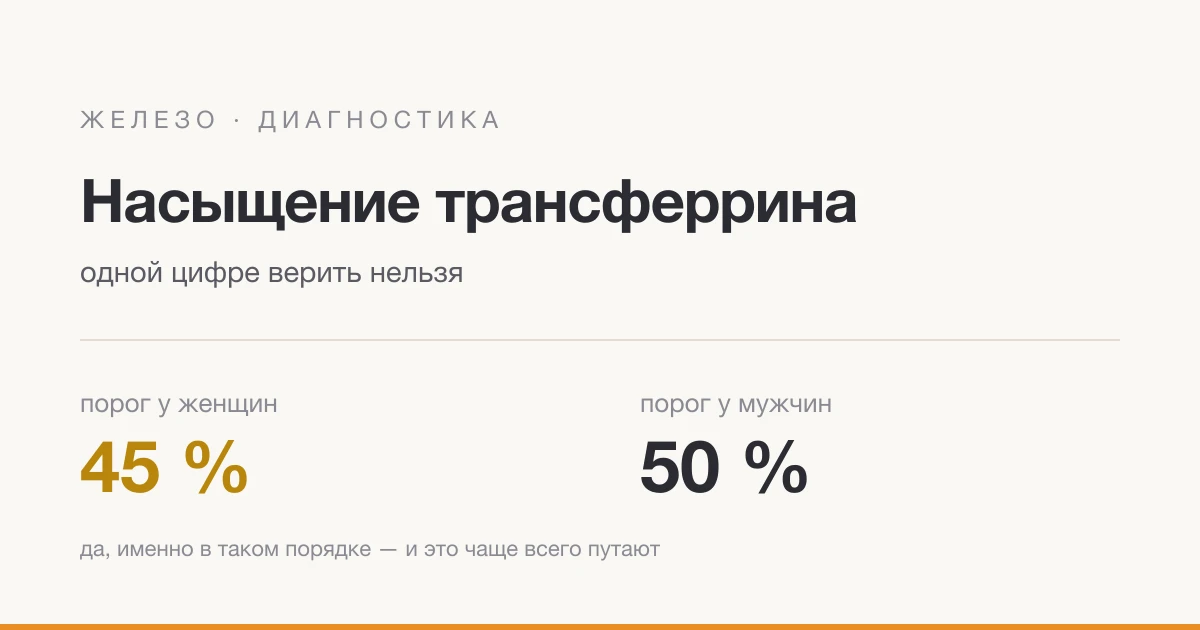
| Threshold for suspicion | TSAT > 45% with ferritin > 200 in premenopausal women; TSAT > 50% with ferritin > 300 in men and postmenopausal women |
| What is needed besides the number | Persistence, and an explanation |
| What the number does not say | How much iron is in the tissues |
A high transferrin saturation frightens people more than it deserves. Briefly, then: what this number is, and why one value of it cannot be trusted.
It is a ratio, not a measurement
Transferrin saturation is calculated, not measured. Serum iron is divided by total iron-binding capacity and multiplied by a hundred.
Which means either part can move. The numerator — blood iron — varies across the day. The denominator — binding capacity — varies with inflammation and protein status. The result can jump while the body's iron stores have not changed at all.
That iron follows a daily rhythm has been shown directly: in a 2024 study, oscillations of iron and saturation persisted even in constant darkness and disappeared when the clock genes were disrupted (PMID 39152780[1]). That work was done in mice, but the human daily pattern is described too — iron stays high roughly from eight in the morning until three in the afternoon (PMID 28947322[2]).
The unexpected part: «strictly fasting» can inflate the result
The familiar advice runs: take iron studies strictly fasting, twelve hours without food. With this panel it works against you.
The same study on diurnal variation says it verbatim: after a fast of twelve hours or longer, iron concentrations may be above usual levels. A representative estimate comes from a draw after five to nine hours without food.
The European haemochromatosis guideline says the same thing more soberly: fasting does not improve the diagnostic utility of this panel.
The practical conclusion is not «do not fast» but something else: what matters is not fasting, but sameness of conditions. If you repeat the test, do it at the same time of day and in the same state.
Where the real thresholds lie
This is where people most often go wrong, and they go wrong in mirror image.
| Who | Threshold for suspicion |
|---|---|
| Premenopausal women | TSAT > 45% with ferritin > 200 μg/L |
| Men and postmenopausal women | TSAT > 50% with ferritin > 300 μg/L |
Intuition says the opposite — it feels as though the threshold should be lower in men. In fact it is the other way round, and the reason is simple: menstruation itself keeps iron stores lower, so in a premenopausal woman the same number means more.
Note the second point too: the threshold is a pair. Saturation is not read alone but alongside ferritin.
One number is not an indication
The most important practical point. What warrants a genetic test is persistently elevated and unexplained saturation — or high saturation together with high ferritin.
Watching the trend helps as well: if on repeat measurement ferritin and saturation are stable or falling, the likelihood of an iron-storage disease drops (PMID 41961610[3]).
If saturation is high but ferritin is normal
A common and coherent combination. The two answer different questions: saturation is about the iron in the blood right now; ferritin is about what is already deposited in tissue.
High saturation with normal ferritin means accumulation has not happened yet. It is either an early stage or a transient rise — and only a repeat tells them apart.
And if it is confirmed
Next comes the genetic test, and what settles it is homozygosity for C282Y: that confirms the diagnosis. Testing for H63D is described as controversial by the guideline — combinations involving it produce mild overload, clinically significant only alongside other liver risk factors.
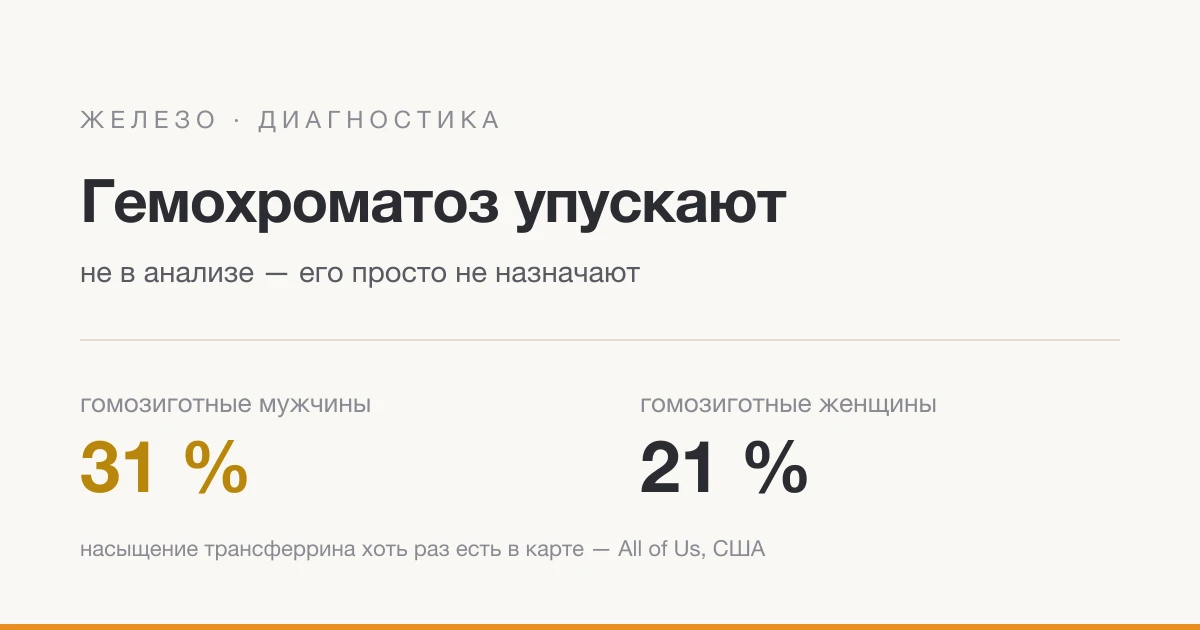
But even a confirmed genotype is not a verdict, and these are the figures worth knowing in advance. Among homozygous women, laboratory signs of overload are found in roughly one in ten, while overload-related disease develops in roughly one in a hundred. In men both figures are around a quarter.
The bottom line
Transferrin saturation is a good pointer and a poor verdict. It is the first thing to rise when iron accumulates, which is precisely why it is measured. But it is a ratio with two moving parts, and one value of it says nothing about disease — nor even that tomorrow it will read the same.
The order worth carrying away: if both saturation and ferritin are above threshold — genetics; if only saturation is high — repeat under the same conditions → see whether it holds → only then genetics.
What to do about a high ferritin, and how to tell overload from inflammation, is in the longer guide on ferritin and the liver. Why haemochromatosis is most often missed, and who should have their iron checked first, is covered separately.
This material is for information only. Interpreting laboratory results and deciding on genetic testing rest with the treating physician.
References
Key facts
- TSAT is not a measurement but a ratio: serum iron divided by total iron-binding capacity. Both parts move, so the result can change while body iron stores do not.
- EASL 2022 thresholds for suspicion: TSAT > 45% with ferritin > 200 in premenopausal women; TSAT > 50% with ferritin > 300 in men and postmenopausal women.
- The indication for genotyping is saturation and ferritin both above the thresholds for your group or, with a normal ferritin, persistently elevated, unexplained saturation. A single high saturation with a normal ferritin is not an indication.
- «Strictly fasting for 12 hours» can inflate the result: after such a fast, serum iron may be higher than usual.
- The guideline states plainly that fasting does not improve the diagnostic utility of this panel — what matters is that two draws are done under the same conditions.
- Even confirmed homozygosity is not a verdict: laboratory signs of overload appear in roughly one homozygous woman in ten, while disease develops in roughly one in a hundred.