In brief
What breaks in Fabry disease
Every cell contains a lysosome, the compartment where spent material is taken apart. One of its enzymes, alpha-galactosidase A, dismantles a fat-like substance called globotriaosylceramide.
In Fabry disease the gene for that enzyme is damaged. The substance is no longer broken down and accumulates inside cells, year after year, from birth. The cells of the renal glomeruli, heart muscle, vessel walls and nerve ganglia suffer most.
Hence the recognisable sequence: in childhood, burning pain in hands and feet, heat intolerance, absent sweating and a characteristic rash; in adulthood, protein in the urine and declining kidney function, thickened heart walls, rhythm disturbances and early strokes. The gene sits on the X chromosome, so men are affected earlier and more severely — but women are not merely carriers: many develop full disease, more often with the heart predominating.
How it was treated before the capsule
Since the early 2000s there has been one answer — enzyme replacement therapy: the missing enzyme is manufactured biotechnologically and infused intravenously every two weeks. For life.
It works, but the price is high, and not only in money:
▸an infusion of several hours every fortnight, tied to a centre or a visiting nurse; ▸infusion reactions and antibodies against the foreign protein in some patients; ▸the infused enzyme distributes unevenly and penetrates some tissues poorly; ▸adolescents and young adults drop out of the schedule — and a missed dose means accumulation resumes.
The idea: repair your own enzyme rather than deliver another
The key observation is this. With many mutations the enzyme is in fact assembled — but it comes out unstable. The cell checks every new protein for correct folding; an unstable molecule fails that check and is sent for destruction before it ever reaches the lysosome. The enzyme is not so much absent as unable to reach its workplace.
Migalastat is a small molecule resembling the terminal fragment of the very substance the enzyme should break down. It sits in the active site and acts as a strut: it holds the protein in the correct shape, the protein passes quality control and reaches the lysosome — where the acidic environment and the excess of substrate displace the strut and free the enzyme to work.
The comparison that fits: enzyme replacement therapy means bringing in a new worker to replace one who dropped out. A chaperone means giving your own worker a crutch so that he can walk to the workshop. The second is cheaper and more convenient — but it requires that a worker exist at all.
The decisive fork: amenable variant or not
A hard limit follows. If the mutation truncates the protein — a large deletion, a nonsense mutation, a frameshift — there is physically no enzyme, and nothing to stabilise. No dose will help.
Prescription is therefore preceded by a mandatory amenability assay. The variant is expressed in cultured cells, migalastat is added, and any increase in enzyme activity is measured. The study that validated this assay tested 600 disease-causing mutations: 268 proved amenable. In men the assay predicted the real-life response well — sensitivity, specificity and predictive values were all at least 0.875.
This inverts the usual order of things. Normally a physician makes the diagnosis and then selects a drug. Here the diagnosis is not enough: two people with the same Fabry disease and the same severity will get different answers depending on which letter of the gene was changed.
What the FACETS trial showed
Sixty-seven people with Fabry disease were enrolled: six months of double-blind comparison against placebo, then open-label treatment.
And here something happened that deserves to be examined on its own. The primary endpoint was not met: the response rate at six months was 41% (13 of 32) on migalastat versus 28% (9 of 32) on placebo, p=0.30.
The reason lies not in the drug but in selection. Participants were recruited using an early, imperfect amenability assay. The validated assay, applied after recruitment but before unblinding, showed that only 50 of the 67 participants carried an amenable variant. The other seventeen could not physically respond to treatment — yet their results entered the main analysis and diluted it.
Among those whose variant proved amenable, the 24-month picture looked different:
| Measure over 24 months | Migalastat, amenable patients |
|---|---|
| Annualised change in estimated GFR | −0.30 ± 0.66 mL/min/1.73 m² |
| Annualised change in measured GFR | −1.51 ± 1.33 mL/min/1.73 m² |
| Left ventricular mass index | *−7.7 g/m²* (95% CI −15.4 to −0.01) |
| Same, with baseline hypertrophy | *−18.6 g/m²* (95% CI −38.2 to 1.0) |
Note the last row. The effect looks large, but the confidence interval crosses zero — the hypertrophy subgroup was simply too small for the claim to be made with confidence. The numbers are useful; they are not the same thing as proof.
Gastrointestinal complaints — diarrhoea, reflux, indigestion — improved separately. For Fabry patients this is no small matter: persistent bowel trouble often bothers them more than their kidney numbers do.
Switching from infusions: ATTRACT
The second question was practical: can someone who has received intravenous enzyme for years be moved onto a tablet? ATTRACT enrolled 57 adults (56% women; 88% had multi-organ disease) and assigned them for 18 months either to migalastat or to continued infusions.
| Measure over 18 months | Migalastat | Enzyme replacement therapy |
|---|---|---|
| Renal function | Comparable change | Comparable change |
| Left ventricular mass index | *−6.6 g/m²* (−11.0 to −2.2) | No significant change |
| Renal, cardiac and cerebrovascular events | 29% | 44% |
| Plasma lyso-Gb3 | Remained low and stable | — |
A 12-month extension produced 30-month data in 46 patients: estimated GFR remained stable in both groups, left ventricular mass fell in those switched from infusions, and 10% experienced a new clinical event. No new safety signals emerged.
Caution is needed in how this is phrased. The difference in events — 29% versus 44% — was not the primary endpoint, and the trial itself was open-label: both physicians and patients knew who was receiving what. Such data are encouraging; they do not establish superiority.
The price of convenience
A tablet instead of an infusion looks like an unambiguous win, until daily life is taken into account.
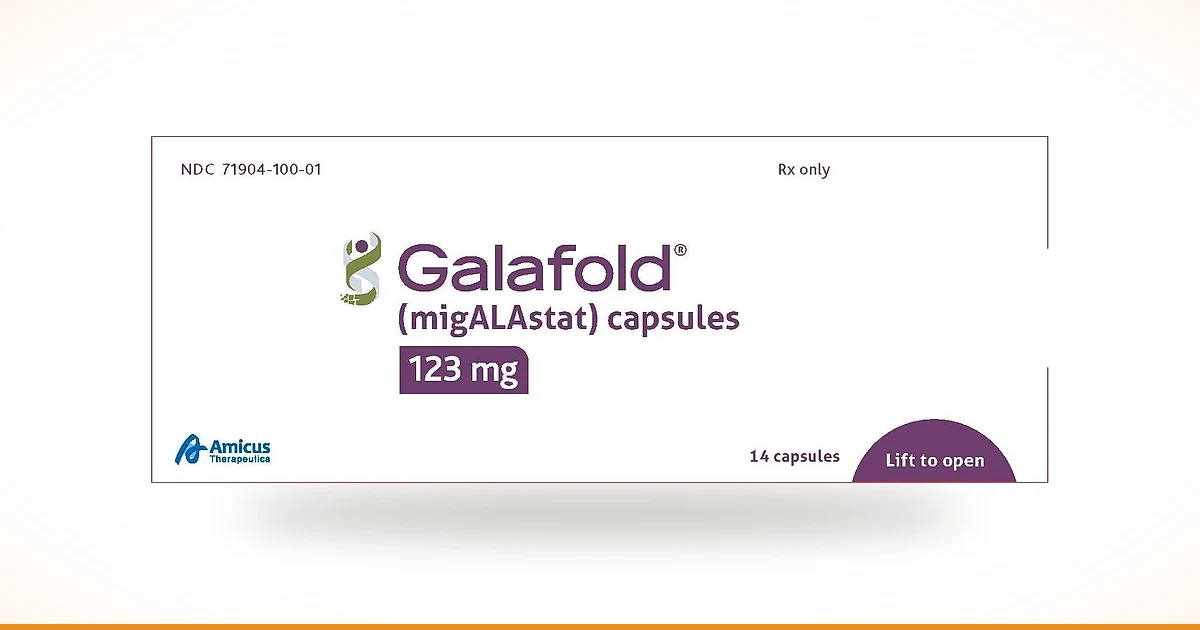
▸Strictly every other day — not daily; a missed or doubled dose breaks the schedule, which is why the manufacturer prints a calendar on the carton with punch-out circles for the off days; ▸strictly on an empty stomach: two hours without food before and two hours after, a four-hour fasting window on each dosing day; ▸a mandatory genetic assay before starting — and a fresh conversation if the variant turns out not to be amenable; ▸monitoring does not stop: kidneys, heart and biomarkers are followed exactly as they were on infusions.
Who it is not for
▸A non-amenable variant — the drug will not work; this is not a matter of dose or duration. ▸Estimated GFR below 30 mL/min/1.73 m² and dialysis — migalastat is cleared by the kidneys, exposure rises substantially in severe impairment, and this group was never studied. ▸Children and adolescents — safety and efficacy have not been established below the age of 18. ▸Pregnancy and breastfeeding — data from three pregnancies in the trials are insufficient to judge risk. ▸Combination with enzyme replacement therapy — the drug replaces it, it is not added to it.
What cannot be claimed yet
The most important caveat sits in the very first line of the label. Approval was granted through the accelerated pathway, on the basis of reduced inclusions of the substance in kidney interstitial capillary cells — that is, on a surrogate measure, not on whether patients reach dialysis, myocardial infarction and stroke less often. The wording is explicit: continued approval may be contingent on verification of clinical benefit in confirmatory trials.
The honest boundaries follow:
▸clinical outcomes — death, dialysis, transplantation, stroke — have never been the primary endpoint of any migalastat trial; ▸the comparison with enzyme replacement therapy used surrogate measures in an open-label design; the 'no worse' conclusion was reached without blinding; ▸the observation horizon is 30 months, while Fabry disease unfolds over decades; ▸subgroups are small: women, the elderly, patients with marked hypertrophy — estimates in these groups are unstable; ▸tolerability is good, but the absence of contraindications in the label also reflects a modest body of experience: only 139 people received the drug across the trials.
Bottom line
▸The first oral treatment for Fabry disease — a 123 mg capsule every other day instead of an intravenous infusion every fortnight. ▸A different mechanism: not replacing the enzyme but stabilising the patient's own so that it reaches the lysosome. ▸Not for everyone: an amenable variant is required; of 600 mutations tested, 268 qualified. ▸The FACETS primary endpoint was not met — because non-amenable patients entered the analysis; among amenable patients kidney function stayed stable and cardiac mass declined. ▸Switching from infusions is feasible: in ATTRACT renal function changed comparably and cardiac mass fell by 6.6 g/m². ▸Approved through the accelerated pathway on a surrogate measure; an effect on dialysis, infarction and stroke has not been demonstrated.
Your own case — which variant you carry, what the biopsy shows and whether switching makes sense — can be reviewed at a consultation; the drug can be ordered here.
References
1. Germain DP, et al. Treatment of Fabry's Disease with the Pharmacologic Chaperone Migalastat. N Engl J Med. 2016;375(6):545–555. PMID 27509102
2. Hughes DA, et al. Oral pharmacological chaperone migalastat compared with enzyme replacement therapy in Fabry disease: 18-month results from the randomised phase III ATTRACT study. J Med Genet. 2017;54(4):288–296. PMID 27834756
3. Benjamin ER, et al. The validation of pharmacogenetics for the identification of Fabry patients to be treated with migalastat. Genet Med. 2017;19(4):430–438. PMID 27657681
4. Feldt-Rasmussen U, et al. Long-term efficacy and safety of migalastat treatment in Fabry disease: 30-month results from the open-label extension of the randomized, phase 3 ATTRACT study. Mol Genet Metab. 2020;131(1-2):219–228. PMID 33012654
5. GALAFOLD (migalastat) — US Prescribing Information, Amicus Therapeutics US, LLC.
Key facts
- Migalastat (brand name Galafold, Amicus Therapeutics) is the first oral treatment for Fabry disease, approved by the FDA in August 2018 for adults with a confirmed diagnosis and an amenable GLA variant.
- Fabry disease is an X-linked inherited disorder: a faulty gene leaves the cell short of the enzyme alpha-galactosidase A, and globotriaosylceramide accumulates in the kidneys, heart, blood vessels and nerve ganglia.
- Before the capsule the only option was enzyme replacement therapy — an intravenous infusion of a manufactured enzyme every two weeks, for life.
- Migalastat is a pharmacological chaperone: it binds the patient's own defective enzyme and holds it in the correct shape so that it survives quality control and reaches the lysosome.
- The drug is powerless when the mutation stops the protein being made at all. Amenability is decided by a cell-based assay: of 600 disease-causing mutations tested, 268 proved amenable.
- In FACETS the primary endpoint was not met — 41% responders versus 28% on placebo (p=0.30) — because patients with non-amenable variants had been enrolled and entered the analysis.
- Among patients with amenable variants, left ventricular mass index fell by 7.7 g/m² over 24 months, and by 18.6 g/m² in those with baseline hypertrophy.
- In ATTRACT, 57 adults were switched from infusions to capsules: renal function changed comparably, left ventricular mass index fell by 6.6 g/m², while it did not change significantly on enzyme replacement therapy.
- The 123 mg capsule is taken every other day on an empty stomach: at least two hours without food before and two hours after — a four-hour fast on each dosing day.
- Approval was granted through the accelerated pathway on the basis of substrate reduction in kidney tissue rather than clinical outcomes; confirmation of clinical benefit is expected from later trials.