In brief
What breaks
Haem is not only part of haemoglobin. It sits inside a great many enzymes, and the liver produces it constantly. Haem is assembled in a chain of eight steps, each with its own enzyme.
In acute hepatic porphyria one of those steps works poorly. One might think the trouble lies in the shortage of finished haem — but the real trouble lies elsewhere.
Finished haem, by a feedback loop, restrains the first enzyme of the chain, ALAS1: enough, no more needed. When haem falls short the restraint loosens and the first enzyme speeds up. The chain runs faster but hits the fault — and unfinished intermediates pile up in front of it.
Two of them are toxic to the nervous system: aminolevulinic acid and porphobilinogen. It is they, not the shortage of haem, that produce the clinical picture.
The result is a vicious circle, and it explains why attacks are triggered by anything that makes the liver produce more haem: certain drugs, alcohol, fasting, infection, the hormonal swings of the cycle.
What an attack looks like
▸Severe abdominal pain — the leading and commonest feature; investigation finds no surgical cause, and such patients are not rarely operated on 'just in case'; ▸nausea, vomiting and constipation; ▸rapid pulse and raised blood pressure; ▸weakness in the arms and legs — sometimes to the point of paralysis, as the peripheral nerves suffer; ▸seizures, anxiety, confusion in severe cases; ▸darkening urine on standing in the light.
An attack lasts days and often requires admission. Before the diagnosis is made such patients spend years being treated for everything from gastritis to somatoform disorder.
The means of breaking an attack is known — intravenous hemin: finished haem restores the feedback loop and quietens the accelerated first enzyme. But that is firefighting. Between attacks all that remained were prohibitions: avoid the triggers, do not fast, watch every prescription.
The idea: keep the first enzyme quietened all the time
If the problem is that the first enzyme has accelerated, it can be held quietened continuously rather than only during an attack.
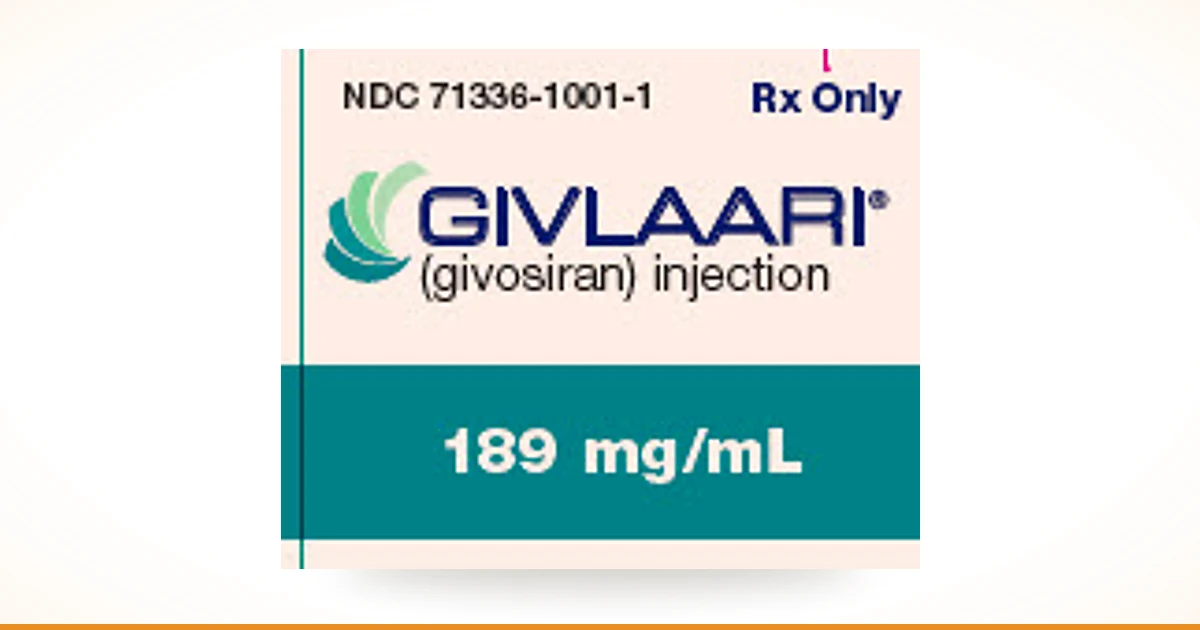
Givosiran is a small interfering RNA. It finds the working copy of the ALAS1 gene in liver cells and marks it for destruction. Less enzyme is made, the chain runs more slowly, and the toxic intermediates have no time to accumulate.
Note the design: the drug makes no attempt to repair the broken step of the chain. It closes the tap above the fault. Exactly the same move is used in primary hyperoxaluria, where lumasiran silences the intact enzyme sitting above the defective one. One device, two different diseases.
What the ENVISION trial showed
A double-blind, placebo-controlled phase 3 trial: 94 patients with symptomatic acute hepatic porphyria, 48 on givosiran and 46 on placebo, monthly injections over six months.
The primary endpoint was the annualised rate of composite attacks in patients with acute intermittent porphyria, the commonest form of the disease. A composite attack was one that led to hospitalisation, an urgent healthcare visit or intravenous hemin at home — that is, only events that genuinely changed a life were counted, not every episode of feeling unwell.
| ENVISION, 6 months | Givosiran | Placebo |
|---|---|---|
| Annualised attack rate | *3.2* | 12.5 |
| Reduction | *74%* (p<0.001) | — |
| Urinary aminolevulinic acid and porphobilinogen | Fell | — |
| Days of hemin use | Fewer | — |
| Daily worst-pain scores | Better | — |
Adverse events seen more often on the drug: elevated liver enzymes, changes in creatinine and estimated filtration rate, and injection-site reactions.
Three years of follow-up
The trial continued open-label with the placebo group switched to the drug; 93 patients took part in the extension.
| At month 36 | Continuous givosiran | Crossed over from placebo |
|---|---|---|
| Patients with no attacks at all | *86%* | *92%* |
| Annualised days of hemin use | Median 0.0–0.4 | Fell from *16.2 to 0.4* |
| Physical component of quality of life (SF-12) | +8.6 | +9.4 |
| Mental component (SF-12) | +8.1 | +3.2 |
| Overall health rating (EQ-5D) | +18.9 | +9.9 |
The median annualised attack rate on treatment was 0.4 — fewer than one attack a year instead of a dozen.
The line on hemin says more about clinical value than the percentages do: in those switched from placebo, the number of days a year requiring emergency hemin fell from sixteen to almost none.
What it costs
The list of precautions here is noticeably longer than for related drugs, and every item calls for action.
▸Anaphylaxis. It occurred in fewer than one per cent, which is precisely why the drug is given by a healthcare professional with emergency support at hand. Severe hypersensitivity to the drug is the only formal contraindication. ▸Hepatic toxicity. Liver tests are checked at baseline and periodically; for severe or clinically significant elevations treatment is interrupted, and on resumption the dose drops to 1.25 mg/kg with a possible return to full dosing. ▸Kidneys. Changes in creatinine and estimated filtration rate have been described — renal function is followed. ▸Injection-site reactions, including recall reactions, where a reaction flares at the site of a previous injection. ▸Raised homocysteine. It is measured before starting and followed over time; if it rises, vitamin B6 is considered. ▸Pancreatitis. Severe upper abdominal pain must be actively investigated rather than written off as another porphyria attack — an error especially easy to make here, since abdominal pain is the disease's leading symptom.
Who it is not for
▸Children and adolescents — the indication is limited to adults. ▸Severe hypersensitivity to givosiran — the formal contraindication. ▸As a means of breaking an attack — an attack in progress is treated with hemin; this drug works by prevention. ▸As a substitute for caution — avoiding triggering drugs, not fasting and watching the cycle all remain necessary.
What cannot be claimed yet
▸Long-term complications were not studied. This disease carries rising risks of kidney damage and liver cancer over time; whether lowering the intermediates affects them has not been shown. ▸Chronic symptoms between attacks improved, but the primary endpoint was attack frequency; how far background pain and neuropathy resolve remains open. ▸The significance of rising homocysteine is unclear. The level rises predictably, but what that means over many years is unknown. ▸Follow-up is three years, while treatment is intended for life. ▸The group is small: 94 participants in the main trial, 93 in the extension.
Bottom line
▸The first drug for preventing attacks rather than breaking them. ▸It silences the first enzyme of the chain, ALAS1 — closing the tap above the fault instead of repairing the broken step. ▸74% fewer attacks over six months of double-blind comparison: 3.2 versus 12.5 a year. ▸Over three years 86–92% of patients had no attacks at all, and days of emergency hemin fell from 16.2 to 0.4 a year. ▸It requires monitoring: liver, kidneys, homocysteine, and vigilance for pancreatitis. ▸Caution with triggers remains — the drug lowers the risk but does not repeal the rules of living with porphyria.
Your own case — whether the diagnosis is confirmed by urinary porphobilinogen and genetically, and whether prophylaxis is indicated — can be reviewed at a consultation; the drug can be ordered here.
References
1. Balwani M, et al. Phase 3 Trial of RNAi Therapeutic Givosiran for Acute Intermittent Porphyria. N Engl J Med. 2020;382(24):2289–2301. PMID 32521132
2. Kuter DJ, et al. Efficacy and safety of givosiran for acute hepatic porphyria: Final results of the randomized phase III ENVISION trial. J Hepatol. 2023;79(5):1150–1158. PMID 37479139
3. Ventura P, et al. Efficacy and safety of givosiran for acute hepatic porphyria: 24-month interim analysis of the randomized phase 3 ENVISION study. Liver Int. 2022;42(1):161–172. PMID 34717041
4. GIVLAARI (givosiran) — US Prescribing Information, Alnylam Pharmaceuticals, Inc.
Key facts
- Givosiran (brand name Givlaari, Alnylam Pharmaceuticals) was approved by the FDA in November 2019 for the treatment of adults with acute hepatic porphyria.
- Acute hepatic porphyria is a group of inherited disorders in which haem assembly in the liver runs into a fault, so unfinished intermediates accumulate instead of finished haem.
- Two of those intermediates — aminolevulinic acid and porphobilinogen — are toxic to the nervous system, and they are what the attacks and chronic symptoms are tied to.
- An attack presents as severe abdominal pain without a surgical cause, joined by vomiting, rapid pulse, raised blood pressure, limb weakness, seizures, confusion and dark urine.
- Givosiran is a small interfering RNA: it silences the ALAS1 gene in liver cells — the very first enzyme of the chain — and production of the intermediates falls.
- In the ENVISION trial, patients with acute intermittent porphyria had an annualised attack rate of 3.2 versus 12.5 on placebo — 74% lower (p<0.001).
- Urinary aminolevulinic acid and porphobilinogen fell too, as did days of hemin use and daily worst-pain scores.
- By the end of three years of follow-up, 86% of patients on continuous givosiran and 92% of those crossed over from placebo had no attacks at all, and annualised days of hemin use fell from 16.2 to 0.4.
- The drug is given by a healthcare professional as a subcutaneous injection of 2.5 mg/kg once monthly; the dose is reduced to 1.25 mg/kg after significant transaminase elevations.
- There is no boxed warning, but the label carries six precautions: anaphylaxis, hepatic toxicity, changes in renal function, injection-site reactions, raised homocysteine and pancreatitis.