In brief
What breaks
Liver cells carry an enzyme that should convert a substance called glyoxylate into the harmless amino acid glycine. In primary hyperoxaluria type 1 the gene for that enzyme, AGXT, is damaged.
Glyoxylate does not simply disappear; it takes the alternative route and is oxidised into oxalate.
And here is the heart of the trouble. Oxalate is a metabolic dead end. The body can neither break it down nor build it into anything. The only way out is through the kidneys. And in urine oxalate meets calcium and precipitates as crystals.
Hence the recognisable sequence:
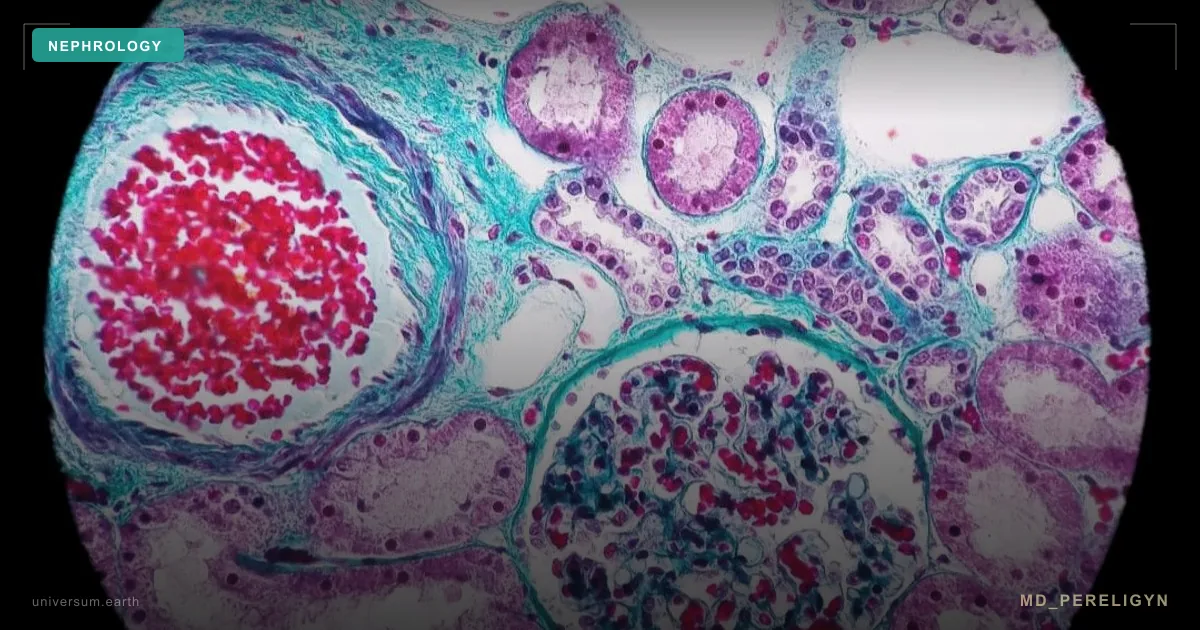
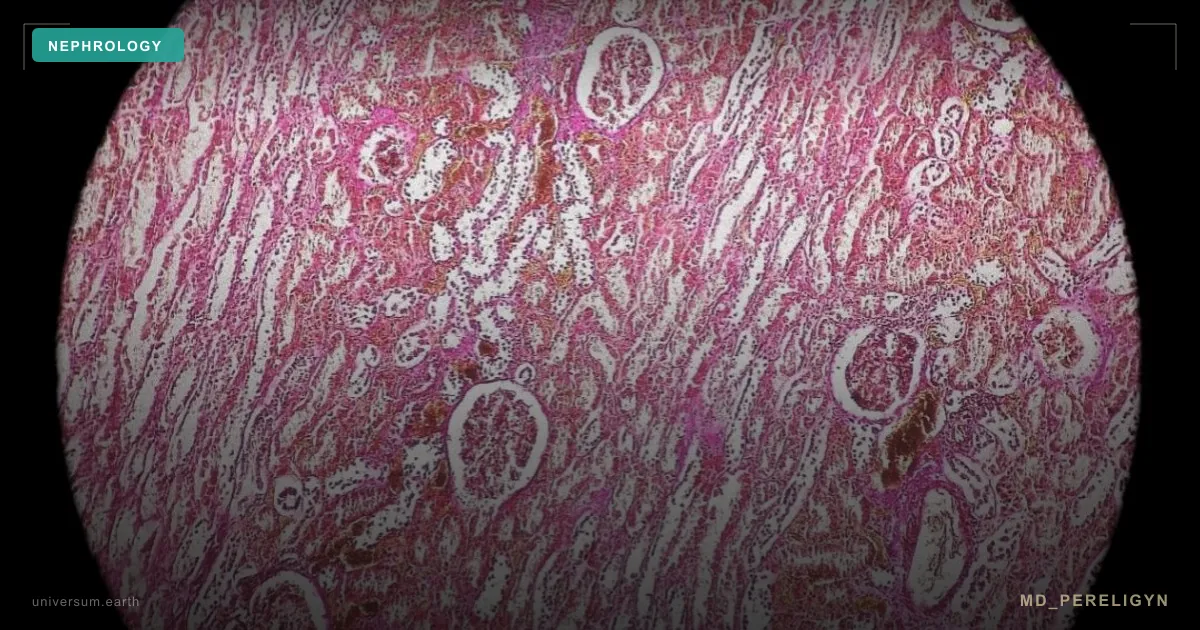
▸kidney stones — often from the first years of life, recurring; ▸nephrocalcinosis — calcium deposits within the kidney tissue itself; ▸progressive kidney failure — the kidney whose job is to excrete oxalate is destroyed by it; ▸systemic oxalosis — once the kidneys fail there is no route out, and oxalate deposits throughout the body: in bone, heart, vessels, eyes.
Historically, severe disease was managed by a combined liver and kidney transplant. A kidney alone will not do: the liver would keep producing oxalate and destroy the transplanted organ. The liver is replaced not because it is diseased but because it is the source.
The idea: close the tap above the fault
The usual logic in an inherited disease is to restore what is broken — deliver the missing enzyme or stabilise the defective one. Here that is impossible: the gene is damaged and the protein is either absent or non-functional.
Lumasiran approaches from an unexpected angle. Consider the whole pathway:
▸the enzyme glycolate oxidase produces glyoxylate — it is intact; ▸the AGT enzyme should convert glyoxylate into glycine — it is broken; ▸bypassing the fault, glyoxylate is oxidised into oxalate — and the disease begins.
If the second link cannot be repaired, the first can be quietened. Lumasiran is a small interfering RNA: it finds the working copy of the HAO1 gene in liver cells and marks it for destruction, so less glycolate oxidase is made. Less enzyme, less glyoxylate. Less glyoxylate, less raw material for oxalate.
The comparison that fits: if the processing shop is broken and turning out poisonous scrap, you need not repair the shop — you can close a valve on the supply line a floor above.
Two practical consequences follow from this design, and both are written into the label.
First: the drug is indifferent to the specific mutation. It acts above the fault, so which letter of the AGXT gene was changed does not matter. That sets it apart from approaches requiring a match to the variant.
Second: in the other types of the disease it is useless. In hyperoxaluria types 2 and 3 the faults lie elsewhere in metabolism, and quietening glycolate oxidase does not reach them.
The same class of drug — small interfering RNA — has already been examined on this site through vutrisiran, but the principle there is different: it silences production of the harmful protein itself. Here an intact enzyme above the fault is silenced instead. The distinction is subtle and it matters.
What the ILLUMINATE-A trial showed
A double-blind phase 3 trial: 39 patients aged 6 and over, randomised two to one, over six months. The primary endpoint was 24-hour urinary oxalate excretion — the very thing that destroys the kidneys.
| Measure at month 6 | Result |
|---|---|
| Fall in urinary oxalate | *65.4%* in the lumasiran group |
| Difference from placebo | *−53.5 percentage points* (p<0.001) |
| Difference in plasma oxalate | *−39.5 percentage points* (p<0.001) |
| Excretion no higher than 1.5× upper limit of normal | *84% versus 0%* on placebo (p<0.001) |
| Injection-site reactions | Mild, transient, in 38% |
The speed deserves note: the reduction was apparent within a month of the first injection. Every secondary endpoint tested in the pre-specified hierarchy was significant.
Five years of follow-up
The trial continued to 60 months, with those originally on placebo switched to the drug.
| Over 60 months | Result |
|---|---|
| Fall in urinary oxalate | *54%* in both groups |
| Fall in plasma oxalate | 35% and 38% |
| Estimated GFR | Remained *stable* |
| Stone event rate | 0.47 and 0.54 per patient-year |
| Grade of nephrocalcinosis | Improved in *21 of 28* (75%) |
The last line carries the most meaning. Nephrocalcinosis is usually regarded as irreversible damage; improvement in three quarters of patients means that some of the deposits go away once the inflow of oxalate is cut off.
The safety profile over five years was unchanged: injection-site reactions most commonly, with most adverse events mild or moderate.
What it looks like in practice
▸Subcutaneous injection on a loading-then-maintenance schedule: three doses one month apart, then maintenance starting a month after the last. ▸Weight-based dosing: from 20 kg, 3 mg/kg three times, then 3 mg/kg every three months; at 10–20 kg, 6 mg/kg three times, then 6 mg/kg every three months; below 10 kg the maintenance dose is monthly. ▸Once every three months for most patients — four visits a year. ▸On haemodialysis the drug is given after the session. ▸Fluid intake and nephrology follow-up still stand — the drug reduces oxalate production but does not dissolve stones that are already there.
Who it is not for
▸Hyperoxaluria types 2 and 3 — the mechanism does not touch the pathways that cause them. ▸Secondary hyperoxaluria (after bowel surgery, or from dietary excess) — a different disease with a different cause. ▸There are no formal contraindications in the label — that section is empty, and there is no separate warnings section either.
What cannot be claimed yet
▸The effect on the need for transplantation was never studied. Kidney function remained stable over five years, but no trial has compared transplant rates. ▸The primary endpoint was a laboratory measure — oxalate excretion, not stone counts, not dialysis, not survival. The link between oxalate levels and kidney damage is strong, but it remains an inference. ▸Few patients have been studied: 39 in the main trial. For an ultra-rare disease that is a great many; for confident safety conclusions it is few. ▸The most severe were excluded: an estimated GFR of at least 30 mL/min/1.73 m² was required, so patients at late stages did not enter the main trial. ▸Cost and lifelong use — the drug does not cure but holds; stopping it restores oxalate production.
Bottom line
▸The first treatment for a disease whose previous answer was a combined liver and kidney transplant. ▸It strikes above the fault: quietening the intact enzyme that supplies the raw material rather than trying to repair the broken one. ▸Independent of the specific AGXT mutation — and useless in types 2 and 3 for the same reason. ▸Urinary oxalate falls by 65%, and in 84% of patients comes close to normal within six months. ▸Over five years the effect holds, filtration stays stable, and nephrocalcinosis improved in three quarters. ▸Tolerability is exceptionally clean — injection-site reactions only, no contraindications, no boxed warning.
Your own case — whether the type has been genetically confirmed and what urinary oxalate and renal ultrasound show — can be reviewed at a consultation; the drug can be ordered here.
References
1. Garrelfs SF, et al. Lumasiran, an RNAi Therapeutic for Primary Hyperoxaluria Type 1. N Engl J Med. 2021;384(13):1216–1226. PMID 33789010
2. Frishberg Y, et al. Final Results of the ILLUMINATE-A Phase 3 Clinical Trial of Lumasiran for Primary Hyperoxaluria Type 1. Clin J Am Soc Nephrol. 2026;21(3):377–388. PMID 41343248
3. Hulton SA, et al. Randomized Clinical Trial on the Long-Term Efficacy and Safety of Lumasiran in Patients With Primary Hyperoxaluria Type 1. Kidney Int Rep. 2022;7(3):494–506. PMID 35257062
4. OXLUMO (lumasiran) — US Prescribing Information, Alnylam Pharmaceuticals, Inc.
Key facts
- Lumasiran (brand name Oxlumo, Alnylam Pharmaceuticals) was approved by the FDA in November 2020 — the first treatment for primary hyperoxaluria type 1, for children and adults with no lower age limit.
- The disease is caused by a fault in the AGXT gene: the liver enzyme that should convert glyoxylate into harmless glycine does not work, and oxalate is produced instead.
- Oxalate can be neither broken down nor reused — the body excretes it only through the kidneys, where it combines with calcium and precipitates as crystals.
- Hence the picture: kidney stones from early childhood, calcium deposits within the kidney tissue itself, progressive kidney failure, and once the kidneys fail, oxalate deposits in bone, heart, vessels and eyes.
- Lumasiran leaves the broken enzyme alone: it quietens the enzyme a floor above — glycolate oxidase, which produces glyoxylate, the raw material for oxalate.
- That is why the drug works regardless of which AGXT mutation the patient carries — and, for the same reason, why it is useless in hyperoxaluria types 2 and 3.
- In ILLUMINATE-A, in 39 patients aged 6 and over, 24-hour urinary oxalate excretion fell by 65.4%, a difference from placebo of 53.5 percentage points (p<0.001), with an effect visible within a month.
- By month six, 84% of treated patients had oxalate excretion no higher than 1.5 times the upper limit of normal — against 0% on placebo.
- Over five years of follow-up the reduction in urinary oxalate was sustained at 54%, estimated GFR remained stable, and the grade of nephrocalcinosis improved in 21 of 28 patients (75%).
- The only common adverse reaction is an injection-site reaction; the label carries no boxed warning, no contraindications and no warnings-and-precautions section at all.