Medicinal Mushrooms: Reishi, Lion's Mane, Cordyceps — What Science Says
md_pereligyn — Перелыгин Владимир ИгоревичFebruary 11, 202612 min
Why Mushrooms Are More Than a Superfood Trend
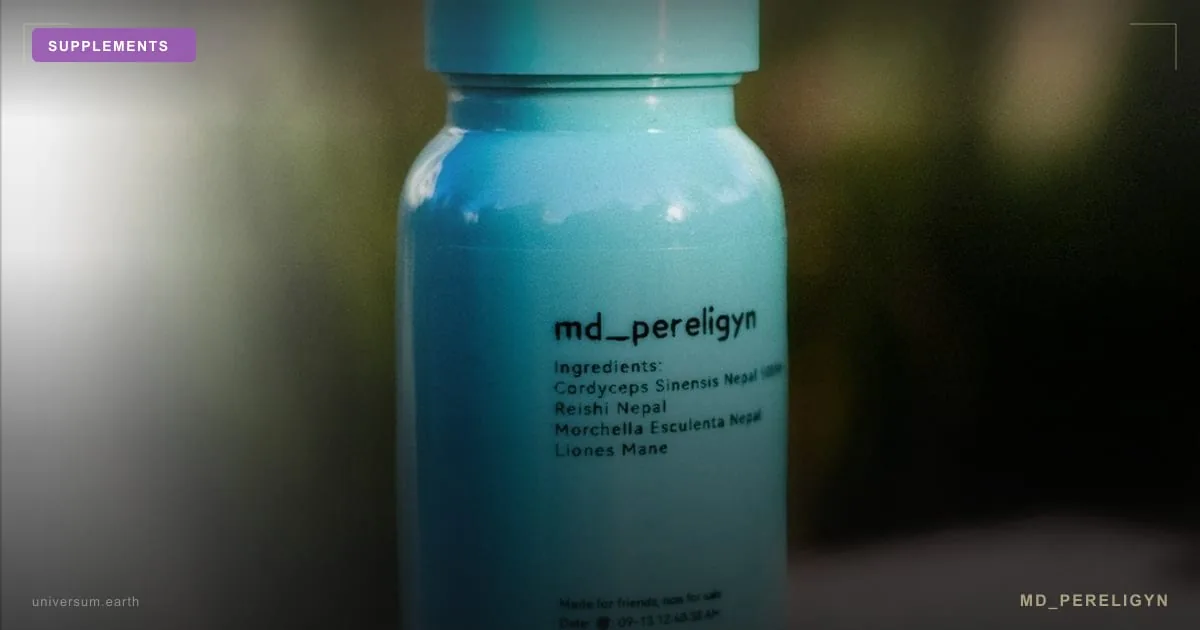
The fungal kingdom (Fungi) is a distinct branch of life, evolutionarily closer to animals than to plants. Medicinal mushrooms have been used in Traditional Chinese Medicine (TCM) and Ayurveda for millennia, but only in recent decades has modern science systematically investigated their bioactive compounds. A review in the International Journal of Molecular Sciences (2019) identified over 130 medicinal functions attributed to various mushroom species, including immunomodulation, antitumor activity, neuroprotection, and antioxidant effects.
Key bioactive groups include: beta-glucans (cell wall polysaccharides), triterpenoids (ganoderic acids in Reishi), phenolic compounds, ergosterol, and species-specific neuroactive substances.
Beta-Glucans: The Molecular Foundation of Immunomodulation
Beta-glucans are polysaccharides with beta-(1-3) and beta-(1-6) glycosidic bonds — the primary pharmacologically active component of mushroom cell walls. Crucially, they are not direct immune stimulants but modulators: they enhance weakened immune responses and dampen excessive ones.
Mechanism of action: beta-glucans bind to the Dectin-1 receptor on macrophages and dendritic cells, activating innate immunity via the Syk/CARD9/NF-kB signaling cascade. Simultaneously, they stimulate IL-10 production (an anti-inflammatory cytokine), preventing excessive inflammatory reactions. Research published in Nature Reviews Immunology (2011) described beta-glucans as "training agents" for innate immunity — a concept known as trained immunity.
Reishi (Ganoderma lucidum): The Mushroom of Immortality
Reishi is one of the most extensively studied medicinal mushrooms. Known as "Ling Zhi" in Traditional Chinese Medicine, its major bioactive compounds include polysaccharides (beta-glucans), triterpenoids (over 150 ganoderic acids), and peptidoglycans.
Lion's Mane (Hericium erinaceus): Neurogenesis in a Capsule
Hericium erinaceus is unique among medicinal mushrooms because it contains compounds with demonstrated neurotrophic activity: hericenones and erinacines. These substances stimulate the synthesis of nerve growth factor (NGF) — a key neurotrophin essential for the growth, survival, and regeneration of neurons.
Cordyceps (Cordyceps militaris): Energy and Endurance
Cordyceps militaris is a cultivated species containing cordycepin (3'-deoxyadenosine) — a nucleoside analog with antiviral, antitumor, and immunomodulatory properties. Unlike wild Cordyceps sinensis, C. militaris can be standardized and produced at industrial scale.
Hot Water vs Dual Extraction: A Critical Distinction
Beta-glucans and polysaccharides are water-soluble but NOT alcohol-soluble. Triterpenoids (ganoderic acids in Reishi) and specific terpenes are extracted through alcohol. Therefore, complete extraction of bioactive compounds requires dual extraction: hot water plus ethanol.
Products made from mycelium on grain substrate (MOG) contain significantly fewer beta-glucans and more starch. Research published in Nature (Scientific Reports, 2017) showed that beta-glucan content in fruiting body products is 15-20 times higher than in mycelium-on-grain products.
Frequently Asked Questions
Can I take all three mushrooms simultaneously?
Yes, they have synergistic effects. Reishi for immune modulation and liver protection, Lion's Mane for cognitive function, Cordyceps for energy. The combination addresses different body systems.
Are medicinal mushrooms safe with autoimmune conditions?
Use with caution. Beta-glucans are immunomodulators, but during active autoimmune flares (SLE, active RA), consult an immunologist first. During remission, they are generally considered safe.
How long until I notice effects?
Reishi immunomodulatory effects: 4-8 weeks. Lion's Mane cognitive effects: 8-16 weeks. Cordyceps energy effects: 2-3 weeks. Minimum recommended course: 3 months.
Are there drug interactions?
Reishi may potentiate anticoagulants (warfarin) and antihypertensive medications. Cordyceps may enhance the hypoglycemic effect of metformin. If taking any medications, physician consultation is mandatory.
Which mushroom should I start with?
For general immune support: Reishi. For cognitive function, memory, and neuroprotection: Lion's Mane. For energy and physical performance: Cordyceps.
Mushroom
Primary effect
Reishi
immune modulation, liver
Lion's Mane
cognitive function
Cordyceps
energy, endurance
This article is for educational purposes only and does not constitute medical advice. Always consult a qualified healthcare professional before starting any treatment protocol.
🌀
Safety Profile, Adverse Events, and Contraindications
Although Reishi, Lion's Mane, and Cordyceps are generally well tolerated, the literature describes specific adverse-event signals and absolute contraindications that warrant systematic discussion.
🌀
Use in Pregnancy, Lactation, Pediatric Patients, and the Perioperative Period
These populations are routinely excluded from medicinal mushroom trials, and the resulting evidence vacuum should be acknowledged explicitly rather than extrapolated from healthy-adult data.
🌀
Lion's Mane in Depression, Anxiety, and Sleep
The current article frames Lion's Mane as a cognitive intervention, but its mood-modulating effects are independently supported and clinically relevant for patients presenting with overlapping cognitive-affective symptoms.
A 2010 randomised, double-blind, placebo-controlled trial enrolled 30 menopausal women with self-reported indefinite complaints including depression and anxiety. Participants consumed cookies containing Hericium erinaceus (0.5 g powdered fruiting body per cookie, four cookies daily) for four weeks. The intervention group showed significantly reduced Center for Epidemiologic Studies Depression scale scores and Indefinite Complaints Index irritation and anxiety subscale scores compared with placebo.
🌀
Quality Control, Heavy Metals, and Laboratory Monitoring on Long-Term Use
Fruiting-body sourcing, dual extraction, and beta-glucan content alone do not guarantee a safe product. Three additional quality and monitoring dimensions deserve explicit attention.
Patient laboratory monitoring on long-term courses (≥6 months). A pragmatic monitoring schedule for adults on combined or single-mushroom supplementation includes: baseline and 6-month complete blood count, comprehensive metabolic panel (including ALT, AST, alkaline phosphatase, bilirubin, creatinine), coagulation screen if on anticoagulants (PT/INR for warfarin, anti-Xa for DOAC where available), and fasting glucose plus HbA1c in diabetic patients. Annual reassessment of indication is warranted; benefits in cognition and energy are not indefinite, and continued supplementation should be re-justified rather than defaulted to. Discontinuation should be considered if no measurable benefit is documented after a 4-month course at adequate dose.
Beta-glucans bind the Dectin-1 receptor on macrophages, activating innate immunity via the Syk/CARD9/NF-kB cascade.
Reishi: a Cochrane meta-analysis (2016) of 5 RCTs (373 patients) showed increased CD3+, CD4+, CD8+ lymphocytes and NK activity.
Lion's Mane contains hericenones and erinacines that stimulate nerve growth factor (NGF) synthesis.
Cordyceps 3000 mg for 3 weeks raised VO2max by 7% in healthy volunteers (Journal of Dietary Supplements, 2017).
Fruiting-body products hold 15–20x more beta-glucans than mycelium-on-grain; dual extraction is needed.
Frequently asked questions
Beta-glucans and polysaccharides are water-soluble but insoluble in alcohol, whereas triterpenoids (reishi's ganoderic acids) and specific terpenes are extracted only by alcohol. Therefore, complete recovery of bioactive compounds requires dual extraction: hot-water plus alcohol. Hot-water extraction alone does not capture the triterpenoid fraction.
Mycelium-on-grain (MOG) products contain substantially fewer beta-glucans and more starch. A study published in Scientific Reports (Nature portfolio, 2017) found that beta-glucan content in fruiting-body products is 15–20 times higher than in mycelium-on-grain products. When selecting a product, fruiting body is the preferred source material over mycelium on grain.
Timelines depend on the species and the intended outcome. The immunomodulatory effect of reishi becomes apparent after 4–8 weeks, cognitive effects of Lion's Mane after 8–16 weeks, and the energising effect of cordyceps after 2–3 weeks. The minimum recommended course of supplementation is 3 months.
Beta-glucans are polysaccharides of the fungal cell wall and the principal pharmacologically active constituents. They are not direct immune stimulants; they are modulators — they enhance a weakened immune response and attenuate an excessive one. The mechanism involves binding to the Dectin-1 receptor on macrophages and dendritic cells, activating innate immunity via the Syk/CARD9/NF-κB cascade while simultaneously stimulating the anti-inflammatory cytokine IL-10.
Endocrinologist · Holistic & reproductive medicine · 15+ years
Practice at the intersection of Western endocrinology and holistic medicine. System-based approach: endocrine (T2D, hypothyroidism, PCOS, adrenal), metabolic, reproductive, nervous, immune. Epigenetic personalization (MTHFR, COMT, VDR). Author of the md_pereligyn protocol for type 2 diabetes remission. Co-founder of Genesis Clinic, ESHRE member.
This article is for informational purposes only and is not a substitute for professional medical advice, diagnosis, or treatment. Always consult your physician before making health decisions. Full disclaimer
Ready to Take Action?
A consultation starts where the article ends: your history, your labs, a plan for your case.