In brief: what this drug is and who needs it
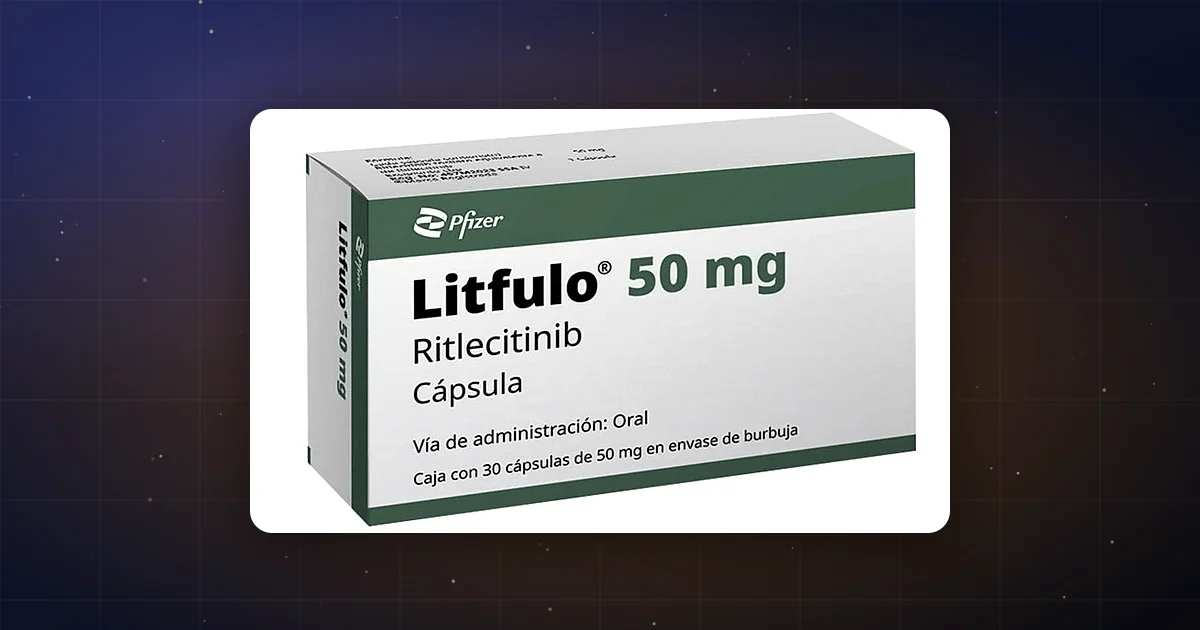
Ritlecitinib (brand name Litfulo, Pfizer) is a tablet for autoimmune hair loss. Not for stress-related shedding, not for age-related thinning, not for postpartum loss — for one specific disease: alopecia areata, in which the immune system attacks its own hair follicles. The FDA approved it on 23 June 2023 and the European Commission followed in September of the same year; in both regions the licence covers adults and adolescents from 12 years of age with severe disease [1], [2].
One dose fits everyone: 50 mg once daily. That detail matters — there is nothing to titrate, but there is mandatory laboratory monitoring, covered below.
This article is a working guide rather than a news summary. In order: what happens to the follicle in alopecia areata, how to make the diagnosis at the bedside without confusing it with four look-alikes, which tests are worth doing once, who can be safely observed, who cannot afford to wait, how ritlecitinib works at the kinase level, what monitoring is obligatory, what the trials showed in numbers, how the four approved drugs differ, when to judge the response and what happens after withdrawal.
What happens in alopecia areata
An anagen hair follicle is one of the few sites in the body with immune privilege: it barely displays its antigens to the immune system (low MHC class I expression) and locally suppresses immune activity. This makes evolutionary sense — a growing hair produces a large amount of new protein, and without such protection the immune system would react to every growth cycle.
In alopecia areata that protection collapses. The follicle starts presenting antigens, cytotoxic CD8+ T cells carrying the NKG2D receptor move in, and an infiltrate forms around the bulb — the "swarm of bees" described in older textbooks. Two cytokines drive it: interferon-gamma (IFN-γ) and interleukin-15 (IL-15), forming a self-sustaining loop — the attacked follicle releases IL-15, IL-15 activates T cells, and the T cells release more IFN-γ [9].
This is where the drugs act. Both cytokines signal through the Janus kinase family: IFN-γ through JAK1/JAK2, IL-15 through JAK1/JAK3. In 2014 a Nature Medicine paper showed that blocking JAK does not merely stop the attack but reverses it: mice with established disease regrew hair, and so did the first patients treated [9]. Every modern therapy for alopecia areata descends from that work.
The practical consequence for the patient: the follicle does not die. It enters something close to enforced dormancy — it miniaturises and stops producing hair, but its structure survives. That is why the skin in the patch stays smooth and scar-free, and why hair can return after years. This is the fundamental difference from scarring alopecias (lichen planopilaris, frontal fibrosing alopecia), where the follicle is replaced by fibrous tissue and the loss is permanent.
How the diagnosis is made
Alopecia areata is a clinical diagnosis. No blood test confirms or excludes it. Three things are assessed.
2. The hair pull test at the edge of the patch. Hairs at the periphery of an active patch come out easily and painlessly in a bundle — a sign of ongoing progression. The absence of that looseness suggests the disease has stabilised.
3. Trichoscopy (dermoscopy of the scalp) — a quick magnified examination that moves the diagnosis from "probably" to "yes":
| Finding | What is seen | What it means |
|---|---|---|
| Exclamation-mark hairs | Short broken hair tapering towards the skin with a thicker distal end | Active phase; pathognomonic |
| Black dots | Dots in the ostia — hair broken at scalp level | Disease activity |
| Yellow dots | Round yellowish dots — dilated ostia filled with keratin and sebum | Chronic phase; characteristic of alopecia areata |
| Broken hairs | Hairs of different lengths, broken at different levels | Activity |
| Vellus hairs | Fine short pale hairs across the patch | Early regrowth — a good sign |
| Preserved ostia | Visible follicular openings | The process is non-scarring |
A biopsy is rarely required: when a scarring alopecia cannot be excluded, in an atypical diffuse presentation, or when another disease is suspected. It is not part of routine workup.
The usual look-alikes
| Condition | How to tell it apart |
|---|---|
| Telogen effluvium | Diffuse thinning across the whole scalp without patches; follows an event 2–4 months earlier — childbirth, surgery, severe infection, rapid weight loss, iron deficiency |
| Androgenetic alopecia | Gradual thinning over the vertex and along the hairline, hairs of differing calibre (miniaturisation), no patches |
| Trichotillomania | Irregularly shaped patches, hairs broken at varying lengths, stubble on palpation; more common in children and adolescents |
| Tinea capitis | Scaling, inflammation, hairs broken at one level, sometimes itch; Wood's lamp and microscopy are mandatory — when in doubt, treat as fungal until excluded |
| Secondary syphilis | "Moth-eaten" alopecia, usually with systemic features; serology settles it |
| Scarring alopecias | Atrophic skin, loss of follicular ostia, often itch, burning and erythema at the margin — biopsy indicated |
Grading severity: the SALT score
Severity is measured with the SALT score (Severity of Alopecia Tool): the scalp is divided into four zones with known surface contributions (vertex 40%, posterior 24%, each side 18%), the percentage of hair loss in each is multiplied by the zone weight and the products are summed. The result runs from 0 (full hair) to 100 (complete scalp hair loss).
The thresholds used in trials and in treatment selection:
▸SALT 0 — complete regrowth; ▸SALT ≤ 10 — a very good response, no more than a tenth of coverage lost; ▸SALT ≤ 20 — the standard trial endpoint: at least 80% of the scalp covered, a cosmetically acceptable result; ▸SALT ≥ 50 — severe disease and the usual threshold for systemic therapy; ▸SALT 100 — alopecia totalis; with body hair loss as well, alopecia universalis.
The scale has a weakness worth explaining to patients: SALT counts the scalp only. Loss of eyebrows and eyelashes — poorly tolerated and functionally relevant, since lashes shield the eye from dust — does not enter the score. Since 2022 additional scales that capture eyebrows, lashes and body hair have been in use, and modern trials report eyebrow and eyelash responses as separate endpoints.
The laboratory minimum
Tests in alopecia areata serve two different purposes, and the two should not be blurred.
▸TSH and anti-TPO antibodies — autoimmune thyroiditis is significantly more frequent in these patients; the marker itself is covered in anti-TPO as a marker of autoimmune thyroiditis; ▸ferritin — low iron stores do not cause alopecia areata but impair any regrowth and often coexist with it; on the upper and lower bounds see the ferritin breakdown; ▸complete blood count — baseline, and required before systemic therapy anyway; ▸vitamin D — deficiency is common and correctable, see vitamin D and K2; ▸screening for vitiligo, coeliac disease and type 1 diabetes — guided by clinical signs, not ordered for everyone.
Purpose 2 — preparation for systemic therapy. Here the list is fixed and mandatory, defined by the label: absolute lymphocyte count, platelets, tuberculosis screening, hepatitis B and C markers, a lipid panel and liver tests. Details in the monitoring section.
What is not needed: extended immunology panels, hair mineral analysis, "hidden infection" tests and genetic panels. None of these change management, though they reliably change the size of the bill.
Who can be observed and who must be treated
This is the first decision, and it matters more than the choice of drug. Alopecia areata can resolve on its own: with one or two small patches present for under a year, hair often regrows within 6–12 months without any treatment. Prescribing a systemic immunomodulator to such a patient is overkill.
The opposite situation is a set of poor-prognosis features in which watchful waiting simply donates time to a disease that is consolidating:
▸onset in childhood; ▸current episode lasting more than a year; ▸ophiasis — a band of loss along the occipital and temporal hairline, the pattern that responds worst to any treatment; ▸total (whole scalp) or universal (scalp and body) disease; ▸nail changes — pitting, longitudinal ridging, roughness; ▸concomitant atopy — asthma, atopic dermatitis, hay fever; ▸family history of alopecia areata or other autoimmune disease.
And one more factor, rarely spelled out in guidelines but decisive in clinic: how heavily the patient is taking it. Alopecia areata does not hurt and does not shorten life, yet its psychiatric burden is comparable to that of severe chronic disease — in propensity-matched cohorts the risk of depression and anxiety disorders exceeds that of controls [13]. A teenager who has stopped going to school is an indication to treat, not a reason to wait another six months.
What to do in limited disease
Before systemic therapy there is a toolkit that is usually sufficient for one to three patches.
Intralesional corticosteroid injections (triamcinolone acetonide) are first line in adults with limited involvement. The drug is injected into the dermis at several points within the patch and repeated every 4–6 weeks. It works locally; the limits are pain, the risk of local skin atrophy with injections that are too frequent or too superficial, and the impossibility of covering a large area. In comparative work the outcome matches or exceeds cryotherapy [14].
Potent topical corticosteroids are the option for children, for patients who cannot tolerate injections, and for sensitive sites. They require months of consistent use and monitoring for atrophy.
Minoxidil does not treat the autoimmune process but prolongs the growth phase and helps follicles that have already been released. It belongs as an adjunct, not as the backbone.
Contact immunotherapy (diphencyprone, DPCP) deliberately induces a mild contact dermatitis on the scalp that diverts the immune attack. The method is old and the evidence base modest, but before JAK inhibitors it was one of the few real options for stubborn extensive disease; it requires an experienced clinician and is not easy to tolerate.
Systemic corticosteroids can halt progression quickly, but the disease usually returns on withdrawal and the price of long-term use (bone, glucose, blood pressure, weight) is too high. Today they are a short tactical tool, not a strategy.
How ritlecitinib is built
Ritlecitinib is a small-molecule kinase inhibitor with a dual target:
▸JAK3 — bound irreversibly and covalently at a cysteine residue in the active site. A covalent bond means the enzyme is switched off not "while the drug circulates" but until a new enzyme molecule is synthesised, which is why once-daily dosing suffices despite a short plasma half-life; ▸the TEC kinase family (including BTK and ITK) — involved in signalling from T- and NK-cell receptors and required for cytotoxic function.
The logic of the combination: JAK3 mainly serves receptors that use the common gamma chain (IL-2, IL-4, IL-7, IL-9, IL-15, IL-21) — the group that includes IL-15, the cytokine sustaining the autoimmune loop. Blocking TEC adds a second layer by damping the cytotoxic lymphocytes and NK cells themselves. The drug therefore quiets both the order to attack and the units carrying it out [1], [12].
One structural difference from the rest of the class: ritlecitinib barely touches JAK2. JAK2 carries signalling for erythropoietin, thrombopoietin and haematopoietic growth factors, so agents with a strong JAK2 component (baricitinib, deuruxolitinib) more often demand attention to blood counts. This is mechanistic reasoning rather than trial evidence — no head-to-head studies between JAK inhibitors in alopecia areata have been done.
Indication and dosing
Dose: 50 mg orally once daily.
▸take at the same time each day, with or without food; ▸swallow the capsule whole — do not open, split or chew; ▸a missed dose is taken as soon as remembered, but skipped if the next dose is due within 8 hours; ▸the 200 mg loading dose given for 4 weeks was studied in the clinical programme but did not enter the approved regimen — start at 50 mg.
Special populations:
| Situation | What to do |
|---|---|
| Renal impairment | No dose adjustment, including severe impairment |
| Hepatic impairment, Child–Pugh A–B | No adjustment |
| Hepatic impairment, Child–Pugh C | Not recommended |
| Strong CYP3A inducers (rifampin, carbamazepine, phenytoin, St John's wort) | Co-administration not recommended — they reduce drug exposure |
| CYP3A and CYP1A2 substrates with a narrow therapeutic index | Ritlecitinib affects their metabolism — monitor and adjust the concomitant drug if needed |
| Pregnancy | No human data; animal studies showed fetotoxicity — not recommended |
| Breastfeeding | Not recommended during treatment and for about 14 hours after the last dose |
| Live vaccines | Contraindicated during and shortly before treatment — complete scheduled vaccination beforehand |
Mandatory monitoring
This is the section that cannot be skipped: most preventable problems come from lapses in monitoring rather than from the drug itself.
Before starting:
▸absolute lymphocyte count and platelets; ▸tuberculosis screening, including latent infection; ▸hepatitis B and C markers; ▸lipid panel and liver tests; ▸review of vaccination status — live vaccines are given before initiation; ▸pregnancy test in women of childbearing potential.
Action thresholds:
| Parameter | Threshold | Action |
|---|---|---|
| Absolute lymphocyte count | < 500/mm³ | Interrupt treatment; resume after recovery |
| Platelets | < 50,000/mm³ | Discontinue |
| Active serious infection | — | Interrupt until resolved |
| Herpes zoster | — | Interrupt until the episode resolves; discuss recombinant zoster vaccination off therapy |
The boxed warning and what it actually means
Every drug in the class carries the same FDA boxed warning: serious infections, mortality, malignancy, major adverse cardiovascular events (MACE) and thrombosis. Its origin matters: it was extrapolated to the class from ORAL Surveillance, in which tofacitinib was compared with TNF inhibitors in rheumatoid arthritis patients over 50 years old with at least one cardiovascular risk factor [10]. That is a fundamentally different population from a 20-year-old with alopecia areata.
What the ritlecitinib data themselves show over 24 months of follow-up (385 patients in the integrated analysis) [4]:
▸major adverse cardiovascular events — 0; ▸deaths — 0; ▸opportunistic infections — 0; ▸serious infections — 1.0% in the 50 mg group; ▸herpes zoster — 4.2%; ▸malignancies excluding non-melanoma skin cancer — 3 cases among 191 patients on 50 mg.
The most frequent adverse events in the registration data were headache (10.8% versus 8.5% on placebo), diarrhoea (10.0% versus 3.8%), acne (6.2%), rash (5.4%), urticaria (4.6%) and folliculitis (3.1%) [2].
The practical conclusion: in a young patient without risk factors the benefit–risk balance usually favours treatment, but smoking, a history of thrombosis or malignancy and age over 65 shift that balance — and that is a conversation before prescribing.
What the trials showed
The registration study ALLEGRO (phase 2b/3) enrolled 718 patients aged 12 and over with at least 50% scalp hair loss; several ritlecitinib regimens were compared with placebo over 24 weeks [3].
▸at week 24, SALT ≤ 20 was reached by 23% on 50 mg versus 1.6% on placebo; ▸the responder rate continued to rise through week 48 — the effect accumulates rather than plateauing at six months.
The integrated analysis of ALLEGRO and the long-term ALLEGRO-LT study (385 patients, follow-up to 24 months) [4]:
| Endpoint | 12 months | 24 months |
|---|---|---|
| SALT ≤ 20 (≥ 80% coverage) | 45.1% | 60.8% |
| SALT ≤ 10 (≥ 90% coverage) | 34.2% | 50.8% |
| Eyebrow response | — | 57.6% |
| Eyelash response | — | 51.2% |
Three-year ALLEGRO-LT data confirm that the effect is maintained on continued therapy [5]. The practical value of these numbers lies not in the percentages but in their trajectory: treatment works slowly and keeps gaining through the second year. That is precisely why non-response at month 3 is not a reason to change drugs.
Every approved drug for alopecia areata
As of August 2026 four drugs are approved worldwide and one more has been filed.
| Drug (brand) | Target | Age | Regimen | Key numbers | Where approved |
|---|---|---|---|---|---|
| Baricitinib (Olumiant, Lilly) | JAK1/JAK2 | 18+ | 2 or 4 mg once daily | SALT ≤ 20 at week 36: 38.8% (4 mg), 22.8% (2 mg) versus 6.2% placebo [6] | FDA (June 2022), EU; a positive CHMP opinion for extension to adolescents has been issued in the EU |
| Ritlecitinib (Litfulo, Pfizer) | JAK3 + TEC | 12+ | 50 mg once daily | SALT ≤ 20 at week 24: 23% versus 1.6% placebo; 60.8% at 24 months [3], [4] | FDA (June 2023), EU (Sept 2023), Japan (June 2023) |
| Deuruxolitinib (Leqselvi, Sun Pharma) | JAK1/JAK2 | 18+ | 8 mg twice daily | SALT ≤ 20 at week 24: 30% (THRIVE-AA1) and 33% (THRIVE-AA2) versus ~1% placebo [7], [8] | FDA (July 2024); US sales began after the patent injunction was lifted |
| Ivarmacitinib (China) | JAK1 | 18+ | 4 or 8 mg once daily | SALT ≤ 20 at week 24: 40.6% (8 mg), 34.9% (4 mg) versus 9.0% placebo [11] | China NMPA (June 2025) |
| Upadacitinib (Rinvoq, AbbVie) | mainly JAK1 | filed for 12+ | 15 or 30 mg once daily | The UP-AA programme met its primary endpoint of SALT ≤ 20 at week 24 and was the first in class to meet complete scalp regrowth (SALT = 0) as a ranked secondary endpoint [15] | Filed with the FDA in April 2026 — not yet approved |
Head-to-head trials between these drugs do not exist. The numbers above come from different studies, populations and time points (week 36 for baricitinib versus week 24 for the others), so comparing them directly is not legitimate. In practice the choice rests on four factors:
▸age — for an adolescent aged 12–17 in the US and EU, ritlecitinib is the only licensed option; ▸comorbidity — a stronger JAK2 component means closer attention to blood counts; a history of atopic dermatitis argues for an agent that also works on skin; ▸convenience — once versus twice daily; ▸availability and cost — in most of the post-Soviet region none of these drugs is registered, and the question is settled case by case.
Timing: when to judge and when to switch
The commonest error, by patient and clinician alike, is judging the result too early and abandoning therapy that is working.
| Time point | What to expect | Decision |
|---|---|---|
| Week 4 | No effect; lymphocyte and platelet check | Continue |
| Months 2–3 | The first vellus hairs may appear in the patches | Continue; absence of regrowth is not grounds to switch |
| Month 6 | The main assessment point: is SALT moving | Movement — continue; none at all — discuss switching |
| Months 9–12 | The definitive response takes shape | Decision on long-term therapy |
| Months 12–24 | The responder rate keeps rising | Continue while tolerated |
If there is no response by months 9–12 with confirmed adherence, switching to an agent with a different target profile is discussed. Evidence that switching within the class helps is limited, but the approach is used clinically.
Withdrawal and relapse
This must be said honestly before treatment starts. JAK inhibitors suppress the autoimmune attack but do not remove its cause: after the drug is stopped, a substantial share of patients lose hair again, usually within months [12]. Three practical consequences follow:
▸therapy is planned as long-term, not as a course to be finished and forgotten; ▸any dose reduction or withdrawal is an individual decision made with relapse anticipated; ▸re-treatment after relapse generally works again.
What not to do
▸Wait it out in severe disease. In total and universal alopecia and in the ophiasis pattern, spontaneous recovery is unlikely and time works against the patient. ▸Treat alopecia areata with androgenetic-alopecia drugs. Finasteride, dutasteride and the like are useless here — the mechanism is different. ▸Mesotherapy, platelet-rich plasma, "strengthening" vitamin injections into the scalp. There is no evidence base for these against an immune attack on the follicle. ▸Long-term systemic corticosteroids. They work, but the effect does not survive withdrawal while the adverse effects accumulate. ▸Megadose biotin. It does nothing for regrowth in alopecia areata but does distort laboratory immunoassays for thyroid hormones and troponin — stop it at least 2–3 days before blood tests. ▸Ignore the psychological side. Anxiety and depression in this disease are not a character flaw but a measurable phenomenon [13] that deserves its own attention.
What is worth doing yourself
None of these replaces therapy or treats the autoimmune process — but each removes an obstacle to regrowth:
▸correct iron deficiency — in a patient with hair loss ferritin is usually kept above 40–50 µg/L, while a high ferritin does not by itself prove iron overload; ▸check and manage the thyroid — with concomitant autoimmune thyroiditis, restoring function is worthwhile in its own right, see treating hypothyroidism; ▸correct vitamin D deficiency; ▸address stress systematically — it does not cause the disease, but it influences the course of autoimmune processes through the hypothalamic–pituitary–adrenal axis, see cortisol and the adrenals; ▸protect the scalp — without hair the skin loses its natural shield: sunscreen and a hat are not optional; ▸with eyelash loss — wear protective glasses in wind and dust: lashes serve a barrier function, and its absence is a genuine ophthalmic risk.
Summary
Alopecia areata is no longer a disease with nothing to offer. Current management logic looks like this:
▸Make the diagnosis clinically — a patch without scarring, preserved ostia, the trichoscopic picture. Blood tests do not confirm it. ▸Grade severity with SALT, and assess eyebrows, eyelashes and psychological burden separately — the score ignores them. ▸Split patients: limited disease under a year — local therapy and observation; severe, prolonged, ophiasis, total and universal — systemic therapy without delay. ▸Before systemic therapy — the mandatory lab set and infection screening; live vaccines are completed in advance. ▸Ritlecitinib 50 mg once daily — the only agent of the class licensed from age 12; lymphocytes and platelets before starting and at week 4. ▸Judge the effect at month 6, decide definitively by months 9–12; the responder rate keeps rising through the second year. ▸Plan long-term treatment — the disease often returns after withdrawal.
None of the drugs described here is self-prescribed: all require a prescription, prior workup and monitoring. The point of this guide is that the conversation with your clinician does not have to start from zero.
References
1. FDA Approves Pfizer's LITFULO™ (ritlecitinib) for Adults and Adolescents With Severe Alopecia Areata. Pfizer, 23 June 2023.
2. LITFULO (ritlecitinib) US Prescribing Information, Pfizer Labs. DailyMed
3. King B, et al. Efficacy and safety of ritlecitinib in adults and adolescents with alopecia areata: a randomised, double-blind, multicentre, phase 2b–3 trial. Lancet. 2023;401(10387):1518–1529. PMID 37062298
4. Piliang M, et al. Efficacy and safety of the oral JAK3/TEC family kinase inhibitor ritlecitinib over 24 months: integrated analysis of the ALLEGRO phase IIb/III and long-term phase III studies in alopecia areata. Br J Dermatol. 2025;192(2):215–227. PMID 39432738
5. Senna M, et al. Long-term efficacy and safety of ritlecitinib in adults and adolescents with alopecia areata: 3-year results from the ALLEGRO phase 2b/3 and ALLEGRO-LT phase 3 studies. Am J Clin Dermatol. 2026. PMID 41917311
6. King B, et al. Two phase 3 trials of baricitinib for alopecia areata. N Engl J Med. 2022;386(18):1687–1699. PMID 35334197
7. King B, et al. Efficacy and safety of deuruxolitinib, an oral selective Janus kinase inhibitor, in adults with alopecia areata: results from the phase 3 randomized controlled trial (THRIVE-AA1). J Am Acad Dermatol. 2024. PMID 39053611
8. Tsianakas A, et al. Efficacy and safety of deuruxolitinib, an oral selective Janus kinase 1/2 inhibitor, in adults with alopecia areata: results from the THRIVE-AA2 phase 3 randomized, double-blind, controlled trial. J Am Acad Dermatol. 2026. PMID 41317911
9. Xing L, et al. Alopecia areata is driven by cytotoxic T lymphocytes and is reversed by JAK inhibition. Nat Med. 2014;20(9):1043–1049. PMID 25129481
10. Ytterberg SR, et al. Cardiovascular and cancer risk with tofacitinib in rheumatoid arthritis (ORAL Surveillance). N Engl J Med. 2022;386(4):316–326. PMID 35081280
11. Zhou C, et al. Ivarmacitinib for the treatment of adults with severe alopecia areata: results from a phase 3 trial. J Am Acad Dermatol. 2026. PMID 40976531
12. Wada-Irimada M, et al. Clinical positioning and future prospects of JAK inhibitors in alopecia areata. Expert Opin Pharmacother. 2026. PMID 41902582
13. Łuczak K, et al. The psychiatric burden in alopecia areata: a propensity-matched cohort study. Dermatol Ther (Heidelb). 2026. PMID 41168551
14. Albarari SSA, et al. Treatment outcomes of triamcinolone acetonide compared with cryotherapy in alopecia areata: evidence synthesis. Dermatol Pract Concept. 2026. PMID 41912160
15. Mostaghimi A, et al. Upadacitinib for severe alopecia areata in adults and adolescents: two phase 3 UP-AA randomized clinical trials. JAMA Dermatol. 2026. PMID 42584887
16. Vañó-Galván S, et al. Ritlecitinib: efficacy of a novel therapy for severe alopecia areata in patients aged 12 years and older. Actas Dermosifiliogr. 2026. PMID 41344610
Key facts
- Alopecia areata is not "stress-related shedding" — it is an autoimmune disease: cytotoxic CD8+NKG2D+ T cells attack the hair follicle after collapse of its immune privilege, and the IFN-γ and IL-15 signals travel inside the cell through JAK kinases. That is precisely why JAK inhibitors work where broad immunosuppression did poorly.
- The diagnosis is clinical: round or oval patches of non-scarring alopecia with preserved follicular ostia; trichoscopy shows exclamation-mark hairs, yellow and black dots and broken hairs. A biopsy is needed only when a scarring process cannot be excluded.
- Ritlecitinib (Litfulo, Pfizer) is an irreversible covalent inhibitor of JAK3 plus the TEC family of kinases. It was approved by the FDA on 23 June 2023 and by the European Commission in September 2023 for SEVERE alopecia areata in adults and adolescents from 12 years of age — the only drug of the class licensed for adolescents in the US and EU.
- One dose fits all: 50 mg orally once daily, with or without food, capsule swallowed whole. The 200 mg loading dose was studied in the trial programme but did not enter the approved regimen.
- Mandatory monitoring: absolute lymphocyte count and platelets before initiation and at week 4. Interrupt if lymphocytes fall below 500/mm³; discontinue if platelets fall below 50,000/mm³. Screen for tuberculosis and viral hepatitis before starting; live vaccines are contraindicated during treatment.
- Efficacy in numbers: in ALLEGRO phase 2b/3, 23% on 50 mg reached SALT ≤ 20 (at least 80% scalp coverage) at week 24 versus 1.6% on placebo; with continued treatment the responder rate keeps climbing — 45.1% at 12 months and 60.8% at 24 months.
- The response is slow: the meaningful assessment point is 6 months and the final decision 9–12 months. Absence of regrowth at month 3 is not a reason to switch drugs.
- Four drugs are now approved for severe alopecia areata: baricitinib (Olumiant, 18+), ritlecitinib (Litfulo, 12+), deuruxolitinib (Leqselvi, 18+, US sales began only after the patent injunction was lifted) and ivarmacitinib (China, since 2025). Upadacitinib (Rinvoq) was filed with the FDA in April 2026.
- The whole class carries the same FDA boxed warning — serious infections, mortality, malignancy, major adverse cardiovascular events and thrombosis. It was extrapolated from a tofacitinib trial in older rheumatoid arthritis patients and maps poorly onto young patients with alopecia, but it still requires individual risk assessment.
- Treatment suppresses the disease rather than curing it: after withdrawal a substantial proportion of patients lose hair again, so therapy is planned as long-term rather than as a course.