In brief
| Question | In the article | Level |
|---|---|---|
| Share of “responders” | brady RR 1.24; tachy 1.27–1.40 | [meta-analysis of RCTs] |
| Average HR in bradyarrhythmias | increased, SMD 1.10 | [2 RCTs] |
| HR in tachyarrhythmias | no significant change, p = 0.19 | [2 RCTs] |
| Adverse events | described as less frequent, no serious ones noted | [RCTs, partly no numbers] |
| Mechanism | 7 candidate genes, PI3K-Akt pathway | [in silico] |
| Mortality, stroke, hospitalizations | no data | — |
HR — heart rate; bradyarrhythmias — a rhythm slower than 60, tachyarrhythmias — faster than 100 beats per minute. RCT — randomized controlled trial: participants are assigned to groups by lot. PI3K-Akt — an intracellular signaling pathway. RR and SMD are explained below, in “How to read the numbers.”
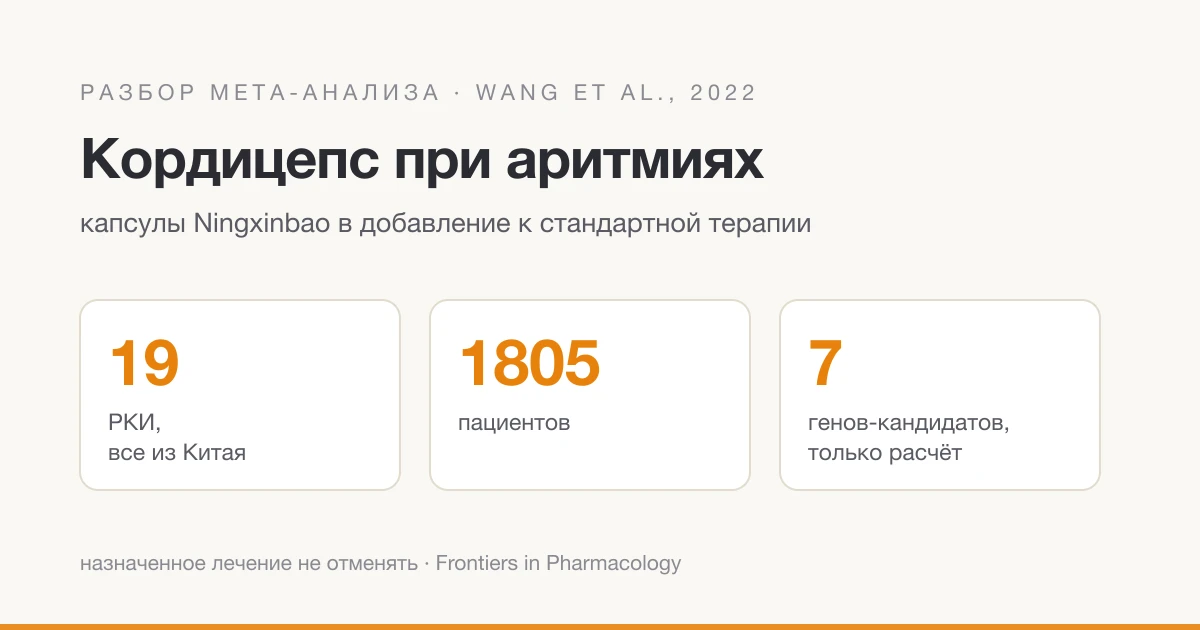
A review of the article Wang L, Front Pharmacol 2022: a meta-analysis of 19 Chinese RCTs (1,805 patients) and a computational search for mechanisms. The first part answers the question “what happened to the patients,” the second — “where the remedy could theoretically act.” The second does not confirm the first: a mechanism on a computer ≠ a clinical effect.
How to read the labels
| Label | Meaning |
|---|---|
| [meta-analysis of RCTs] | several randomized trials in humans pooled together |
| [N RCTs] | the conclusion rests on one to three trials in humans |
| [RCTs, no numbers] | trials in humans, result given in words; “partly” — figures not available for all |
| [traditional use] | used in practice; not proven in the article |
| [animals] | experiments in rats, mice, and other animals |
| [experiment] | an experiment whose model is not specified in the article |
| [tissue], [in vitro] | tissue samples, cells outside the body |
| [in silico] | computer calculation based on databases, without living cells |
| [hypothesis] | the authors' assumption, not tested in the article |
| [not cordyceps] | data on another substance or on the pathway in general |
| [label; label] | data of two levels in one study |
01 · The article
What was studied was not the wild fungus or any supplement “with cordyceps,” but Ningxinbao capsules — a standardized traditional Chinese medicine product made from dry mycelium powder of cordyceps grown by liquid submerged fermentation. The fungal species and strain are not named in the article. Dose in the RCTs — 0.5 g 3 times a day; in one RCT, 0.25 g 3 times a day. The product is widely used for arrhythmias, including atrioventricular block, refractory bradycardia, and conduction block [traditional use].
Starting point: the authors themselves write that there is no credible scientific evidence supporting the use of cordyceps to treat and prevent arrhythmias: the available RCTs are small and give inconsistent results. The authors' rationale: according to them, antiarrhythmic drugs have not been proven to reduce mortality and cause side effects (cited from Hao et al., 2015). It is no reason to stop prescribed drugs: in all trials, the capsules were added to routine treatment.
| Type | Bradyarrhythmias | Tachyarrhythmias |
|---|---|---|
| HR | below 60 per minute | above 100 per minute |
| Examples | sinus bradycardia, sinoatrial and AV block, SSS | premature beats, atrial flutter and fibrillation |
02 · Methods
Search — PubMed and four Chinese databases (CNKI, Wanfang, VIP, SinoMed), up to December 30, 2021; all 19 included trials were published in Chinese. Randomized trials of “Ningxinbao + routine therapy vs. routine therapy alone” were included. At least 10 people in each group, follow-up of at least 2 weeks. Non-randomized or non-blinded trials and studies with a Jadad score below 2 were excluded. The Jadad scale is a short rating of RCT quality: how randomization was done, whether there was “blinding,” and whether dropouts were described; the higher the score, the more rigorous the trial. The included trials scored 3 or 4.
How to read the numbers
- RR — relative risk: the share of “responders” on Ningxinbao divided by the share in the control group. RR 1 — no difference. A hypothetical example, not from the article: with 50% “responders” in the control group, RR 1.24 gives 62%; the article does not report absolute proportions by group.
- SMD — standardized mean difference, in units of the measure's spread rather than in beats per minute. SMD 0 — no difference.
- 95% CI — confidence interval: the range in which the true value most likely lies. If it does not include 1 (for RR) or 0 (for SMD), the difference is considered significant.
- I² — the share of differences between trials that cannot be explained by chance. The closer to 100%, the more the trials contradict each other.
- p — the probability of getting such a result by chance if there is no effect. The threshold in the article is 0.05.
03 · Efficacy
6 RCTs in bradyarrhythmias (641 people) and 13 in tachyarrhythmias (1,164 people), from 20 to 180 participants in each, treatment from 2 weeks to 1.5 years, all in China. Judging by the trial titles, the patients differed widely. In bradyarrhythmias — elderly patients and patients with inferior myocardial infarction; background therapy in 4 of 6 — trimetazidine. In tachyarrhythmias — premature ventricular contractions in CHD (coronary heart disease) and viral myocarditis, ventricular arrhythmias in unstable angina, paroxysmal atrial fibrillation; background therapy — amiodarone, propafenone, verapamil, metoprolol, and others. Pooling them into a single number is the authors' assumption. 16 trials used the “total effectiveness rate” as the primary outcome.
Total effectiveness
| Group | RCTs | RR (95% CI) | I² |
|---|---|---|---|
| Bradyarrhythmias | 5 | 1.24 (1.15–1.35) | 37% |
| Tachy · ventricular | 5 | 1.27 (1.17–1.39) | 51% |
| Tachy · atrial | 4 | 1.40 (1.20–1.63) | 7% |
| Tachy · multiple types | 4 | 1.34 (1.19–1.51) | 88% |
In all four groups, the share of “responders” is higher when the capsules are added, no interval touches 1, and in all groups p < 0.0001 [meta-analysis of RCTs]. In the “multiple types” group I² = 88%: the trials differ greatly from one another, and the pooled number is least reliable for them.
Heart rate
| Measure (2 RCTs) | SMD (95% CI) | Result |
|---|---|---|
| Brady · average HR | 1.10 (0.85–1.36) | significantly increased |
| Brady · minimal HR | 0.99 (−0.49 to 2.46) | not significant |
| Tachy · average HR | −1.14 (−2.83 to 0.56) | not significant |
Only one result is significant: in bradyarrhythmias, average HR increased with the capsules (272 people, I² 0%) [2 RCTs]. Minimal HR in bradyarrhythmias and average HR in tachyarrhythmias did not change significantly [2 RCTs]. Yet the article's text speaks of a “significant increase” in average HR in tachyarrhythmias with I² = 0%. Table 2 gives SMD −1.14, p = 0.19, I² = 97%. A negative SMD means a decrease, not an increase, and the interval crosses 0. The text also describes minimal HR in bradyarrhythmias as significantly increased, although p = 0.19. In the same paragraph on bradyarrhythmias, one sentence earlier, the text states that HR after treatment did not differ between the groups.
Results of single trials
Ventricular arrhythmias, Tao et al., 2014 (40 / 41 people). The article's text speaks of a “greater reduction” in all four disorders. By the numbers, three intervals widely cross 1, and for ventricular fibrillation the upper limit is 0.98 and p = 0.05 — right at the threshold of significance [1 RCT].
| Disorder | RR | p |
|---|---|---|
| Ventricular premature beat | 0.34 | 0.09 |
| Ventricular tachycardia | 1.02 | 0.97 |
| Ventricular flutter | 0.51 | 0.58 |
| Ventricular fibrillation | 0.13 | 0.05 |
Xu and Zheng, 1992 (according to its title, a double-blind trial in 64 patients): according to the article's authors, the capsules had a “mild effect” — they relieved palpitations and chest distress caused by premature ventricular contractions [1 RCT]. No figures, only a verbal assessment. The trial is more than 30 years old.
Cao et al., 2021 (66 / 66 people, 2 months), inflammation markers, SMD: hs-CRP (high-sensitivity C-reactive protein) 2.86, IL6 (interleukin-6) 2.29, TNF (tumor necrosis factor) 2.13. The authors write that levels in the Ningxinbao group were “better,” but why the difference is positive and in which direction the markers changed is not explained [1 RCT].
04 · Safety
| RCTs in bradyarrhythmias | With capsules | Routine only |
|---|---|---|
| Zhong, 2016 | 0% | 19.6% |
| Wang, 2017 | 2.22% | 7.8% |
| Chen, 2018 | 0% | 17.9% |
AEs (adverse events) were mentioned by all 6 bradyarrhythmia trials; three gave numbers. Digestive AEs were significantly less frequent in the Ningxinbao group [3 RCTs]. In tachyarrhythmias, 8 trials described AEs quantitatively. The authors write of a “distinct difference” — fewer cardiovascular and digestive AEs in the Ningxinbao group — but no numbers are given [RCTs, no numbers]. The abstract states that no serious AEs occurred with cordyceps. In total, 14 of 19 trials reported AEs: skin allergy, nausea, vomiting, abdominal discomfort, and others; the article does not say in which group they occurred.
- Both groups received the same routine therapy. The article does not explain why adding the capsules lowered the incidence of AEs rather than raising it.
- The trials were small (20–180 people) and lasted from 2 weeks to 1.5 years; rare AEs may not show up in such samples.
- The meta-analysis did not separately analyze interactions between the capsules and antiarrhythmic drugs; only one trial (Liu, Chen, 2018), judging by its title, assessed the safety of the combination.
- There is no pooled estimate of AEs across all trials.
05 · In silico mechanisms
The second half of the article is network pharmacology: it compares lists from databases — “which proteins the herb's compounds might act on” and “which genes are linked to the disease”; matches are treated as mechanism candidates [in silico].
Calculation pipeline: 18 cordyceps compounds from the TCMSP database → 159 target proteins → overlap with arrhythmia genes from GeneCards → protein network (STRING) → signaling pathways (GO and KEGG) → docking. TCMSP and GeneCards are databases of compounds and genes; STRING is a database of protein interactions; GO and KEGG are a dictionary of gene functions and an atlas of signaling pathways; docking is a calculation of how a molecule fits into a protein pocket. The article itself contains no experiments on cells or animals [in silico]. The composition was taken from a database for “cordyceps” in general; the article contains no analysis of the composition of Ningxinbao capsules.
Of 159 possible targets, 40 matched bradyarrhythmia genes and 34 matched tachyarrhythmia genes; that is how the figures show it, while the text gives the reverse. Key targets per the article — IL6, TNF, TP53, CASP3, CTNNB1, EGF, NOS3 [in silico].
| Bradyarrhythmias | Tachyarrhythmias |
|---|---|
| PI3K-Akt | PI3K-Akt |
| Adrenergic signaling in cardiomyocytes | AGE-RAGE in diabetic complications |
| Fluid shear stress and atherosclerosis | Fluid shear stress and atherosclerosis |
| mTOR · Rap1 | MAPK · FOXO |
These are the leading KEGG pathways per the article [in silico]; cardiomyocytes are heart muscle cells. The same top-20 lists include “type 2 diabetes mellitus,” “insulin secretion,” “salivary secretion,” “rheumatoid arthritis,” and “inflammatory bowel disease.” Enrichment analysis shows which pathways the genes on the list belong to, not that the compound acts on them.
The authors' final scheme (Figure 7) links cordyceps to adrenergic signaling and the PI3K-Akt pathway in cardiomyocytes and derives “improved rhythm” from this [hypothesis]. The authors themselves write that the mechanisms require experimental confirmation.
Docking
Docking is a computer “fitting” of a molecule into a pocket of a protein: the more negative the number, the tighter the calculated fit. The lowest energies — beta-sitosterol and CASP3 (−7.0 kcal/mol), caffeine and TP53 (−6.3), arachidonic acid and NOS3 (−5.6) [in silico]. The authors write of 11 complexes but show 10; all values are said to indicate “a stable combination,” but the threshold is not stated. Caffeine appears in 5 of the 10 pairs — the article does not say how much of it Ningxinbao capsules contain.
06 · The authors' explanations
The claim that “one remedy both speeds up and slows down the rhythm” rests mainly on the “total effectiveness rate” in both groups; direct heart rate measurement in tachyarrhythmias did not show significant slowing [hypothesis]. Most of the references the authors use to explain it concern other substances, the proteins themselves, or animal experiments.
Only one cited study is an experiment with cordyceps itself. Mei et al., 1989: a petroleum ether extract of cordyceps improved aconitine-induced arrhythmia — it prolonged the time to its onset and reduced its duration and severity [animals]; it had an antagonistic effect on arrhythmia induced by barium chloride [animals]. Aconitine and barium chloride are poisons used to induce arrhythmia in animal experiments. Possible mechanism — regulation of ion channel transport in the cell membrane [hypothesis].
Targets and rhythm
- IL6: in rats, IL-6 injection increased susceptibility to atrial fibrillation (Liao et al., 2021) [animals]
- TNF: rapidly increased spontaneous calcium release in mouse atrial cells (Zuo et al., 2019) [in vitro]
- NOS3: mice lacking this gene have more arrhythmias (Wang et al., 2008) [animals]
- CASP3: in bradyarrhythmia induced by trimethyltin chloride, the activity of Na⁺/K⁺-ATPase (a pump that maintains the charge of the cell membrane) may be closely correlated with CASP3 expression (Liu et al., 2020) [experiment]
- CTNNB1: essential for cardiac conduction; loss of the cell-to-cell “junction” proteins leads to arrhythmias (Swope et al., 2012) [experiment]
- TP53: based on left ventricular tissue data, presumably linked to ventricular arrhythmias (Huizar 2019; Haywood 2020) [tissue]
- EGF: according to experimental data, presumably protects the heart from the deleterious effects of adrenaline (Lorita et al., 2002; rodents, per the title) [animals]
Caffeine and other substances
Low doses of caffeine reduced HR during submaximal cycle ergometry (Flueck et al., 2016) [not cordyceps]; a high dose, 150 mg, increased HR in healthy people (Vukovich et al., 2005; caffeine together with ephedra, per the title) [not cordyceps]. Hence the authors' suggestion: a low dose slows the pulse, a high dose speeds it up, and this may be one of the reasons for “bidirectionality.” This was not tested in patients [hypothesis].
Beta-sitosterol inhibited arrhythmias induced by aconitine, ouabain, and myocardial ischemia (Zhang et al., 2013) [not cordyceps]. Arachidonic and linoleic acids given intravenously had strong antiarrhythmic effects in three experimental models (Forster et al., 1976; Xiao et al., 2004) [not cordyceps]. The article did not measure what concentrations of these substances the capsules produce when taken by mouth. Studies of the PI3K-Akt pathway — Pretorius et al., 2009 [animals; tissue], McMullen et al., 2014, and Liang et al., 2010 [animals] — show that the pathway matters for heart rhythm, but not that cordyceps affects it [not cordyceps].
07 · Summary
What is shown
- Adding Ningxinbao to routine therapy increased the share of “responders” in bradyarrhythmias (RR 1.24) and tachyarrhythmias (RR 1.27–1.40) [meta-analysis of RCTs]
- In bradyarrhythmias, average HR increased (SMD 1.10) [2 RCTs]
- AEs in the Ningxinbao group are described as less frequent; no serious AEs were noted [RCTs, partly no numbers]
- Genes shared by cordyceps targets and arrhythmias belong to the PI3K-Akt and adrenergic signaling pathways [in silico]
What is not shown
- Effect on mortality, stroke, hospitalizations — the article has no data.
- Long-term outcomes — unknown; the authors say so directly.
- Effect of the capsules without routine therapy — not studied.
- Which arrhythmias respond better — the subgroups are small, and they are not compared with one another.
- Changes in cardiac conduction — not reported in the results.
- What counted as a “response to treatment” — not defined; how many people benefited in absolute numbers — not reported.
- Results outside China — not a single trial.
- Effect of the compounds on cells and animals — not tested in the article; capsule composition and caffeine content — not analyzed.
- Applicability to other cordyceps products — no basis: a single standardized product was studied.
- Contraindications, safety in pregnancy, in children, in liver and kidney disease — not considered in the article.
The authors themselves name four limitations. All trials were published in Chinese, and sample sizes were small. All were conducted in China, and geographic bias limits generalization to other countries. All reported positive results — publication bias is possible: unsuccessful trials are published less often. The mechanisms were predicted only by network pharmacology and require experiments. What is needed, according to the authors, are strictly designed multicenter RCTs to assess efficacy and safety, especially with long-term “hard” endpoints (that is, events that matter to the patient: death, stroke, hospitalization).
Inconsistencies in the article
- Effect measures: OR (odds ratio) and MD (simple mean difference) in the methods, RR and SMD in the results. The fail-safe number method is stated — how many unpublished “null” trials would be needed for the result to stop being significant; its result is not reported.
- HR in tachyarrhythmias: “significant increase” and I² 0% in the text; SMD −1.14, p = 0.19, I² 97% in the table.
- 11 trials with the “effectiveness” outcome in tachyarrhythmias, but 5 + 4 + 4 = 13 in the subgroups.
- “8 trials” with AEs in tachyarrhythmias — the list has 9 references, one of them repeated twice.
- Common targets: 34 with bradyarrhythmias and 40 with tachyarrhythmias in the text; the reverse in the figures.
- The Discussion claims improved “sinus node and atrioventricular conduction”; the results contain no such data.
Practical implications
In all trials, Ningxinbao was only added to routine treatment; there are no data on taking it instead of antiarrhythmic drugs. Participants were also receiving amiodarone, propafenone, verapamil, metoprolol, trimetazidine, and other drugs, and the meta-analysis did not separately analyze compatibility. The list of adverse reactions in the article is incomplete and not linked to a group: if skin allergy, nausea, vomiting, abdominal discomfort, or other reactions appear while taking the capsules, discuss with your physician whether to continue.
Conclusion
A meta-analysis of 19 small Chinese RCTs with an undefined surrogate outcome shows a signal of benefit from Ningxinbao capsules as an add-on to arrhythmia treatment. The mechanism is a calculated hypothesis without experimental confirmation. This is a basis for rigorous trials, not a proven treatment. The authors conclude that the study “confirmed that Cordyceps has a certain positive effect” and that it “is effective in stabilizing heart rates”; however, in tachyarrhythmias HR did not change significantly (p = 0.19). The authors also acknowledge that the effect on long-term outcomes is unknown.
Download the guide
The full guide — 74 pages laid out for a phone screen: tables and diagrams for each section, all of the article's inconsistencies, a glossary, and the list of cited works. Swipe through it or send it to whoever needs it more: download the PDF.
Also read the second guide in the series — “Cordyceps and immunity”, a review of Das et al., 2021 — and the article on why wild Himalayan and lab-grown cordyceps are two different products.
In short
Signal in RCTs — present. Mechanism — calculation. Hard outcomes — no data.
This material is for information and does not replace a consultation. Discuss with your physician whether to take cordyceps for arrhythmia and whether to combine it with medications; do not stop prescribed treatment on the basis of this article.
References
- Wang L, Front Pharmacol 2022. PMID 36059969
Key facts
- [meta-analysis of RCTs] Adding Ningxinbao capsules to routine therapy increased the share of “responders”: in bradyarrhythmias RR (relative risk) 1.24 (1.15–1.35), in tachyarrhythmias RR 1.27–1.40. What counted as a response to treatment is not disclosed in the article.
- [2 RCTs] In bradyarrhythmias, average heart rate (HR) increased: SMD (standardized mean difference) 1.10, 95% CI 0.85–1.36. In tachyarrhythmias, HR did not change significantly (SMD −1.14, 95% CI −2.83 to 0.56, p = 0.19), although the authors write that cordyceps is “effective in stabilizing heart rates.”
- [3 RCTs] In bradyarrhythmias, in the three RCTs that reported numbers, adverse event incidence with the capsules was 0%, 2.22%, and 0%; in the control groups, 19.6%, 7.8%, and 17.9%. According to the abstract, there were no serious adverse events with cordyceps [RCTs, partly without numbers]. Contraindications, pregnancy, and children were not addressed in the article.
- [in silico] The mechanism was only predicted by computation and remains a hypothesis: 7 candidate genes (IL6, TNF, TP53, CASP3, CTNNB1, EGF, NOS3), PI3K-Akt and adrenergic signaling pathways. The article contains no experiments on cells or animals.
- [meta-analysis of RCTs] All 19 trials were conducted in China and published in Chinese; each had 20 to 180 participants, and treatment lasted from 2 weeks to 1.5 years. The article has no data on mortality, strokes, or hospitalizations.
- [meta-analysis of RCTs] In all trials, the capsules were only added to routine treatment. There are no data on taking them instead of antiarrhythmic drugs. Prescribed treatment must not be stopped on the basis of this article; the decision to take cordyceps is made with a physician.