In brief
| Topic | What the review has | Level |
|---|---|---|
| Immunity | both enhancement and suppression of the response | preclinical |
| Immunity in humans | one RCT, no numbers | humans · RCT |
| Endurance | Cs-4, 12 weeks: higher thresholds in older adults | humans · placebo-controlled |
| Kidneys | several studies with patients | humans · design not described |
| Blood sugar, lipids, blood pressure | effects in mice and rats | animals |
| Safety in humans | no frequencies, doses or durations | — |
A review of Das G, Front Pharmacol 2021. Cordyceps is an insect-parasitizing fungus from Tibetan and traditional Chinese medicine. Here: which effects are described, where they were observed (in a test tube, in animals or in humans), and what the review does not show.
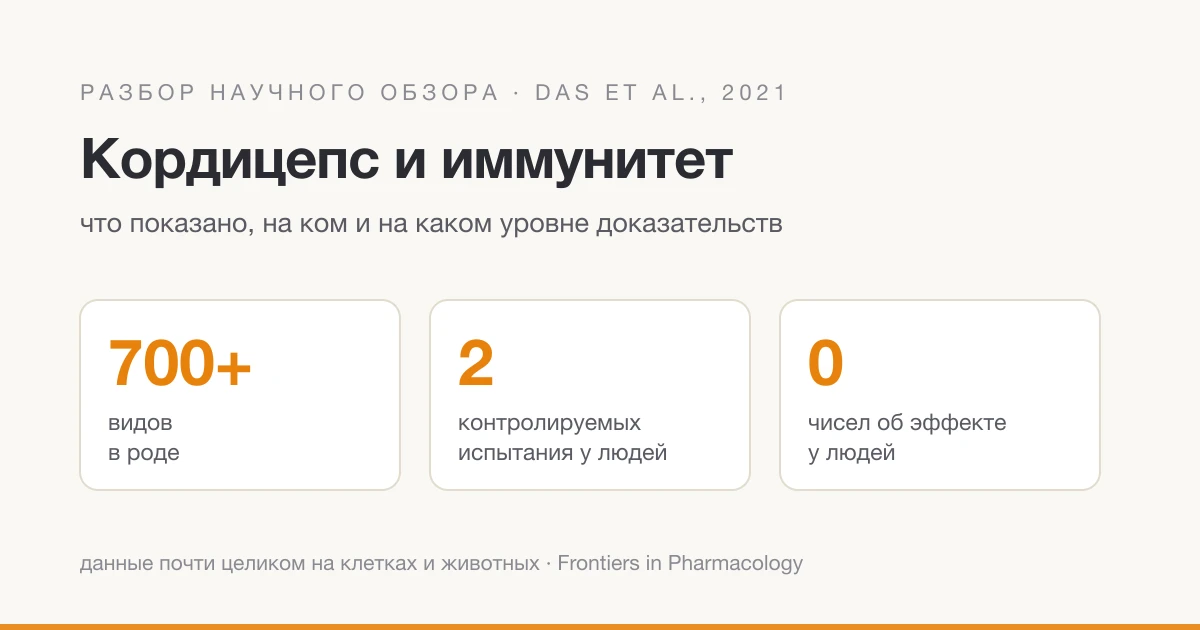
Species in the genus: more than 700. Controlled trials in humans in the review: two. Numbers on the effect in humans: zero. In the abstract the authors themselves write that the pharmacological activities of cordyceps have been “reported in pre-clinical studies,” that is, in cells and animals.
How to read the labels
A label follows every statement about an effect on the body: it tells you in whom or in what the result was obtained. The closer a label is to the word “humans,” the closer the result is to the question “will this help me.” Most labels are “in vitro” and “animals.” An RCT is a randomized controlled trial: groups are assigned at random; in a placebo-controlled trial the comparison is with a dummy pill.
| Label | What it means |
|---|---|
| [traditional use] | folk use; experience, not testing |
| [chemical analysis] | what was found in the fungus; says nothing about the effect |
| [in vitro] | cells in a test tube or dish |
| [in vitro · human cells] | human cells, but the experiment is in a test tube |
| [animals] | mice, rats and other animals |
| [preclinical] | cells and/or animals; the review does not specify |
| [humans · design not described] | people took part; the design is not reported |
| [humans · RCT] or [humans · placebo-controlled] | controlled trials |
| [review authors’ opinion] | an assumption, not the result of an experiment |
| [level not stated] | not said in whom it was obtained |
01 · About the review
A literature review in Frontiers in Pharmacology (Ethnopharmacology section), 2021, volume 11, article 602364. Seventeen authors from South Korea, Mexico, India, Chile and Portugal. Funding: the National Research Foundation of Korea and Dongguk University; no conflict of interest declared. The authors searched PubMed, SpringerLink, Scopus, ScienceDirect, Elsevier journals and Google, only in English. The review contains no new experiments: it retells other studies.
What the methods leave out
- how many studies were found and how many were included;
- which years the search covered;
- how studies were selected by design (cells, animals, humans);
- how study quality and risk of bias were assessed;
- whether results were pooled into a single estimate (meta-analysis).
02 · The fungus
“Cordyceps” is not one fungus but hundreds of species with different compositions. About 20 parasitize Elaphomyces fungi; the rest parasitize insects and arachnids. It grows in the mountains at 3,600–4,000 m. The best-studied species are C. sinensis (current name Ophiocordyceps sinensis) and C. militaris.
The fungus develops inside a living larva, replaces its tissues and emerges as a stalk, the fruiting body. Because of overharvesting the wild fungus has become scarce; since the 1970s scientists have been looking for ways to ferment and cultivate it, and C. militaris is considered a cheaper substitute for C. sinensis. Fungus from a mountain meadow and mycelium (the network of fungal threads) from a fermenter are different products. The review describes C. sinensis as a dietary supplement that complies with the requirements of the FDA, the US Food and Drug Administration (Wu et al., 2015): this refers to dietary supplement requirements, not to a proven therapeutic effect.
Traditional use
- In traditional Chinese medicine (TCM), a tonic for diseases of the respiratory tract, liver and kidneys, for high blood sugar and for tumors. [traditional use]
- For energy, endurance, aerobic capacity and “cellular immunity”; for fatigue and weakness, and to ease the symptoms of altitude sickness. [traditional use]
- TCM practitioners recommend regular intake of C. sinensis “to avoid infections, colds, and flues,” and for cough, asthma and bronchial diseases. [traditional use]
- Local healers choose the dose and route “by trial and error” (Maity, 2013). [traditional use]
- Benefits “have also been observed in athletes”: the review attributes them to a rise in cellular ATP but cites no study for this. [review authors’ opinion]
03 · Composition
The fungus contains dozens of groups of substances: nucleosides, sterols, flavonoids, cyclic peptides, phenolics, alkaloids, polysaccharides and others. In many cases it is unknown which of them is responsible for which effect. Not all of the substances found are “beneficial”: they include immunosuppressants.
- Cordycepin (3′-deoxyadenosine) is an almost exact copy of adenosine, missing one oxygen atom; it is notably abundant in C. militaris. [chemical analysis]
- Because of its resemblance to adenosine, cordycepin is linked to intracellular targets, apoptosis and the cell cycle (Tuli et al., 2013b). [preclinical]
- “Cordycepic acid” is in fact D-mannitol; C. sinensis contains 7–29% of it, depending on the growth stage. [chemical analysis] It is credited with effects in liver fibrosis, a diuretic effect and free-radical-scavenging properties. [level not stated] Judging by their titles, the two papers the review cites here are a general review of liver fibrosis and a review of kidney injury from mannitol; neither studied cordyceps.
- Polysaccharides make up 3–8% of the fruiting body. Only β-(1→3)-glucan, galactosaminoglycan and proteopolysaccharide showed antitumor activity. [level not stated]
- A polysaccharide fraction of C. sinensis mycelium switches macrophages from the M2 type (“healing”) to the M1 type (“attack”) via NF-κB (Chen W et al., 2010; 2012). [in vitro]
| Part of the fungus | Ergosterol, mg/g | Protein, % |
|---|---|---|
| Mycelium | 1.44 | 14.8 (fermenter) |
| Fruiting body | 10.68 | 30.4 |
| Dead larvae | — | 29.1 |
04 · Immunity
The main topic of the review. Cordyceps, its extracts and compounds have been linked to production of the cytokines IL-1β, IL-2, IL-6, IL-8, IL-10, IL-12 and TNF-α. [preclinical] It has also been linked to enhanced phagocytosis, nitric oxide production via the enzyme iNOS, triggering of the inflammatory response via the MAPK signaling pathway and synergism with interferon-γ in cytokine production. [preclinical]
Two sides
| Enhances | Restrains |
|---|---|
| cytokines IL-1β, IL-6, TNF-α ↑ | NO, TNF-α, IL-12 ↓ |
| phagocytosis ↑ | T-cell proliferation ↓ |
| NK cells ↑ | immunosuppression after kidney transplant |
- C. militaris polysaccharides in mice with cyclophosphamide-suppressed immunity: lymphocyte proliferation and the phagocytic index increased (Wang M et al., 2012). [animals]
- An acidic polysaccharide of C. militaris given intranasally to mice with influenza A: less virus in the lungs, higher survival; the same polysaccharide increased TNF-α, IFN-γ and NO in macrophages (Ohta et al., 2007). [animals · in vitro] The review provides no data on oral use for influenza in humans.
- Methanol fractions of C. sinensis suppressed lymphocyte proliferation, NK cell activity and IL-2 and TNF-α production by human mononuclear cells (Kuo et al., 1996). [in vitro · human cells]
- Aqueous extract of C. militaris suppressed NO, TNF-α and IL-6 production by activated macrophages (Jo et al., 2010). [in vitro]
- Cordycepin and C. sinensis in human cells: at rest, IL-1β, IL-6, IL-8, IL-10 and TNF-α rise; after activation with PHA (phytohemagglutinin, a substance used in the laboratory to activate lymphocytes), IL-2, IL-4, IL-5, IL-12, IFN-γ and TNF-α fall (Zhou et al., 2008). [in vitro · human cells]
At the same time, the first row of Table 2 calls C. militaris polysaccharides on RAW264.7 macrophages an “immunostimulant,” although its results are a decrease in NO, TNF-α and IL-1β; in one of the studies in the same row, “↓ NO, TNF-α and activates macrophages.” In the section on inflammation, the same review calls a decrease in NO and TNF-α an anti-inflammatory effect. The experimental conditions in this row are not explained, and the label “immunostimulant” does not follow from the results given.
What there is in humans
| Study | What the review says | Level |
|---|---|---|
| Guan, 1992 | renal failure: better cellular immunity | humans · design not described |
| Li, 2009 | after kidney transplant: “cost-effective immunosuppressive agent” | humans · design not described |
| Lin, Li, 2011 | respiratory infections; the source is a book | level not stated |
| Jung, 2019 | healthy adults, Korea; P. hepiali; no numbers | humans · RCT |
Jung et al., 2019: CBG-CS-2 mycelium (Paecilomyces hepiali); randomized and double-blind, according to its title in the reference list. [humans · RCT] The review reports that the trial assessed efficacy and safety, but gives no data on adverse effects. The review writes that CBG-CS-2 components enhance NK cell activity and phagocytosis, but does not say whether this was obtained in the human trial. [level not stated]
05 · Inflammation and tumors
- Ethanol extract of C. militaris mycelium reduced carrageenan-induced edema and iNOS expression in macrophages (Won & Park, 2005). [animals · in vitro]
- Aqueous extract of C. militaris in dextran sulfate–induced colitis: less weight loss, diarrhea, bleeding and mucosal damage (Han et al., 2011). [animals] Carrageenan and dextran sulfate are substances used to induce inflammation artificially in animals: these are models of disease, not the human disease itself.
- Cordycepin in BV2 microglial cells dose-dependently reduced NO, prostaglandin E2 and proinflammatory cytokines (Jeong et al., 2010). [in vitro] From these data the authors speak of “high potential” in neurodegenerative diseases; this has not been tested in humans.
- C. sinensis compounds suppressed the release of superoxide anion and elastase by human neutrophils: IC50 0.45 and 1.68 μg/mL versus 38.32 and 31.98 for indomethacin, an anti-inflammatory drug used as the control (Yang et al., 2011). “Most of the compounds” outperformed indomethacin; the values are as given in the review. [in vitro · human cells] IC50 is the concentration at which the effect is inhibited by half: the smaller the number, the stronger the compound in a test tube. It says nothing about potency in the body.
- A C. sinensis polysaccharide in tumor-bearing mice increased SOD and GPx (enzymes that neutralize free radicals) and lowered MDA, a marker of radical damage to fats (Chen et al., 2006). [animals]
- In old mice, C. sinensis improved learning and memory (Wang et al., 2004). [animals] Human lifespan was not studied in the review.
Tumors and other effects
- Cordycepin inhibits cancer cell proliferation via A3 adenosine receptors and the Wnt pathway (Yoshikawa et al., 2004–2008). [in vitro · animals] As the review stresses, cordycepin acts through pathways “depending upon the cell type.”
- At low concentration, cordycepin increased the sensitivity of gallbladder cancer cells to gemcitabine and 5-fluorouracil (Wu et al., 2014). [in vitro]
- C. militaris inhibited the growth of T-cell lymphoma transplanted into mice (Park et al., 2017). [animals]
- Individual compounds from different species inhibited E. coli, the malaria parasite Plasmodium, Mycobacterium tuberculosis and HIV-1 reverse transcriptase. [in vitro] These are compounds isolated from individual species, not effects of taking cordyceps.
06 · Metabolism and endurance
Endurance: the only placebo-controlled trial with a result
Cs-4 (C. sinensis) for 12 weeks in healthy older adults, a double-blind, placebo-controlled trial (Chen S et al., 2010): higher metabolic and ventilatory thresholds. [humans · placebo-controlled] The number of participants, dose and effect size are not given in the review. According to the review, higher thresholds indicate better aerobic performance without fatigue in older people. This is the review’s strongest result by design among those with a described outcome.
Xiao et al., 1999: according to its title in the reference list, increased aerobic capacity in healthy older adults on Cs-4 (an abstract); in the text of the review the study is mentioned only in connection with the “anaerobic threshold.” [humans · design not described] The fungus’s reputation in sports: in 1993 world athletics champions spoke of a diet that included cordyceps (Kashyap et al., 2016). This is a story, not a study. [level not stated]
Blood sugar, lipids, blood pressure, mood
- A polysaccharide of C. sinensis mycelium lowered plasma glucose in mice when injected into the abdominal cavity; with oral intake the lowering was “slight” (Kiho et al., 1993). [animals] People take cordyceps by mouth.
- CordyMax Cs-4 in rats: lower basal glucose and insulin, higher insulin sensitivity (Balon et al., 2002; Zhao et al., 2002). [animals]
- A protein component of C. sinensis lowered mean arterial pressure in rats (Chiou et al., 2000). [animals]
- A C. militaris polysaccharide lowered blood and liver lipids (Wang L et al., 2015). [animals]
- Mice given C. sinensis mycelium polysaccharides swam longer to exhaustion (Li & Li, 2009; Yan et al., 2012). [animals]
- A supercritical extract of C. sinensis had an antidepressant-like effect in the mouse tail suspension test (Nishizawa et al., 2007). [animals] Mood in humans was not studied in the review.
07 · Hormones and kidneys
- Cordyceps is called “Himalayan Viagra” in popular literature (Kashyap et al., 2016). [traditional use]
- C. militaris mycelium improved sperm motility and morphology in subfertile boars and in rats (Lin et al., 2007; Chang et al., 2008). [animals]
- Cordycepin increased testosterone in Leydig cells and in mouse plasma (Leu et al., 2011). [in vitro · animals]
- In normal mouse Leydig cells, C. sinensis raised testosterone in some experiments and in others lowered testosterone production in response to hCG (human chorionic gonadotropin, the hormone used in these experiments to stimulate testosterone production). [in vitro]
- In human granulosa cells, C. sinensis increased estradiol production (Huang B M et al., 2004). [in vitro · human cells] The conclusion that it is “a brilliant candidate for increasing the fecundity of women” has not been tested in women. [review authors’ opinion]
- The review gives no data on potency, fertility or the levels of these hormones in humans. If you have a hormone-dependent condition, discuss taking cordyceps with your physician.
Kidneys: the most “human” topic
- Kidney transplant patients (per the study title), long-term C. sinensis: less blood and protein in the urine (Ding et al., 2011). [humans · design not described]
- Older patients (per the study title): kidney protection from aminoglycoside antibiotics (Bao et al., 1994). [humans · design not described]
- Chronic renal failure: improved kidney function (Guan et al., 1992). [humans · design not described]
- CmNo1 (fruiting body and mycelium of C. militaris) preserved kidney function in mice with type 2 diabetes (Yu et al., 2016). [animals]
08 · Safety
- “These properties are concentration-dependent, and in most cases, no adverse effects were reported, although the evaluation of isolated compounds such as cordycepin is preferred.” [review authors’ opinion]
- The only RCT (Jung et al., 2019) also assessed safety, but the review gives no data on adverse effects. [humans · RCT]
- The only section of the review devoted to toxicity describes harm to the fungal culture in a polypropylene bag, not to humans (Holliday et al., 2004). [chemical analysis]
- Rugulosin and skyrin from C. formosana in CHO cells (a non-tumor line from Chinese hamster ovary): LD50 18.3 ± 0.2 and 103.7 ± 5.9 μg/mL (Lu et al., 2014). [in vitro] LD50 is the dose that kills half of the test subjects.
- Cyclosporin has been found in the species Cordyceps subsessilis (Segelken, 1996). [chemical analysis] C. sinensis has been used as a “cost-effective immunosuppressive agent” after kidney transplantation (Li et al., 2009). [humans · design not described]
- In mice, C. sinensis increased testosterone and the androgen receptor and accelerated the growth of prostate cancer cells (Ma et al., 2018). [animals] In LNCaP human prostate cancer cells, apoptosis and autophagy have been described (Lee et al., 2014). [in vitro · human cells] The data contradict each other, and cell experiments do not show what will happen when a person takes the fungus.
- “New toxicological studies are needed to ensure their safety.” [review authors’ opinion]
Combination with drugs
- C. sinensis together with cyclosporin A in kidney transplantation (Ding et al., 2009). [level not stated]
- Cordycepin increased the sensitivity of cancer cells to gemcitabine and 5-fluorouracil. [in vitro]
- Polysaccharides with chemotherapy drugs: “synergism.” [animals]
- Among the proposed applications of cordyceps, the review lists anti-thrombotic and anticoagulant effects (Qian et al., 2012; Liu Y et al., 2015). [level not stated]
- Lowering of blood sugar in mice and rats, and of mean arterial pressure in rats. [animals]
The review gives no data on drug interactions in humans. But everything listed is a signal that the fungus’s components may alter how drugs work. If blood-thinning, glucose-lowering and blood pressure–lowering effects exist in humans, they may add to the action of drugs with the same purpose.
09 · Summary
What the review does not show
- that oral intake strengthens the immunity of a healthy person or reduces the number of infections;
- what dose and duration of intake work in humans;
- how large the effect is in humans: not a single number;
- which species, which part of the fungus and which extract produce the described effects;
- how safe long-term use is;
- whether cordyceps treats cancer, diabetes or kidney disease in humans.
Weak points of the review
- The methods do not describe how studies were selected and how their quality was assessed.
- Table 2 labels as “Immunostimulant” a row in which NO and TNF-α decrease.
- References do not always match the claim: the paper cited for a cordyceps polysaccharide (Gu et al., 2003) is, in the reference list, about withanolides from the plant Physalis.
- Conflicting results (immunity, testosterone) are listed but not analyzed.
- The “Toxic effects” section is about the fungal culture, not about humans.
- Only articles in English.
What follows from this
The review is a map of hypotheses, not proof of benefit. It cannot be used to choose a species, form or dose of cordyceps for humans. Its claims need to be checked against the original sources.
- “Strengthens immunity” is a preclinical claim in the review; in humans it is not supported by numbers.
- Cordyceps can both enhance and suppress the immune response.
- Discuss with your physician before taking it: after organ transplantation and when taking immunosuppressants, during chemotherapy, with prostate cancer, and when taking blood thinners, glucose-lowering or blood pressure–lowering drugs.
If you already take cordyceps or are considering it, tell your treating physician, especially if you have any of the conditions listed.
Download the guide
The full guide is 89 pages laid out for a phone screen: all nine sections, a glossary and the list of human studies from the review — download the PDF.
In short
Cordyceps is hundreds of species with different compositions. In cells and animals its compounds both enhance and suppress the immune response. [preclinical] In humans: one RCT on immunity with no numbers, one placebo-controlled trial on endurance with no effect size, and several kidney studies without a described design. [humans · mixed designs]
Read also the second guide, Cordyceps and Arrhythmias: A Review of Wang et al., 2022, and the article on why wild Himalayan and lab-grown cordyceps are two different products.
This material is for information and does not replace a consultation with a physician. The guide is based on the Das et al., 2021 review alone: other studies are named as they appear in its reference list and are presented as the review describes them; we have not read those studies ourselves.
References
- Das G, Front Pharmacol 2021. PMID 33628175
Key facts
- Almost all data on how cordyceps affects immunity come from cells and mice. The Das et al., 2021 review shows that cordyceps both enhances and suppresses the immune response [preclinical]
- The review mentions one RCT on immunity in humans (Jung et al., 2019, CBG-CS-2 mycelium). It says the trial assessed efficacy and safety but gives not a single number [humans · RCT]
- Cs-4 (a mycelial fermentation product of C. sinensis) for 12 weeks in healthy older adults: higher metabolic and ventilatory thresholds. Number of participants, dose and effect size are not given [humans · placebo-controlled]
- In mice, C. sinensis accelerated prostate cancer growth: testosterone and the androgen receptor increased (Ma et al., 2018) [animals]
- Cytotoxicity (the ability to kill cells): rugulosin and skyrin from the cordyceps species C. formosana, LD50 18.3 ± 0.2 and 103.7 ± 5.9 μg/mL in non-tumor Chinese hamster CHO cells [in vitro]
- Among the proposed applications of cordyceps the review lists anticoagulant effects; lower blood sugar and blood pressure are described in animals. People taking blood thinners, glucose-lowering or blood-pressure-lowering drugs should discuss the combination with a physician [level not stated · animals]