Introduction: "take magnesium" is insufficient advice
Magnesium (Mg²⁺ - a divalent cation) is involved in 600+ enzymatic reactions, including ATP-dependent transport, DNA synthesis, and regulation of myocardial potassium and calcium channels. It is the second most abundant intracellular cation after potassium.
Subclinical deficiency is common in 50–60% of adults on a Western diet (DiNicolantonio JJ, Open Heart 2018, PMID 29387426[1]). Causes include soil depletion, grain refining, losses during cooking, diuretics, PPIs (proton pump inhibitors), chronic stress, and alcohol. Symptoms - muscle twitching, nocturnal cramps, anxiety, insomnia, extrasystoles, headaches - are often attributed to "age" and "fatigue."
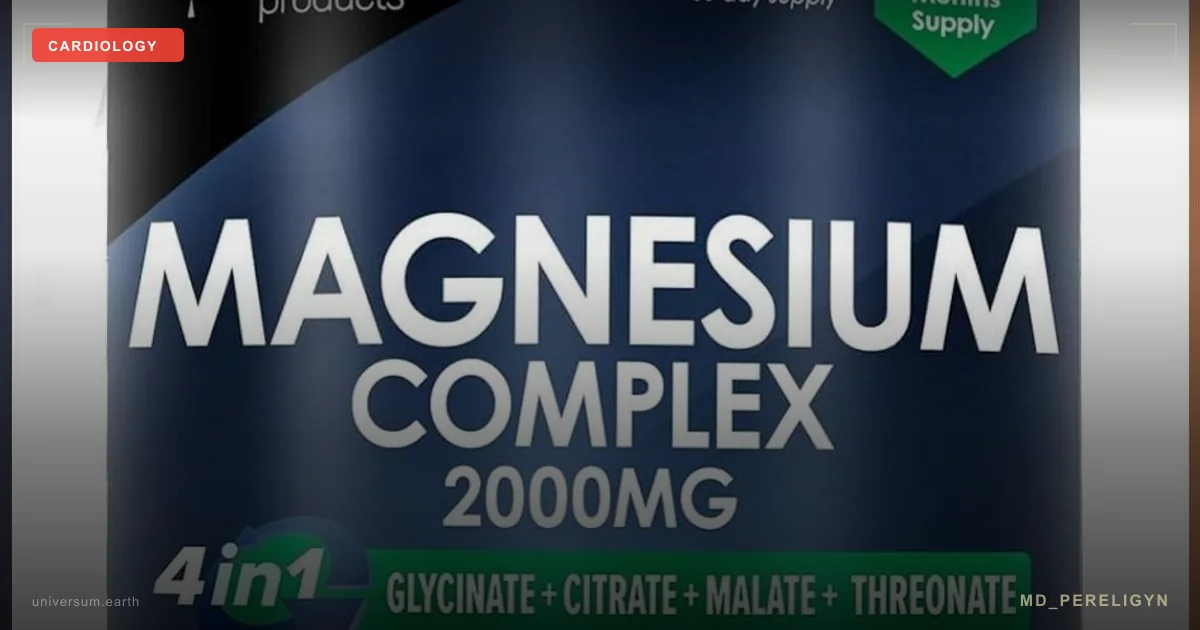
The main message of the md_pereligyn protocol: not simply to "take magnesium," but to choose the form for the clinical goal. The bioavailability and tissue selectivity of four popular forms differ radically. Citrate is the most accessible, but the target is not the heart. Taurate works for the myocardium. Glycinate works for sleep and blood pressure. Malate works for energy. Threonate works for the brain. These are four different tools, not four equivalent alternatives.
🌀
Absorption biochemistry: why the form matters
A magnesium molecule is not absorbed as a free ion. The intestine accepts it in a complex with a ligand (an anion or amino acid). The ligand determines three parameters: absorption rate, tissue selectivity, and adverse effects.
▸Bioavailability ranges from 4% (oxide) to 40+% (glycinate, taurate). Cheap forms (oxide, sulfate) pass through the intestine with minimal absorption and act osmotically, hence the laxative effect. ▸Tissue selectivity is determined by the ligand. Taurine concentrates in the myocardium → taurate selectively delivers magnesium into cardiomyocytes. Threonate crosses the blood-brain barrier → delivery into neurons. Glycine is a neurotransmitter and activates GABA receptors → anxiolytic effect. ▸Adverse effects - primarily diarrhea due to the osmosis of unabsorbed magnesium. Amino acid chelates (glycinate, taurate) almost never cause GI adverse effects. Citrate and oxide are a frequent cause of diarrhea when the dose is exceeded.
This is the rationale for selecting the form. Not "magnesium is useful," but "this form solves this problem."
🌀
Four forms, four goals
A review by actual clinical specialization. All doses are in elemental magnesium (the Mg²⁺ content in the molecule, stated on the label).
•Magnesium taurate - bound to taurine, a sulfur-containing amino acid. Taurine concentrates in the myocardium and retina, providing tissue selectivity. Cardiac specificity: RCTs (randomized controlled trials) show reduced AFib (atrial fibrillation) episodes in patients with paroxysmal AFib, a mild reduction in blood pressure, and an antiarrhythmic effect (McCarty MF, Med Hypotheses 1996, PMID 8910882[2]). The baseline choice for cardioprotection and arrhythmias. •Magnesium glycinate (bisglycinate) - a double chelate with glycine. Bioavailability >40%, does not cause GI adverse effects. Glycine activates GABA (gamma-aminobutyric acid) receptors → anxiolytic effect, inhibits NMDA receptors → reduced excitability. Target: reduction of nocturnal sympathetic tone, improved sleep, reduced anxiety, mild reduction in blood pressure (Schwalfenberg GK, Scientifica 2017, PMID 29093983[3]). •Magnesium malate - bound to malic acid, a participant in the Krebs cycle. Malate is a substrate for the mitochondrial ATP factory. Target: muscle fatigue, fibromyalgia, a state of "heavy morning start-up." Its relation to cardio is indirect, through mitochondrial energetics. •Magnesium L-threonate (Magtein) - the only form that crosses the blood-brain barrier at a meaningful concentration. Target: cognitive function, neuroplasticity, reduced anxiety. An expensive form (5–10 times more expensive than taurate). It has no advantages for the heart - taurate and glycinate work there.
| Form | Goal | Dose |
|---|---|---|
| Taurate | heart, AFib, BP | 400–600 mg |
| Glycinate | sleep, anxiety, BP | 200–400 mg |
| Malate | energy, mitochondria | 400–600 mg AM |
| Threonate | brain, cognition | 1500–2000 mg (Magtein) |
| Oxide | constipation (4% uptake) | not for deficiency |
Principle: one form rarely covers all goals. A typical regimen is taurate in the morning (for the heart), glycinate at night (for sleep and blood pressure).
🌀
What to avoid
These forms are either ineffective or have a narrow application that does not justify regular use.
▸Magnesium oxide - bioavailability 4%. Cheap, included in most pharmacy "magnesium+B6" products. Useless as a source of systemic magnesium; acts osmotically. Used only for constipation. ▸Oral magnesium sulfate - a laxative (Epsom salt). Not for systemic correction of deficiency. Intravenous sulfate is an emergency antiarrhythmic in the hospital setting, but that is a different story. ▸Magnesium citrate - high bioavailability (~25–30%), but activates peristalsis. Target: constipation. For the heart, it is NOT the first-line choice. With long-term use, it often causes diarrhea. ▸"Magnesium+B6" complexes without the form specified - usually contain oxide. Read the composition; if the form is not stated, skip it. ▸Carbonate, hydroxide - antacids, not a magnesium source.
🌀
Doses and distribution
The daily adult requirement is 320–420 mg of elemental magnesium. For therapeutic correction of deficiency, hypertension, and arrhythmias, it is higher.
▸Taurate for the heart - 400–600 mg of elemental magnesium per day, divided into 2 doses (morning + daytime). In AFib therapy, the dose should be selected by a cardiologist based on RBC Mg results. ▸Glycinate for sleep and blood pressure - 200–400 mg 30–60 minutes before sleep. It can be combined with taurate during the day. ▸Malate for energy - 400–600 mg in the morning, on an empty stomach. Not at night (it produces a mild stimulating effect through activation of the Krebs cycle). ▸Threonate for cognitive function - 1500–2000 mg of the total form (Magtein) per day, divided into 2 doses. Contains ~144 mg of elemental magnesium per 2000 mg of the total form.
🌀
The holistic md_pereligyn protocol
Principle: RBC Mg first, then the form. Select the dose and form according to the goal and confirmed deficiency, not "just in case."
1. Initial diagnostics
▸RBC Mg - the only valid marker of tissue stores. Test in the morning while fasting. ▸24-hour urinary magnesium excretion - assessment of renal loss. Useful with diuretic and PPI use. ▸Serum potassium - magnesium and potassium are regulated in parallel; hypomagnesemia is often accompanied by hypokalemia. ▸Vitamin D - low vitamin D worsens magnesium absorption. Target 60–80 ng/mL.
2. Baseline protocol for cardiovascular goals
▸Magnesium taurate 400–600 mg/day, divided into 2 doses (morning + daytime). ▸Magnesium glycinate 200–300 mg 30–60 minutes before sleep. ▸Vitamin B6 (pyridoxal-5-phosphate, P5P) 25–50 mg/day - a cofactor for intracellular magnesium transport. ▸Vitamin D3 + K2 to a target D3 level of 60–80 ng/mL - without correcting D, magnesium deficiency often recurs.
3. For sleep disturbance and anxiety
▸Magnesium glycinate 300–400 mg 30–60 minutes before sleep. ▸Glycine 3 g additionally - synergy with glycinate, inhibits NMDA receptors. ▸L-threonine 500–1000 mg - for pronounced anxiety.
4. For muscle fatigue and fibromyalgia
▸Magnesium malate 400–600 mg in the morning, on an empty stomach. ▸CoQ10 (ubiquinol) 100–200 mg - mitochondrial support. ▸B-complex with active forms (P5P, methylfolate, methylcobalamin) - cofactors of mitochondrial metabolism.
5. Nutrition
▸Green leafy vegetables (spinach, Swiss chard, kale) - 100–150 g/day. ▸Pumpkin seeds - a 30 g handful contains 150 mg of magnesium. ▸Dark chocolate 80%+ - 30 g contains 60 mg of magnesium. ▸Nuts (almonds, cashews, Brazil nuts) - 30 g contain 80–100 mg of magnesium. ▸Avocado, bananas, black beans - additional sources.
🌀
What does NOT work
▸"Taking magnesium" without understanding the form - magnesium oxide (in most cheap products) does not correct deficiency even at a dose of 500 mg of the total form. ▸Relying on serum magnesium - normal serum magnesium does not rule out tissue deficiency. RBC Mg is mandatory. ▸Ignoring vitamin D and B6 - without them, magnesium absorption and intracellular transport are impaired. ▸Taking magnesium with calcium in the same dose - calcium competes with magnesium for absorption. Separate them by at least 2 hours. ▸Taking magnesium with PPIs and fluoroquinolones - PPIs block absorption, and fluoroquinolones are chelated by magnesium in the intestine (both magnesium and the antibiotic are lost). Separate them in time. ▸High doses of citrate in people prone to diarrhea - adverse effects will exceed benefits. Switch to glycinate or taurate.
🌀
When to seek medical care
▸Arrhythmias (AFib, extrasystoles), especially nocturnal ▸Arterial hypertension not controlled by standard therapy ▸Chronic use of diuretics, PPIs, metformin ▸Insomnia, chronic anxiety, muscle twitching ▸Migraine, tension-type headaches ▸Type 2 diabetes, metabolic syndrome (often accompanied by magnesium deficiency) ▸Family history of coronary artery disease or sudden cardiac death
I perform comprehensive nutraceutical screening (RBC Mg, vitamin D, B12, homocysteine, omega-3 index, ferritin, zinc) and create a personalized protocol with selection of specific magnesium forms for the clinical goal.
🌀
Conclusion
Magnesium is not one nutrient, but four different tools depending on the form. Taurate is for the myocardium and AFib. Glycinate is for sleep and blood pressure. Malate is for mitochondrial energetics. Threonate is for the brain. Oxide and sulfate miss the target.
The diagnostic starting point is RBC Mg, not serum magnesium. Without confirmed deficiency, high doses make no sense; with confirmed deficiency, the choice of form is more important than the mere fact of taking magnesium.
Magnesium deficiency is the most underdiagnosed background driver of cardiometabolic pathology in 50–60% of adults. Correcting it over 8–12 weeks often produces improvements that "correct" classes of cardiovascular drugs do not provide.
The decision on dose and form is individual, based on RBC Mg, vitamin D, and concomitant therapy.
🌀
Sources
▸DiNicolantonio JJ, O'Keefe JH, Wilson W. Subclinical magnesium deficiency: a principal driver of cardiovascular disease and a public health crisis. Open Heart 2018;5:e000668. PMID 29387426[1] ▸Schwalfenberg GK, Genuis SJ. The importance of magnesium in clinical healthcare. Scientifica (Cairo) 2017;2017:4179326. PMID 29093983[3] ▸McCarty MF. Complementary vascular-protective actions of magnesium and taurine. Med Hypotheses 1996;46:89–100. PMID 8910882[2] ▸Zhang X, Li Y, Del Gobbo LC, et al. Effects of magnesium supplementation on blood pressure: meta-analysis. Hypertension 2016;68:324–333. PMID 27402922[4] ▸Slutsky I, Abumaria N, Wu LJ, et al. Enhancement of learning and memory by elevating brain magnesium. Neuron 2010;65:165–177. PMID 20152124[5]
Related articles: Endothelium: the foundation of vascular health, Cholesterol without statins.
🌀
FAQ
Can you get enough magnesium from food alone? With an ideal diet (green leafy vegetables, nuts, seeds, dark chocolate, legumes), theoretically yes: the 320–420 mg requirement can be covered. Reality: soil depletion, refining, and cooking losses reduce actual intake by 30–50%. In most adults on a Western diet, deficiency is a dietary gap, not an anomaly. Supplements are often necessary, especially with stress, sports, and pregnancy.
How long does it take to feel the effect of magnesium? The anxiolytic effect of glycinate appears within the first 1–2 weeks. Reduction in muscle twitching and nocturnal cramps takes 2–4 weeks. Blood pressure reduction (mild, 5–8 mmHg) takes 4–8 weeks. Rhythm stabilization in AFib takes 8–12 weeks. Recovery of RBC Mg takes 8–12 weeks.
Can you overdose on magnesium? From food, it is practically impossible. From supplements, yes: overdose symptoms begin with diarrhea, then nausea, hypotension, and muscle weakness. Dangerous doses are >5000 mg per day. Therapeutic doses of 400–600 mg are safe with preserved kidney function. In CKD (chronic kidney disease), only under medical supervision (risk of hypermagnesemia).
Is it okay to take glycinate and taurate together? Yes, this is a common regimen: taurate in the morning (for the heart), glycinate at night (for sleep). The total daily dose of elemental magnesium should not exceed 600–800 mg. Select the dose based on RBC Mg and individual tolerability.
What should I do if I take a PPI (omeprazole)? Long-term PPI use (>1 year) reduces magnesium and B12 absorption. Needed: RBC Mg monitoring every 6 months, magnesium glycinate supplementation 200–400 mg/day, and separating it from the PPI by at least 2 hours. In parallel, discuss with your physician the possibility of discontinuing the PPI through alginates, H2 blockers, or correction of the primary cause.
This article is informational and does not replace a physician consultation. Before starting any nutraceuticals, changing medication therapy, or undergoing diagnostic procedures, discuss the plan with your treating physician.
Key facts
- Magnesium is involved in 600+ enzymatic reactions; subclinical deficiency affects 50–60% of adults on a Western diet.
- 99% of magnesium is intracellular; serum does not reflect stores — the valid marker is RBC Mg (target 5.5–6.5 mg/dL).
- Taurate is myocardium-selective: RCTs show fewer AFib episodes and a mild blood-pressure reduction.
- Bioavailability ranges from 4% (oxide) to 40+% (glycinate, taurate).
- Daily requirement is 320–420 mg elemental magnesium; 400–600 mg is safe with preserved kidney function.