in pictures and a few words
What it is and why it matters
Fatigue is one of the most common complaints doctors hear. A targeted set of blood tests helps not to miss causes that can be fixed.
- Ten tests: iron, blood count, thyroid, sugar, vitamins, liver, inflammation, cortisol
- A targeted set beats a long one: it raises fewer false alarms
- Check the ranges against your own lab’s report form
Iron stores
A ferritin test shows how much iron is held in reserve. Low iron can be tiring even when there is no anaemia.
- Below 15 µg/L (15 ng/mL) — iron deficiency
- With inflammation the bar is higher: deficiency is below 70 µg/L (70 ng/mL)
- Below 30 µg/L (30 ng/mL) doctors often consider stores low
Tested in people. Tested in people: in menstruating women with fatigue and low iron stores, taking iron reduced fatigue more than a dummy pill.
Full blood count
A full blood count shows anaemia. It can show up as tiredness, dizziness and breathlessness on exertion.
- In women, anaemia means haemoglobin below 120 g/L (12 g/dL)
- In men — below 130 g/L (13 g/dL)
- In pregnancy the ranges are different
Thyroid
Two tests are done: the hormone used to check the thyroid, and the thyroid hormone itself.
- The first above range and the second normal — a mild thyroid glitch
- Then both tests are repeated in 2–3 months, together with thyroid antibodies
Tested in people. If there is fatigue with such a mild glitch, it may ease with treatment — one study showed this.
Blood sugar
Fasting sugar and average sugar over recent months are checked so as not to miss diabetes. Sugar and insulin are tested fasting: no calories for at least 8 hours.
- Fasting sugar 5.6–6.9 mmol/L (100–125 mg/dL) — prediabetes
- From 7.0 mmol/L (126 mg/dL) — diabetes, confirmed by a repeat test
- Insulin is tested with sugar; the index calculated from them has no single cut-off
Important. See a doctor if glucose is repeatedly below 3.0 mmol/L (54 mg/dL) or above 8.9 mmol/L (160 mg/dL).
Vitamins D and B12
Fatigue can be a frequent sign of low vitamin B12. And in young people with fatigue and low vitamin D, a single dose of the vitamin helped more often than a dummy pill.
- Vitamin D below 50 nmol/L (20 ng/mL) — too low
- B12 below 133 pmol/L (180 pg/mL) — deficiency
- B12 from 133 to 258 pmol/L (180–350 pg/mL) — grey zone, a second test is needed
Liver and inflammation
A liver enzyme shows whether the liver is all right. An inflammation protein shows whether there is inflammation in the body.
- Enzyme raised — the liver is checked for fatty liver disease and viral hepatitis
- Inflammation protein persistently above 10 mg/L (1.0 mg/dL) — look for the cause
- It is tested with ferritin: with inflammation, iron stores are read differently
Morning cortisol
A blood test for cortisol, an adrenal hormone, is taken in the morning to rule out adrenal insufficiency.
- Blood is drawn in the morning, between 6 and 10 a.m.
- Weakness and fatigue occur with this condition, but also with many others
- Below 140 nmol/L (5 µg/dL) — a confirmatory test is needed; a doctor orders it
Who should see a doctor first
If fatigue comes with any of these signs, see a doctor first.
- Breathlessness on exertion, palpitations or chest pain
- Weight loss, abdominal pain and craving for salt
- Numbness, tingling, trouble concentrating
Important. In pregnancy the ranges are different: tests are ordered by the doctor who is managing the pregnancy.
In one sentence
A targeted set of tests helps not to miss fixable causes of fatigue. If everything is normal, that is a result too: a doctor will help look further.
Key points
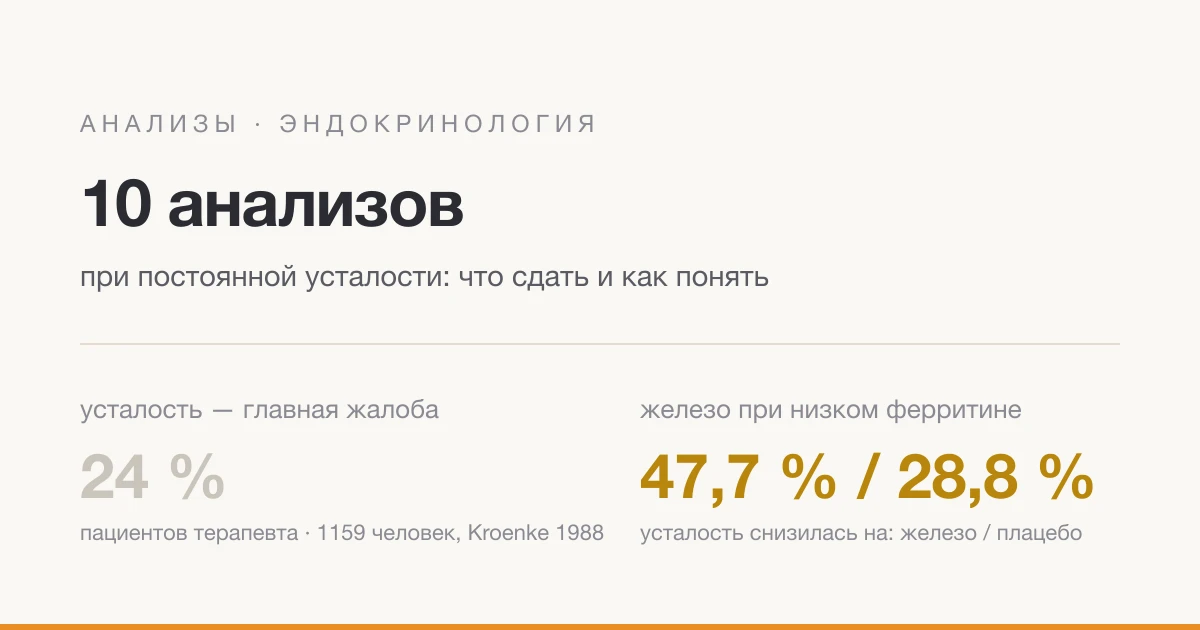
Fatigue is one of the most common complaints in primary care: of 1159 patients, 24% called it a major problem (Kroenke K JAMA 1988. PMID 3398197[1]). A targeted set of tests helps avoid missing correctable causes.
| Test | What it shows | When to see a doctor / reference point |
|---|---|---|
| Ferritin | Iron stores | Below 15 µg/L (15 ng/mL) — deficiency, with inflammation — below 70 µg/L (70 ng/mL) (WHO 2020); below 30 µg/L (30 ng/mL) — “low stores”, a common practical threshold (Snook 2021) |
| TSH (thyroid-stimulating hormone) and free T4 (thyroxine) | Thyroid | TSH 4.0–10.0 mIU/L (4.0–10.0 µIU/mL) — mildly raised, above 10 mIU/L (10 µIU/mL) — markedly raised; T4 — by the laboratory range (Pearce 2013) |
| Vitamin D, 25(OH)D (25-hydroxyvitamin D) | Vitamin D stores | Below 50 nmol/L (20 ng/mL) — inadequate (Ross 2011) |
| Vitamin B12 | B12 stores | Below 133 pmol/L (180 pg/mL) — deficiency; 133–258 pmol/L (180–350 pg/mL) — grey zone, a second test is needed (UK guidance 2024) |
| Fasting glucose and insulin, HOMA-IR (homeostatic model assessment of insulin resistance) | Blood sugar and insulin sensitivity | Glucose: see a doctor if repeatedly below 3.0 mmol/L (54 mg/dL) or above 8.9 mmol/L (160 mg/dL) (author's rule); 5.6–6.9 mmol/L (100–125 mg/dL) — prediabetes (American Diabetes Association — ADA, 2026); HOMA-IR — no single threshold, 2.7 is often used (Geloneze 2009) |
| Glycated haemoglobin (HbA1c) | Average blood sugar over recent months | 39–47 mmol/mol (5.7–6.4%) — prediabetes, from 48 mmol/mol (6.5%) — diabetes (ADA 2026) |
| Morning blood cortisol | Rule out adrenal insufficiency | Below 140 nmol/L (5 µg/dL) — a confirmatory test is needed (Bornstein 2016) |
| Full blood count | Anaemia | Haemoglobin below 120 g/L (12 g/dL) in women, below 130 g/L (13 g/dL) in men (WHO 2024) |
| ALT (alanine aminotransferase) | Liver | The laboratory limit is usually up to 40 U/L (667 nkat/L) in men and up to 30 U/L (500 nkat/L) in women; “healthy” limits — up to 30 U/L (500 nkat/L) in men and up to 19 U/L (317 nkat/L) in women (Prati 2002) |
| CRP (C-reactive protein) | Inflammation | Persistently above 10 mg/L (1.0 mg/dL) — look for the cause (Pepys 2003) |
Iron and blood
Ferritin shows iron stores. A shortage of iron causes fatigue even without anaemia: in a randomised trial in 198 menstruating women aged 18–53 with fatigue, normal haemoglobin and ferritin below 50 µg/L (50 ng/mL), taking iron for 12 weeks reduced fatigue by 47.7% versus 28.8% on placebo (Vaucher P CMAJ 2012. PMID 22777991[2]).
The threshold of 15 µg/L (15 ng/mL), and 70 µg/L (70 ng/mL) with infection or inflammation, comes from the WHO guideline (WHO 2020. PMID 33909381[3]); 30 µg/L (30 ng/mL) is a common practical threshold for low iron stores, used by the British Society of Gastroenterology (Snook J Gut 2021. PMID 34497146[4]).
A full blood count shows anaemia: it can present with fatigue, dizziness and breathlessness on exertion (WHO 2024. PMID 38530913[5]). Among people who see a doctor about fatigue, anaemia is found in 2.8% (Stadje R BMC Fam Pract 2016. PMID 27765009[6]).
Thyroid
In subclinical hypothyroidism — when TSH is raised but free T4 is normal — the complaints include marked fatigue; if it is present, according to one good-quality study it may lessen with treatment. In this case both tests are repeated after 2–3 months together with TPO (thyroid peroxidase) antibodies (Pearce SH Eur Thyroid J 2013. PMID 24783053[7]). More in the article on normal TSH.
Blood sugar
Fasting glucose and HbA1c are needed so as not to miss diabetes: glucose from 7.0 mmol/L (126 mg/dL) means diabetes, confirmed by a repeat test; the prediabetes thresholds are in the table (ADA Diabetes Care 2026. PMID 41358893[8]). HbA1c is part of the core set of the UK National Institute for Health and Care Excellence (NICE) for long-term fatigue (NICE NG206, 2021).
HOMA-IR = fasting glucose (mmol/L) × fasting insulin (µU/mL) / 22.5, or glucose (mg/dL) × insulin / 405. The index agrees with the reference method for assessing insulin resistance: correlation coefficient 0.88 (Matthews DR Diabetologia 1985. PMID 3899825[9]). Above 2.7 means insulin resistance according to the Brazilian Metabolic Syndrome Study, BRAMS (Geloneze B Arq Bras Endocrinol Metabol 2009. PMID 19466221[10]).
Vitamins D and B12
In a double-blind trial in 120 otherwise healthy young people (mean age 29) with fatigue and vitamin D below 50 nmol/L (20 ng/mL), a single dose of vitamin D led to improvement in 72% versus 50% on placebo (Nowak A Medicine 2016. PMID 28033244[11]). A level from 50 nmol/L (20 ng/mL) is enough for at least 97.5% of people, according to the US Institute of Medicine (IOM) (Ross AC J Clin Endocrinol Metab 2011. PMID 21118827[12]).
Unexplained fatigue is on the list of common signs of B12 deficiency, together with “brain fog”, pins and needles and numbness; the thresholds in the table come from the same source (NICE NG239, 2024). More in the article on B12 deficiency.
Liver, inflammation, cortisol
Liver tests are also part of the NICE core set. If ALT is raised, the liver is checked for fatty liver disease and viral hepatitis (Kwo PY Am J Gastroenterol 2017. PMID 27995906[13]). The “healthy” limits from the table identified people with hepatitis C virus in the blood better than the usual ones (Prati D Ann Intern Med 2002. PMID 12093239[14]). More in the article on ALT.
CRP shows inflammation: in 99% of healthy young blood donors it is not above 10 mg/L (1.0 mg/dL), and if it is persistently higher, an examination and a search for the cause are needed (Pepys MB J Clin Invest 2003. PMID 12813013[15]).
Morning blood cortisol is measured to rule out adrenal insufficiency: its signs include weakness and fatigue; they are nonspecific, and the diagnosis is often made late. If cortisol is low, a test with ACTH (adrenocorticotropic hormone) is needed: a peak below 500 nmol/L (18 µg/dL) indicates insufficiency (Bornstein SR J Clin Endocrinol Metab 2016. PMID 26760044[16]).
How to prepare for the tests
- Glucose and insulin are taken fasting — no calories for at least 8 hours (ADA Diabetes Care 2026. PMID 41358893[8]).
- Cortisol — in the morning, blood is drawn between 6 and 10 am (Bornstein SR J Clin Endocrinol Metab 2016. PMID 26760044[16]).
- Ferritin — together with CRP: with inflammation, ferritin is read against a different threshold (WHO 2020. PMID 33909381[3]).
- Check the reference ranges against your own laboratory's report; for B12 NICE advises exactly this (NICE NG239, 2024).
Who should see a doctor first
- If fatigue comes with breathlessness on exertion, palpitations or chest pain — this is how anaemia can present.
- If there is weight loss, abdominal pain and salt craving — this is how adrenal insufficiency can present (Bornstein SR J Clin Endocrinol Metab 2016. PMID 26760044[16]).
- If there is numbness, pins and needles or difficulty concentrating — these are common signs of B12 deficiency.
- If glucose is repeatedly below 3.0 mmol/L (54 mg/dL) or above 8.9 mmol/L (160 mg/dL) — the author's rule.
- In pregnancy the ranges are different: anaemia in the 1st and 3rd trimester is haemoglobin below 110 g/L (11 g/dL) (WHO 2024. PMID 38530913[5]); tests are ordered by the doctor managing the pregnancy.
Bottom line
Tests are a good first step: in 8 out of 100 people with new unexplained fatigue they find a disease, and a targeted set is better than a long one, which gives more false abnormalities (Koch H Br J Gen Pract 2009. PMID 19341544[17]). If everything is normal, a doctor will help look further: for example, depression is found in 18.5% of people who see a doctor about fatigue (Stadje R BMC Fam Pract 2016. PMID 27765009[6]). You can go through your results at a consultation.
Caveats
- Ferritin. WHO gives 70 µg/L (70 ng/mL) only for infection or inflammation, and it is a conditional recommendation with low certainty of evidence (WHO 2020. PMID 33909381[3]); without inflammation, 70 µg/L (70 ng/mL) is a practice reference point, not a proven threshold. 50 µg/L (50 ng/mL) in Vaucher is the trial's inclusion criterion, not a reference range.
- Vitamin D. 75 nmol/L (30 ng/mL) is called a “desirable” level following the Endocrine Society's 2011 guideline; the IOM disagreed (Rosen CJ J Clin Endocrinol Metab 2012. PMID 22442278[18]), and in 2024 the society does not set target levels (Demay MB J Clin Endocrinol Metab 2024. PMID 38828931[19]). For fatigue, NICE leaves this test to the doctor's judgement (NICE NG206, 2021).
- Insulin and HOMA-IR are the weakest item: they are neither in the NICE core set nor in the ADA diagnostic criteria, and the thresholds in studies range from 1.6 to 3.8 (Gayoso-Diz P BMC Endocr Disord 2013. PMID 24131857[20]).
- Cortisol. The thresholds of 140 nmol/L (5 µg/dL) and 500 nmol/L (18 µg/dL) apply if the person is not receiving treatment that itself changes cortisol; the ACTH test result depends on the laboratory method (Bornstein SR J Clin Endocrinol Metab 2016. PMID 26760044[16]).
- Iron and vitamin D. Fatigue decreased in people with initially low levels; in people without a deficiency the effect was not studied in these trials.
- Not the whole set. The NICE core set for long-term fatigue also includes urinalysis, urea and electrolytes, calcium and phosphate, coeliac screening, CK (creatine kinase) and ESR (erythrocyte sedimentation rate) (NICE NG206, 2021).
This material is for information only and does not replace a consultation with a doctor. Test results are interpreted and treatment is decided by your doctor.
References
- Kroenke K JAMA 1988. PMID 3398197
- Vaucher P CMAJ 2012. PMID 22777991
- WHO 2020. PMID 33909381
- Snook J Gut 2021. PMID 34497146
- WHO 2024. PMID 38530913
- Stadje R BMC Fam Pract 2016. PMID 27765009
- Pearce SH Eur Thyroid J 2013. PMID 24783053
- ADA Diabetes Care 2026. PMID 41358893
- Matthews DR Diabetologia 1985. PMID 3899825
- Geloneze B Arq Bras Endocrinol Metabol 2009. PMID 19466221
- Nowak A Medicine 2016. PMID 28033244
- Ross AC J Clin Endocrinol Metab 2011. PMID 21118827
- Kwo PY Am J Gastroenterol 2017. PMID 27995906
- Prati D Ann Intern Med 2002. PMID 12093239
- Pepys MB J Clin Invest 2003. PMID 12813013
- Bornstein SR J Clin Endocrinol Metab 2016. PMID 26760044
- Koch H Br J Gen Pract 2009. PMID 19341544
- Rosen CJ J Clin Endocrinol Metab 2012. PMID 22442278
- Demay MB J Clin Endocrinol Metab 2024. PMID 38828931
- Gayoso-Diz P BMC Endocr Disord 2013. PMID 24131857
Key facts
- Fatigue is one of the most common complaints in primary care: of 1159 patients, 24% called it a major problem (Kroenke K, JAMA 1988).
- Ferritin below 15 µg/L (15 ng/mL) means iron deficiency according to WHO, and with infection or inflammation below 70 µg/L (70 ng/mL); below 30 µg/L (30 ng/mL) is a common practical threshold for low stores (WHO 2020; Snook J, Gut 2021).
- In menstruating women aged 18–53 with fatigue, without anaemia and with ferritin below 50 µg/L (50 ng/mL), taking iron for 12 weeks reduced fatigue by 47.7% versus 28.8% on placebo (Vaucher P, CMAJ 2012).
- Vitamin D below 50 nmol/L (20 ng/mL) is inadequate (US Institute of Medicine, 2011); in 120 otherwise healthy young people (mean age 29) with fatigue and this level, a single dose of vitamin D led to improvement in 72% versus 50% on placebo (Nowak A, Medicine 2016).
- Fasting glucose of 5.6–6.9 mmol/L (100–125 mg/dL) or glycated haemoglobin (HbA1c) of 39–47 mmol/mol (5.7–6.4%) means prediabetes (American Diabetes Association, 2026); the author's rule: see a doctor if glucose is repeatedly below 3.0 mmol/L (54 mg/dL) or above 8.9 mmol/L (160 mg/dL).