in pictures and a few words
What it is and why it matters
TSH is the hormone used to check the thyroid. It’s a simple, inexpensive blood test — the first step of a check-up.
- Helps find early changes a person doesn’t know about
- It’s a first step, not a diagnosis
- Tiredness has other causes too: low iron, poor sleep, stress
How it works
TSH is made by a small gland at the base of the brain. It works like a volume control for the thyroid.
- Too little thyroid hormone — the brain “turns up” TSH
- Too much thyroid hormone — the brain “turns down” TSH
What’s normal
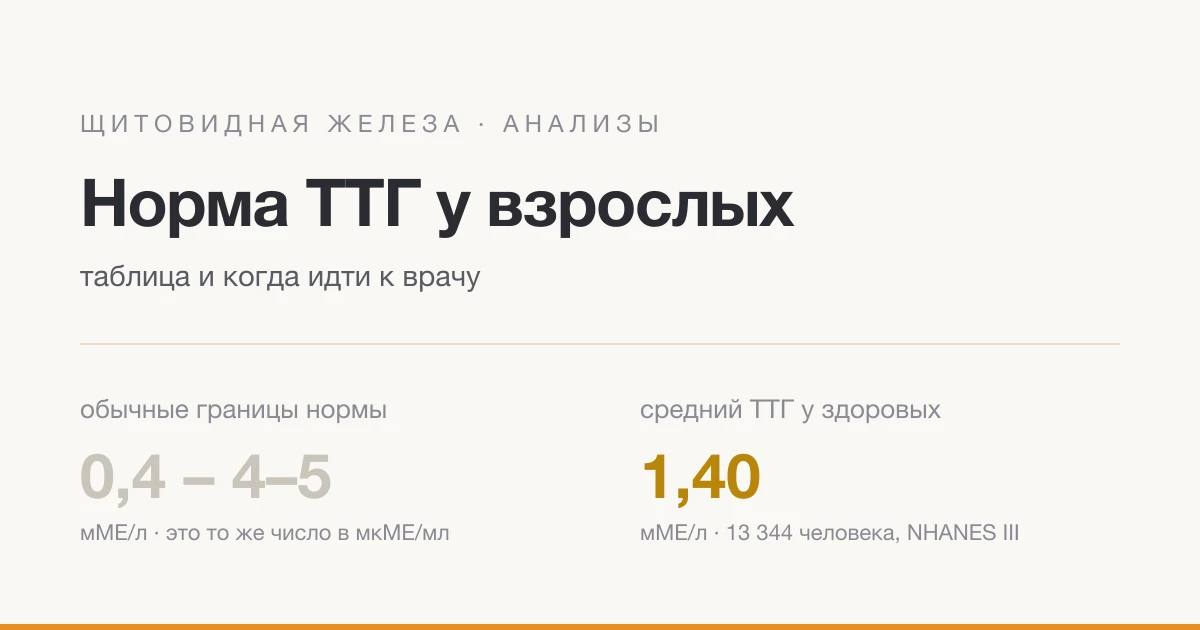
Normal TSH is usually about 0.4 to 4–5 mIU/L (0.4 to 4–5 µIU/mL). The exact limits are on your lab’s report form.
- Compare your result with the limits on your own report
- mIU/L, µIU/mL and mU/L are different labels, but the number is the same
- TSH is normal — nothing to do; repeat as your doctor advises
Tested in people. Tested in people: with normal TSH, a change in the next few years was rare.
Normal is higher with age
In healthy people, TSH is higher with age — that’s normal. In older people, a mild rise often turns out to be normal for their age.
- In young people the upper limit is lower; after 80 it is noticeably higher
- Doctors advise taking age-specific ranges into account
- After 80–85, with TSH up to 10 mIU/L (10 µIU/mL), people are usually monitored without treatment
Tested in people. Tested in people: in most older people with TSH above the usual limit, it was within the normal range for their age.
A mild rise often goes away
TSH above the limit on your report, but up to 10 mIU/L (10 µIU/mL), is a mild rise. It is often temporary and goes away on its own.
- After 2–3 months, TSH, the thyroid hormone itself and thyroid antibodies are retested
- If you have symptoms, see a doctor
- High TSH together with low thyroid hormone is a reason to see a doctor
Tested in people. Tested in people: in more than half, a mild rise went away without treatment within a few years.
Not everyone needs tablets
Most people with a mild TSH rise are monitored without treatment. If a doctor prescribes tablets because of symptoms, the effect is judged 3–4 months after TSH is back in range; if there’s no improvement, they are usually stopped.
- With a mild rise, tablets did not noticeably improve well-being, tiredness or mood
- TSH above 10 mIU/L (10 µIU/mL), confirmed by a repeat test: under 65–70, many advise treatment even without symptoms
Honestly. Doctors disagree, especially with TSH from 10 to 20 mIU/L (10–20 µIU/mL). The decision about treatment is made together with a doctor.
If TSH is low
Low TSH may mean the thyroid is working too hard. A mild drop is often temporary, and young people without symptoms are usually just monitored.
- 0.1–0.39 mIU/L (0.1–0.39 µIU/mL) — retest together with thyroid hormones
- Over 65 or with a racing heart — see a doctor even for a mild drop
- Below 0.1 mIU/L (0.1 µIU/mL) — see a doctor soon
Important. Persistent TSH below 0.1 mIU/L (0.1 µIU/mL) is linked to risks for the heart and bones. Treatment is discussed with a doctor.
What can skew the result
TSH is affected by more than the thyroid. Sometimes biotin, the time of day or a serious illness throws off the result.
- Biotin — a vitamin for hair and nails — can distort the test
- TSH rises at night — retest at about the same time of day
- After a serious illness TSH can be off — the test is repeated after recovery
Honestly. Biotin can push results either up or down, so it’s important to tell your doctor about it.
Who should see a doctor first
In these cases it’s better to see a doctor. A diagnosis is confirmed with a repeat test.
- Pregnancy or planning one — the ranges are different; discuss TSH with a doctor right away
- TSH below 0.1 mIU/L (0.1 µIU/mL) or above 10 mIU/L (10 µIU/mL)
- Racing heart, trembling, weight loss for no reason, severe weakness, feeling cold — at any TSH
Important. If you take biotin, hormonal anti-inflammatory medicines or thyroid hormone, tell your doctor before the test.
In one sentence
TSH is a simple first step in checking the thyroid. Normal is usually 0.4 to 4–5 mIU/L (0.4 to 4–5 µIU/mL) — more precisely, on your report — and it is higher with age. A mild deviation often goes away on its own; it is confirmed with a repeat test.
Key points
What TSH is
TSH is made by the pituitary gland at the base of the brain. It works like a volume control: when there is too little thyroid hormone, the pituitary “turns up” TSH; when there is too much, it “turns it down”.
The units mIU/L (milli-international units per liter), mU/L (milliunits per liter) and the American µIU/mL (micro-international units per milliliter) give the same number: 2.0 mIU/L = 2.0 µIU/mL.
Normal range and age
In the NHANES III survey (the US National Health and Nutrition Examination Survey), the reference group (13,344 people without thyroid disease or antibodies) had a mean TSH of 1.40 mIU/L (1.40 µIU/mL); it is higher in women and rises with age (Hollowell JG J Clin Endocrinol Metab 2002. PMID 11836274[1]).
Of older people with TSH above 4.5 mIU/L (4.5 µIU/mL), 70% were within the reference interval for their age (Surks MI J Clin Endocrinol Metab 2007. PMID 17911171[4]). The ETA advises taking age-specific reference intervals into account and usually monitoring people over 80–85 with TSH up to 10 mIU/L (10 µIU/mL) without treatment (Pearce SH Eur Thyroid J 2013. PMID 24783053[3]).
What your TSH means and when to see a doctor
| TSH | What it may mean | What to do |
|---|---|---|
| Below 0.1 mIU/L (0.1 µIU/mL) | Possibly an overactive thyroid (hyperthyroidism) | See a doctor soon; test free T4 and free T3 |
| 0.1–0.39 mIU/L (0.1–0.39 µIU/mL) | Mild decrease, often temporary | Retest with free T4 and free T3; if over 65 or with palpitations, see a doctor |
| 0.4–4.0 mIU/L (0.4–4.0 µIU/mL) | Usual normal range (check your lab report) | Nothing; repeat as your doctor advises |
| 4.0–10 mIU/L (4.0–10 µIU/mL) | Mild rise; often temporary, in older people often normal for age | Retest TSH, free T4 and TPO antibodies after 2–3 months; with symptoms, see a doctor |
| Above 10 mIU/L (10 µIU/mL) | A more marked rise | See a doctor: the decision on treatment is made individually |
In the table: free T4 — free thyroxine; free T3 — free triiodothyronine; TPO antibodies — antibodies to thyroid peroxidase. Thresholds follow ETA guidelines (Pearce SH Eur Thyroid J 2013. PMID 24783053[3]; Biondi B Eur Thyroid J 2015. PMID 26558232[6]); otherwise, use your laboratory’s limits. “Often temporary” for low TSH comes from an observational study in which low TSH was defined as below 0.35 mIU/L (0.35 µIU/mL): it normalized in more than half (Meyerovitch J Arch Intern Med 2007. PMID 17646608[5]).
With a normal TSH, the chance of an abnormal result over the next 5 years is about 2% (Meyerovitch J Arch Intern Med 2007. PMID 17646608[5]). If TSH is high and free T4 is below normal, that is overt hypothyroidism — with this result, see a doctor.
Next step: free T4
TSH above normal with normal free T4 is called subclinical (mild) hypothyroidism. Up to 10% of adults have it, usually because of Hashimoto’s thyroiditis; with positive TPO antibodies, the risk of progressing to overt hypothyroidism is higher. Most people are monitored without treatment (Biondi B JAMA 2019. PMID 31287527[2]).
According to the ETA, in people under 65–70, treatment is recommended for TSH above 10 mIU/L (10 µIU/mL) even without symptoms; at lower values with symptoms, tablets are tried and the effect is assessed 3–4 months after TSH has returned to normal; if there is no improvement, they are usually stopped (Pearce SH Eur Thyroid J 2013. PMID 24783053[3]).
The diagnosis is made if low TSH persists on a repeat test. Persistent TSH below 0.1 mIU/L (0.1 µIU/mL) is linked to a risk of atrial fibrillation, heart failure and fractures, and after 65 treatment is indicated, although there are no randomized trials; young people without symptoms with TSH of 0.1–0.39 mIU/L (0.1–0.39 µIU/mL) are monitored (Biondi B Eur Thyroid J 2015. PMID 26558232[6]).
What distorts the result
TSH is not the whole picture
TSH is an excellent first step, but it is not a diagnosis. We read test results as a series, not a single point, and look at the whole system: a repeat test, free T4, antibodies, symptoms and other causes of fatigue — iron, vitamin B12, sleep, stress. More in the article TSH is a pituitary hormone, not a thyroid one.
What the studies showed
| What was studied | Who took part | Result |
|---|---|---|
| NHANES III, 2002 | 17,353 people aged 12 and over, USA | Reduced thyroid function in 4.6% (overt hypothyroidism 0.3%), increased in 1.3% |
| Age-specific norms, 2007 | People without thyroid disease | Upper limit 3.56 mIU/L (3.56 µIU/mL) at 20–29 and 7.49 mIU/L (7.49 µIU/mL) after 80 |
| Retesting over 5 years, 2007 | 346,549 untreated people | TSH of 5.5–10 mIU/L (5.5–10 µIU/mL) normalized in 62.1%, above 10 mIU/L (10 µIU/mL) in 27.2% |
| Daily rhythm, 2015 | 465,593 TSH measurements | Reference interval depends on age, sex and time of day; difference between sexes no more than 0.1 mIU/L (0.1 µIU/mL) |
| Biotin 10 mg a day for a week, 2017 | 6 healthy adults | 9 of 23 biotin-based tests distorted |
| Tablets for mild hypothyroidism, 2019 | 21 studies, 2,192 adults | No clinically meaningful benefit for quality of life or symptoms (moderate- and high-quality evidence) |
Guidelines disagree for TSH of 10–20 mIU/L (10–20 µIU/mL). In 21 studies, tablets for mild hypothyroidism gave no clinically meaningful benefit for quality of life, fatigue or depressive symptoms (moderate- and high-quality evidence). A BMJ (British Medical Journal) panel advises against them for most adults, except people planning pregnancy, people with TSH above 20 mIU/L (20 µIU/mL), possibly young adults under 30, and people with marked symptoms (Bekkering GE BMJ 2019. PMID 31088853[10]). Here, the ETA recommends treatment for people under 65–70.
Who should be more careful
- Pregnant women and those planning pregnancy: norms are different; discuss your TSH with a doctor right away.
- With TSH below 0.1 mIU/L (0.1 µIU/mL) or above 10 mIU/L (10 µIU/mL), see a doctor; the diagnosis is confirmed by a repeat test.
- With palpitations, tremor, unexplained weight loss, marked weakness or feeling cold, see a doctor whatever your TSH.
- If you take biotin, glucocorticoids or thyroid hormone, tell your doctor before the test.
Bottom line
TSH is a simple, inexpensive test and the first step in checking the thyroid. The usual normal range is roughly 0.4 to 4–5 mIU/L (0.4 to 4–5 µIU/mL), and it is higher with age; a mild deviation often goes away on its own, so it is confirmed by a repeat test with free T4. You can go through all your results in a consultation.
This material is for information only and does not replace a doctor’s consultation. Norms depend on the laboratory; decisions about treatment are made by a doctor.
References
- Hollowell JG J Clin Endocrinol Metab 2002. PMID 11836274
- Biondi B JAMA 2019. PMID 31287527
- Pearce SH Eur Thyroid J 2013. PMID 24783053
- Surks MI J Clin Endocrinol Metab 2007. PMID 17911171
- Meyerovitch J Arch Intern Med 2007. PMID 17646608
- Biondi B Eur Thyroid J 2015. PMID 26558232
- Li D JAMA 2017. PMID 28973622
- Ehrenkranz J Thyroid 2015. PMID 26061389
- Young R Crit Care Resusc 2004. PMID 16556110
- Bekkering GE BMJ 2019. PMID 31088853
Key facts
- The traditional upper limit of normal for TSH (thyroid-stimulating hormone) is 4–5 mIU/L (4–5 µIU/mL), and the exact limits depend on the laboratory; the European Thyroid Association (ETA) considers 4.0–10 mIU/L (4.0–10 µIU/mL) a mild rise (Biondi B, JAMA 2019; Pearce SH, Eur Thyroid J 2013).
- In healthy people, the upper limit of TSH (thyroid-stimulating hormone) is 3.56 mIU/L (3.56 µIU/mL) at age 20–29 and 7.49 mIU/L (7.49 µIU/mL) after age 80 (Surks MI, J Clin Endocrinol Metab 2007).
- TSH (thyroid-stimulating hormone) of 5.5–10 mIU/L (5.5–10 µIU/mL) returned to normal without treatment in 62.1% of people over 5 years of follow-up (Meyerovitch J, Arch Intern Med 2007).
- A raised TSH (thyroid-stimulating hormone) with normal free thyroxine is retested together with free thyroxine and thyroid peroxidase antibodies after 2–3 months (Pearce SH, Eur Thyroid J 2013).
- Biotin 10 mg a day for one week distorted 9 of 23 biotin-based laboratory tests in 6 healthy adults (Li D, JAMA 2017).