in pictures and a few words
Why it’s worth looking into
Hands and feet that feel cold even when it’s warm are a common complaint. The good news: many causes are easy to check.
- Some causes are found with a blood test, others with an exam
- Many of them can be treated
- Everyone’s hands get cold in frosty weather; it’s worth looking into when they feel cold all the time
An underactive thyroid
Thyroid hormones set the pace of metabolism and heat production. When there are too few of them, a person may feel cold.
- No single sign is reliable on its own
- So even a slight suspicion is a reason to get a blood test
- It’s easy to find and treat, although some people keep having symptoms
Important. Feeling cold together with tiredness, weight gain, dry skin and constipation is a reason to have your thyroid checked.
Low iron and anemia
In a small study, women with anemia due to low iron had a lower body temperature in cool water than healthy women.
- A course of iron corrected the anemia and improved body temperature
- Iron stores are checked together with a test for inflammation — that’s more reliable
Honestly. With depleted iron stores but no anemia, no difference was seen. But there were few people: effect not shown, not “no effect”.
Fingers turn white in the cold
In the cold or under stress, the fingers suddenly turn white, then blue, and then red. This is the small blood vessels of the fingers narrowing for a while.
- It’s common — more often in women, with a family history, smoking and migraine
- Sometimes it’s the first sign of another disease — a doctor can examine the blood vessels near the nail
Important. Sores or small wounds on the fingertips — see a doctor without delay.
Less food — lower body temperature
When a person eats noticeably less for a long time, the body uses less energy — and body temperature may drop.
- This was seen in people with excess weight who cut calories for a long time
- On a strict diet, it’s worth having your nutrition assessed
Honestly. There are no data on feeling cold specifically with low body weight. Only a drop in body temperature was seen.
Narrowed leg arteries
With smoking, diabetes and age, plaques build up in the leg arteries — and less blood reaches the feet.
- The check is simple: a doctor compares the blood pressure at the ankle and at the arm
- It’s worth discussing if your calves hurt, after age 65, or after 50 if you smoke or have diabetes
Important. Calf pain when walking that goes away with rest — a planned visit to a doctor.
Numbness, not cold
Numbness and tingling in the feet are sometimes described as “my feet are cold”. That’s a reason to check vitamin B12.
- When vitamin B12 is low, the nerves suffer
- Feeling cold itself hasn’t been studied in B12 deficiency
- A clue: large red blood cells in a complete blood count
Important. Numbness, tingling or an unsteady walk — check B12 without putting it off: early treatment helps prevent nerve damage.
Which tests to discuss
Some causes are checked with blood tests, others with an exam. Which ones you need is for your doctor to decide.
- The hormone used to check the thyroid
- Iron stores together with a test for inflammation, and a complete blood count
- If there’s numbness — vitamin B12
Honestly. Normal ranges depend on the lab, so it’s best to go over the results with a doctor.
Who should see a doctor first
With these signs, it’s better not to wait — they differ in urgency.
- A suddenly cold, pale and painful arm or leg — call an ambulance
- Sores or small wounds on the fingertips — see a doctor without delay
- Calf pain when walking that goes away with rest — a planned visit to a doctor
Important. Numbness or an unsteady walk — check B12 without putting it off.
In one sentence
Hands and feet that are always cold are a reason to check your thyroid, iron and blood together with a doctor. Many causes are easy to check, and many of them can be treated.
Key points
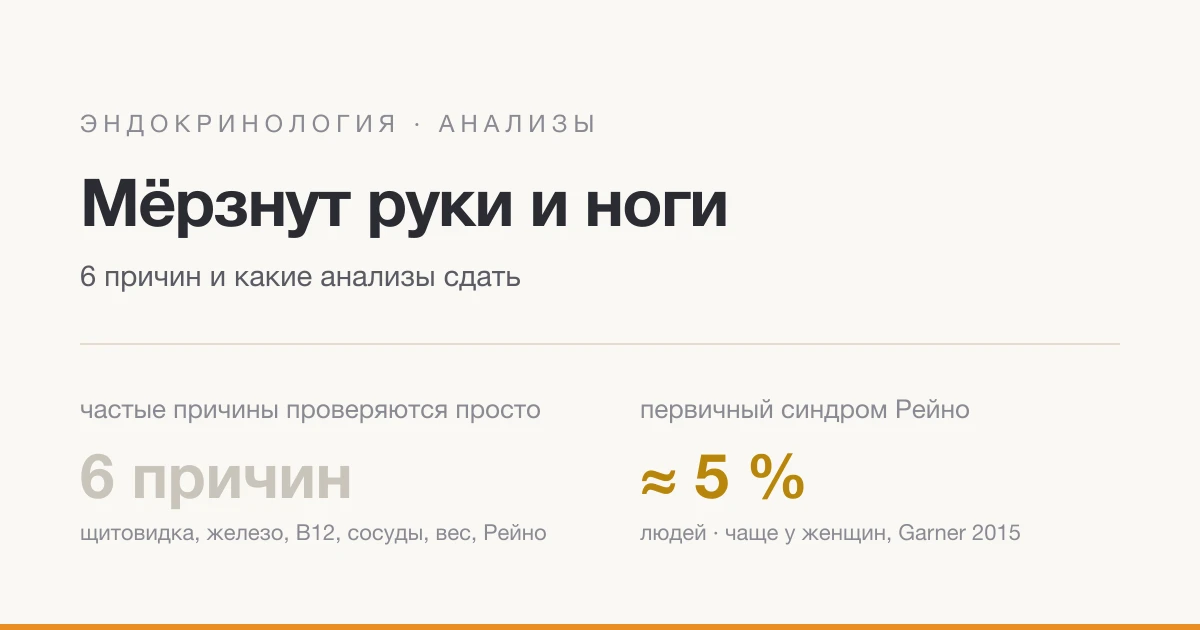
6 causes at a glance
- Hypothyroidism — the thyroid gland makes too little hormone.
- Low iron and anemia.
- Raynaud's phenomenon — attacks of spasm in the small blood vessels of the fingers.
- Eating too little.
- Narrowing of the leg arteries — more common in smokers, in people with diabetes and with age.
- Vitamin B12 deficiency — not feeling cold, but numbness that is sometimes mistaken for cold.
In frosty weather everyone's hands get cold; it is worth looking into when they feel cold all the time, even in the warmth.
1. Hypothyroidism
Thyroid hormones set the pace of metabolism and heat production. When they are low, a person may feel cold; this often comes with fatigue, sluggishness, weight gain, constipation and dry skin (Chaker L Lancet 2017. PMID 28336049[1]).
But symptoms are misleading. A Danish study compared 140 people with newly diagnosed overt autoimmune hypothyroidism with 560 healthy people: the most common complaint was fatigue (81%), but neither the presence nor the absence of any single symptom helped decide who needed a test (Carlé A Eur J Endocrinol 2014. PMID 25305308[5]).
2. Low iron and anemia
In a study of 10 women with iron-deficiency anemia, 8 with depleted iron stores but no anemia, and 12 healthy people, after 100 minutes in 28 °C water body temperature was lower with anemia — 36.0 vs 36.2 °C. A course of iron corrected the anemia and improved body temperature (Beard JL Am J Clin Nutr 1990. PMID 2239756[2]).
3. Vitamin B12 deficiency
Feeling cold with B12 deficiency has not been studied, but a lack of it damages the nerves (Devalia V Br J Haematol 2014. PMID 24942828[6]). Numbness and tingling in the feet are sometimes described as “my feet are cold” — this is a reason to check B12. More in the article on B12 deficiency.
4. Raynaud's phenomenon
In the cold or with emotional stress, the fingers suddenly turn white, then blue, and then red. According to a review of 33 studies (33,733 people), primary Raynaud's, not linked to another disease, occurs in 4.85% of people (the review's estimate ranges from 2 to 9%). The odds are higher in women (1.65-fold), with a family history, smoking and migraine (Garner R BMJ Open 2015. PMID 25776043[3]).
Sometimes Raynaud's is secondary — the first sign of a connective tissue disease. In a review of 639 people with primary Raynaud's followed for about 4 years on average, such a disease developed in 12.6%. It was best predicted by capillaroscopy — examining the small blood vessels at the base of the nail under magnification: with abnormal capillaries the disease developed in 47%, with antinuclear antibodies in 30% (Spencer-Green G Arch Intern Med 1998. PMID 9521223[4]).
5. Eating too little and low weight
In a study of 48 healthy overweight people (4 groups), those who ate 25% fewer calories for six months had a drop in body temperature, and their energy expenditure fell more than expected from weight loss (Heilbronn LK JAMA 2006. PMID 16595757[7]). There are no data on feeling cold specifically with low weight; on a strict diet it is worth reviewing your nutrition.
6. Narrowed leg arteries
With smoking, diabetes and age, plaques build up in the leg arteries, and less blood reaches the feet. A typical sign is calf pain when walking that goes away at rest. According to a review of 34 studies (112,027 people), in high-income countries narrowing of the leg arteries (peripheral artery disease) affects about 5% of people aged 45–49 and 18–19% of those aged 85–89; smoking raises the odds 2.7-fold, diabetes 1.9-fold (Fowkes FG Lancet 2013. PMID 23915883[8]).
The check is simple: the doctor compares blood pressure at the ankle and at the arm (the ankle-brachial index); 0.90 or lower indicates narrowed arteries (Fowkes FG Lancet 2013. PMID 23915883[8]).
Which tests to discuss with your doctor
If your calves hurt when walking, if you are over 65, or over 50 and smoke or have diabetes, discuss the ankle-brachial index (Gornik HL Circulation 2024. PMID 38743805[11]), and if secondary Raynaud's is suspected, capillaroscopy and antinuclear antibodies.
What the studies showed
| What was studied | Participants | Result |
|---|---|---|
| Symptoms of hypothyroidism, 2014 | 140 with overt autoimmune hypothyroidism, 560 healthy | No single symptom is reliable on its own |
| Cooling and iron, 1990 | 10 women with anemia, 8 with depleted stores, 12 healthy | With anemia, body temperature was lower (36.0 vs 36.2 °C); iron improved it |
| Primary Raynaud's, review, 2015 | 33 studies, 33,733 people | Prevalence 4.85% (2 to 9%); more common in women |
| Outcome of primary Raynaud's, 1998 | 639 people, about 4 years of follow-up | Secondary disease in 12.6% |
| Cutting calories by 25%, 2006 | 48 overweight people, 4 groups | Body temperature fell |
| Narrowing of the leg arteries, 2013 | 34 studies, 112,027 people | In high-income countries: 5% at 45–49, 18–19% at 85–89; smoking — odds ×2.7 |
Not everything is equally proven: in 8 women with depleted iron stores but no anemia, the response to cooling did not differ from healthy people, but the sample was small — this means “an effect was not shown”, not “there is no effect” (Beard JL Am J Clin Nutr 1990. PMID 2239756[2]).
Who should be more careful
- A suddenly cold, pale and painful arm or leg — call an ambulance (Björck M Eur J Vasc Endovasc Surg 2020. PMID 31899099[12]).
- Small sores or wounds on the fingertips — see a doctor promptly.
- Numbness, tingling or unsteady walking — get B12 checked without delay: early treatment helps avoid nerve damage.
- Calf pain when walking that goes away at rest — a planned visit to the doctor.
- Feeling cold together with fatigue, weight gain, dry skin and constipation — a reason to check your thyroid.
Bottom line
Many causes of constantly cold hands and feet are easy to check: some are found with blood tests (TSH, ferritin together with CRP, a complete blood count and, if you have numbness, B12), some on examination. Hypothyroidism and iron-deficiency anemia are treated. Primary Raynaud's affects about 5% of people, and 12.6% of them developed a secondary disease over about 4 years. You can sort out the causes and choose the right tests at a consultation.
This material is for information only and does not replace a consultation with a doctor. Tests and treatment are chosen by a doctor based on an examination.
References
- Chaker L Lancet 2017. PMID 28336049
- Beard JL Am J Clin Nutr 1990. PMID 2239756
- Garner R BMJ Open 2015. PMID 25776043
- Spencer-Green G Arch Intern Med 1998. PMID 9521223
- Carlé A Eur J Endocrinol 2014. PMID 25305308
- Devalia V Br J Haematol 2014. PMID 24942828
- Heilbronn LK JAMA 2006. PMID 16595757
- Fowkes FG Lancet 2013. PMID 23915883
- WHO 2020. PMID 33909381
- Allen LH Am J Clin Nutr 2009. PMID 19116323
- Gornik HL Circulation 2024. PMID 38743805
- Björck M Eur J Vasc Endovasc Surg 2020. PMID 31899099
Key facts
- Cold intolerance is one of the most common symptoms of hypothyroidism in adults, along with fatigue, weight gain, constipation and dry skin (Chaker L, Lancet 2017).
- In 10 women with iron-deficiency anemia, after 100 minutes in 28 °C water, body temperature was lower than in healthy people (36.0 vs 36.2 °C); a course of iron improved it (Beard JL, Am J Clin Nutr 1990).
- Primary Raynaud's phenomenon affects about 5% of people (the review's estimate ranges from 2 to 9%), more often women and people with a family history (Garner R, BMJ Open 2015).
- Of 639 people with primary Raynaud's phenomenon followed for about 4 years on average, 12.6% developed a secondary disease, almost always a connective tissue disease; the best predictor was abnormal capillaries at the base of the nail (Spencer-Green G, Arch Intern Med 1998).
- In high-income countries, narrowing of the leg arteries affects about 5% of people aged 45–49 and 18–19% of those aged 85–89; smoking raises the odds 2.7-fold (Fowkes FG, Lancet 2013).