A small organ with a big job: what everyone should know
A butterfly on the neck
The gland is small but has a generous blood supply.
- in an adult it is quite small
- blood passes through it again and again
- a tiny organ with a big job
A hormone store
The gland keeps ready hormone inside, like a pantry.
- the hormone is kept in the gland for several months
- in inflammation the store can spill into the blood
The iodine pump
The gland picks iodine out of the blood and stores it.
- iodine is needed for the hormone
- excess iodine briefly slows the work
- after a contrast CT almost always all is well
From precursor to working hormone
The gland mostly makes a precursor, and the hormone becomes active in the tissues.
- the precursor is called T4
- the working hormone T3 is assembled outside the gland
- selenium from food takes part
Works almost everywhere
Receptors for the hormone are in almost every cell.
- so complaints vary
- fatigue, feeling cold, constipation
- dry skin, weight gain
The remote control in the brain
The brain commands the gland through the hormone TSH.
- TSH is on average higher in the morning
- test at the same time of day
- repeat a small abnormality after a couple of months
Women and nodules
Gland disease is more common in women.
- neck nodules are a common finding
- most are benign
- if a nodule grows, see a doctor
What to do
A few simple habits.
- test TSH at the same time of day
- do not draw conclusions from one number
- tell your doctor about your thyroid before a CT
When to see a doctor
Some signs should not wait.
- a lump on the neck grows quickly
- hoarse voice, pain at the front of the neck
- persistent fatigue, feeling cold, constipation
- in older people palpitations and irregular beats
Important. Important: with such signs discuss tests with your doctor and do not diagnose yourself.
The main points
The thyroid is small but reliable: it has its own hormone store, fine tuning for iodine and a "remote control" in the brain. In most people it copes for years, and a few simple habits help catch a problem early: test TSH at the same time of day, repeat a small abnormality after 2 to 3 months and tell your doctor about your thyroid before a contrast CT.
| Fact | Number | Why it is useful to know | What the sources showed |
|---|---|---|---|
| 1. Size and blood flow | 6 to 20 g; 5 mL of blood per g of tissue per minute | A small gland with a generous blood supply | Endotext textbook: 0.4 per mille of body weight with 2% of blood flow (Maenhaut C Endotext 2015. PMID 25905409[1]) |
| 2. Hormone store | Several months; turnover about 1% a day | The gland keeps a store of ready hormone | Review and textbook chapter (Ahad F Indian J Endocrinol Metab 2010. PMID 21448409[2]; Rousset B Endotext 2015. PMID 25905405[3]) |
| 3. Iodine pump | Takes up about 20% of iodide per pass; concentrates it 20 to 50 times | Iodine is needed, but excess briefly slows synthesis | Textbook chapter; 422 people after contrast CT: no overt dysfunction (Rousset B Endotext 2015. PMID 25905405[3]; Carlqvist J Eur Thyroid J 2024. PMID 39400593[4]) |
| 4. From precursor to working hormone | 94 to 110 µg T4 and 10 to 22 µg T3 a day; about 80% of T3 made outside the gland | Tests and treatment take T4 to T3 conversion into account | Textbook and review (Rousset B Endotext 2015. PMID 25905405[3]; Mariotti S Endotext 2021. PMID 25905193[5]; Mullur R Physiol Rev 2014. PMID 24692351[6]) |
| 5. Works almost everywhere | Receptors in practically every cell | A problem causes varied complaints | Review and guidelines (Gereben B Endocr Rev 2008. PMID 18815314[7]; Chaker L Lancet 2017. PMID 28336049[8]) |
| 6. Remote control in the brain | TSH normal 0.4 to 4.0 mIU/L; higher in the morning | Test at the same time of day | 20,019 samples: above 4.0 mIU/L in 14.1% in the morning and 7.9% in the afternoon (Pearce S H S Eur Thyroid J 2013. PMID 24783053[9]; Andersen I B PLoS One 2015. PMID 26461522[10]) |
| 7. Women and nodules | Hypothyroidism in women 3.5 per 1000 a year, in men 0.6; nodules on ultrasound in 19 to 68% | Nodules are mostly benign | Cohorts of 2,779 and 9,705 people; ATA guideline (Vanderpump M P Clin Endocrinol 1995. PMID 7641412[11]; Benseñor I M Arch Endocrinol Metab 2021. PMID 33844894[12]; Haugen B R Thyroid 2016. PMID 26462967[13]) |
How to use these facts
If you have TSH tested, have blood drawn at about the same time of day: in the morning the value is on average higher. If the result is only slightly above normal, do not draw conclusions from one number: the recommendation is to repeat TSH with free T4 after 2 to 3 months. After a severe illness TSH can be temporarily raised, so a test right after recovery is also worth rechecking.
1. Size and blood flow
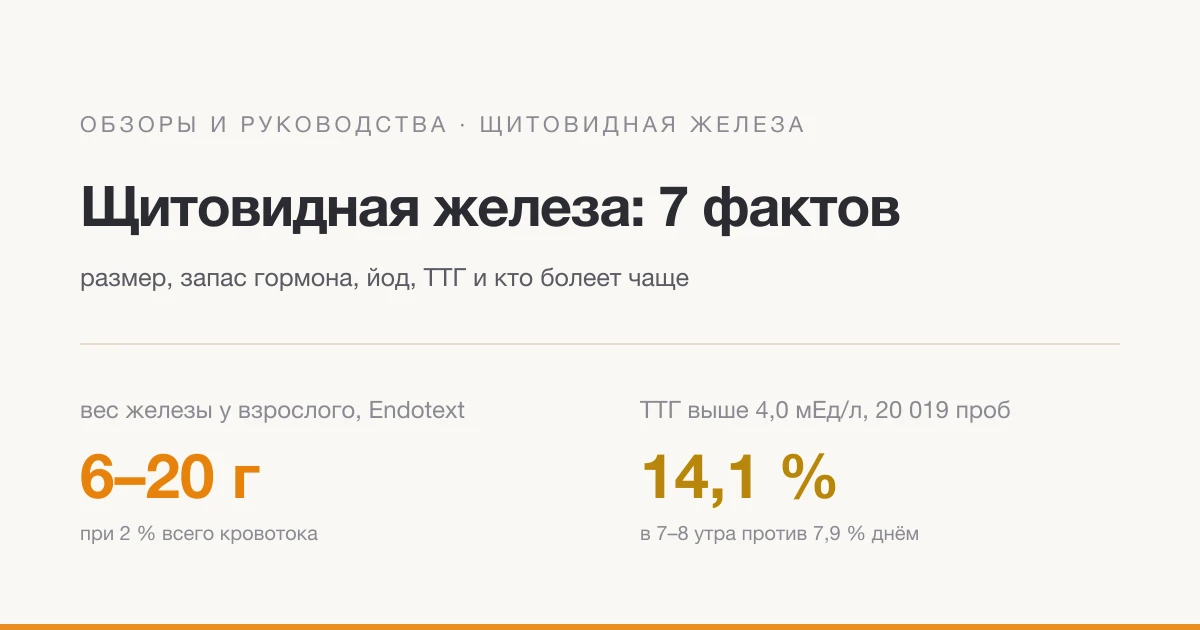
The thyroid of an adult without goitre weighs 6 to 20 g, depending on body size and iodine in the diet. At autopsy of 90 people aged 2 to 87, the mean weight in those over 15 was 14.2 ± 0.4 g (Zaichick V Sci Total Environ 1997. PMID 9373990[14]). About 5 mL of blood per g of tissue flows through it every minute: with 0.4 per mille of body weight the gland takes 2% of all blood flow, which is 50 times its share by weight (our calculation); the whole blood volume passes through it about once an hour (Maenhaut C Endotext 2015. PMID 25905409[1]).
2. A store of ready hormone
An adult body holds 15 to 20 mg of iodine, 70 to 80% of it in the thyroid; hormones are kept in the follicles as colloid for several months (Ahad F Indian J Endocrinol Metab 2010. PMID 21448409[2]). The pool of organic iodine turns over by about 1% a day, which gives a time of the order of 100 days (our recalculation) (Rousset B Endotext 2015. PMID 25905405[3]). In inflammation of the gland, cells break down and ready hormone is released into the blood: first a temporary excess, then often a temporary shortage, usually with recovery (De Leo S Lancet 2016. PMID 27038492[15]).
3. The iodine pump and CT contrast
On each pass of blood the gland takes up about 20% of the iodide and holds 20 to 50 times more inside than in plasma; in Graves disease more than 100 times. Excess iodine briefly slows hormone production (the Wolff–Chaikoff effect) (Rousset B Endotext 2015. PMID 25905405[3]).
An ordinary contrast CT supplies 2500 to 5000 µg of free iodine against a daily need of 150 µg, that is 17 to 33 times more (our calculation) (Lee S Y J Clin Endocrinol Metab 2015. PMID 25375985[16]). In 422 people aged 50 to 65, with blood taken before and 4 to 12 weeks after a coronary CT, no one developed overt hypo- or hyperthyroidism; mild shifts or isolated changes in free T4 appeared in 3.5% of those whose hormones were normal before the CT; on the questionnaire, completed by 368 people, complaints did not increase. The risk was higher with antibodies to thyroid peroxidase; nodules did not raise it (Carlqvist J Eur Thyroid J 2024. PMID 39400593[4]).
4. From precursor to working hormone
The main product of the thyroid is T4, a prohormone with four iodine atoms; the working T3 has three. In a day a healthy gland releases 94 to 110 µg of T4 and 10 to 22 µg of T3 (Rousset B Endotext 2015. PMID 25905405[3]). About 80% of the T3 in blood is made outside the gland from T4, in the liver and kidneys (Mariotti S Endotext 2021. PMID 25905193[5]); this needs the deiodinase enzymes, all of which contain selenium (Mullur R Physiol Rev 2014. PMID 24692351[6]). But extra selenium beyond the diet, in a 5-year trial of 491 people aged 60 to 74 with borderline selenium, barely changed thyroid hormones, and the authors found no justification for taking it (361 completed) (Winther K H Eur J Endocrinol 2015. PMID 25740851[17]).
5. The hormone works almost everywhere
The thyroid hormone T3 changes gene activity through nuclear receptors in practically every cell (Gereben B Endocr Rev 2008. PMID 18815314[7]). That is why complaints in hypothyroidism vary: fatigue, lethargy, cold intolerance, weight gain, constipation, voice change, dry skin; total cholesterol and LDL cholesterol rise (Chaker L Lancet 2017. PMID 28336049[8]). In older people an excess of hormone gives fewer symptoms but more heart complications (De Leo S Lancet 2016. PMID 27038492[15]).
Low TSH in people over 60 is linked to atrial fibrillation: within 10 years it appeared in 28% with TSH of 0.1 mIU/L or lower versus 11% with normal TSH, hazard ratio 3.1 (95% CI 1.7 to 5.5). The study included 2007 people, the low-TSH group had 61 people, and many were taking thyroid hormone (Sawin C T N Engl J Med 1994. PMID 7935681[18]).
6. The remote control in the brain: TSH
The pituitary controls the gland through TSH. The normal value in a healthy adult is about 0.4 to 4.0 mIU/L (sometimes up to 5.0); in primary hypothyroidism it is above 5 and up to hundreds, in hormone excess below 0.004 (Mariotti S Endotext 2021. PMID 25905193[5]). TSH works like an amplifier: in mild hypothyroidism, when total T4 is still 77 to 116 nmol/L (6 to 9 µg/dL), TSH is already 5.3 mIU/L versus 1.3 in healthy people, 4 times higher; in severe hypothyroidism it is 149 mIU/L (115 times higher; our calculation), while T3 hardly changes until a severe stage (Mariotti S Endotext 2021. PMID 25905193[5]).
TSH has a daily rhythm: a low in the early afternoon, about 30% higher in the evening and at night, with a peak between 9 pm and 2 am. Each person has their own "corridor" of TSH about a third of the width of the normal range (Pearce S H S Eur Thyroid J 2013. PMID 24783053[9]). In one laboratory, among 20,019 samples, TSH above 4.0 mIU/L was found in 14.1% of samples at 7 to 8 am and 7.9% of samples at 2 to 3 pm; these are different people at different times, not one person over a day (Andersen I B PLoS One 2015. PMID 26461522[10]).
7. Women are affected more often, and nodules are common
In a British 20-year follow-up of 2779 adults, hypothyroidism appeared in women at 3.5 per 1000 a year and in men at 0.6, so about 6 times less often (our calculation); hyperthyroidism 0.8 per 1000 a year in women and only isolated cases in men; 1877 survivors took part in the repeat (Vanderpump M P Clin Endocrinol 1995. PMID 7641412[11]). In a Brazilian cohort of 9705 people over 4 years overt hypothyroidism was 3.2 times more frequent in women (0.76% a year versus 0.24%), all disorders together 1.36 times (Benseñor I M Arch Endocrinol Metab 2021. PMID 33844894[12]). Hypothyroidism is also more frequent in people over 65 (Chaker L Lancet 2017. PMID 28336049[8]).
Nodules: they can be felt in about 5% of women and 1% of men, and ultrasound finds them in 19 to 68% of randomly selected people; cancer is found in 7 to 15% of nodules. Usually nodules larger than 1 cm are assessed, and the signals for examination are rapid growth and hoarseness (Haugen B R Thyroid 2016. PMID 26462967[13]).
Who should see a doctor first
Rapid growth of a lump on the neck, hoarseness, pain at the front of the neck, trouble swallowing: see a doctor. Fatigue, cold intolerance, constipation and weight gain with raised TSH, or palpitations and irregular beats in a person over 60 with low TSH: discuss the test results with your doctor. People with known untreated hormone excess are usually not given contrast for a CT.
Summary
The thyroid is built reliably: with a hormone store, fine tuning for iodine and TSH as the remote control. Test TSH at the same time of day, do not draw conclusions from a single number and see a doctor promptly if a lump, hoarseness or persistent complaints appear.
References
- Maenhaut C Endotext 2015. PMID 25905409
- Ahad F Indian J Endocrinol Metab 2010. PMID 21448409
- Rousset B Endotext 2015. PMID 25905405
- Carlqvist J Eur Thyroid J 2024. PMID 39400593
- Mariotti S Endotext 2021. PMID 25905193
- Mullur R Physiol Rev 2014. PMID 24692351
- Gereben B Endocr Rev 2008. PMID 18815314
- Chaker L Lancet 2017. PMID 28336049
- Pearce S H S Eur Thyroid J 2013. PMID 24783053
- Andersen I B PLoS One 2015. PMID 26461522
- Vanderpump M P Clin Endocrinol 1995. PMID 7641412
- Benseñor I M Arch Endocrinol Metab 2021. PMID 33844894
- Haugen B R Thyroid 2016. PMID 26462967
- Zaichick V Sci Total Environ 1997. PMID 9373990
- De Leo S Lancet 2016. PMID 27038492
- Lee S Y J Clin Endocrinol Metab 2015. PMID 25375985
- Winther K H Eur J Endocrinol 2015. PMID 25740851
- Sawin C T N Engl J Med 1994. PMID 7935681
Key facts
- Size: the adult thyroid weighs 6 to 20 g depending on body size and iodine in the diet, yet it receives about 2% of all blood flow (Maenhaut C Endotext 2015. PMID 25905409).
- Store: hormones are kept inside the gland in follicles for several months (Ahad F Indian J Endocrinol Metab 2010. PMID 21448409); the pool of organic iodine turns over by about 1% a day, that is around 100 days, which is our recalculation of the chapter (Rousset B Endotext 2015. PMID 25905405).
- Contrast CT: in 422 people aged 50 to 65 no one developed overt thyroid dysfunction, and 3.5% (among those whose hormones were normal before the CT) had mild shifts in tests; on the questionnaire, completed by 368 people, complaints did not increase (Carlqvist J Eur Thyroid J 2024. PMID 39400593).
- TSH depends on the time of day: in one laboratory, among 20,019 samples a value above 4.0 mIU/L was found in 14.1% of samples at 7 to 8 am and in 7.9% of samples at 2 to 3 pm (Andersen I B PLoS One 2015. PMID 26461522).
- Women and men: hypothyroidism appeared in women at 3.5 per 1000 a year and in men at 0.6 (about 6 times less often); in another cohort overt hypothyroidism was 3.2 times more frequent in women (Vanderpump M P Clin Endocrinol 1995. PMID 7641412; Benseñor I M Arch Endocrinol Metab 2021. PMID 33844894).