Introduction
One of the most common scenarios in an endocrinology clinic: a patient diagnosed with hypothyroidism, on a stable dose of levothyroxine, biochemically compensated by TSH, who still complains of fatigue, morning sleepiness, hair shedding, cold intolerance, and poor exercise capacity. Saravanan et al. (PMID 12390330) showed that up to 30–40% of patients on an "adequate" thyroxine dose continue to report clinical hypothyroid symptoms despite a target TSH. This is not aggravation or somatization. It is objective biology — TSH reflects pituitary feedback but does not tell us how much active T3 actually reaches cellular receptors.
Hoermann et al., in a review for Frontiers in Endocrinology (PMID 29375474), demonstrated that levothyroxine monotherapy restores a normal TSH but does not always normalize peripheral conversion or tissue T3 effect. Between "normal TSH" and "normal metabolic state" there is a clinical gap, and a significant portion of treated patients lives inside that gap.
The thesis of this review: residual fatigue on thyroxine runs along three independent axes — T4→T3 conversion via deiodinases, cofactor status (iron, vitamin D, magnesium), and the HPA cortisol rhythm. Thyroxine closes only one of them — the substrate axis. The other two require separate diagnosis and separate correction.
🌀
What the three axes measure
The biology of fatigue at "normal" TSH is a story about hormone activation at the tissue level, not about its delivery. Each axis has its own biochemical circuit and its own marker set.
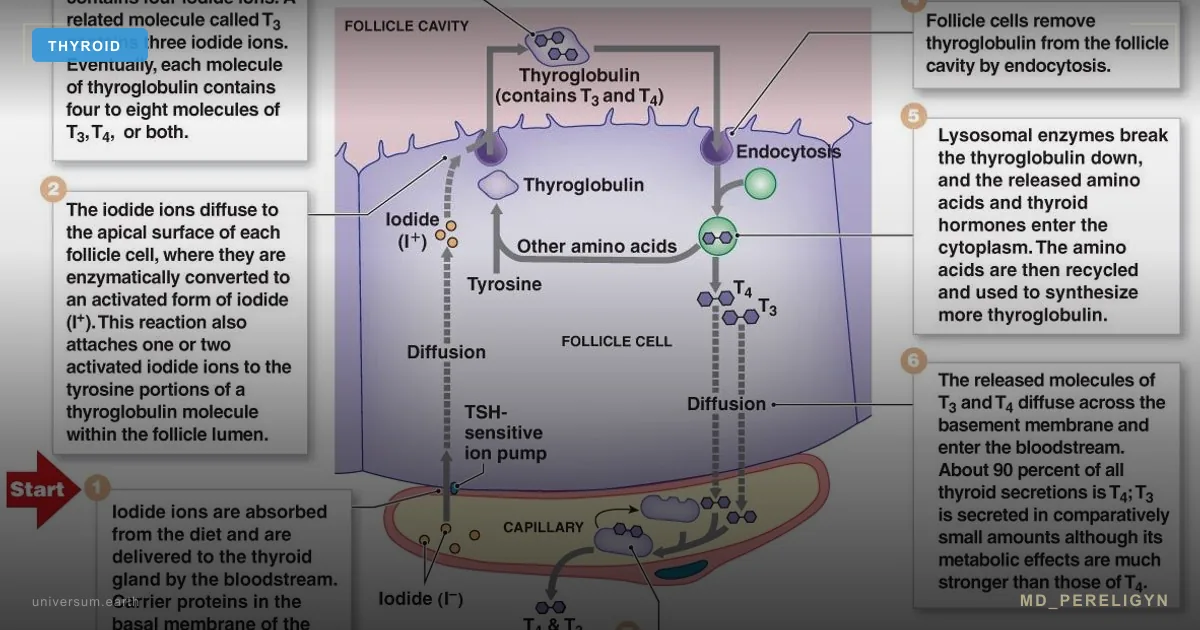
▸Axis 1 — T4→T3 conversion. Active T3 is produced in 90% of cases not by the thyroid itself but by peripheral deiodination of T4 by enzymes D1 (liver, kidney) and D2 (brain, pituitary, muscle, brown fat). Selenium is the obligatory cofactor of the deiodinase active center; iron is a structural cofactor of thyroid peroxidase (TPO). Chronic stress, fasting, and severe illness shift deiodination toward the D3 pathway, which converts T4 into inactive reverse-T3 (rT3). Clinically this looks like "hypothyroidism with normal TSH": TSH compensated on thyroxine, fT4 mid-to-upper range, fT3 low, rT3 high. Axis marker: fT3 + rT3.
▸Axis 2 — cofactors. Even with adequate conversion, thyroid hormone does not deliver an effect if peripheral receptors and mitochondrial machinery lack raw material. Iron (ferritin) is a cofactor of hormone synthesis at the TPO step. Vitamin D modulates thyroid receptor expression and immune activity in autoimmune thyroiditis. Magnesium is a cofactor of ATP synthase — energy turnover does not start even with sufficient T3 if magnesium is deficient. Axis markers: ferritin + 25(OH)D + magnesium (RBC or ionized).
▸Axis 3 — HPA cortisol. The hypothalamic-pituitary-adrenal axis sets the global energy floor. Chronic stress load, sleep deprivation, infectious or trauma history produce a flat cortisol curve (low morning anchor, absent circadian rise), which is clinically indistinguishable from hypothyroidism. Chronic cortisol dysregulation also activates D3 and shunts T4 into reverse-T3. Axis marker: morning serum cortisol at 08:00 or four-point salivary curve (06–09, 11–13, 16–18, 22–24).
🌀
Clinical decision-making — when to test, when not to
Not every fatigue is a conversion story. Before launching the extended panel it is important to exclude conditions in which fatigue does not belong to the conversion–cofactor–HPA triad.
▸Overt hypothyroidism with elevated TSH — this is etiology axis one, requiring thyroxine dose increase per the 1.6 mcg/kg/day protocol with TSH-driven titration. The extended fT3/rT3/ferritin panel is redundant at the compensation stage. ▸Central (secondary) hypothyroidism — low TSH with low fT4, post-pituitary or iatrogenic. Different management — pituitary axis screen, MRI, fT4-driven replacement. ▸Vitamin B12 / folate deficiency, iron deficiency anemia — independent cause of fatigue that does not need selenium and magnesium. CBC + B12 + folate + ferritin is the baseline minimum. ▸Obstructive sleep apnea — oximetry or polysomnography. Daytime sleepiness from apnea does not respond to thyroid protocols. ▸Major depressive disorder — separate etiology requiring psychiatric assessment. Thyroid correction does not replace depression treatment. ▸Decompensated type 2 diabetes — hyperglycemia and insulin resistance are independent fatigue causes. HbA1c, fasting and postprandial glucose are mandatory.
The conversion–cofactor–HPA story is about residual symptoms in a patient on adequate thyroxine dose with biochemically normal TSH. If TSH is not controlled or there is an obvious competing diagnosis, etiology is treated first, and only then are the residual axes addressed. Related article — T4 to T3 conversion and functional hypothyroidism — covers deiodinase biochemistry in more depth.
🌀
Common pitfalls
Standard outpatient management of hypothyroidism is TSH monitoring once or twice a year with thyroxine titration to that single marker. This algorithm is adequate for most patients with overt primary hypothyroidism but systematically misses three categories of patients.
▸Normal TSH, low fT3. Without measuring fT3 this dissociation is invisible. The patient receives the "right" dose of thyroxine for years, lives with a low-energy phenotype, and every primary-care visit ends with "your labs are fine, this is just overwork". ▸rT3 is not part of the standard panel. In most laboratories rT3 is a separate and relatively expensive test. Without it the conversion-block index (fT3/rT3) cannot be calculated and a stress-induced D3 shift is missed. ▸Ferritin at the "lower limit of normal" is called "fine". The lab reference starts at 15–30 ng/mL. Clinically, TPO works poorly with ferritin under 70 ng/mL, hair shedding correlates with ferritin under 40, and muscle weakness with under 50. "Low end of normal" is a lab-report trap. ▸25(OH)D of 20–30 ng/mL is called "sufficient". For thyroid receptor activity and immunomodulation in autoimmune thyroiditis, target 25(OH)D is in the range of 60–80 ng/mL (Holick, PMID 21646368). ▸Morning cortisol is not measured. A single morning cortisol gives a rough but workable HPA estimate. Four-point saliva is more precise but more expensive and logistically harder. Either one is better than ignoring the axis. ▸Selenium and iron are not combined with thyroid therapy systematically. Selenium is a D2 cofactor — if it is deficient, even an ideal thyroxine dose is not converted. Iron is a TPO substrate cofactor. Without them the thyroid story does not close, no matter how the dose is titrated.
🌀
Full panel — what to measure beyond TSH
The extended evaluation protocol for residual fatigue on thyroxine includes three blocks — conversion, cofactor, HPA. All markers are drawn at the same time, fasting morning, from one laboratory, to remove inter-lab variability.
| Marker | Target |
|---|---|
| fT3 | ≥ 5.0 pmol/L |
| fT3/rT3 | ≥ 0.2 |
| Ferritin | 70–150 ng/mL |
| 25(OH)D | 60–80 ng/mL |
| Cortisol 08:00 | 300–700 nmol/L |
▸Conversion block. TSH (0.4–4.0 mIU/L, target 0.5–2.0 on therapy), fT4 (12–22 pmol/L, target upper half), fT3 (4.0–7.0 pmol/L, target ≥ 5.0), rT3 (9–24 ng/dL). The fT3/rT3 ratio is a working conversion marker — values < 0.2 suggest functional hypothyroidism with a D3 shift. ▸Cofactor block. Ferritin (target ≥ 70 ng/mL, ideally 70–150), 25(OH)D (target 60–80 ng/mL), RBC or ionized magnesium (often unavailable — substituted by serum Mg ≥ 0.85 mmol/L as an approximation), zinc (12–18 µmol/L), selenium (90–130 µg/L if available). ▸HPA block. Serum cortisol at 08:00 (300–700 nmol/L) or four-point saliva (06–09 morning, 11–13 midday, 16–18 evening, 22–24 night) — a curve instead of a single point. DHEA-S (200–500 µg/dL in women, 280–640 in men) is a longer-term marker of HPA reserve. If structural adrenal pathology is suspected, ACTH at 08:00 is added.
Related article — cortisol, adrenals and the HPA axis — interprets morning cortisol and four-point saliva in more detail. Related article — ferritin, liver and iron overload — explains why "higher is better" is not always true and where the boundary between target ferritin and overload sits.
🌀
Starter protocol based on the panel
If the extended panel confirms one or more deficits, the starter protocol is built by axis priority. Doses are standard evidence-based regimens for deficient states, not for treating a healthy person.
▸Axis 1 — selenium. Selenium 200 mcg as L-selenomethionine, morning fasting, 8-week course, then 100 mcg maintenance. Selenomethionine is absorbed better than inorganic selenite. Goal — restoring D2 activity and damping autoimmune activity in concurrent autoimmune thyroiditis (anti-TPO drop of 20–40% per Gärtner et al., PMID 11932302). ▸Axis 2 — iron. Iron 25 mg as chelated bisglycinate, with vitamin C 250 mg, every other day, morning fasting, avoiding dairy and coffee/tea for 2 hours around the dose. Alternate-day dosing instead of daily improves the absorbed fraction (Stoffel, PMID 31448793). Target — ferritin ≥ 70 ng/mL. ▸Axis 2 — vitamin D3 + K2. Vitamin D3 4000 IU + vitamin K2 (MK-7) 90–120 mcg, daily with a fatty meal. Target 25(OH)D 60–80 ng/mL. Check at 12 weeks, then maintain at 1000–2000 IU year-round. Related article — cholesterol without statins — covers the role of D3 in lipid metabolism. ▸Axis 2 — magnesium. Magnesium 300 mg as glycinate or taurate, evening, before bed. These forms are better tolerated than oxide and have a mild calming effect — useful for HPA dysregulation and sleep disruption. ▸Axis 3 — HPA support. Magnesium (above) already works this axis. For flat curves and a low morning anchor — circadian hygiene (morning light, evening darkness, fixed bedtime), caffeine cutoff after noon, consideration of adaptogens (ashwagandha 300–600 mg — Lopresti, PMID 31515756). Hydrocortisone or systemic glucocorticoids are reserved for proven structural adrenal pathology, never for "functional fatigue".
Related article — hypothyroidism and natural desiccated thyroid (NDT) — adjacent topic on NDT and iodine status when fT3 remains low on levothyroxine monotherapy.
🌀
Monitoring — what and when to reassess
At 8 weeks of the starter protocol, the extended panel is repeated. This is the interval during which most cofactor deficits close and the conversion picture begins to shift. Blind titration "by feel" without objective markers is not acceptable.
▸8 weeks — extended panel: fT3, rT3, ferritin, 25(OH)D, morning cortisol. TSH and fT4 in parallel for control of the underlying thyroid therapy. ▸Target values: fT3 ≥ 5.0 pmol/L, fT3/rT3 ≥ 0.2, ferritin 70–150 ng/mL, 25(OH)D 60–80 ng/mL, morning cortisol in the middle third of the reference range. ▸Adjust by labs, not by symptoms. If fT3 has risen to 5.2 and the patient reports a modest improvement — continue maintenance, do not escalate. If fT3 has not moved — reassess adherence, selenium dose, ferritin (it may not have risen — then iron requires further workup for malabsorption). ▸Concomitant medication review — drug interactions matter. PPIs (omeprazole) reduce iron and magnesium absorption. Levothyroxine is taken strictly fasting, 30–60 min before breakfast; iron and cofactors are taken at a different time, at least 4 hours from the thyroxine dose. ▸Symptom tracking — energy, morning wakefulness, exercise tolerance, peripheral temperature, hair shedding, libido. These are secondary to labs but matter for the overall picture.
At 16 weeks — the next interim check, then every 6 months if the picture is stable. Related article — iodine and the thyroid: a five-step protocol — covers iodine status, which independently affects conversion.
🌀
Caution — limitations and contraindications
The starter protocol is built on doses justified for confirmed deficit states. Applying the same doses without a documented deficit, in the presence of contraindications, or in certain comorbid states is not safe.
▸Selenium. Long-term safe ceiling is around 400 mcg/day (IOM UL). Chronic excess leads to selenosis — brittle hair, white nail spots, garlic skin odor, peripheral neuropathy. The 200 mcg × 8-week course is safe; 100 mcg maintenance is acceptable long-term. ▸Iron. Contraindicated in hemochromatosis (HFE C282Y/H63D genotyping is indicated in family history or ferritin > 300 ng/mL with transferrin saturation > 45%). Related article — ferritin and iron overload — covers this boundary in detail. Iron suppresses absorption of levothyroxine, zinc, and calcium — dose timing must be separated. ▸Vitamin D3. Doses of 4000–5000 IU are safe in the absence of hypercalcemia. Contraindicated in primary hyperparathyroidism, sarcoidosis and other granulomatous diseases, and familial idiopathic hypercalciuria. Serum calcium check at baseline and at 12 weeks is mandatory. ▸Magnesium. Contraindicated in severe renal failure (eGFR < 30 mL/min). Glycinate and taurate are the best-tolerated forms; oxide causes diarrhea and is poorly absorbed. ▸Ashwagandha — contraindicated in hyperthyroidism (including transient thyrotoxicosis in autoimmune thyroiditis), pregnancy, lactation, and active flares of autoimmune disease. May potentiate benzodiazepines and sedatives. ▸Selenium + iodine. In untreated iodine deficiency, high-dose selenium can paradoxically intensify the autoimmune process. Related article — iodine and the thyroid: a five-step protocol — mandatory reading before expanding the cofactor protocol.
🌀
Bottom line
Residual fatigue on adequate levothyroxine is not unusual and not aggravation. It is the objective biology of three parallel axes.
▸TSH is pituitary feedback, not a report on cellular T3 effect. The extended panel fT3 + rT3 + ferritin + 25(OH)D + cortisol is mandatory in residual-symptom patients. ▸T4→T3 conversion (axis 1) — selenium and iron as structural cofactors of deiodinases and TPO; restraining the D3 shift through work on the cortisol background. ▸Cofactors (axis 2) — ferritin ≥ 70, 25(OH)D 60–80 ng/mL, magnesium in the middle third of the reference. "Low end of normal" is not the target. ▸HPA axis (axis 3) — morning cortisol or four-point saliva, circadian hygiene, adaptogens for documented flat curves. ▸8-week reassessment — extended panel, not "by feel". Adjustments are made on objective numbers. ▸When it is not a conversion story — overt hypothyroidism with high TSH, central hypothyroidism, B12/anemia, sleep apnea, depression, type 2 diabetes — treat the etiology, not "selenium and magnesium".
A correctly assembled lab set saves the patient months of blind titration and aimless supplementation. Symptoms present, TSH "in range" — measure T3, ferritin, and cortisol. That is the working rule.
🌀
About the author
I am Dr. Vladimir Pereligyn, endocrinologist and researcher. I specialize in endocrine, metabolic, and autoimmune protocols with a holistic approach and individualized lab diagnostics. Book a consultation — universum.earth/consultation. Daily clinical breakdowns — @md_pereligyn_thyroid.
🌀
Sources
▸Hoermann R, Midgley JEM, Larisch R, Dietrich JW. Recent advances in thyroid hormone regulation: toward a new paradigm for optimal diagnosis and treatment. Front Endocrinol (Lausanne). 2017;8:364. (PMID 29375474) ▸Saravanan P, Chau WF, Roberts N, et al. Psychological well-being in patients on 'adequate' doses of l-thyroxine: results of a large, controlled community-based questionnaire study. Clin Endocrinol (Oxf). 2002;57(5):577-585. (PMID 12390330) ▸Gärtner R, Gasnier BC, Dietrich JW, Krebs B, Angstwurm MW. Selenium supplementation in patients with autoimmune thyroiditis decreases thyroid peroxidase antibodies concentrations. J Clin Endocrinol Metab. 2002;87(4):1687-1691. (PMID 11932302) ▸Holick MF, Binkley NC, Bischoff-Ferrari HA, et al. Evaluation, Treatment, and Prevention of Vitamin D Deficiency: An Endocrine Society Clinical Practice Guideline. J Clin Endocrinol Metab. 2011;96(7):1911-1930. (PMID 21646368) ▸Stoffel NU, Zeder C, Brittenham GM, Moretti D, Zimmermann MB. Iron absorption from supplements is greater with alternate day than with consecutive day dosing in iron-deficient anaemic women. Haematologica. 2020;105(5):1232-1239. (PMID 31448793) ▸Lopresti AL, Smith SJ, Malvi H, Kodgule R. An investigation into the stress-relieving and pharmacological actions of an ashwagandha (Withania somnifera) extract: A randomized, double-blind, placebo-controlled study. Medicine (Baltimore). 2019;98(37):e17186. (PMID 31515756)
This article is for informational purposes only and does not replace a medical consultation. Before starting any supplements, changing medication, or undergoing diagnostic procedures, discuss the plan with your physician.
Key facts
- Residual fatigue runs along three axes: T4→T3 conversion, cofactors (iron, vitamin D, magnesium), and HPA cortisol.
- Active T3 is produced ~90% by peripheral deiodination of T4 via enzymes D1 and D2; selenium is the obligatory cofactor.
- Clinically TPO works poorly with ferritin under 70 ng/mL; hair shedding correlates with ferritin under 40.
- For thyroid receptor activity in autoimmune thyroiditis, target 25(OH)D is 60–80 ng/mL (Holick, PMID 21646368).
- Reassess at 8 weeks with the extended panel — fT3, rT3, ferritin, 25(OH)D, cortisol — adjusting by labs, not by feel.