Introduction
Levothyroxine (L-T4) has been the first-line standard for overt hypothyroidism for more than half a century. It is cheap, stable, has predictable pharmacokinetics, and in most cases normalizes thyroid-stimulating hormone (TSH). But clinical practice meets a different reality: a substantial fraction of patients with biochemically normalized TSH continue to report fatigue, weight gain, depression, dry skin, hair loss, and cold intolerance.
This is neither uncommon nor a fabrication. Saravanan and colleagues in a prospective population-based study (PMID 12390330) showed that patients on adequate replacement therapy with normal TSH have statistically significantly lower quality of life and more pronounced psychoneurological symptoms than euthyroid controls matched for age and sex. The current American Thyroid Association position (ATA Guideline, Garber et al., PMID 22954017) explicitly acknowledges this and recommends an expanded workup when symptoms persist.
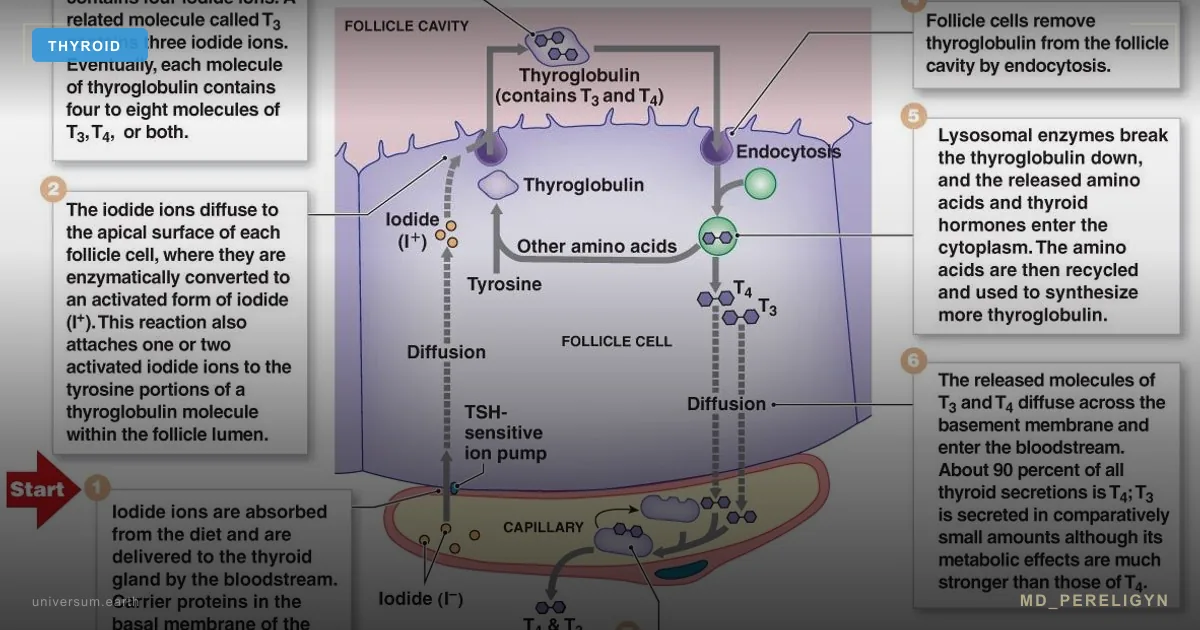
The key is understanding that hypothyroidism manifests clinically not in blood but in the target cell. Levothyroxine delivers the prohormone T4. For it to act, the entire chain must function: peripheral conversion to active T3, transmembrane transport, binding to the nuclear receptor, transcription of target genes, synthesis of mitochondrial proteins. Failure at any link produces "functional hypothyroidism" with a normal TSH.
🌀
What TSH Measures — and What It Misses
TSH is a pituitary hormone responding to circulating T4 (predominantly) and T3 via negative feedback. When circulating thyroid hormone rises, TSH falls; on replacement therapy with L-T4, normalization of TSH means one thing: there is sufficient T4 in the blood.
But the clinical activity of thyroid hormone unfolds in tissues, not in plasma. At each step there are critical nodes:
▸T4→T3 conversion — performed by deiodinases (D1, D2, D3) in liver, muscle, brain, kidney, thyroid. D2 is the key enzyme for hypothalamic-pituitary regulation; D1 is for systemic plasma T3. See the T4→T3 conversion and deiodinases deep dive. ▸Membrane transport — MCT8, MCT10, OATP-family transporters. MCT8 mutation in males causes Allan-Herndon-Dudley syndrome with severe developmental delay despite "normal" circulating hormones — a dramatic illustration of transport importance. ▸Nuclear TR receptor (TRα, TRβ) — binds T3, initiates transcription. Resistance to thyroid hormone (RTH) is a clinically meaningful entity. ▸Mitochondrial response — T3 controls mitochondrial biogenesis via PGC-1α. Without sufficient intracellular T3, ATP production falls — clinical fatigue with a "normal" laboratory picture.
The practical conclusion: TSH is a necessary but insufficient marker of treatment quality. Free T3, free T4, fT3/fT4 ratio, and reverse T3 (rT3) are required.
🌀
What Interferes With Thyroxine
Before suspecting functional hypothyroidism, exclude pharmacokinetic causes. L-T4 is a narrow-therapeutic-window drug with capricious absorption.
▸Coffee, calcium, iron within one hour of dosing — reduce absorption by 19–38%. Benvenga et al. (PMID 18341376) confirmed the coffee effect. Rule: take L-T4 on an empty stomach 60 minutes before food and coffee. ▸Proton pump inhibitors (omeprazole, pantoprazole) — raise gastric pH, decrease tablet solubility and absorption. Centanni et al. (PMID 16641395) documented systematic increase in L-T4 requirement on chronic PPIs. ▸Hypochlorhydria — atrophic gastritis, autoimmune gastritis (frequently associated with Hashimoto), requires dose escalation. ▸Intestinal inflammation, celiac disease, SIBO — celiac is detected in 3–4% of Hashimoto patients (above general population); gluten-induced enteropathy sharply reduces absorption. ▸Estrogens / oral contraceptives / hormone replacement therapy — raise thyroxine-binding globulin (TBG), bind free T4, increase dose requirement. After OCP initiation, recheck TSH at 6 weeks. ▸Selenium, zinc, iron deficiency — reduce deiodinase activity, impair T4→T3 conversion.
If these are excluded and symptoms persist, expand the workup.
🌀
What Is Usually Not Tested
A standard primary-care or endocrinology visit often stops at TSH. This misses 80% of useful information. Minimum expanded panel for persistent symptoms:
▸Free T3 (fT3) — actual peripheral active hormone. Target — upper third of reference. ▸Free T4 (fT4) — substrate for conversion. Target — mid-to-upper half of reference. ▸Reverse T3 (rT3) — the "brake": deiodination variant where T4 becomes inert rT3 instead of active T3. Elevated in stress, fasting, severe inflammation, critical illness, selenium deficiency. Tied to cellular resistance. See the reverse T3 and weight gain deep dive. ▸fT3/fT4 ratio — functional marker of conversion quality. Normally > 0.30 (same units). Decrease indicates functional hypothyroidism at the deiodinase level. ▸Anti-TPO, anti-Tg antibodies — to confirm autoimmune etiology and assess activity. ▸Morning (8:00) and evening (22:00) cortisol or salivary profile — both hypo- and hypercortisolemia impair T4→T3 conversion and peripheral hormone response. The thyroid-adrenal connection — see cortisol and the HPA axis. ▸Ferritin — target > 70 ng/mL (some sources > 90). Iron is a cofactor for thyroid peroxidase and deiodinases. With iron deficiency, even an adequate L-T4 dose yields a weak response. ▸Plasma selenium — cofactor for all three deiodinases. Selenium deficiency is one of the most common causes of "functional hypothyroidism" on L-T4. ▸Zinc — cofactor for thyroid hormone synthesis and TR-receptor binding. ▸Vitamin D (25-OH) — target > 50 ng/mL. Immunomodulation and metabolism. ▸Vitamin B12, homocysteine — neurocognitive symptoms of hypothyroidism often mask B12 deficiency (especially with atrophic gastritis in Hashimoto). ▸Celiac (tTG-IgA, total IgA), SIBO (hydrogen breath test), H. pylori — routine in treatment-resistant hypothyroidism.
🌀
Full Cofactor Protocol
After expanded diagnostics, an individualized protocol is built. Baseline elements in most patients:
▸Selenium 100–200 µg/day — selenomethionine preferred over sodium selenite. Cycles of 3–6 months with monitoring. Do not exceed 400 µg/day (selenosis risk). In parallel — 20–40% reduction in anti-TPO over 6 months in a subset of Hashimoto patients. ▸Zinc 15–30 mg/day — citrate, picolinate, or bisglycinate. Morning on an empty stomach or with a light dairy-free snack. With long-term use (> 3 months) add 1–2 mg copper for balance. ▸Iron to ferritin > 70 ng/mL — iron bisglycinate 30–60 mg elemental with vitamin C (250–500 mg). Recheck ferritin at 8 weeks. If ferritin > 300 ng/mL, stop and assess overload causes (see ferritin and iron overload). ▸Vitamin D to 25-OH > 50 ng/mL — start cholecalciferol 4000–5000 IU/day, recheck at 12 weeks. ▸Magnesium 300–400 mg/day — bisglycinate, citrate, or threonate. Cofactor in over 300 enzymes including ATP synthesis and neurotransmission. Helps with sleep, anxiety, muscle tension — background hypothyroid symptoms. ▸L-tyrosine 500–1000 mg/day — substrate for thyroid hormone synthesis. Morning on empty stomach. Caution with anxiety disorders and hypertension. ▸Iodine — only with confirmed deficiency (urinary iodine < 100 µg/L) and negative anti-TPO. In active Hashimoto, high-dose iodine may amplify autoimmune attack. See the five-step iodine protocol.
If labs show hypocortisolism (morning cortisol < 10 µg/dL, disrupted evening) — parallel work on the HPA axis: sleep, adaptogens (rhodiola, ashwagandha), blood glucose stabilization. With pronounced adrenal insufficiency — endocrinology referral for short-term hydrocortisone.
If T4→T3 conversion does not normalize — consider natural desiccated thyroid (NDT, e.g., Thyroid-S) or L-T4 + liothyronine (T3) combination under endocrinology supervision. See the NDT for hypothyroidism breakdown.
🌀
8-Week Control
Any nutraceutical protocol requires objective evaluation. Control points at 8–12 weeks:
| Marker | Target |
|---|---|
| TSH | 0.4–2.5 mIU/L |
| fT3/fT4 | > 0.30 |
| Ferritin | > 70 ng/mL |
| Vitamin D (25-OH) | > 50 ng/mL |
| Selenium | 100–200 µg/day |
▸TSH 0.4–2.5 mIU/L — target range for most treated patients. Young, active, symptomatic — closer to 1.0–1.5. Elderly — 2.0–3.0 acceptable. ▸Free T4 — upper half of reference (e.g., reference 12–22 pmol/L — aim 17–22). ▸Free T3 — at or above mid-reference (e.g., reference 3.1–6.8 pmol/L — above 4.5–5.0). ▸fT3/fT4 > 0.30 — marker of preserved peripheral conversion. ▸rT3 — falls compared to baseline. fT3/rT3 ratio rises. ▸Symptoms by Zulewski (ZSDS) or equivalent questionnaire — reduction in fatigue, depression, cold intolerance scores. ▸Morning basal temperature — 36.6 °C and above (axillary measurement immediately on waking, before rising, three consecutive days). Marker of metabolic activity. ▸Anti-TPO, anti-Tg antibodies — dynamics at 16 weeks in Hashimoto. ▸Ferritin, selenium, vitamin D — nutrient levels at 12 weeks after protocol initiation.
If parameters improve and symptoms regress — maintenance phase with reassessment every 6 months. If TSH normalizes but fT3 remains low and symptoms persist — next step (combination therapy or NDT, see above).
🌀
Caution
The extended cofactor protocol is powerful but demands caution.
▸Do not self-discontinue L-T4 — even if cofactors improve symptoms, withdrawal in overt hypothyroidism is dangerous (myxedema coma in severe forms). ▸Hashimoto with high anti-TPO — high-dose iodine is contraindicated, may amplify autoimmune attack. Selenium and zinc are safe and often reduce antibodies. ▸Pregnancy — L-T4 requirement rises 25–50% in the first trimester. Target TSH < 2.5 mIU/L in T1, < 3.0 in T2–T3. Cofactors — only under physician supervision. ▸Concurrent amiodarone, lithium, interferon — require a tailored approach; not part of the standard cofactor protocol. ▸Selenium > 400 µg/day chronically — selenosis risk (hair loss, brittle nails, peripheral neuropathy). ▸Iron at ferritin > 300 ng/mL — stop, assess overload causes and Fenton stress risk. ▸Hypocortisolism — starting or escalating L-T4 in undiagnosed adrenal insufficiency may precipitate addisonian crisis. Mandatory cortisol assessment before thyroid dose changes if suspicion exists. ▸Autoimmune comorbidities — Hashimoto + celiac + type 1 diabetes (APS-III) or + adrenal insufficiency (APS-II) require specialist endocrinology follow-up.
For persistent or unexplained symptoms — endocrinology referral. Low-dose naltrexone may be considered for the autoimmune component — see the LDN in Hashimoto breakdown.
🌀
Bottom Line
Hypothyroidism is not a pill deficiency. It is a systems failure: thyroid → T4→T3 conversion → membrane transport → nuclear receptor → mitochondrial response. The ATA Guideline (Garber et al., PMID 22954017) explicitly recommends a systems approach in treatment-resistant cases. We do not treat a TSH number — we treat the entire chain. Then the patient stops "living for the pill" and regains capacity for work, focus, normal body temperature, and normal weight.
🌀
About the Author
I am Dr. Vladimir Pereligyn, endocrinologist and researcher. I specialize in endocrine, metabolic, and autoimmune protocols with a holistic approach and individualized lab diagnostics. Book a consultation — universum.earth/consultation. Daily clinical breakdowns — @md_pereligyn_thyroid.
🌀
Sources
▸Saravanan P. et al. Psychological well-being in patients on adequate doses of L-thyroxine: results of a large, controlled community-based questionnaire study. Clinical Endocrinology, 2002. (PMID 12390330) ▸Garber J.R. et al. Clinical practice guidelines for hypothyroidism in adults: cosponsored by the American Association of Clinical Endocrinologists and the American Thyroid Association. Thyroid, 2012. (PMID 22954017) ▸Benvenga S. et al. Altered intestinal absorption of L-thyroxine caused by coffee. Thyroid, 2008. (PMID 18341376) ▸Centanni M. et al. Thyroxine in goiter, Helicobacter pylori infection, and chronic gastritis. New England Journal of Medicine, 2006. (PMID 16641395) ▸Jonklaas J. et al. Guidelines for the treatment of hypothyroidism: prepared by the American Thyroid Association task force on thyroid hormone replacement. Thyroid, 2014. (PMID 25266247)
This article is for informational purposes only and does not replace a medical consultation. Before starting any supplements, changing medication, or undergoing diagnostic procedures, discuss the plan with your physician.
Key facts
- Coffee, calcium, or iron within an hour of dosing cut L-T4 absorption by 19–38%; take on an empty stomach 60 min before food.
- Selenium 100–200 µg/day lowers anti-TPO by 20–40% over 6 months in some Hashimoto patients; do not exceed 400 µg/day.
- Targets: ferritin > 70 ng/mL, vitamin D (25-OH) > 50 ng/mL; stop iron if ferritin > 300 ng/mL.
- An fT3/fT4 ratio > 0.30 marks preserved peripheral T4→T3 conversion; a drop signals deiodinase-level failure.
- Target TSH on therapy 0.4–2.5 mIU/L; levothyroxine need rises 25–50% in the first trimester of pregnancy.