Introduction
A textbook scene in the endocrinology office: a woman aged 35–45, complaining of chronic fatigue, weight gain, hair loss, cold hands and feet, puffiness, and broken sleep. Her primary care doctor ordered TSH and free T4. TSH is 1.8 mIU/L (normal), free T4 is 14 pmol/L (normal). Verdict: "Your labs are fine, you just need rest."
This is the single most common miss in first-line hypothyroidism work-up. TSH and free T4 describe the pituitary–secretory arm of the axis, but they say nothing about peripheral conversion and cellular response. Chronic stress does not block the thyroid at the gland level — it blocks it at three other levels: the hypothalamus, the deiodinases, and the T3 receptor. The clinical syndrome is called functional hypothyroidism, and in its milder form wellness fatigue — cellular hypothyroidism on a normal TSH and free T4.
This article walks through the three levels of the mechanism, the exact lab markers, the target ratios, an 8-week correction protocol, and the reassessment endpoints.
🌀
Level 1: the hypothalamus and TRH pulsatility
The thyroid axis starts in the hypothalamus. TRH (thyrotropin-releasing hormone) is a short peptide released in pulses into the portal pituitary system; it drives thyrotrophs to secrete TSH. In a healthy person these pulses fire every 90–120 minutes, with an early-morning surge.
Chronic stress dismantles that pulsatility through two mechanisms. The first is direct cortisol suppression of TRH neurons in the paraventricular nucleus of the hypothalamus. Glucocorticoid receptors are expressed on TRH neurons themselves. The second is via CRH (corticotropin-releasing hormone): the same CRH that drives the HPA axis directly inhibits TRH neurons through inhibitory interneurons.
The clinical picture:
▸TSH stays normal or low-normal — the thyrotroph secretory reserve is intact; the drive is the problem ▸free T4 normal — the gland is responding faithfully to whatever signal it receives ▸free T3 starts to fall — intrathyroidal T3 synthesis also tracks TRH pulse ▸Morning basal temperature drops — a marker of reduced cellular metabolism ▸A chronic "no drive" feeling — a stereotyped patient description
This is the key point that routine workup misses: when TRH is suppressed, TSH does not rise, because the gland is not "failing" — it is simply receiving less signal. To see this level, you have to look at fT3 and the fT3/rT3 ratio, not just TSH.
Related article — T4 → T3 conversion, deiodinases, and functional hypothyroidism — opens up the second level in detail.
🌀
Level 2: deiodinases and T4 → T3 conversion
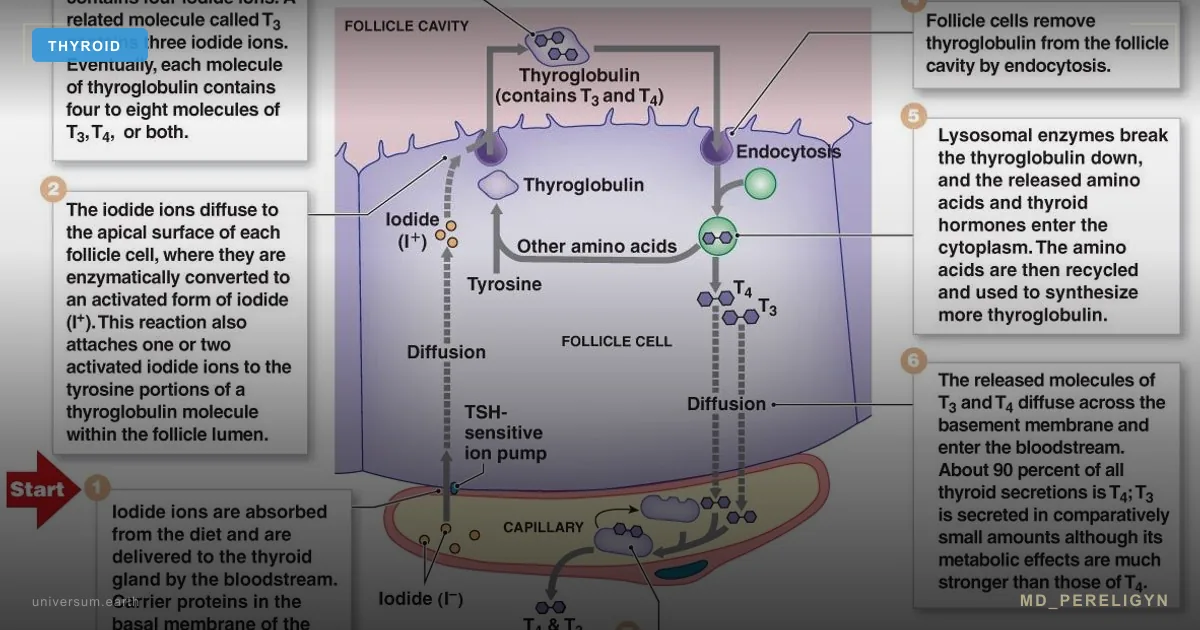
The thyroid gland secretes mostly T4 (thyroxine) — about 80–85% of its total output. T4 is a prohormone with very weak biological activity. The active form, T3 (triiodothyronine), is generated peripherally by three deiodinase enzymes: D1, D2, D3. These are selenium-containing enzymes that regulate hormone activity by altering its chemical structure.
Under chronic stress, deiodinase activity is rewired:
▸D2 (T4 → active T3) — suppressed. Cortisol downregulates DIO2 gene expression in the pituitary, brain, muscle, and brown adipose tissue. This is the central activation pathway, and it is closed. ▸D3 (T4 → reverse rT3) — upregulated. Cortisol increases DIO3 gene expression. rT3 is a biologically inactive T3 isomer that does not trigger the genomic response, but competes with T3 at the receptor. The cell receives an "empty" ligand. ▸D1 (T4 → T3, mostly liver and kidney) — also suppressed under selenium deficiency and chronic inflammation.
The net result: T4 is in the blood, but it is not being converted to active hormone — it is being shunted into inactive rT3. Peeters et al. described this phenomenon in detail (PMID 15886232) in non-thyroidal illness syndrome (NTI), and the same physiology extends to any prolonged physiological stressor: surgery, severe infection, fasting, hard training without recovery, chronic depression.
The lab picture:
▸TSH normal or low-normal ▸free T4 normal (sometimes high-normal — substrate accumulates) ▸free T3 low — at the lower quartile or below the reference ▸rT3 high — at the upper quartile or above the reference ▸fT3/rT3 ratio < 20 : 1 — the diagnostic marker of functional hypothyroidism
This is the central diagnostic axis that needs to be checked in any patient with hypothyroid symptoms and a normal TSH.
🌀
Level 3: the receptor and the cellular response
The third level is the cellular response to T3 itself. The thyroid hormone receptor (TR) is a nuclear receptor that binds T3, forms a complex with RXR, and activates transcription of more than 600 genes — including mitochondrial complexes, uncoupling proteins, beta-oxidation enzymes, and key regulators of thermogenesis.
Chronic stress and the inflammation that accompanies it interfere with this level in three ways:
▸rT3 competition at TR — it occupies the T3 site without activating transcription, effectively blocking the signal ▸Cytokine suppression of TR expression — IL-6, TNF-α, IL-1β (the low-grade inflammation signature) reduce TR-α and TR-β expression in peripheral tissues ▸Mitochondrial dysfunction — cofactor deficiency (B12, iron, selenium) limits T3-dependent bioenergetics even when hormone levels are adequate
Hoermann et al. in a frequently cited review (PMID 29375474) show that at the population level the symptoms of hypothyroidism (fatigue, weight gain, dry skin, depression, puffiness) correlate much better with fT3 and the fT3/rT3 ratio than with TSH itself. A meaningful subgroup of patients with a "euthyroid" TSH have full cellular hypothyroid symptomatology that responds to rT3 and cofactor correction.
🌀
Target zone: fT3/rT3
The fT3/rT3 ratio is the most sensitive lab marker of functional hypothyroidism.
| fT3/rT3 | Interpretation |
|---|---|
| > 20:1 | optimal cellular activity |
| 14–20:1 | borderline zone |
| 10–14:1 | pronounced functional hypothyroidism |
| < 10:1 | deep conversion block |
▸> 20 : 1 — optimal cellular activity. The hormone reaches its target; rT3 does not block the receptor. ▸14–20 : 1 — borderline zone. Early conversion dysregulation, usually symptomatic in sensitive patients. ▸10–14 : 1 — pronounced functional hypothyroidism. Symptoms are clear, TSH and free T4 are normal, routine work-up misses it. ▸< 10 : 1 — deep conversion block. Heavy clinical picture, requires targeted correction.
To calculate the ratio correctly, both units must be in pmol/L (SI). If fT3 is in pg/mL and rT3 is in ng/dL, the lab should convert, or use a unit converter. Most European and post-Soviet labs report in SI; American labs in conventional units.
The state of normal TSH and free T4, low fT3 and high rT3 is what the literature calls wellness fatigue or euthyroid sick syndrome lite — mild cellular hypothyroidism on top of normal screening labs.
🌀
What blocks T3: seven blockers
This is the inventory of reasons why a patient might be stuck at the conversion and receptor level:
▸Cortisol — the main driver. Elevated morning cortisol, or loss of the circadian rhythm (low morning, high evening), is equally damaging to deiodinases. More — cortisol and the HPA axis. ▸Selenium deficiency — D2 and GPx (glutathione peroxidase) are selenoproteins. With plasma selenium < 100 μg/L (1.27 μmol/L), D2 activity is reduced. ▸Ferritin < 70 ng/mL — iron is needed for thyroid peroxidase, mitochondrial respiration, and D1. In menstruating women, ferritin < 70 is a frequent finding. ▸Chronic inflammation — IL-6 and TNF-α suppress D2 and TR expression even when cofactors are adequate. ▸B12 deficiency — mitochondrial bioenergetics and methylation are B12-dependent. Below 400 pg/mL, the cellular response to T3 is incomplete. ▸Hypocaloric diet, fasting, prolonged VLCD — the strongest trigger for D3 activation and rT3 elevation. Evolutionarily, an energy conservation mode. ▸Insulin resistance and glucose swings — chronic hyperinsulinism impairs conversion and raises rT3 indirectly through oxidative stress.
Related article — ferritin, liver, and iron overload — covers the optimal ferritin corridor (70–150 ng/mL).
🌀
Full panel and the 8-week strategy
Minimum diagnostic panel for functional hypothyroidism assessment:
▸TSH, free T4, free T3, rT3 — three-level axis assessment and fT3/rT3 calculation ▸anti-TPO, anti-Tg — rule out concurrent autoimmune thyroiditis ▸Salivary cortisol, 4 points — 8 AM, 12 PM, 5 PM, 11 PM — HPA rhythm assessment. A single morning cortisol is insufficient. ▸Ferritin, TIBC, transferrin saturation — iron status ▸Plasma selenium — target corridor > 100 μg/L ▸B12, folate, homocysteine — mitochondria and methylation ▸hsCRP, panel for occult inflammation — to identify the cytokine suppression axis
Baseline 8-week recovery protocol:
▸7–9 hours of sleep in full darkness, lights out before 11 PM. The cheapest and most effective way to lift cortisol pressure off the deiodinases. ▸Stress management — breathing techniques (4-7-8, box breathing), a 20-minute morning sun walk, 10 minutes of meditation or yoga nidra in the evening. ▸Calories at or above basal metabolic rate — calculated by Mifflin–St Jeor. Chronic caloric deficit is the main trigger of D3 activation. ▸Selenium 100–200 μg/day — as selenomethionine or selenium-enriched yeast. With marked anti-TPO, up to 200 μg. ▸Iron to ferritin > 70 ng/mL — if deficiency is confirmed. Form: iron bisglycinate 25–50 mg or iron succinate, every other day for better absorption. ▸Magnesium 300–400 mg in the evening — glycinate or threonate, not oxide. Affects sleep, cortisol, insulin sensitivity. ▸Vitamin D to 50–70 ng/mL (125–175 nmol/L) — cofactor for cortisol synthesis and immune balance in anti-TPO. ▸No coffee after 12 PM — caffeine extends the evening cortisol peak.
🌀
8-week reassessment
At 8 weeks, repeat the full panel and check the endpoints:
▸fT3/rT3 ideally > 20 : 1 ▸Morning salivary cortisol < 18 μg/dL (or its equivalent in nmol/L — under 21 nmol/L depending on the lab reference) ▸Evening cortisol < 5 μg/dL (< 7 nmol/L) ▸Ferritin > 70 ng/mL ▸Plasma selenium > 100 μg/L (1.27 μmol/L) ▸Tracker-measured sleep — deep plus REM together ≥ 2.5 hours, sleep efficiency > 85% ▸Symptoms — morning temperature 36.5–36.8 °C, energy on waking, resolution of facial and hand puffiness
If at 8 weeks fT3/rT3 has not crossed 20 : 1 and the cortisol rhythm remains deformed, this is an indication for a deeper workup: targeted inflammation work, search for occult infections (EBV, HSV, chlamydia), exclusion of iron overload, hepatic function assessment (ALT, AST, GGT, FibroTest), and serial iodine status (see iodine and the thyroid).
In a subset of patients with a deep conversion block and confirmed high rT3, it is reasonable to consider low-dose L-T3 (liothyronine) at 5–10 μg/day or NDT (natural desiccated thyroid) — Thyroid-S/Armour Thyroid — as preparations that contain ready T3 and bypass the deiodinase block. The decision must be made by the physician after cardiovascular and cortisol-rhythm assessment.
🌀
Caution
A few important caveats and contraindications.
▸TSH > 4 mIU/L on top of positive anti-TPO — that is already subclinical autoimmune hypothyroidism, not "purely functional." This requires classical L-thyroxine replacement, and cofactor correction is an add-on, not a substitute. ▸rT3 < 100 pg/mL (or < 0.15 nmol/L) with low fT3 — atypical picture, requires repeat testing and method review at the lab. ▸Pregnancy and lactation — fT3/rT3 assessment and any thyroid therapy manipulation only under endocrinologist supervision. Selenium up to 100 μg/day only from verified sources. No self-treatment. ▸Cardiac arrhythmia, ischemic heart disease, atrial fibrillation — adding T3 (liothyronine, NDT) only under cardiology supervision. T3 raises myocardial oxygen demand faster than L-T4. ▸Corticosteroid therapy (prednisone, dexamethasone, high-dose inhaled steroids) — itself creates the picture of functional hypothyroidism. Correction is only possible within the framework of the underlying therapy. ▸Active depression with suicidal ideation — psychiatric evaluation has priority. Low fT3 is a risk factor for treatment-resistant depression, but it is not the primary target in acute presentation. ▸Selenium > 400 μg/day chronically — toxic; risk of selenosis (hair loss, brittle nails, neurological symptoms). Do not exceed 200 μg/day without lab monitoring.
Related article — low-dose naltrexone (LDN) for the thyroid and Hashimoto — for the autoimmune component.
🌀
Bottom line
Charmandari and colleagues in Annual Review of Physiology (PMID 15709959) phrase the principle this way: hypothyroidism in the setting of chronic stress is not a malfunction — it is an adaptation. The body conserves energy when it perceives a prolonged resource shortage — whether the shortage is a real famine, chronic sleep loss, hard work without recovery, emotional trauma, or chronic inflammation. Lowered T3 is an evolutionary survival mechanism.
The clinical implication: treating functional hypothyroidism with thyroxine alone is like trying to floor the engine with the brake on. The load has to come off first — restore sleep, normalize the cortisol rhythm, close the cofactor gaps (selenium, iron, B12, magnesium), control inflammation. Only then, if conversion still does not recover, add direct T3 as a medication.
That is the holistic approach: see the full axis — hypothalamus, deiodinases, receptor, cofactors, rhythm — not just TSH.
🌀
About the author
I am Dr. Vladimir Pereligyn, endocrinologist and researcher. I specialize in endocrine, metabolic, and autoimmune protocols with a holistic approach and individualized lab diagnostics. Book a consultation — universum.earth/consultation. Daily clinical breakdowns — @md_pereligyn_thyroid.
🌀
Sources
▸Charmandari E, Tsigos C, Chrousos G. Endocrinology of the stress response. Annu Rev Physiol. 2005 (PMID 15709959) — review of the HPA axis and its influence on the thyroid axis; the foundation of the stress-induced functional hypothyroidism concept. ▸Peeters RP, Wouters PJ, van Toor H, et al. Serum 3,3',5'-triiodothyronine (rT3) and 3,5,3'-triiodothyronine/rT3 are prognostic markers in critically ill patients and are associated with postmortem tissue deiodinase activities. J Clin Endocrinol Metab. 2005 (PMID 15886232) — direct tissue measurements of D1, D2, D3 in stress-induced hypothyroidism. ▸Hoermann R, Midgley JEM, Larisch R, Dietrich JW. Recent advances in thyroid hormone regulation: toward a new paradigm for optimal diagnosis and treatment. Front Endocrinol (Lausanne). 2017 (PMID 29375474) — critical review of the limitations of TSH-centric diagnosis. ▸Jonklaas J, Bianco AC, Bauer AJ, et al. Guidelines for the treatment of hypothyroidism. Thyroid. 2014 (PMID 25266247) — ATA guideline, discussion of combined L-T4 + L-T3 therapy in persistent symptoms. ▸Mancini A, Di Segni C, Raimondo S, et al. Thyroid hormones, oxidative stress, and inflammation. Mediators Inflamm. 2016 (PMID 27051079) — review of the interaction between inflammation, oxidative stress, and the thyroid axis.
This article is for informational purposes only and does not replace a medical consultation. Before starting any supplements, changing medication, or undergoing diagnostic procedures, discuss the plan with your physician.
Key facts
- The fT3/rT3 ratio is the most sensitive marker of functional hypothyroidism: > 20:1 optimal, < 10:1 deep conversion block.
- Plasma selenium < 100 μg/L (1.27 μmol/L) reduces deiodinase D2 activity.
- Ferritin < 70 ng/mL impairs thyroid peroxidase, mitochondrial respiration, and D1; target > 70 ng/mL.
- Salivary cortisol at 4 points (8AM, 12PM, 5PM, 11PM); target morning < 18 μg/dL, evening < 5 μg/dL.
- Vitamin D to 50–70 ng/mL, magnesium 300–400 mg at night; chronic caloric deficit is the main rT3 trigger.