Introduction
When a patient presents with cold hands, morning fatigue, hair loss, weight gain, and low libido, and the TSH comes back at 1.8 mIU/L ("ideal"), the standard system response is "thyroid is fine, look elsewhere." This is one of the most common errors in modern endocrinology. TSH reflects only the pituitary-thyroid feedback loop, while the clinical picture of hypothyroidism is determined by how much T3 actually entered the cell and bound to the nuclear receptor.
Serum T3 is only the transport phase. The biological effect unfolds at the nuclear TR receptor inside the target cell, and the gap between serum free T3 and intracellular T3 can be enormous. This article covers why this is the case, what blocks T3 action, which full panel to order, and how to interpret the results.
🌀
Where and how T3 works
T3 (triiodothyronine) is the only thyroid hormone that binds the nuclear receptor with high affinity. T4 (thyroxine) is a prohormone; its affinity for the TR receptor is 10–15 times lower. The biological action in the cell is therefore carried out almost exclusively by T3.
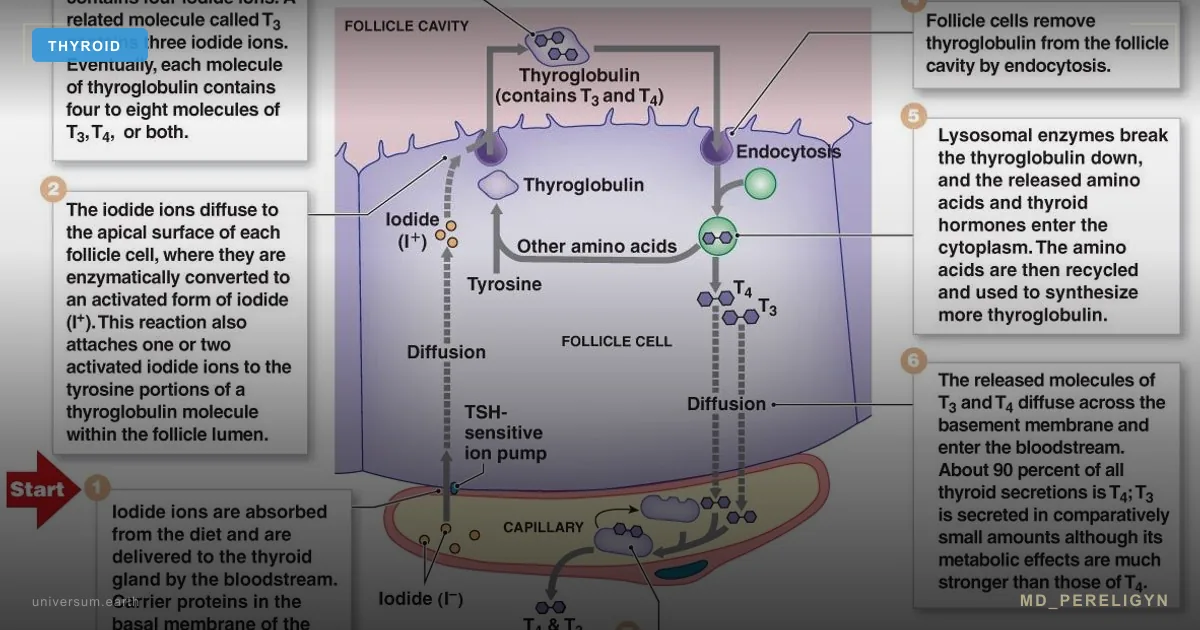
The mechanism is classical nuclear. T3 enters the cell through specialized transporters (MCT8, MCT10, OATP1C1), binds the TR-α or TR-β receptor in the nucleus, the receptor forms a heterodimer with RXR (retinoid X receptor), and binds TRE elements in target gene promoters. This drives transcription of more than 100 genes (PMID 11844744):
▸Mitochondrial biogenesis — PGC-1α, NRF1, TFAM (more mitochondria = more energy) ▸Basal metabolic rate — Na+/K+-ATPase, UCP1, UCP3 (resting energy expenditure) ▸Thermoregulation — UCP1 in brown fat, uncoupling of oxidation and phosphorylation ▸Myocardial contractility — α-MHC, SERCA2 (force and speed of contraction) ▸Cholesterol metabolism — hepatic LDL receptor, HMG-CoA reductase (T3 lowers LDL) ▸Cognitive function — myelination, synaptic plasticity, hippocampal neurogenesis ▸Glucose metabolism — GLUT4, glycolytic enzymes ▸Bone turnover — remodeling, osteoblast and osteoclast activity
The distribution of TR-α and TR-β across tissues explains the clinical picture. TR-α dominates in heart, skeletal muscle, and bone — so in hypothyroidism the first to suffer are myocardial contractility, strength endurance, and bone mineral density. TR-β dominates in liver, pituitary, and brain — so hypothyroidism disrupts cholesterol clearance, pituitary feedback, and cognitive function.
🌀
T4 → T3 conversion and the deiodinases
The thyroid gland secretes 80% T4 and only 20% T3 into the bloodstream. This means the main pool of active hormone is generated not in the gland itself but in peripheral tissues — through the deiodinase enzyme family.
▸Deiodinase D1 — liver, kidney, thyroid. Converts T4 to active T3 (~20% of systemic T3) and metabolizes rT3. ▸Deiodinase D2 — muscle, brain, pituitary, brown fat. The main activating enzyme: converts T4 to T3 intracellularly (~60% of systemic T3). Highly sensitive to stress and selenium deficiency. ▸Deiodinase D3 — placenta, skin, brain. The inactivating enzyme: converts T4 to rT3 (reverse T3), and T3 to T2. Acts as a "brake" under stress, fasting, and severe illness.
All three deiodinases are selenoenzymes. Without selenium, they physically cannot function. This explains why selenium deficiency (one of the most prevalent micronutrient deficiencies in Europe and the post-Soviet region) masquerades as clinical hypothyroidism even with normal TSH and fT4.
A deeper dive into conversion biochemistry and pharmacology of deiodinases is in the T4-to-T3 conversion, deiodinases, and functional hypothyroidism review.
Bianco and Kim in the Journal of Clinical Investigation (PMID 17016550) demonstrated the key mechanism: under acute or chronic stress (physical, emotional, infectious), D2 activity is suppressed via ubiquitin-mediated degradation, while D3 activity is upregulated. Result: less T4 is converted to active T3, more is shunted to reverse rT3. Serum fT4 and TSH may remain normal, while the patient is clinically — deeply hypothyroid.
🌀
Hidden cellular hypofunction
In some patients with normal TSH, clinically significant cellular hypothyroidism goes undetected by standard TSH screening. These patients show the full syndrome: fatigue, weight gain, hair loss, cold extremities, constipation, dry skin, depressive mood — but fT4, fT3, and TSH are within reference range.
The cause is not in the gland itself. The cause sits at one of three levels:
▸Impaired T3 transport into the cell — mutations or reduced expression of MCT8/MCT10 transporters, competition with other ligands ▸Impaired T4 → T3 conversion — deficiency of selenium, zinc, iron; DIO2 gene polymorphisms (Thr92Ala — in 12–16% of the population reduces D2 activity by 30–50%) ▸Elevated rT3 — competes with T3 at the TR receptor as an antagonist
The DIO2 Thr92Ala polymorphism deserves separate attention. Panicker et al. in the Journal of Clinical Endocrinology and Metabolism (PMID 19190113) showed that carriers of this variant on levothyroxine monotherapy report persisting hypothyroid symptoms significantly more often than wild-type carriers and respond significantly better to combined T4+T3 therapy. This is a minority, but a clinically important one — roughly 1 in 6 patients on levothyroxine.
Related article — hypothyroidism and natural desiccated thyroid NDT — covers the protocol for switching to Thyroid-S when levothyroxine monotherapy is inadequate.
🌀
What blocks T3
Based on clinical experience and pathophysiology, six main blockers of active cellular T3 action can be identified. They frequently combine in the same patient.
▸Chronic stress — cortisol upregulates D3, increases rT3, suppresses D2. Morning cortisol > 22 μg/dL or a flat diurnal curve equals high-rT3 syndrome even with normal fT3. ▸Selenium deficiency — all three deiodinases are selenoenzymes. Plasma selenium < 100 μg/L is associated with reduced D2 activity and elevated TPO antibodies in AIT. ▸Zinc deficiency — cofactor for TR receptor binding to DNA (zinc-finger domain). Without zinc the receptor does not engage the TRE element. ▸Iron deficiency (ferritin < 70 ng/mL) — iron is needed for thyroid peroxidase (T4 synthesis) and for normal D1 activity. Ferritin is the limiting factor in women of reproductive age. ▸Iodine deficiency — without iodine there is no T4 or T3 to begin with. See iodine and the thyroid: a five-step protocol. ▸Inflammation (IL-6, TNF-α) — proinflammatory cytokines activate D3 and suppress D2 at the transcriptional level. Chronic low-grade inflammation = functional hypothyroidism. ▸Low-calorie diet and chronic energy deficit — D2 in muscle is suppressed under energy restriction as an adaptation. Starvation = "hibernation" of the metabolism.
A detailed mechanism of the rT3 trap during weight loss is covered in weight loss, thyroid, and reverse T3.
Related topic — cortisol, adrenals, and the HPA axis — because the stress block of conversion cannot be addressed without HPA-axis correction.
🌀
The full panel: what to test
The standard "thyroid screening" in primary care is TSH. Sometimes fT4 is added. This is catastrophically insufficient for assessing cellular T3 action. The full panel of an integrative endocrinologist when cellular hypothyroidism is suspected:
Marker | Optimum TSH | 0.5-2.0 mIU/L fT3/rT3 | >20:1 (ideally >25:1); <15:1 = block fT3/fT4 | >0.30 Plasma selenium | 110-150 μg/L (<100 = deficiency) Ferritin | >70 ng/mL (>100 with hair loss)
▸TSH — optimum 0.5–2.0 mIU/L. Values 2.0–4.5 with symptoms warrant deeper investigation. ▸free T4 (fT4) — optimum in the upper third of reference range. fT4 in the lower third with "normal" TSH = subclinical hypothyroidism. ▸free T3 (fT3) — optimum in the upper third of reference range (approximately 3.2–4.4 pg/mL). Low fT3 with normal TSH and fT4 = impaired conversion. ▸reverse T3 (rT3) — should sit in the lower third of reference range. Elevated rT3 = blocked conversion or D3 activation. ▸fT3/rT3 ratio — index of deiodinase activity. Normal > 20:1 (ideally > 25:1). Below 15:1 = pronounced conversion block regardless of the rest of the panel. ▸fT3/fT4 ratio — normal > 0.30. Lower = impaired conversion. ▸TPO and TG antibodies — to detect Hashimoto AIT. TPO antibodies in particular. ▸plasma or erythrocyte selenium — optimum 110–150 μg/L. Below 100 = deficiency. ▸serum zinc — optimum 90–130 μg/dL. ▸ferritin — optimum in women with thyroid pathology > 70 ng/mL; in hair loss > 100 ng/mL. ▸morning serum cortisol or 4-point salivary cortisol — HPA-axis assessment. ▸vitamin D (25(OH)D) — optimum 50–80 ng/mL; below 30 = immunomodulatory deficiency in AIT.
Iodine status and the repletion protocol are detailed in iodine and the thyroid.
🌀
What is commonly missed
The standard patient pathway in a public-health system is TSH → "normal" → "you are fine, look for another cause." What gets missed in the process:
▸Isolated low fT3 with normal TSH — functional hypothyroidism. The most common picture in women 30–45 with chronic stress and/or rapid weight loss. ▸Elevated rT3 with normal fT3 — non-thyroidal illness syndrome (NTIS), often on the background of chronic infection (EBV, CMV, long COVID), MASLD, obesity, chronic insomnia. ▸Normal fT3 and fT4 + positive TPO antibodies — compensated AIT. Without intervention it progresses to overt hypothyroidism over 5–10 years. Here selenium, LDN, and vitamin D correction are justified. ▸DIO2 Thr92Ala polymorphism — genotyping is not insurance-covered, but in persistent symptoms on adequate-dose levothyroxine, the test is justified. ▸Severe insulin resistance — by itself blocks D2 in muscle through chronic hyperinsulinemia. ▸Hidden gluten sensitivity (NCGS) or celiac disease — found serologically in 5–10% of Hashimoto patients. A gluten-free diet lowers TPO antibodies.
Current evidence suggests levothyroxine monotherapy is adequate for 80–85% of hypothyroid patients, but in 15–20% — persistent symptoms with "normal" lab values — and this subgroup requires an individualized approach that accounts for polymorphisms, T3 add-on, or transition to NDT.
🌀
Therapeutic protocol for cellular hypothyroidism
The algorithm for low fT3 / high rT3 / low fT3/rT3 ratio with normal TSH:
▸Step 1 — remove conversion blockers: selenium 200 μg/day (selenomethionine, not inorganic selenite), zinc 25–50 mg/day with copper 2 mg, iron when ferritin < 70 ng/mL, iodine when deficiency is confirmed. Reassess at 8–12 weeks. ▸Step 2 — HPA-axis correction: adaptogens (rhodiola, ashwagandha), 7–9 hours of sleep, caffeine cutoff at noon, limit fasted high-intensity training. With pronounced HPA dysfunction — short course of pantethine or phosphatidylserine. ▸Step 3 — anti-inflammatory background: omega-3 EPA+DHA 2–3 g/day, vitamin D to 50–70 ng/mL, eliminate hidden inflammatory drivers (chronic autoimmune activity, gut dysbiosis, EBV reactivation). ▸Step 4 — reassessment at 12 weeks: repeat fT4, fT3, rT3, fT3/rT3, TSH, TPO antibodies. ▸Step 5 — when symptoms and low fT3 persist: consider adding liothyronine (T3) 5–12.5 μg/day to levothyroxine or transitioning to natural desiccated thyroid (Thyroid-S, Armour Thyroid, Nature-Throid). Starting NDT dose — 30 mg (½ grain) in the morning on an empty stomach, titrating by 15 mg every 4 weeks to target fT3 in the upper third of reference range and symptom resolution. ▸Step 6 — with Hashimoto AIT: add a gluten-free diet for 3–6 months (re-test TPO antibodies), low-dose naltrexone LDN 1.5–4.5 mg at night when antibodies remain elevated.
🌀
Follow-up and monitoring
Dynamic follow-up is a mandatory part of the protocol. What to assess and when:
▸At 6–8 weeks after starting micronutrient correction — repeat fT3, fT4, TSH, plasma selenium, ferritin. Assess subjective dynamics (energy, cold tolerance, cycle, libido). ▸At 12 weeks on any thyroid therapy adjustment — full panel of fT4, fT3, rT3, TSH, TPO antibodies. ▸When titrating NDT or T4+T3 — measure fT3 2–3 hours after dose (peak) and at trough — to assess pharmacokinetics. ▸Every 6 months on stable therapy — full panel + TPO antibodies for autoimmune dynamics. ▸Once every 12 months — thyroid ultrasound in Hashimoto AIT (volume, echogenicity, nodules). ▸Morning cortisol + vitamin D — every 6–12 months for cofactor dynamics.
Therapeutic targets: fT3 in the upper third of reference range, fT3/rT3 ratio > 25:1, TSH 0.5–2.0 mIU/L, TPO antibodies — sustained year-over-year decline, restoration of subjective parameters (energy, thermoregulation, menstrual regularity, sleep).
🌀
Caution and limitations
The T3 activation protocol is a powerful tool, but it does not fit everyone.
▸Coronary artery disease, arrhythmias, heart failure — adding T3 or transitioning to NDT increases myocardial oxygen demand. Start only with stable cardiology, from minimum doses, under ECG and pulse monitoring. ▸Thyrotoxicosis (Graves, thyrotoxic phase of AIT) — diagnostically the opposite picture. High fT3 with suppressed TSH is NOT an indication for the protocol, it is a contraindication. ▸Pregnancy — thyroid therapy is conducted only by an endocrinologist; transition to NDT is in most cases inappropriate; the standard is levothyroxine with TSH target 0.5–2.5 in the first trimester. ▸Severe adrenal insufficiency — starting T3 without prior cortisol correction can precipitate an adrenal crisis. First diagnose and correct the HPA axis, then activate the thyroid. ▸Osteoporosis — excess T3 increases bone resorption. In postmenopausal women with low BMD — the TSH target sits closer to 1.5–2.0 rather than 0.5. ▸Drugs affecting conversion: β-blockers (especially propranolol) suppress D1; amiodarone blocks D2/D3 and floods the thyroid with iodine; glucocorticoids suppress D2. When discontinuation is not possible — adjust thyroid therapy with these effects in mind. ▸Anticoagulants (warfarin, apixaban) — adding T3 potentiates the effect. Monitor INR or anti-Xa in the first 4–6 weeks.
🌀
Bottom line
Clinically that means: in a hypothyroid syndrome with "normal" TSH and fT4 — do not discard the diagnosis; expand the workup to the full panel with fT3, rT3, and ratios. Treat the patient, not the TSH number. Titrate therapy by clinical dynamics and by fT3 in the upper third of reference range, not by a midpoint TSH. And always correct conversion cofactors in parallel with replacement therapy — because without selenium, zinc, iron, and a balanced cortisol axis, any T4 dose will miss the receptor.
🌀
About the author
I am Dr. Vladimir Pereligyn, endocrinologist and researcher. I specialize in endocrine, metabolic, and autoimmune protocols with a holistic approach and individualized lab diagnostics. I tailor therapy for subclinical and cellular hypothyroidism individually, accounting for deiodinase polymorphisms, HPA-axis status, micronutrient profile, and autoimmune background.
Book a consultation — universum.earth/consultation. Daily clinical breakdowns — @md_pereligyn_thyroid.
This article is for informational purposes only and does not replace a medical consultation. Before starting any supplements, changing medication, or undergoing diagnostic procedures, discuss the plan with your physician.
References
Key facts
- T3 is the only thyroid hormone with high nuclear-receptor affinity; T4 is a prohormone with 10-15x lower affinity.
- The thyroid secretes 80% T4 and 20% T3; deiodinases make active T3 in tissues (D2 supplies ~60%).
- All three deiodinases are selenoenzymes; without selenium, T4→T3 conversion fails and mimics hypothyroidism.
- DIO2 Thr92Ala polymorphism (12-16%) cuts D2 activity 30-50%; worse response to levothyroxine monotherapy.
- fT3/rT3 ratio indexes conversion: normal >20:1 (ideally >25:1); below 15:1 = pronounced block.