In brief
| Question | In brief |
|---|---|
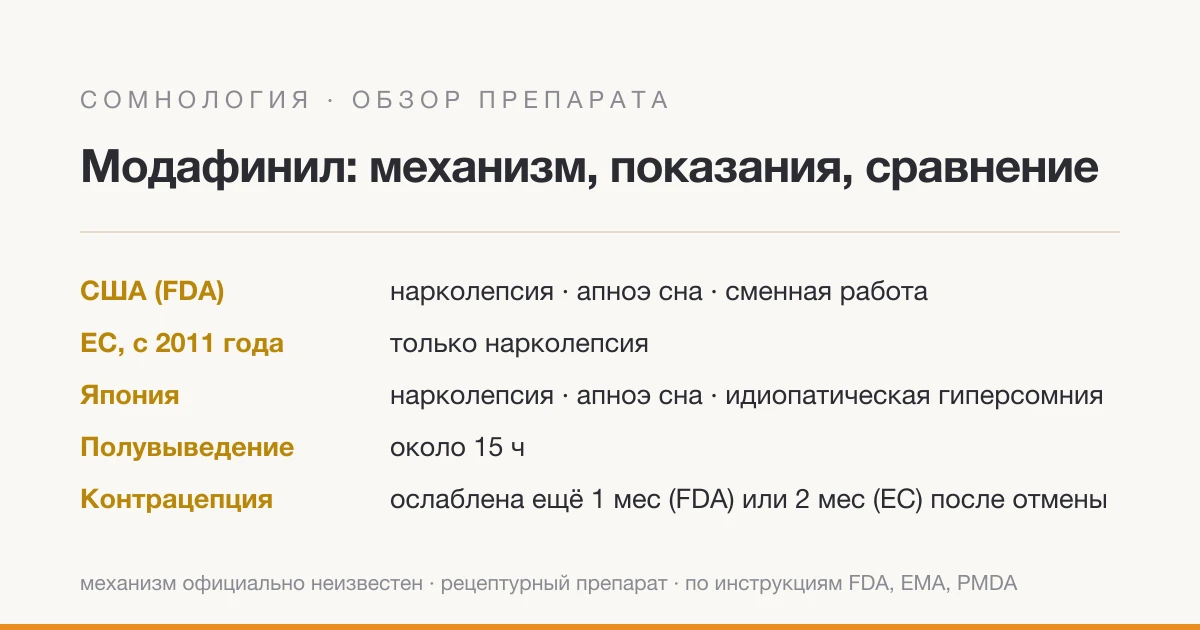
| What it is | A prescription wake-promoting agent. Armodafinil is its R-enantiomer (one of the two mirror-image forms of the molecule), a separate drug |
| Where it is approved and for what | US: narcolepsy, obstructive sleep apnoea (OSA), shift work — in adults. EU, UK, Switzerland: narcolepsy only. Japan: narcolepsy, idiopathic hypersomnia, OSA during CPAP (positive airway pressure treatment) |
| How long it acts | Peak concentration after 2–4 h; effective elimination half-life with repeated dosing about 15 h (FDA label) |
| Main interaction | Induction of the enzyme CYP3A4/5 (speeds up elimination of its substrates): hormonal contraception may work less well — during use and for 1 month after stopping (FDA) or up to 2 months (EU and UK SmPC) |
| Main risk | Serious skin reactions; in the EU and UK, suspected congenital malformations — not used in pregnancy |
Modafinil is used for pathological daytime sleepiness. Obstructive sleep apnoea (OSA) is a condition in which the airway becomes blocked during sleep; CPAP is continuous positive airway pressure treatment during sleep. The SmPC is the official prescribing information for doctors in the EU and UK (summary of product characteristics). Below is what is known from regulators' documents and research: mechanism, duration of action, indications by country, efficacy, off-label use, comparison with other wake-promoting agents, interactions and safety. The US and European labels differ on several important points — from indications to contraception time frames — and we give both versions with sources.
What modafinil is
The European Medicines Agency (EMA) defines modafinil as a wake-promoting agent (EMA, assessment report 2011). In the WHO Anatomical Therapeutic Chemical classification its code is N06BA07, in the group "centrally acting sympathomimetics" (WHO, ATC/DDD). Its molecule exists in two mirror-image forms — enantiomers: modafinil contains both in equal amounts (a 1:1 racemate), armodafinil only the R-enantiomer (FDA label for Nuvigil). Modafinil was first approved in France in June 1992 (Modiodal). In the US, the Food and Drug Administration (FDA) approved Provigil on 24 December 1998 — at that time only for sleepiness in narcolepsy (FDA letter, 1998). Of the countries for which we have regulators' documents, modafinil was then approved in Canada (Alertec, 1999), Australia (2002) and Japan (Modiodal, 2007). Armodafinil (Nuvigil) was approved in the US on 15 June 2007 (FDA letter, 2007). In the US both drugs are Schedule IV controlled substances (21 CFR 1308.14). In the UK modafinil is a prescription-only medicine but does not appear in the controlled drug schedules (Misuse of Drugs Regulations 2001); nor is it in the annexes of the German Narcotics Act (BtMG) (BtMG, Annex III).
Part 1. How modafinil maintains wakefulness
| Link in the chain | What was shown | Where it was shown |
|---|---|---|
| Dopamine transporter (DAT) | Binds to DAT and inhibits dopamine reuptake, but weakly (half-maximal inhibitory concentration IC50 6.4 µM); no wake-promoting effect in mice lacking DAT | In vitro, mice; DAT occupancy — positron emission tomography (PET) in humans |
| Noradrenaline transporter (NET) | Inhibits noradrenaline uptake about 5 times more weakly (IC50 35.6 µM); occupies NET in the thalamus | In vitro, monkeys |
| Dopamine D1 and D2 receptors | Their antagonists blocked the effect of low doses | Mice |
| Adrenergic receptors | The antagonist terazosin suppressed the effect; according to the authors, this link depends on dopamine | Mice |
| Hypothalamus: histamine and orexin | Wakefulness centres are activated; histamine release rises to 150% of baseline | Rats |
| Glutamate, GABA, serotonin | Changes depend on brain region and dose; serotonin reuptake is not inhibited | Rats, brain slices |
The first link is the best supported: the dopamine transporter (DAT), a protein that carries dopamine back into the nerve cell (reuptake). According to the FDA label, modafinil is not a direct- or indirect-acting dopamine receptor agonist, but in vitro it binds to DAT and inhibits dopamine reuptake; in genetically engineered mice lacking DAT it had no wake-promoting effect; at the same time, in rats haloperidol did not abolish modafinil-induced wakefulness (FDA label for Provigil). The action on transporters is weak. The concentration that inhibits uptake by half (IC50) was 6.4 µM for dopamine, 35.6 µM for noradrenaline and more than 500 µM for serotonin, meaning that no inhibition of serotonin uptake was detected within the measurable range (Madras BK, J Pharmacol Exp Ther 2006). In a screen of rat brain receptors and transporters, measurable activity was found only at DAT, but the authors allow for a contribution from non-dopaminergic mechanisms as well (Zolkowska D, J Pharmacol Exp Ther 2009).
In humans, DAT occupancy was measured with positron emission tomography (PET). In a pilot study in 10 healthy men, single doses of 200 and 400 mg occupied 53.8% of transporters in the caudate nucleus, 47.2% in the putamen and 39.3% in the nucleus accumbens, and raised extracellular dopamine. The authors drew from this not a conclusion about safety but a warning: drugs that increase dopamine in the nucleus accumbens have the potential for abuse, so heightened awareness of potential abuse of and dependence on modafinil in vulnerable populations is needed (Volkow ND, JAMA 2009). In the second PET study (10 healthy people, single dose, no placebo), striatal DAT occupancy was 51.4% at 200 mg and 56.9% at 300 mg and correlated with plasma concentration; the authors concluded that this is close to methylphenidate and that, in terms of abuse potential from the standpoint of dopamine transmission, modafinil may be at the same level (Kim W, Int J Neuropsychopharmacol 2014). Armodafinil, in an open-label PET study without placebo (6 people per dose), occupied 60.5% of striatal DAT at 1 h and 65.2% at 2.5 h at 250 mg; the 100 mg dose gave 34.0% and 40.4%, but it is below the recommended range, so this is a comparison of two doses, not a gradient within clinical doses (Spencer TJ, Biol Psychiatry 2010).
The following links have been shown only in animals and at doses far above human ones. In mice, D1 or D2 receptor antagonists blocked the wake-promoting effect of low doses of modafinil (22.5 and 45 mg/kg); at 90 and 180 mg/kg the D1 antagonist had no effect on wakefulness at all, whereas the D2 antagonist halved the wakefulness (Qu WM, J Neurosci 2008). Destroying the noradrenergic projections from the locus coeruleus to the forebrain did not abolish the effect of modafinil, whereas the adrenergic antagonist terazosin suppressed it; a dopamine autoreceptor agonist also weakened the effect, and the authors interpret this link as dopamine-dependent adrenergic signalling (Wisor JP, Neuroscience 2005). In rats, during modafinil-induced wakefulness, the histaminergic tuberomammillary nucleus and the orexin neurons of the hypothalamus were activated, and at higher doses also the striatum and cingulate cortex; an activation marker does not prove that these cells are a direct target (Scammell TE, J Neurosci 2000). Histamine release in the anterior hypothalamus rose to 150% of baseline, that is, 1.5-fold, but did not change when modafinil was injected directly into the histaminergic nucleus, so the authors regard histamine as a link further down the chain rather than a target (Ishizuka T, Neurosci Lett 2003). Orexin is not required for prolonging wakefulness: in mice lacking orexin, modafinil increased wake time even more than in normal mice, but did not suppress cataplexy-like transitions (Willie JT, Neuroscience 2005). More on the orexin system in our article on daridorexant.
The rest is even less certain. Data on glutamate and GABA come from a single group in rats at 30–300 mg/kg: glutamate release rose in the thalamus and hippocampus, while GABA release in the striatum and globus pallidus fell (Ferraro L, Neuroreport 1997; Ferraro L, Neurosci Lett 1998). Modafinil enhanced evoked serotonin release in the cortex but, unlike paroxetine, did not inhibit serotonin reuptake; this is a mechanistic difference, not evidence of an antidepressant effect (Ferraro L, Neuropharmacology 2000). In humans, on functional MRI, modafinil reduced the baseline activity of the locus coeruleus–noradrenaline system, enhanced its task-related activity and the coupling of the locus coeruleus with the prefrontal cortex; the abstract gives no effect sizes (Minzenberg MJ, Science 2008). The European SmPC states that in non-clinical models modafinil, unlike classical psychomotor stimulants, acts predominantly on brain regions that regulate sleep and wakefulness; in an experiment in cats, amphetamine and methylphenidate activated neurons throughout the brain, whereas modafinil induced labelling in only a few cells in those same areas (Lin JS, Proc Natl Acad Sci U S A 1996), and the FDA label specifies that the relevance of this finding to its action in humans is unknown. Reviews summarise the picture as follows: many of the effects may be secondary to catecholamine effects (Minzenberg MJ, Neuropsychopharmacology 2008); modafinil is an exceptionally weak, but apparently very selective, DAT inhibitor, and its clinical differences from amphetamines do not rule out a catecholaminergic basis for its action (Wisor J, Front Neurol 2013).
Part 2. Duration of action: pharmacokinetics
| Stage | Modafinil | Armodafinil |
|---|---|---|
| Peak concentration | After 2–4 h; food may delay it by about 1 h, overall bioavailability does not change | About 2 h fasting; food may delay it by about 2–4 h |
| Elimination half-life | Effective — about 15 h with repeated dosing; about 15 h for the R-form, about 4 h for the S-form | Apparent terminal — about 15 h |
| Steady-state concentration | After 2–4 days | No data |
| Elimination | About 90% — metabolism in the liver, mainly to inactive modafinil acid (40–50% of the dose); less than 10% unchanged | Mainly amide hydrolysis; secondarily sulfone formation via CYP3A4/5 |
Plasma protein binding is about 60%, mainly to albumin; the volume of distribution is about 0.9 L/kg. The enantiomers do not convert into each other. The R-form is eliminated about three times more slowly than the S-form, so at steady state its exposure is three times higher, and before the next dose the circulating drug is 90% R-modafinil (FDA label for Provigil). No label gives a figure for the share of elimination handled by CYP3A4. The Provigil label states that there are several metabolic pathways and the fastest is not related to cytochrome P450 (CYP) enzymes, so a substantial effect of CYP inhibitors is unlikely; however, because CYP3A is partly involved, strong CYP3A4/5 inducers (carbamazepine, phenobarbital, rifampicin) or inhibitors (ketoconazole, erythromycin) may alter modafinil concentrations. The sulfone metabolite is eliminated with a half-life of about 40 h and accumulates. A review by the manufacturer's employees also considers it unlikely that CYP inducers and inhibitors greatly change the pharmacokinetics of modafinil (Robertson P Jr, Clin Pharmacokinet 2003).
| Group | US (FDA label) | EU and UK (SmPC) |
|---|---|---|
| Severe hepatic impairment | Dose is halved | Dose is halved |
| Mild and moderate hepatic impairment | No guidance | No guidance |
| Renal impairment | No dosing guidance | Insufficient data to determine the safety and efficacy of dosing |
| Older people | Consider lower doses and close monitoring | Over 65: start at 100 mg a day |
| Children | Not approved for any indication | Not to be used under 18 |
Where these rules come from. In cirrhosis (9 patients, Child–Pugh class B and C), modafinil clearance was about 60% lower and the steady-state concentration twice as high. In severe chronic renal failure (creatinine clearance 20 mL/min or less, a single 200 mg dose), the pharmacokinetics of modafinil itself did not change significantly, but exposure to the inactive modafinil acid rose 9-fold; repeated dosing was not studied in this group. In 12 older people (mean age 82 years, 300 mg a day), concentrations were about twice those in comparable young people in earlier studies (historical control); according to the FDA label, the difference may not be due to age alone — these patients were taking many other drugs — but clearance may be reduced in older people (FDA label for Provigil; Provigil SmPC, UK). Doses in the labels are for adults with approved indications. US: in narcolepsy and OSA, 200 mg once in the morning; doses up to 400 mg a day as a single dose have been well tolerated, but there is no consistent evidence of additional benefit over 200 mg; in shift work disorder, 200 mg about 1 h before the start of the shift. UK (narcolepsy only): the starting dose is 200 mg a day, as a single morning dose or in two doses, morning and noon; up to 400 mg in one or two doses only if the response to 200 mg is inadequate.
Armodafinil and modafinil. In pooled single-dose data in healthy people, the terminal half-life of both is about 13 h, but the concentration of modafinil declines in two phases — the S-form is cleared quickly. As a result, per milligram, the area under the concentration curve (AUC) of armodafinil is 33–40% higher, and its concentration is sustained longer into the afternoon (Darwish M, Clin Drug Investig 2009). In 42 patients with residual sleepiness in OSA on CPAP (open-label crossover study, 200 mg each), the armodafinil-to-modafinil AUC ratio was 1.64 after a single dose and 1.69 after repeated dosing, and the peak concentration ratio after repeated dosing was 1.37; half-lives were comparable (16.5 and 14.4 h); on a post hoc check against FDA criteria, the drugs are not bioequivalent (Darwish M, Clin Ther 2010). The authors of both studies are linked to the manufacturer, and the clinical benefit of a more even concentration is their hypothesis. There are no direct controlled comparisons in patients of the duration of action of modafinil and armodafinil in hours. In a 12-week RCT of armodafinil in narcolepsy (196 people, no modafinil arm), the time to falling asleep in the Maintenance of Wakefulness Test (MWT) was longer than on placebo not only at 9:00–15:00 but also at 15:00–19:00 — by 2.8 min for the pooled doses (Harsh JR, Curr Med Res Opin 2006). In 107 healthy men during overnight sleep deprivation, armodafinil 200 mg gave a peak concentration comparable to modafinil 200 mg but higher concentrations 6–14 h after dosing; in this window the time to falling asleep in the MWT was longer and there were fewer attention lapses on the psychomotor vigilance test (PVT); the abstract gives no statistical comparison of the two drugs (Dinges DF, Curr Med Res Opin 2006).
Timing of doses. In 32 patients with narcolepsy (a small study without a parallel placebo group) who responded to modafinil but became sleepy again by evening, 400 mg in two doses maintained evening wakefulness better than 200 or 400 mg once daily (both p < 0.05). By physician assessment, evening sleepiness improved in 80% with split dosing, 82% with 400 mg once daily and 27% with 200 mg. The authors write that split dosing "may be" superior (Schwartz JR, Clin Neuropharmacol 2003). In the registration studies, polysomnography showed no effect on night-time sleep with morning dosing or on daytime sleep with dosing before a night shift; taking it shortly before bedtime may make it harder to fall asleep (FDA label for Provigil).
Where it is approved and for what
| Country | Indications in adults | Year | Document |
|---|---|---|---|
| US, Provigil | Narcolepsy; OSA and shift work | 1998; 2004 | FDA |
| US, Nuvigil (armodafinil) | OSA, narcolepsy, shift work | 2007 | FDA |
| EU | Narcolepsy with or without cataplexy only | Since 2011 (previously, in some countries, also OSA, shift work, idiopathic hypersomnia) | EMA |
| UK | Narcolepsy with or without cataplexy only | No data | SmPC |
| Switzerland, Modasomil | Narcolepsy only; started after diagnosis by a neurologist or pulmonologist and/or at a sleep medicine centre | No data | Prescribing information |
| Japan, Modiodal | Narcolepsy; OSA in people receiving treatment for the obstruction, such as CPAP; idiopathic hypersomnia | 2007; 2011; 2020 | PMDA |
| Canada, Alertec | Narcolepsy; OSA — as an adjunct to successful standard treatment of the obstruction, if sleepiness persists; shift work | 1999 (first authorisation) | Monograph |
| Australia, Modavigil | Narcolepsy; moderate to severe chronic shift work sleep disorder (under the current Modavigil label, 2026 — if non-drug measures are ineffective or inappropriate); OSA as an adjunct to CPAP | 2002; 2007 | PBAC |
| South Korea | Modafinil restricted to narcolepsy; armodafinil (Nuvigil) — narcolepsy only | Restriction 2011; armodafinil 2017 | MFDS |
| Worldwide, according to the manufacturer | Narcolepsy — 36 countries and regions; OSA on CPAP — 6; idiopathic hypersomnia — Mexico only | 2018 | Dossier, PMDA |
US. The current Provigil label (revision 12/2022): to improve wakefulness in adults with excessive sleepiness associated with narcolepsy, OSA or shift work disorder. In OSA the drug treats the sleepiness, not the obstruction; if CPAP is the treatment of choice for a patient, a maximal effort to treat with CPAP for an adequate period should be made before starting and while taking modafinil (FDA label for Provigil). In 1998 there was a single indication — narcolepsy; the FDA added OSA and shift work on 23 January 2004 (FDA letter, 2004). Idiopathic hypersomnia is not in the US label. Modafinil is not approved for children for any indication in the US, Canada and Australia; in the EU and UK it is not used under 18, in Switzerland it is not recommended under 18, and in Japan no studies in children have been conducted. In a 6-week RCT in narcolepsy in children (165 people), no significant difference from placebo was shown on the Multiple Sleep Latency Test (MSLT) or the Clinical Global Impression of Change (CGI-C) (FDA label for Provigil). In Australia, armodafinil has also been registered since 2015 with the same three indications; the PBAC rejection that same year concerned public subsidy, not registration (PBAC, 2016). In Italy, Provigil 100 mg is dispensed on a restricted prescription (RRL) and is in reimbursement class A (AIFA). We did not find primary regulatory documents from China, India, Brazil or Israel; the idiopathic hypersomnia indication in Mexico is known only from the manufacturer.
Why the EU kept only narcolepsy in 2011
The Article 31 review was started at the request of the UK on 14 May 2009. At the time of the review (according to the 2011 assessment report), modafinil was authorised in 21 European countries: for narcolepsy everywhere, for OSA in 11 member states, for shift work in 10 and for idiopathic hypersomnia in 4 (EMA, assessment report 2011). The Committee for Medicinal Products for Human Use (CHMP) confirmed its opinion on 18 November 2010, and the European Commission decision was adopted on 27 January 2011. For OSA (including sleepiness persisting despite proper use of CPAP), shift work and idiopathic hypersomnia, the CHMP concluded that the data on effectiveness were not sufficient to outweigh the risks, and that the benefit–risk balance was therefore negative (EMA, questions and answers, 2011). The scientific conclusions: in narcolepsy, short-term efficacy was demonstrated, long-term efficacy was not shown; in OSA the effect size is small and does not necessarily reflect a clinically significant benefit; in shift work the effects did not provide clear evidence of overall benefit (EMA, 2011). Among the risks, the EMA named serious, life-threatening skin reactions (a risk that appears higher in children), and psychiatric and cardiovascular reactions. The indications were withdrawn, not the marketing authorisations themselves; the manufacturer disagreed with the CHMP's conclusions. In February 2011, South Korea also restricted modafinil to narcolepsy (MFDS). According to the European Commission's competition decision of 26 November 2020, armodafinil had not been placed on the market in the European Economic Area (EEA) by that time; the decision does not mention any refusal or withdrawal of marketing authorisation (European Commission, 2020).
Two indications were not approved in the US; they are known from company announcements, because such FDA letters are not published. On 9 August 2006 Cephalon announced that it had received a not approvable letter from the FDA on its application for Sparlon — modafinil for attention deficit hyperactivity disorder (ADHD) in children and adolescents — and stopped development; according to the company's chief executive, the FDA disagreed with the company's experts about a single suspected case of Stevens–Johnson syndrome, a severe reaction of the skin and mucous membranes (Cephalon, 2006). For armodafinil for sleepiness due to jet lag (eastward travel), the company announced two FDA Complete Response letters, on 29 March and 27 December 2010: this means that the application cannot be approved in its current form, not a formal refusal. The first letter raised questions about the robustness of the data on the patient's global assessment of severity; after the second, the company abandoned the indication (Cephalon, 2010). In South Korea in 2017, the armodafinil application included OSA and shift work; the regulator MFDS approved only narcolepsy, citing the 2011 restriction of modafinil and the fact that armodafinil had not demonstrated improved safety (MFDS).
Part 3. Efficacy in approved indications
How to read the figures. The data come from randomised controlled trials (RCTs), in which participants are assigned to groups at random, and from meta-analyses — the statistical pooling of several studies. ESS is the Epworth Sleepiness Scale, a questionnaire: the lower the score, the less the sleepiness. MWT is the Maintenance of Wakefulness Test: how many minutes a person stays awake when trying to remain awake (in modafinil's registration studies a session lasted 20 min). MSLT is the Multiple Sleep Latency Test: how many minutes it takes a person to fall asleep when given the opportunity to sleep. CGI-C is the clinician's Clinical Global Impression of Change. The 95% CI is the confidence interval, the range in which the true effect most likely lies; RR is the risk ratio.
| Indication | Main RCT | Versus placebo | Caveat |
|---|---|---|---|
| Narcolepsy | 2 RCTs of 9 weeks, 558 randomised (FDA label) | MWT +2.0 to +2.3 min from a baseline of about 6 min (placebo −0.7); CGI-C improvement in 58–72% vs 37–38% | Per the SmPC, efficacy beyond 9 weeks has not been assessed |
| OSA with sleepiness on CPAP | 12 weeks, 327 people | MWT at week 12: 14.8–15.0 vs 12.6 min; ESS −4.5 vs −1.8 | EMA: the effect is small, clinical relevance questionable |
| Shift work disorder | 3 months, 209 people | Night-time MSLT +1.7 vs +0.3 min; CGI-C 74% vs 36% | Night-time sleepiness and impaired performance persisted |
In narcolepsy, two pivotal US RCTs (283 patients at 18 centres and 271 at 21 centres, 200 or 400 mg a day) showed reduced sleepiness on the ESS, MSLT and MWT and improvement on the CGI-C (US Modafinil in Narcolepsy Multicenter Study Group, Ann Neurol 1998; US Modafinil in Narcolepsy Multicenter Study Group, Neurology 2000). The numbers of participants differ between sources: 283 and 271 in the publications (554 in total), 558 randomised in the FDA label. According to the FDA label, there is no consistent evidence of additional benefit of 400 mg over 200 mg. In the second RCT, after a two-week withdrawal, sleepiness returned to baseline and there were no amphetamine-type withdrawal symptoms — the effect lasts while the drug is being taken (US Modafinil in Narcolepsy Multicenter Study Group, Neurology 2000). A meta-analysis of 9 RCTs (1054 patients): ESS lower by 2.73 points (95% CI 2.08–3.39), MSLT longer by 1.11 min, MWT by 2.82 min (2.40–3.24) (Golicki D, Med Sci Monit 2010). The 2021 systematic review by the American Academy of Sleep Medicine (AASM): ESS lower by 2.8 points (95% CI 1.7–3.8; moderate certainty of evidence), MWT longer by 4.1 min (3.4–4.8; high), MSLT by 1.6 min (0.9–2.2; moderate). The mean estimates exceed the AASM thresholds of clinical significance (2 points, 2 min and 1 min), but the lower bounds of the CIs for ESS and MSLT do not reach the threshold (Maski K, J Clin Sleep Med 2021). An updated 2026 meta-analysis (5 studies, 997 patients) gave MWT +3.56 min and ESS −3.34 points; the authors stress that these RCTs date mostly from the 1990s and early 2000s and that long-term efficacy has not been established (Mann GS, Sleep Med X 2026).
We did not find long-term controlled efficacy studies: there are open-label extensions and one short randomised withdrawal. In two pooled 40-week open-label extensions (478 patients), the mean ESS fell from 16.5 to 12.4 by week 2 and stayed at that level; 71% completed, and 9% withdrew because of adverse events (Mitler MM, Sleep Med 2000). In a randomised two-week withdrawal after 16 weeks of open-label use, MWT in those continuing modafinil was 16.4 min versus 9.7 min on placebo, and ESS 13.2 versus 15.4 (Moldofsky H, Sleep Med 2000). The European SmPC: efficacy beyond 9 weeks has not been assessed, and with long-term use the doctor should periodically re-evaluate the need for it (EMA, 2011; modafinil SmPC, UK). The 2021 AASM guideline gives modafinil a strong recommendation in narcolepsy in adults compared with no treatment; pitolisant, sodium oxybate and solriamfetol also have strong recommendations (they are listed alphabetically; this is not a ranking), and armodafinil, dextroamphetamine and methylphenidate conditional ones; the guideline notes that modafinil may reduce the effectiveness of oral contraception (Maski K, J Clin Sleep Med 2021). The 2021 European guideline (EAN, ESRS, EU-NN) gives strong recommendations for daytime sleepiness in adults to scheduled naps, modafinil, pitolisant, sodium oxybate and solriamfetol, and weak ones to methylphenidate and amphetamine derivatives (Bassetti CLA, J Sleep Res 2021).
In OSA, modafinil treats only the sleepiness that remains on CPAP. In a 12-week RCT (327 patients according to the FDA label), the time to falling asleep in the MWT at week 12 was 15.0 min on 400 mg and 14.8 min on 200 mg versus 12.6 min on placebo. ESS fell by 4.5 points on both doses versus 1.8. CGI-C improvement was seen in 61% on 200 mg and 68% on 400 mg versus 37%; the drug did not affect night-time sleep or CPAP use (Black JE, Sleep 2005). In a 4-week RCT (77 people on modafinil, 80 on placebo), ESS normalised (below 10) in 51% versus 27%, whereas no difference was shown in MSLT normalisation — 29% versus 25%; headache — 23% versus 11% (Pack AI, Am J Respir Crit Care Med 2001). In a crossover RCT in 30 people, no difference from placebo was shown on ESS and MSLT, MWT was 18.3 versus 16.6 min, and CPAP use fell slightly — 6.3 versus 6.5 h a night (Kingshott RN, Am J Respir Crit Care Med 2001).
A meta-analysis of 10 RCTs in sleepiness on CPAP (1466 patients, modafinil together with armodafinil): ESS better by 2.2 points (95% CI 1.5–2.9), MWT by 3 min (2.1–3.8); three times as many adverse events, twice as many withdrawals due to them, and no more serious ones; the authors advise deciding on an individual basis (Chapman JL, Eur Respir J 2016). In a network meta-analysis in OSA (14 RCTs, 3085 patients), at 4 weeks solriamfetol lowered ESS by 3.85 points (high certainty), armodafinil–modafinil probably by 2.25 (moderate), and armodafinil–modafinil probably increased discontinuation due to adverse events (RR 2.01; 95% CI 1.14–3.51) (Pitre T, Ann Intern Med 2023). In another network meta-analysis, at up to 4 weeks MWT lengthened by 3.61 min on modafinil and by 11.66 min on solriamfetol (Tanayapong P, CNS Drugs 2025). These are indirect comparisons.
In shift work disorder, in a 3-month RCT (209 patients, 200 mg before the start of each shift), night-time sleep latency on the MSLT increased by 1.7 min versus 0.3 min — the authors called this a "modest" improvement. CGI-C improvement was seen in 74% versus 36%; PVT attention lapses decreased by 2.6 versus an increase of 3.8. Accidents or near-accidents on the drive home were reported by 29% versus 54% (self-report, without a baseline). Despite this, treated patients continued to have excessive sleepiness and impaired performance at night (Czeisler CA, N Engl J Med 2005). A Cochrane review: modafinil "probably" reduces sleepiness on the Karolinska scale by 0.90 points out of 10 (one RCT, 183 participants, moderate-quality evidence); there are no studies in shift workers without the disorder (Liira J, Cochrane Database Syst Rev 2014).
Off-label use
Below are conditions that are not in the US and EU labels. Of these, only idiopathic hypersomnia is approved anywhere: in Japan (2020) and, according to the manufacturer's data for 2018, in Mexico. "Superiority over placebo not shown" does not mean "proven not to work": many studies are small and short. The 2021 AASM guideline gives modafinil conditional recommendations for sleepiness due to Parkinson's disease, traumatic brain injury and myotonic dystrophy, and in multiple sclerosis only for hypersomnia, not for fatigue. For idiopathic hypersomnia in adults, the 2021 AASM guideline gives modafinil a strong recommendation compared with no treatment — the only strong one for this diagnosis; it is based on 1 RCT and 4 observational studies (Maski K, J Clin Sleep Med 2021). SMD in the tables is the standardised mean difference between groups; OR is the odds ratio. Sources for the tables, apart from those discussed below: idiopathic hypersomnia — Trotti LM, Cochrane Database Syst Rev 2021; Parkinson's disease — Rodrigues TM, Parkinsonism Relat Disord 2016 and Elbers RG, Cochrane Database Syst Rev 2015; traumatic brain injury — João RB, Brain Inj 2025, Kaiser PR, Neurology 2010 and Jha A, J Head Trauma Rehabil 2008; myotonic dystrophy — Annane D, Cochrane Database Syst Rev 2024; stroke — Bivard A, Stroke 2017 and Poulsen MB, Stroke 2015; post-polio syndrome — Vasconcelos OM, Neurology 2007; HIV — Rabkin JG, J Clin Psychiatry 2010; chronic fatigue syndrome — Randall DC, J Psychopharmacol 2005.
| Condition | Status | Evidence | What was shown |
|---|---|---|---|
| Idiopathic hypersomnia | Japan — approved (2020); Mexico — according to the manufacturer (2018); US and EU — not approved | Cochrane: 2 RCTs, 101 participants, high certainty; AASM 2021 — strong recommendation | ESS −5.08 points, MWT +4.74 min versus placebo |
| Parkinson's disease | Not in the labels | Meta-analysis of 3 RCTs | Sleepiness: ESS −2.24; no evidence of an effect on fatigue found (Cochrane) |
| Traumatic brain injury | Not in the labels | Meta-analysis of 3 RCTs of modafinil and armodafinil, 158 people | ESS −1.65 (CI bound −0.04, close to zero); insomnia more frequent (RR 3.73); not shown for fatigue |
| Myotonic dystrophy | Not in the labels | Cochrane: 6 short RCTs of psychostimulants, 136 people | ESS −2.55 in favour of modafinil (low certainty); MWT, MSLT, quality of life — very uncertain |
| Fatigue in multiple sclerosis | Not in the labels | Meta-analysis of 7 studies; TRIUMPHANT-MS RCT | MFIS −4.42 — around the threshold of importance to patients; superiority not shown in the RCT |
| Fatigue after stroke | Not in the labels | 2 small RCTs | One showed reduced fatigue, the other did not meet its primary endpoint |
| Post-polio syndrome | Not in the labels | Crossover RCT, 36 people | Superiority for fatigue and quality of life not shown |
| Condition | Status | Evidence | What was shown |
|---|---|---|---|
| ADHD in children and adolescents | Not in the labels; in the US the application was not approved (2006, according to the company) | 3 RCTs; meta-analysis of 5 RCTs | Symptoms decreased (SMD −0.71 to −0.77); 3 cases of serious rash among 933 treated |
| ADHD in adults | Not in the labels | Network meta-analysis; RCT, 330 people | Superiority over placebo not shown; less well tolerated |
| Depression, as an add-on to treatment | Not approved anywhere | Meta-analysis of 6 RCTs, 910 people | Small improvement; remission OR 1.61 |
| Bipolar depression | Not in the labels | Meta-analysis of 5 RCTs; 3 phase 3 RCTs of armodafinil | Response RR 1.18; primary endpoint met in one of three phase 3 RCTs |
| Schizophrenia, negative symptoms | Not approved anywhere | Meta-analysis of 6 RCTs of modafinil and armodafinil | Statistically significant but small: SMD −0.26; the advantage disappeared in chronically ill patients |
| Cancer-related fatigue | Not approved anywhere | 2 RCTs (867 and 208 people); meta-analyses disagree | Benefit only in the subgroup with severe fatigue; not shown in lung cancer |
| Fatigue in HIV | Not in the labels | 4-week RCT, 115 people | Fatigue response 73% vs 28% |
| Chronic fatigue syndrome | Not in the labels | Crossover RCT, 14 people | No effect on fatigue detected; possibly underpowered |
ADHD. In three RCTs of 7–9 weeks in children aged 6–17, modafinil outperformed placebo on the ADHD-RS symptom scale (school version), but among the 933 who received the drug in this programme there were 3 cases of serious rash, including possible Stevens–Johnson syndrome; the FDA label stresses that modafinil is not approved for the treatment of ADHD (FDA label for Provigil). In a meta-analysis of 5 short RCTs in children, the SMD was −0.77 for ratings at home and −0.71 at school; insomnia (RR 6.16) and decreased appetite (RR 5.02) were more frequent; the authors ask that the results be applied in practice with caution (Wang SM, J Psychiatr Res 2017). In adults, in a network meta-analysis, modafinil did not statistically significantly outperform placebo (SMD 0.16; 95% CI −0.28 to 0.59) and was less well tolerated: the OR for dropout due to side effects was 4.01 (Cortese S, Lancet Psychiatry 2018); in an RCT in 330 adults over 9 weeks, no benefit was demonstrated (Arnold VK, J Atten Disord 2014).
Fatigue. In multiple sclerosis, a meta-analysis of 7 controlled studies showed a reduction in the MFIS (Modified Fatigue Impact Scale) score by 4.42 and in ESS by 0.87, with more frequent adverse events (RR 1.30) (Ghazanfar S, Brain Behav 2024); the minimal patient-important difference on the MFIS is about 4 points, so the effect is borderline (Toljan K, Mult Scler Relat Disord 2025). In the TRIUMPHANT-MS crossover RCT (141 randomised, modafinil up to 100 mg twice daily, 6 weeks), amantadine, modafinil and methylphenidate did not outperform placebo: MFIS 39.0 on modafinil versus 40.6 (p = 0.20 for the overall drug effect), adverse events 40% versus 31% (Nourbakhsh B, Lancet Neurol 2021). In cancer-related fatigue, in a phase 3 RCT (867 randomised, 631 analysed), modafinil 200 mg helped only with severe baseline fatigue — this is an interaction analysis, not a main effect (Jean-Pierre P, Cancer 2010); in advanced non-small cell lung cancer, no difference from placebo was shown, with a pronounced placebo effect (Spathis A, J Clin Oncol 2014). The meta-analyses here contradict each other: in one, modafinil is no better than placebo (Qu D, Eur J Cancer Care (Engl) 2016); in a network meta-analysis, it is better than placebo but worse than paroxetine (Chow R, BMJ Support Palliat Care 2023).
Mood. In a meta-analysis of 6 RCTs (910 people with major depressive disorder or bipolar depression), adding modafinil or armodafinil gave a small improvement on depression scales (−0.35; 95% CI −0.61 to −0.10) and in remission (OR 1.61; 1.04–2.49) without excess adverse events (Goss AJ, J Clin Psychiatry 2013). In bipolar depression (5 RCTs, 4 of them of armodafinil), response RR 1.18, remission RR 1.38; there is no signal of increased mood switching or suicide attempts, but the upper CI bounds reach 2.5–2.85 (Nunez NA, Bipolar Disord 2020). The phase 3 programme of armodafinil in bipolar I depression gave a mixed result: one of three 8-week RCTs met its primary endpoint (Calabrese JR, J Clin Psychiatry 2014), two did not (Ketter TA, J Affect Disord 2015; Frye MA, Int J Bipolar Disord 2015); the reason the programme was stopped is not given in the sources we found. In schizophrenia, adding modafinil or armodafinil to antipsychotics reduced negative symptoms statistically significantly but slightly — by 0.27 points on the PANSS-N negative symptom scale; without the single RCT in acutely ill patients the effect lost significance, and in chronically ill patients and those with a high burden of negative symptoms the advantage disappeared (Andrade C, J Psychiatr Res 2015); according to a Cochrane review, most of the evidence is of low or very low quality (Ortiz-Orendain J, Cochrane Database Syst Rev 2019).
Cognitive effects in healthy people
Well-rested people
In well-rested adults the effects are small. In a meta-analysis of 19 placebo-controlled single-dose studies the overall effect was g = 0.10 (95% CI 0.05–0.15) — g, like SMD, denotes a standardised mean difference; no differences between cognitive domains were found, no effect of dose (100 or 200 mg) was shown, and the authors see only "limited potential" for modafinil as a cognitive enhancer outside sleep deprivation (Kredlow MA, J Clin Psychopharmacol 2019). In another meta-analysis (14 studies in healthy well-rested people) the overall effect was SMD 0.12 (0.02–0.21) with high heterogeneity; of individual functions only working memory updating was significant (SMD 0.28), and on an equivalence test the overall effect lay within the ±0.2 bounds — a borderline result (Roberts CA, Eur Neuropsychopharmacol 2020). A systematic review with meta-analysis found improved attention in well-rested people; the abstract gives no pooled effect sizes (Repantis D, Pharmacol Res 2010). A systematic review without meta-analysis: with basic tests, most studies showed improved executive function, but only half showed improvements in attention, learning and memory, and a few reported impaired creative thinking; with complex tests, modafinil, in the authors' words, "appears to consistently" improve performance (Battleday RM, Eur Neuropsychopharmacol 2015). In an RCT in 60 students the improvements were isolated, and the authors considered them insufficient to regard modafinil as a cognitive enhancer in well-rested people (Randall DC, J Clin Psychopharmacol 2005). There is also a short section on modafinil in our article on nootropics.
Under sleep deprivation
We did not find a meta-analysis with pooled effect sizes specifically for sleep deprivation — there are small laboratory RCTs with 10–16 people per group. A systematic review: under sleep deprivation, modafinil maintained wakefulness, memory and executive function significantly better than placebo, but repeated doses did not prevent deterioration with longer sleep deprivation (Repantis D, Pharmacol Res 2010). After 41.5 h without sleep, 200 and 400 mg acted comparably to caffeine 600 mg; the authors concluded that modafinil does not appear to offer advantages over caffeine (Wesensten NJ, Psychopharmacology (Berl) 2002). After 44 h without sleep, modafinil 400 mg, dextroamphetamine 20 mg and caffeine 600 mg equally restored reaction speed and reduced attention lapses on the PVT; caffeine had the shortest duration of action and dextroamphetamine the longest; caffeine produced the most subjective side effects, while for modafinil no difference from placebo was shown; recovery sleep was worse in the dextroamphetamine group (Killgore WD, J Sleep Res 2008). In 32 military pilots after about 17 h awake, both modafinil 200 mg and caffeine 300 mg reduced the decline in vigilance, and at 8 h modafinil outperformed caffeine on the PVT and subjective sleepiness — an advantage in duration, not strength, and caffeine was given as a single dose (Wingelaar-Jagt YQ, J Psychopharmacol 2023). At 45–50 h without sleep (RCT, 54 people), the modafinil group outperformed the others on perseverative errors in the Wisconsin Card Sorting Test, while in the Tower of Hanoi the caffeine group needed fewer moves; the stimulants did not affect speed of performance. In the authors' assessment, each stimulant may offer its own advantages depending on the task, and the tasks cannot be compared with each other because of different dosing times (Killgore WD, Sleep 2009). In 39 male residents after a night without sleep, modafinil improved performance on working memory and planning tasks, but not skills on a virtual laparoscopy simulator (Sugden C, Ann Surg 2012). The 600 mg of caffeine in these experiments is three times the 200 mg single dose that the European Food Safety Authority (EFSA) considers not to raise safety concerns in healthy adults (EFSA, 2015). Real-world outcomes — errors at work, accidents — were not studied in this research.
Part 4. Comparison with other wake-promoting agents
| Drug | Mechanism according to the label | Sleepiness: US | Sleepiness: EU |
|---|---|---|---|
| Modafinil | Unknown; binds to DAT | Narcolepsy, OSA, shift work | Narcolepsy only |
| Armodafinil | R-enantiomer of modafinil | Narcolepsy, OSA, shift work | Not placed on the EEA market (data as of 2020) |
| Caffeine | Adenosine receptor blockade | Over the counter: restoring alertness during fatigue or drowsiness, from age 12; not a treatment for sleep disorders | No medicinal indication found; EFSA assesses it as a food component |
| Methylphenidate | Blocks reuptake of noradrenaline and dopamine, increases their release | Narcolepsy (immediate-release Ritalin), ADHD | France: narcolepsy when modafinil is ineffective; Germany: narcolepsy (package leaflet) |
| Amphetamines | Thought to block reuptake of noradrenaline and dopamine and to increase their release | Narcolepsy, ADHD | No data; UK: dextroamphetamine — narcolepsy |
| Solriamfetol | Unclear; possibly inhibition of dopamine and noradrenaline reuptake | Narcolepsy, OSA | Narcolepsy; OSA if sleepiness persists on primary therapy such as CPAP |
| Pitolisant | Unclear; possibly antagonism or inverse agonism at histamine H3 receptors | Narcolepsy (sleepiness or cataplexy), from age 6 | Narcolepsy, from age 6; a separate product — OSA in adults if primary therapy has not helped or is not tolerated |
| Sodium oxybate | CNS depressant; taken at night | Cataplexy or sleepiness in narcolepsy, from age 7; Xywav — also idiopathic hypersomnia in adults; Lumryz — a once-nightly form, the same narcolepsy indications | Narcolepsy with cataplexy only, from age 7 |
| Drug | Elimination half-life | Abuse (comparator) | US (DEA) | Germany and UK |
|---|---|---|---|---|
| Modafinil | About 15 h (effective, repeated dosing) | Drug liking similar to methylphenidate, but no response on the ARCI amphetamine scale (comparator: methylphenidate) | Schedule IV | Not in BtMG; in the UK prescription-only, not scheduled |
| Armodafinil | About 15 h (apparent terminal) | The study in the label was done with modafinil; physical dependence possible, tolerance described | Schedule IV | Germany — no data; in the UK not scheduled |
| Caffeine | About 4 h, 2–8 h (EFSA); about 5 h (FDA label) | No data; withdrawal syndrome recognised in DSM-5 | Not scheduled | Food component |
| Methylphenidate | About 3.5 h (1.3–7.7) | "High potential for abuse" (FDA label) | Schedule II | BtMG, Annex III; UK — Class B |
| Amphetamines | d-amphetamine about 12 h | "High potential for abuse" (FDA labels) | Schedule II | BtMG, Annex III; UK — Class B |
| Solriamfetol | About 7.1 h (apparent) | Liked more than placebo but less than phentermine 90 mg | Schedule IV | Not in BtMG; in the UK not scheduled |
| Pitolisant | About 20 h (median after a single dose) | At placebo level, less than phentermine 60 mg | Not controlled (according to the manufacturer's report) | Not in BtMG; in the UK not scheduled |
| Sodium oxybate | 0.5–1 h | EU SmPC: "well-known abuse potential" | Schedule III (GHB itself, gamma-hydroxybutyric acid, is Schedule I); only through the REMS risk management programme | BtMG, Annex III; UK — Class B |
What can and cannot be concluded. There are no direct comparative RCTs between most of these agents. In the only direct RCT in patients with narcolepsy among our sources (HARMONY I, 8 weeks, 95 people), pitolisant was better than placebo, but non-inferiority to modafinil was not demonstrated (difference 0.12 ESS points; 95% CI −2.5 to 2.7) — this does not mean that pitolisant is worse (Dauvilliers Y, Lancet Neurol 2013). In a network meta-analysis in narcolepsy (19 RCTs, 2504 patients, indirect comparisons), solriamfetol outperformed modafinil on the MWT (SMD 0.42; 95% CI 0.05–0.79), but the authors judged the efficacy–safety profiles of pitolisant, sodium oxybate and modafinil to be more balanced than that of solriamfetol (Chien PY, J Clin Med 2022). Abuse-potential studies used different comparators — methylphenidate (Jasinski DR, J Psychopharmacol 2000), phentermine 90 mg (Carter LP, J Psychopharmacol 2018) and 60 mg (Setnik B, Sleep 2020) — so they cannot be lined up in a single ranking. The half-lives are also of different types (effective, terminal, median after a single dose) and do not equal duration of action. The mechanism of caffeine is taken from a review (McLellan TM, Neurosci Biobehav Rev 2016), the withdrawal syndrome from reviews (Juliano LM, Psychopharmacology (Berl) 2004; Addicott MA, Curr Addict Rep 2014). DEA in the table is the US Drug Enforcement Administration. Sources for the tables: FDA labels for Ritalin, Ritalin LA, Dexedrine, Adderall, Sunosi, Wakix, Xyrem, Xywav and caffeine citrate; EMA documents for Sunosi, Wakix and Xyrem; national labels of France (Ritaline), Germany (Ritalin) and the UK (dextroamphetamine); the controlled substance schedules of the US (21 CFR 1308), Germany (BtMG) and the UK (Misuse of Drugs Act); the US monograph for over-the-counter stimulants (21 CFR 340); EFSA; the pitolisant manufacturer's report (Harmony Biosciences, 10-K for 2025). Where there is no source, we say so.
Part 5. Interactions: CYP3A4, contraception, pregnancy
Modafinil affects drug-metabolising enzymes in two opposite ways. It induces CYP3A4/5, that is, it speeds up the elimination of substances broken down by this enzyme: on a plasma marker of CYP3A4/5 (the ratio of 4β-hydroxycholesterol to cholesterol), 400 mg a day for 14 days raised this marker about 2.1-fold, and on modelling modafinil was classified as a weak to moderate inducer (Rodrigues AD, Clin Pharmacol Ther 2022). And according to in vitro data, it and its sulfone metabolite reversibly inhibit CYP2C19 and may slow the elimination of CYP2C19 substrates (FDA label for Provigil). For an endocrinologist, what is missing also matters: we found no pharmacokinetic data on modafinil with levonorgestrel, etonogestrel, depot medroxyprogesterone, estradiol for hormone replacement therapy, systemic glucocorticoids or levothyroxine. There is one case report: in an 85-year-old woman with secondary adrenal insufficiency and chronic kidney disease on hydrocortisone, symptoms consistent with adrenal crisis appeared 9 days after starting modafinil; having excluded other causes, the authors attributed this to accelerated hydrocortisone clearance (Aquinos BM, Medicina (B Aires) 2021). Glucocorticoids are not named in either the US or the European label.
| Group | What happens | US (FDA) | EU and UK (SmPC) |
|---|---|---|---|
| Hormonal contraceptives | Effectiveness may be reduced; ethinylestradiol: peak concentration (Cmax) −11%, AUC −18% (FDA label, section 12.3) | Alternative or additional method during use and for 1 month after stopping | Alternative or additional method during treatment and for up to 2 months after stopping |
| CYP3A4/5 substrates: ciclosporin, midazolam, triazolam | Concentration may fall; triazolam: Cmax −42%, AUC −59%; ciclosporin −50% in one case | Consider monitoring ciclosporin concentration and adjusting the dose | The greatest effect is possible with ciclosporin, HIV protease inhibitors, buspirone, triazolam, midazolam, most calcium channel blockers and statins |
| CYP2C19 substrates: phenytoin, diazepam, propranolol, omeprazole, clomipramine | Exposure may increase; armodafinil 400 mg increased omeprazole exposure by 40% | Dose adjustment may be needed | Phenytoin: monitor for toxicity; repeat level checks may be appropriate |
| Tricyclic antidepressants and SSRIs in CYP2D6 deficiency | The CYP2C19 pathway becomes more important (deficiency in 7–10% of Caucasians); with clomipramine the pharmacokinetics did not change in a study, one case of an increase described | Lower doses of tricyclics may be needed | Lower doses of antidepressants may be needed |
| Warfarin | Possible inhibition of CYP2C9 (in vitro) | Consider more frequent monitoring of prothrombin time and INR | Monitor prothrombin time regularly for the first 2 months and after dose changes |
| MAO inhibitors | No clinical studies | Caution | Not mentioned in the interactions section |
Contraception
Which methods are suitable. The MHRA (UK), citing guidance from the FSRH — the UK Faculty of Sexual and Reproductive Healthcare — advises that with modafinil women avoid combined hormonal pills, rings and patches, progestogen-only pills, implants and ulipristal emergency contraception; suitable long-term methods are the copper intrauterine device (IUD), the levonorgestrel-releasing IUD and progestogen depot injections; for emergency contraception, if a copper IUD is unsuitable, a double dose of oral levonorgestrel (MHRA, 2020). The general 2022 FSRH guidance on enzyme inducers does not name modafinil; according to it, enzyme inducers appear not to affect the depot injection, the levonorgestrel IUD or the copper IUD, and for a drug that is both an inducer and a teratogen (the European SmPC suspects modafinil of teratogenicity), a copper or levonorgestrel IUD or a depot injection together with condoms is recommended (FSRH, 2022). The US label extends the warning to depot injections and implants, and the patient Medication Guide also to hormonal IUDs; this is a genuine discrepancy between the regulator and the guidance. All the time frames — 28 days in the FSRH guidance for enzyme inducers in general, 1 month from the FDA, 2 months in the EU and UK SmPC — are precautions: how long induction persists after stopping has not been measured, and there are no data on ovulation rates or contraceptive failures on modafinil. Only the pharmacokinetics has been measured: in a study in 41 women (including a placebo group), modafinil 200 mg for 7 days, then 400 mg for 21 days, lowered the peak concentration of ethinylestradiol by an average of 11% and AUC by 18% (figures from the FDA label for Provigil, section 12.3; Robertson P Jr, Clin Pharmacol Ther 2002). In an English primary care cohort, fewer than half of women of childbearing potential on modafinil were on recommended contraception, and 3 women became pregnant while taking modafinil and oral contraceptives; adherence is unknown, so causality has not been established (Davies M, Drug Saf 2013).
Pregnancy and breastfeeding
| Study | Sample | Major malformations | Caveats |
|---|---|---|---|
| Kaplan S, Neurol Clin Pract 2025 | US registry 2010–2024: 137 prospective live births | 13.1% (95% CI 8.0–20.0) vs 3% in the general population | Comparison with an external rate; funded by the manufacturer |
| Damkier P, JAMA 2020 | Denmark 2004–2017: 49 exposed in the first trimester | 12% vs 4.5% on methylphenidate and 3.9% unexposed; OR 3.4 and 2.7 | Few cases; 27% with multiple sclerosis |
| Cesta CE, JAMA 2020 | Sweden and Norway: 133 exposed | 2.3%; crude RR 1.06 (0.35–3.25) | The CI allows for a more than threefold risk |
| Kanoun M, Pharmacoepidemiol Drug Saf 2026 | France 2009–2024: 865 children | Versus methylphenidate (first trimester) RR 1.77 (1.01–3.07) — the CI is wide and close to no effect; versus unexposed 1.23 (0.76–1.99) — a possible moderate increase, no clear association | A moderate risk cannot be ruled out |
| Onken M, Acta Psychiatr Scand 2024 | ENTIS, 12 countries: 173 exposed in the first trimester | 2.0% (0.6–6.1) | No control group; the authors call the findings preliminary |
The results contradict each other, and the authors of the US registry themselves write of conflicting data in the literature. On interim data from the same registry (78 pregnancies), the MHRA cited 14.75% major malformations, including heart defects — 4.92% versus 1% in the general population; a European review of the registry and spontaneous reports named heart defects, hypospadias and cleft lip and palate among the malformations (MHRA, 2020). The Swedish–Norwegian figures are given according to the corrected version of the publication (JAMA 2021, correction). A second analysis of the French database, funded by the manufacturer, gave RR 1.32 (0.81–2.15) (Kaplan S, Drug Saf 2026). The ENTIS authors see no signs of an increased risk of major malformations; birth weight tended to be lower, and in an unadjusted analysis each +100 mg of mean daily dose corresponded to −0.28 standard deviations of birth weight; until new data are available, the authors do not recommend modafinil in pregnancy. Breastfeeding: under the EU and UK SmPC, modafinil is not used (in rats the concentration in milk is about 11.5 times that in plasma); under the US label, excretion into breast milk is unknown and caution is needed. Two single-patient case reports give a relative infant dose of 5.3% — this infant was not breastfed (Aurora S, J Clin Sleep Med 2018) — and 4.85%, measured for armodafinil only; the exclusively breastfed infant developed normally (Leggett C, J Hum Lact 2023). The authors of both reports consider infant exposure low; the regulators' position does not change because of this.
Safety
Multi-organ hypersensitivity reactions (fever, rash, myocarditis, hepatitis, eosinophilia) were detected 13 days after starting (median; range 4 to 33), and at least one fatal case has been described; angioedema did not occur in modafinil studies but has been described after marketing, and at its signs the drug is stopped and a doctor is contacted immediately (FDA label for Provigil). The UK SmPC lists angioedema, urticaria and anaphylaxis among reactions of unknown frequency, and tachycardia, palpitations, vasodilation and chest pain as common (modafinil SmPC, UK; Provigil SmPC, UK). Psychiatric reactions: in controlled RCTs in adults, the drug was stopped because of anxiety and because of nervousness in about 1% of cases each, and because of insomnia, confusion, agitation and depression in fewer than 1%; after marketing, mania, delusions, hallucinations, suicidal ideation and aggression have been described, some requiring hospitalisation; many, but not all, of these patients had a history of psychiatric disorders. Under the FDA label, discontinuation is considered with such symptoms; under the EU SmPC, the drug is stopped and not restarted. Also under the EU SmPC, patients with major anxiety are treated with modafinil only in a specialist unit. The UK SmPC classes nervousness, insomnia, anxiety and depression as common reactions, and hallucinations, mania and psychosis as rare (Provigil SmPC, UK).
| Question | US (FDA label) | EU and UK (SmPC) |
|---|---|---|
| Contraindications | Only hypersensitivity to modafinil, armodafinil or excipients | Also uncontrolled moderate to severe hypertension, cardiac arrhythmias |
| ECG before starting | No requirement for everyone | Recommended for everyone; if abnormal — specialist assessment |
| Blood pressure and heart rate | Closer monitoring after recent myocardial infarction or with unstable angina | Monitor regularly; in arrhythmia or moderate to severe hypertension — stop |
| Left ventricular hypertrophy, mitral valve prolapse | Not recommended with a history of hypertrophy or with prolapse if mitral valve prolapse syndrome developed on CNS stimulants | The same, and also with a history of cor pulmonale |
How much blood pressure rises. In short (up to 3 months) controlled studies there were no clinically significant changes in mean systolic and diastolic blood pressure compared with placebo, but in a retrospective analysis new or increased antihypertensive medication was needed more often: 2.4% versus 0.7%, and in OSA 3.4% versus 1.1% (FDA label for Provigil). The CHMP noted a mean rise in systolic pressure of 2–3 mmHg in the long-term extensions of the main studies and cardiovascular adverse events in 11% versus 6% on placebo (EMA, assessment report 2011). In 12 healthy volunteers (crossover RCT), 400 mg for 3 days compared with placebo raised resting heart rate by 9.2 beats/min, systolic pressure by 7.3 mmHg (95% CI 0.2–14.4) and diastolic pressure by 5.3 (Taneja I, Hypertension 2005); in an open-label extension of armodafinil lasting 12 months or longer, blood pressure rose by 3.6/2.3 mmHg and heart rate by 6.7 beats/min (Black JE, J Clin Sleep Med 2010). In studies, three patients with mitral valve prolapse or left ventricular hypertrophy had cardiovascular reactions, including chest pain, palpitations, dyspnoea and transient ischaemic T-wave changes, and one episode of 9-second asystole was described in a 35-year-old man with narcolepsy, obesity and a history of fainting (FDA label for Provigil).
| Adverse event | Modafinil (n = 934), % | Placebo (n = 567), % |
|---|---|---|
| Headache | 34 | 23 |
| Nausea | 11 | 3 |
| Nervousness | 7 | 3 |
| Rhinitis | 7 | 6 |
| Diarrhoea | 6 | 5 |
| Back pain | 6 | 5 |
| Anxiety | 5 | 1 |
| Insomnia | 5 | 1 |
| Hypertension | 3 | 1 |
| Chest pain | 3 | 1 |
| Tachycardia, palpitations, depression, abnormal liver tests | 2 each | 1 each |
| Discontinuation due to adverse events | 8 | 3 |
The table shows pooled placebo-controlled RCTs from the FDA label (narcolepsy, OSA, shift work; 200–400 mg); headache and anxiety were dose-dependent. Mean GGT and alkaline phosphatase were higher on modafinil but not on placebo, and few values fell outside the normal range; there were no differences in ALT, AST or bilirubin (FDA label for Provigil). According to the UK SmPC, the most common reaction is headache, in about 21% (not adjusted for placebo), usually mild or moderate, dose-dependent and resolving within a few days (Provigil SmPC, UK). In a meta-analysis of 9 RCTs in OSA and shift work (1265 adults), modafinil increased the risk of discontinuation due to adverse events (RR 2.50), insomnia (RR 4.64), nausea (RR 2.57) and anxiety or nervousness (RR 3.08) (de Lima MS, Sleep Med 2026; the authors are linked to a pharmaceutical consulting company and the Brazilian drug manufacturer Libbs). Driving: according to the UK SmPC, in people with abnormal levels of sleepiness, wakefulness on modafinil may not return to normal, so they should be reassessed frequently and, if appropriate, advised not to drive; the FDA label adds that patients may not acknowledge sleepiness until directly asked about it. Overdose: deaths have been described — from modafinil alone or in combination with other drugs; symptoms include insomnia, restlessness, confusion, agitation, hallucinations, nausea, diarrhoea, tachycardia or bradycardia, raised blood pressure and chest pain; no label defines a toxic threshold. According to the FDA label there is no specific antidote, and management is mainly supportive with cardiovascular monitoring (FDA label for Provigil); the UK SmPC suggests considering induced emesis or gastric lavage and hospitalisation with monitoring of psychomotor status and the cardiovascular system until symptoms resolve (Provigil SmPC, UK).
Abuse potential. According to the FDA label, in an inpatient study in people with experience of psychoactive drug use, modafinil produced psychoactive and euphoric effects consistent with other scheduled CNS stimulants (methylphenidate); patients are monitored for signs of abuse — dose escalation, drug-seeking — especially those with a history of substance abuse. During 14 days of observation after 9 weeks of use no withdrawal symptoms were reported, but in narcolepsy sleepiness returned (FDA label for Provigil). In a double-blind RCT in 24 men with the same experience, both modafinil and methylphenidate were distinguished from placebo, and the effects of both were liked, but modafinil produced no significant response on the amphetamine scale of the ARCI questionnaire (Jasinski DR, J Psychopharmacol 2000). For comparison with the PET data in Part 1: oral methylphenidate at 120 min occupied 54% of DAT at 20 mg and 72% at 40 mg (7 healthy volunteers) (Volkow ND, Am J Psychiatry 1998). With the same radiotracer, modafinil after single doses of 200 and 400 mg occupied 53.8% of DAT in the caudate nucleus (pilot study, Volkow ND, JAMA 2009); the Kim 2014 figures were obtained with a different radiotracer and are not directly comparable. The samples are small (7 and 10 people), so the comparison is approximate. EU SmPC: a potential for dependence has been shown in studies, and with long-term use dependence cannot be entirely excluded (EMA, 2011); the UK SmPC urges caution in people with a history of alcohol, drug or illicit substance abuse (modafinil SmPC, UK). According to the armodafinil label, physical dependence is possible (FDA label for Nuvigil).
Bottom line
Modafinil reduces pathological daytime sleepiness, but the exact mechanism of its action has not been officially established; binding to the dopamine transporter is the best supported. Indications differ: in the US, narcolepsy, OSA and shift work; in the EU, UK and Switzerland, narcolepsy only; in Japan, also idiopathic hypersomnia and OSA during treatment of the obstruction. The effect in RCTs is statistically significant (in OSA, small by the EMA's assessment) and confirmed over periods of up to 9–12 weeks; outside the labels, the data are most reliable in idiopathic hypersomnia, while in healthy people the cognitive effect is small and is not an indication anywhere. For women of childbearing potential, the key points are the reduced effectiveness of hormonal contraception during use and after stopping (1 month under the FDA label, 2 months under the EU and UK SmPC) and suspected congenital malformations in European and British documents.
This material is for information only and does not replace a consultation with a doctor. Modafinil is a prescription drug; the decision on prescribing, the dose and the method of contraception during treatment is made by a doctor.
References
- Madras BK, J Pharmacol Exp Ther 2006. PMID 16885432
- Zolkowska D, J Pharmacol Exp Ther 2009. PMID 19197004
- Volkow ND, JAMA 2009. PMID 19293415
- Kim W, Int J Neuropsychopharmacol 2014. PMID 24451483
- Spencer TJ, Biol Psychiatry 2010. PMID 21035624
- Qu WM, J Neurosci 2008. PMID 18716204
- Wisor JP, Neuroscience 2005. PMID 15857707
- Scammell TE, J Neurosci 2000. PMID 11069971
- Ishizuka T, Neurosci Lett 2003. PMID 12614915
- Willie JT, Neuroscience 2005. PMID 15652995
- Ferraro L, Neuroreport 1997. PMID 9376524
- Ferraro L, Neurosci Lett 1998. PMID 9774168
- Ferraro L, Neuropharmacology 2000. PMID 10963741
- Minzenberg MJ, Science 2008. PMID 19074351
- Lin JS, Proc Natl Acad Sci U S A 1996. PMID 8943072
- Minzenberg MJ, Neuropsychopharmacology 2008. PMID 17712350
- Wisor J, Front Neurol 2013. PMID 24109471
- Robertson P Jr, Clin Pharmacokinet 2003. PMID 12537513
- Darwish M, Clin Drug Investig 2009. PMID 19663523
- Darwish M, Clin Ther 2010. PMID 21118743
- Harsh JR, Curr Med Res Opin 2006. PMID 16684437
- Dinges DF, Curr Med Res Opin 2006. PMID 16393442
- Schwartz JR, Clin Neuropharmacol 2003. PMID 14520165
- US Modafinil in Narcolepsy Multicenter Study Group, Ann Neurol 1998. PMID 9450772
- US Modafinil in Narcolepsy Multicenter Study Group, Neurology 2000. PMID 10720292
- Golicki D, Med Sci Monit 2010. PMID 20671626
- Maski K, J Clin Sleep Med 2021. PMID 34743790
- Mann GS, Sleep Med X 2026. PMID 41852498
- Mitler MM, Sleep Med 2000. PMID 10828434
- Moldofsky H, Sleep Med 2000. PMID 10767651
- Maski K, J Clin Sleep Med 2021. PMID 34743789
- Bassetti CLA, J Sleep Res 2021. PMID 34173288
- Black JE, Sleep 2005. PMID 16171291
- Pack AI, Am J Respir Crit Care Med 2001. PMID 11719309
- Kingshott RN, Am J Respir Crit Care Med 2001. PMID 11282766
- Chapman JL, Eur Respir J 2016. PMID 26846828
- Pitre T, Ann Intern Med 2023. PMID 37155992
- Tanayapong P, CNS Drugs 2025. PMID 40208562
- Czeisler CA, N Engl J Med 2005. PMID 16079371
- Liira J, Cochrane Database Syst Rev 2014. PMID 25113164
- Trotti LM, Cochrane Database Syst Rev 2021. PMID 34031871
- Rodrigues TM, Parkinsonism Relat Disord 2016. PMID 27010071
- Elbers RG, Cochrane Database Syst Rev 2015. PMID 26447539
- João RB, Brain Inj 2025. PMID 40388311
- Kaiser PR, Neurology 2010. PMID 21079179
- Jha A, J Head Trauma Rehabil 2008. PMID 18219235
- Annane D, Cochrane Database Syst Rev 2024. PMID 39555632
- Bivard A, Stroke 2017. PMID 28404841
- Poulsen MB, Stroke 2015. PMID 26534969
- Vasconcelos OM, Neurology 2007. PMID 17502549
- Rabkin JG, J Clin Psychiatry 2010. PMID 20492840
- Randall DC, J Psychopharmacol 2005. PMID 16272188
- Wang SM, J Psychiatr Res 2017. PMID 27810669
- Cortese S, Lancet Psychiatry 2018. PMID 30097390
- Arnold VK, J Atten Disord 2014. PMID 22617860
- Ghazanfar S, Brain Behav 2024. PMID 38988104
- Toljan K, Mult Scler Relat Disord 2025. PMID 40043557
- Nourbakhsh B, Lancet Neurol 2021. PMID 33242419
- Jean-Pierre P, Cancer 2010. PMID 20564068
- Spathis A, J Clin Oncol 2014. PMID 24778393
- Qu D, Eur J Cancer Care (Engl) 2016. PMID 26490083
- Chow R, BMJ Support Palliat Care 2023. PMID 34593386
- Goss AJ, J Clin Psychiatry 2013. PMID 24330897
- Nunez NA, Bipolar Disord 2020. PMID 31643130
- Calabrese JR, J Clin Psychiatry 2014. PMID 25099397
- Ketter TA, J Affect Disord 2015. PMID 25933099
- Frye MA, Int J Bipolar Disord 2015. PMID 26330288
- Andrade C, J Psychiatr Res 2015. PMID 25306261
- Ortiz-Orendain J, Cochrane Database Syst Rev 2019. PMID 31828767
- Kredlow MA, J Clin Psychopharmacol 2019. PMID 31433334
- Roberts CA, Eur Neuropsychopharmacol 2020. PMID 32709551
- Repantis D, Pharmacol Res 2010. PMID 20416377
- Battleday RM, Eur Neuropsychopharmacol 2015. PMID 26381811
- Randall DC, J Clin Psychopharmacol 2005. PMID 15738750
- Wesensten NJ, Psychopharmacology (Berl) 2002. PMID 11862356
- Killgore WD, J Sleep Res 2008. PMID 18522689
- Wingelaar-Jagt YQ, J Psychopharmacol 2023. PMID 36515156
- Killgore WD, Sleep 2009. PMID 19238808
- Sugden C, Ann Surg 2012. PMID 21997802
- Baranski JV, J Sleep Res 1997. PMID 9377538
- Dauvilliers Y, Lancet Neurol 2013. PMID 24107292
- Chien PY, J Clin Med 2022. PMID 36362535
- Jasinski DR, J Psychopharmacol 2000. PMID 10757254
- Carter LP, J Psychopharmacol 2018. PMID 30269642
- Setnik B, Sleep 2020. PMID 31626696
- McLellan TM, Neurosci Biobehav Rev 2016. PMID 27612937
- Juliano LM, Psychopharmacology (Berl) 2004. PMID 15448977
- Addicott MA, Curr Addict Rep 2014. PMID 25089257
- Rodrigues AD, Clin Pharmacol Ther 2022. PMID 34623637
- Aquinos BM, Medicina (B Aires) 2021. PMID 34633961
- Darwish M, Clin Pharmacokinet 2008. PMID 18076219
- Robertson P Jr, Clin Pharmacol Ther 2002. PMID 11823757
- Davies M, Drug Saf 2013. PMID 23483377
- Kaplan S, Neurol Clin Pract 2025. PMID 41070135
- Damkier P, JAMA 2020. PMID 31990303
- Cesta CE, JAMA 2020. PMID 32870289
- Kanoun M, Pharmacoepidemiol Drug Saf 2026. PMID 42543074
- Onken M, Acta Psychiatr Scand 2024. PMID 38110225
- JAMA 2021, correction. PMID 33399829
- Kaplan S, Drug Saf 2026. PMID 42274903
- Aurora S, J Clin Sleep Med 2018. PMID 30518447
- Leggett C, J Hum Lact 2023. PMID 36384330
- Taneja I, Hypertension 2005. PMID 15753235
- Black JE, J Clin Sleep Med 2010. PMID 20957846
- de Lima MS, Sleep Med 2026. PMID 42468246
- Volkow ND, Am J Psychiatry 1998. PMID 9766762
Key facts
- The exact mechanism of action of modafinil is officially unknown — as both the FDA label (US) and the European label (SmPC) state. The best-supported finding is binding to the dopamine transporter: in two small positron emission tomography studies in healthy volunteers (10 people each, a single dose of 200–400 mg), modafinil occupied about 39–57% of transporters, and the authors of both studies urge caution regarding its abuse potential.
- Modafinil's indications differ by country. In the US (FDA): excessive sleepiness in adults with narcolepsy, obstructive sleep apnoea (OSA) and shift work disorder; in the EU after the 2011 review, in the UK and in Switzerland: narcolepsy only; in Japan: narcolepsy, idiopathic hypersomnia and OSA in people receiving treatment for the obstruction; in Canada and Australia: the same three as in the US, with caveats. Modafinil is not approved for children in either the US or the EU.
- In the EU, a European Commission decision of 27 January 2011 removed modafinil's indications for OSA, shift work and idiopathic hypersomnia: the CHMP concluded that the data on effectiveness were not sufficient to outweigh the risks — serious skin, psychiatric and cardiovascular reactions.
- In narcolepsy in adults, according to the 2021 AASM systematic review, modafinil versus placebo lowered the Epworth Sleepiness Scale (ESS) score by 2.8 and lengthened the time to falling asleep in the Maintenance of Wakefulness Test (MWT) by 4.1 minutes. The pivotal RCTs lasted 9 weeks; according to the European label (SmPC), efficacy beyond 9 weeks has not been assessed. The AASM gives modafinil a strong recommendation in narcolepsy compared with no treatment.
- According to the FDA label, modafinil reaches peak concentration in 2–4 hours, its effective elimination half-life with repeated dosing is about 15 hours, and steady state is reached in 2–4 days; about 90% is eliminated through metabolism in the liver. In severe hepatic impairment, both the FDA label and the European label (SmPC) halve the dose.
- Modafinil induces the enzyme CYP3A4/5 and may reduce the effectiveness of hormonal contraception. Under the FDA label (US), an alternative or additional method is needed while taking it and for 1 month after stopping; under the EU and UK labels (SmPC), during treatment and for up to 2 months after stopping. Regulators assess suitable methods differently: the UK's MHRA considers the copper and levonorgestrel-releasing intrauterine devices and progestogen depot injections suitable, whereas the FDA label extends its warning to depot injections and implants as well. The method is chosen with a doctor.
- Under the EU and UK labels (SmPC), modafinil is suspected of causing congenital malformations and is not used in pregnancy; under the FDA label (US), only if the benefit justifies the risk to the fetus (animal data suggest possible harm). In the final US pregnancy registry, major malformations were recorded in 13.1% of prospective live births versus 3% in the general population, but without an internal control group; data from Denmark, Sweden and Norway (a joint study) and France are conflicting.
- Serious skin reactions to modafinil — Stevens–Johnson syndrome, toxic epidermal necrolysis, DRESS — are rare but have been described in adults and children; in studies in children under 17, rash requiring discontinuation occurred in about 0.8%. Under the FDA label, the drug is stopped at the first sign of rash unless the rash is clearly not drug-related; under the European label (SmPC), at the first sign of rash, without restarting.
- Improving cognitive function in healthy people is not a registered indication for modafinil in any country. In well-rested adults, the overall effect in meta-analyses is small — a standardised mean difference of 0.10 and 0.12; under sleep deprivation, in small laboratory RCTs, modafinil was comparable to caffeine, and in one study it led people to overestimate their own performance.