Introduction: the question nobody asks in the psychiatry office
A patient has been on antidepressants for five years without lasting benefit. Medication switched, dose adjusted, second-line therapy tried — partial improvement at best. The question nobody asked: was a full thyroid panel, including TPO antibodies, ever run, or just TSH at a routine physical three years ago?
The link between thyroid disease and mental health is not an alternative-medicine hypothesis — it is a statistically reproducible finding across case-control studies and systematic reviews. This article answers a narrow, specific question: which mental illness is actually linked to hypothyroidism, and how much that should change patient management.
🌀
Which mental illness is linked to hypothyroidism
The most consistently replicated pair is major depressive disorder and generalized anxiety disorder (GAD). In a classic case-control study (19 patients with Hashimoto disease in the euthyroid phase, 19 with euthyroid goitre, two control groups of 76 each, DSM-IV diagnoses), patients with Hashimoto disease showed:
| Disorder | Lifetime OR (95% CI) |
|---|---|
| Depressive episode | 6.6 (1.2–25.7) |
| Generalized anxiety disorder | 4.9 (1.5–25.4) |
| Social phobia | 20.0 (2.3–153.3) |
▸Lifetime depressive episode — OR 6.6 (95% CI 1.2–25.7) ▸Generalized anxiety disorder — OR 4.9 (95% CI 1.5–25.4) ▸Social phobia — OR 20.0 (95% CI 2.3–153.3)
The key detail: the association held independent of thyroid function — that is, in patients with no functional thyroid impairment at the time of study (Carta MG, et al. Clin Pract Epidemiol Ment Health 2005;1:23. PMID 16285879[1]).
A larger 2021 systematic review and meta-analysis confirms the association between clinical hypothyroidism and depression at the population level (PMID 34524390[2]), while meta-analyses of subclinical hypothyroidism show odds ratios ranging from 1.78 to 3.56 depending on the cohort, with a stronger association in patients under 60.
🌀
Mechanism: why the thyroid changes mood
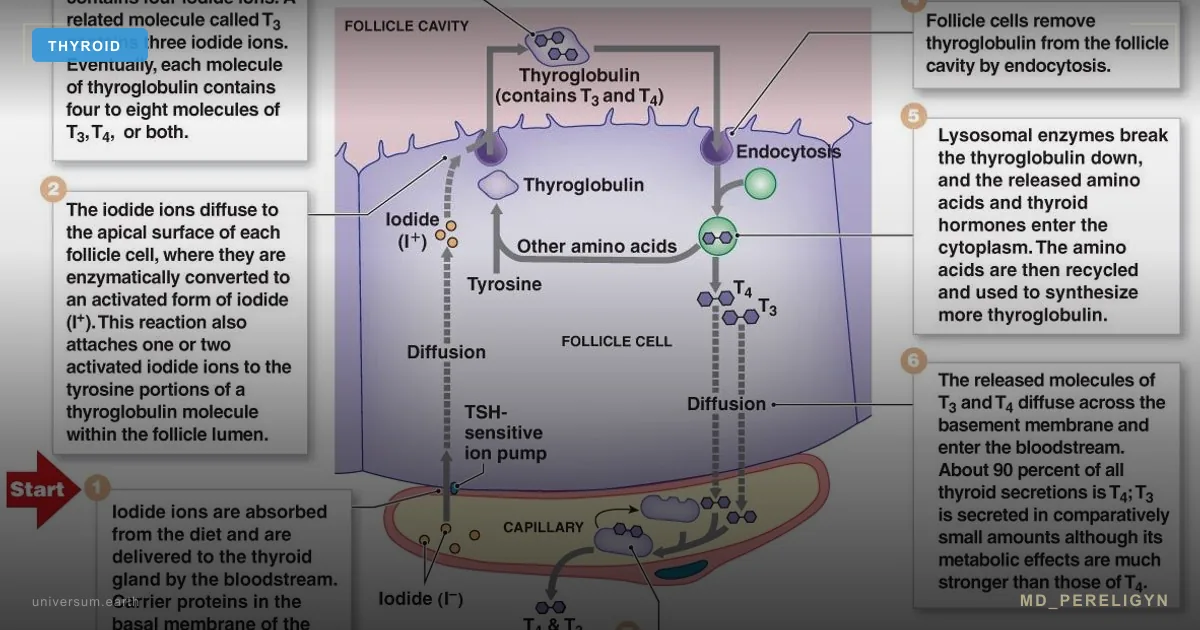
Thyroid hormone receptors are found in high density precisely in the amygdala and hippocampus — structures governing anxiety regulation and emotional memory. T3 modulates serotonergic signaling: it desensitizes 5-HT1A autoreceptors in the raphe nuclei (which should increase serotonin availability) and increases postsynaptic 5-HT2 receptor sensitivity (Hage MP, Azar ST. J Thyroid Res 2012;2012:590648. PMID 22220285[3]).
In hypothyroidism, this mechanism runs in reverse: reduced thyroid signaling in the limbic system is associated with reduced glucose metabolism in the amygdala and anterior cingulate cortex on PET imaging — regions involved in stress response and affective states.
This does not mean depression and anxiety are "caused solely by the thyroid." It means thyroid status is one measurable, correctable factor shaping the clinical picture, alongside whatever psychiatric treatment is already in place.
🌀
Euthyroid Hashimoto's: anxiety without abnormal labs
The practical takeaway from the Carta study is that the depression/anxiety link with Hashimoto thyroiditis does not require impaired thyroid function. The presence of TPO antibodies itself is associated with elevated risk, independent of TSH and fT4.
This changes the diagnostic algorithm: in a patient with treatment-resistant depression or anxiety, a normal TSH does not close the question of thyroid involvement — if TPO antibodies were never checked, the autoimmune component remains unexamined. For the full driver-checking algorithm in autoimmune thyroiditis, see low-dose naltrexone (LDN) in Hashimoto thyroiditis.
🌀
Postpartum thyroiditis and postpartum depression: an honest look at mixed evidence
Postpartum thyroiditis affects 5–9% of women and is accompanied by circulating TPO antibodies. Some studies link positive TPO antibodies to increased depressive symptomatology postpartum, but a 2022 systematic review characterizes the evidence as conflicting: there is insufficient evidence to confirm a consistent association between postpartum depression and postpartum thyroiditis, or isolated positive TPO antibodies in euthyroid women (PMID 35351167[4]).
Practical takeaway: a thyroid panel is justified in the differential diagnosis of postpartum depression, but not as the sole or dominant hypothesis — overstating this link is as inaccurate as ignoring it.
🌀
Markers: what to check before treating "just depression"
▸TSH — baseline screening for any first depressive or anxiety episode. ▸Free T4 and free T3 — for borderline-high TSH or persistent symptoms on therapy. ▸TPO antibodies, Tg antibodies — mandatory in treatment-resistant depression/anxiety, even with normal TSH (see euthyroid Hashimoto's above). ▸Reverse T3, selenium, ferritin — when functional hypothyroidism is suspected, covered in T4 → T3 conversion and functional hypothyroidism.
Without this panel, a subset of patients receive years of psychiatric treatment alone while a correctable endocrine component goes unaddressed.
🌀
When T3 works as an antidepressant augmentation
In the STAR*D trial (Sequenced Treatment Alternatives to Relieve Depression), patients who had failed two antidepressant trials were augmented with either lithium or T3 (liothyronine, up to 50 mcg/day). Remission on T3 was 24.7% versus 15.9% on lithium, with T3 better tolerated and less often discontinued for side effects (Nierenberg AA, et al. Am J Psychiatry 2006;163:1519–1530. PMID 16946176[5]).
This is a third-line augmentation strategy, prescribed by a psychiatrist after two antidepressant trials have failed — not a replacement for first-line therapy and not self-treatment for a first episode of low mood.
🌀
What does NOT work, and common mistakes
▸Ignoring TPO antibodies when TSH is normal in a patient with treatment-resistant depression — the Hashimoto's link persists even in the euthyroid state. ▸Attributing any fatigue or low mood to the thyroid without lab confirmation — overdiagnosis is as harmful as underdiagnosis. ▸Self-adding T3 or NDT to antidepressants without psychiatric and endocrine supervision — risk of tachycardia and mood instability at an uncontrolled dose. ▸Expecting TSH correction to fully replace psychiatric treatment — thyroid status is one contributing factor, not the sole cause of the clinical picture.
🌀
When to seek care
▸A first depressive or anxiety episode without a prior thyroid panel. ▸Treatment-resistant depression after two antidepressant trials — discuss T3 augmentation with a psychiatrist and endocrinologist. ▸Anxiety or depression with a known Hashimoto's diagnosis or family history of autoimmune thyroiditis. ▸Depressive symptoms postpartum — a thyroid panel as part of, not a replacement for, standard workup.
I perform a comprehensive thyroid assessment (TSH, fT4, fT3, TPO antibodies, Tg antibodies) in the context of the psychiatric picture and coordinate a correction protocol together with the treating psychiatrist.
🌀
Conclusion
Depression and generalized anxiety disorder are statistically linked to hypothyroidism and, separately, to Hashimoto autoimmune thyroiditis — with the Hashimoto's link persisting even at normal thyroid function. T3 has a confirmed role as a third-line augmentation strategy in treatment-resistant depression. None of this replaces psychiatric care — it adds a measurable, correctable endocrine component that standard TSH+fT4 screening without TPO antibodies can miss.
This article is for informational purposes and does not replace consultation with a psychiatrist or endocrinologist. Adjustments to depression or anxiety treatment should only be made under the supervision of the treating physician.
🌀
Sources
▸Carta MG, Hardoy MC, Carpiniello B, et al. A case control study on psychiatric disorders in Hashimoto disease and euthyroid goitre. Clin Pract Epidemiol Ment Health 2005;1:23. PMID 16285879[1] ▸Hage MP, Azar ST. The link between thyroid function and depression. J Thyroid Res 2012;2012:590648. PMID 22220285[3] ▸Nierenberg AA, Fava M, Trivedi MH, et al. A comparison of lithium and T3 augmentation following two failed medication treatments for depression: a STAR*D report. Am J Psychiatry 2006;163:1519–1530. PMID 16946176[5] ▸Association of Hypothyroidism and Clinical Depression: A Systematic Review and Meta-analysis. 2021. PMID 34524390[2] ▸Postpartum depression in maternal thyroidal changes: a systematic review. 2022. PMID 35351167[4]
Related articles: T4 → T3 conversion and functional hypothyroidism, Low-dose naltrexone (LDN) in Hashimoto thyroiditis, Hypothyroidism and natural desiccated thyroid (NDT).
Key facts
- Depression and generalized anxiety disorder are the most consistently replicated mental-health link to hypothyroidism and Hashimoto’s.
- Case-control (Carta 2005): lifetime OR 6.6 for depression, 4.9 for GAD, 20.0 for social phobia in euthyroid Hashimoto’s.
- The link persists with normal TSH and fT4 — TPO antibodies themselves raise risk, not hormone deficiency.
- STAR*D: adding T3 after two failed antidepressants produced 24.7% remission versus 15.9% on lithium.
- Thyroid hormone receptors are dense in the amygdala and hippocampus; T3 modulates serotonergic signaling.