Hormone replacement therapy (HRT) is oestrogen and, when the womb is intact, oestrogen together with a progestogen, which protects the womb lining (endometrium). Below are the forms, doses and regimens recognised by the UK National Institute for Health and Care Excellence (NICE), the British Menopause Society (BMS), the US society The Menopause Society and the European regulator EMA (European Medicines Agency).
The main points
- The most powerful remedy for hot flushes. HRT cuts the number of hot flushes by 75 % compared with placebo and reduces night sweats (MacLennan AH Cochrane Database Syst Rev 2004. PMID 15495039[1]).
- Window of opportunity. Under 60 or within the first 10 years after the last period, the benefits of HRT outweigh the risks (The Menopause Society Menopause 2022. PMID 35797481[2]; Stuenkel CA J Clin Endocrinol Metab 2015. PMID 26444994[3]).
- Bones. In the WHI trial (Women's Health Initiative, 16,608 women) there were 34 % fewer hip fractures and 24 % fewer fractures overall (Rossouw JE JAMA 2002. PMID 12117397[4]).
- Urogenital symptoms. Vaginal oestrogens relieve dryness and pain during sex; this is the only type of HRT not linked to breast cancer risk (Collaborative Group on Hormonal Factors in Breast Cancer Lancet 2019. PMID 31474332[5]; 108,647 cases).
- Sleep and mood. Night-time flushes and sweats wake you; HRT reduces both their frequency and their severity. NICE recommends considering HRT also for low mood that began together with hot flushes (NICE NG23, 2026).
- A safe route exists. Patch, gel and spray do not raise the risk of venous blood clots: odds ratio 0.93 versus 1.58 for tablets (Vinogradova Y BMJ 2019. PMID 30626577[6]; 80,396 cases).
- Mortality does not rise. Over 18 years of WHI follow-up, all-cause mortality was 27.1 % in those who took HRT and 27.6 % on placebo (Manson JE JAMA 2017. PMID 28898378[7]).
- Warnings revised. In November 2025 the US regulator, the FDA (Food and Drug Administration), began removing cardiovascular risks, breast cancer and dementia from the «black box» warning on the packaging; the first 6 products received new labels in February 2026 (FDA, 12.02.2026).
Oestrogens
| Substance | Forms | What matters |
|---|---|---|
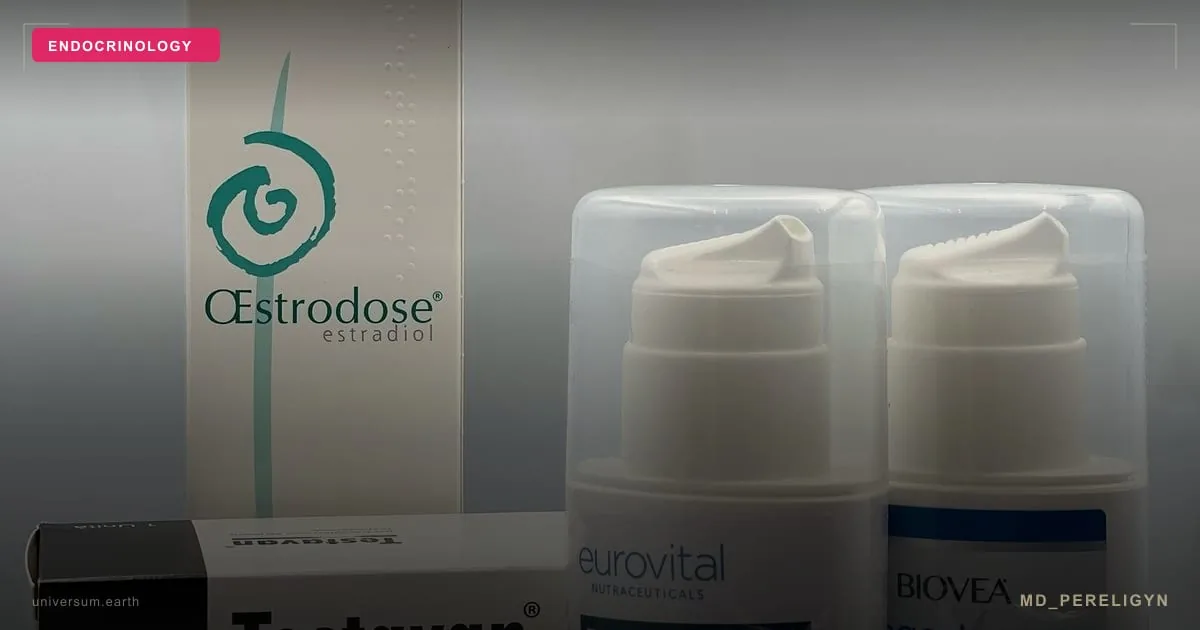
| Estradiol (identical to the body's own) | tablet, patch, gel, spray; vaginal tablet 10 µg, ring 7.5 µg/day | the basis of most regimens; in tablet form 15–17 % fewer blood clots than with conjugated oestrogens |
| Conjugated oestrogens (CE) | tablets 0.3 / 0.625 / 1.25 mg | studied in WHI; available in combination with bazedoxifene (below) |
| Estriol | local only: cream 0.1 % and 0.01 %, pessaries, gel 50 µg/g | for urogenital symptoms |
| Estetrol (E4) | tablets 14.2 and 18.9 mg once a day | approved in the European Union (EU) on 26.03.2026 (Fylrevy); by week 12, 16–22 fewer hot flushes a week than on placebo (Simoncini T Maturitas 2026. PMID 42068869[8]); with a womb — together with a progestogen |
Routes of administration
- Tablet — once a day; passes through the liver, so it raises the risk of blood clots and gallbladder disease.
- Patch — changed 1–2 times a week; gives a steady hormone level.
- Gel — daily on the skin; the dose is easy to adjust by the number of pumps.
- Spray — on the skin of the forearm, 1–3 doses according to the label.
- Vaginal forms (cream, pessaries, a 3-month ring, tablet) — act locally, with minimal amounts entering the blood (NICE).
Equivalent estradiol doses (BMS, 2026; for ages 45–55). An asterisk marks off-label doses — only in selected cases. Absorption varies noticeably between people, so the dose is adjusted by symptoms.
| Form | Low | Medium | High |
|---|---|---|---|
| Tablet | 0.5 mg | 1–2 mg | 3 mg* |
| Patch, µg/day | 25–37.5 | 40–75 | 100 |
| Pump gel 0.06 % (0.75 mg per pump) | 1 pump | 2–3 pumps | 4 pumps |
| Gel sachet | 0.5 mg | 1 mg (2 mg*) | 2.5–3 mg* |
| Spray | 1–2 doses | 3 doses (4*) | 5–6 doses* |
Progestogens: protecting the endometrium
- Needed by everyone who still has a womb: oestrogen without a progestogen raises the risk of endometrial hyperplasia and cancer (BMS).
- After removal of the womb (hysterectomy) a progestogen is usually not needed.
| Progestogen | Sequential regimen | Continuous regimen |
|---|---|---|
| Micronised progesterone (oral; vaginal — off-label, same doses) | 200 mg for 12–14 days a month (300 mg with a high oestrogen dose) | 100 mg daily (200 mg with a high dose) |
| Dydrogesterone | 10 mg for 12–14 days | 5 mg in the combined tablet, separately — 10 mg |
| Norethisterone acetate (NETA) | 1 mg in combined tablets | 0.5–1 mg in combined tablets |
| Medroxyprogesterone acetate (MPA) | 10 mg for 12–14 days | 2.5–5 mg |
| Levonorgestrel (LNG) | intrauterine system (IUS) 52 mg — up to 5 years, with any regimen | IUS 52 mg or a patch together with estradiol |
| Drospirenone | — | 2 mg in a tablet with 1 mg of estradiol |
Differences in risk — in favour of the «gentle» progestogens
- Breast cancer, the French E3N cohort (80,377 women): with progesterone the relative risk was 1.00, with dydrogesterone 1.16 (neither significantly raised), with other progestogens 1.69 (Fournier A Breast Cancer Res Treat 2008. PMID 17333341[9]).
- UK data from 2020: with use for longer than 5 years, the odds ratio was 1.24 with dydrogesterone and 1.88 with norethisterone (Vinogradova Y BMJ 2020. PMID 33115755[10]).
- The Lancet 2019 meta-analysis: if the link is causal, 5 years of HRT from age 50 give 1 extra case per 50 women with daily progestogen, per 70 with intermittent progestogen and per 200 with oestrogen alone. After use for less than a year the excess risk is minimal.
- Venous thromboembolism (VTE — blood clots in the veins and the pulmonary artery): among tablets the lowest risk is with estradiol plus dydrogesterone (1.18, not significant), the highest with CE plus MPA (2.10). In the French ESTHER study micronised progesterone was not linked to VTE risk — 0.7 (Canonico M Circulation 2007. PMID 17309934[11]).
Regimens
| Regimen | For whom | How |
|---|---|---|
| Sequential (cyclical) | last period less than 1 year ago (less than 2 years in early menopause) | oestrogen daily + progestogen for 12–14 days a month; a withdrawal bleed once a month |
| Continuous combined | 12 months without periods or after ≥1 year of a sequential regimen | oestrogen and progestogen daily, no bleeding |
| Oestrogen only | after hysterectomy | oestrogen daily |
- A progestogen for fewer than 10 days a month raises the risk of endometrial hyperplasia (BMS).
- Women under 50 often need the sequential regimen for longer.
- Exceptions to «oestrogen only»: after hysterectomy for severe endometriosis — continuous combined regimen; after subtotal hysterectomy — a 3-month trial of progestogen; after endometrial ablation — combined HRT.
Ready-made combined products
| Form | Substances (examples) |
|---|---|
| Tablets, sequential | estradiol 1 or 2 mg + dydrogesterone 10 mg (Femoston 1/10, 2/10); estradiol + NETA 1 mg (Novofem, Elleste Duet, Trisequens) |
| Tablets, continuous | estradiol 1 mg + dydrogesterone 5 mg (Femoston conti); estradiol 1 mg + NETA 0.5 mg (Kliovance); estradiol 2 mg + NETA 1 mg (Kliofem); estradiol 1 mg + MPA 2.5 or 5 mg (Indivina); estradiol 1 mg + drospirenone 2 mg (Angeliq); capsule estradiol 1 mg + progesterone 100 mg (Bijuve) |
| Patches | estradiol + NETA (Evorel Sequi, Evorel Conti, Estradot Conti); estradiol + levonorgestrel once a week (FemSeven Conti, Femseptevo, Femity — a separate review) |
| IUS + oestrogen | LNG-IUS (levonorgestrel intrauterine system) 52 mg + oestrogen in any form: tablet, patch, gel, spray |
The LNG-IUS also serves as contraception in the perimenopause. For the lower-dose systems (13.5 and 19.5 mg) there are no data on endometrial protection, so a progestogen is added to them (BMS).
Tibolone, TSEC and local therapy
Tibolone — 2.5 mg a day, no earlier than 12 months after the last period.
- Relieves hot flushes and preserves bone: in the LIFT trial (4538 women aged 60–85 with osteoporosis, half dose 1.25 mg) there were 45 % fewer vertebral fractures (Cummings SR N Engl J Med 2008. PMID 18703472[12]).
- Not used after breast cancer: in the LIBERATE trial recurrences were 15.2 % versus 10.7 % on placebo (Kenemans P Lancet Oncol 2009. PMID 19167925[13]).
- After 60 the risk of stroke is taken into account (relative risk 2.19 in LIFT).
TSEC (tissue-selective estrogen complex — an oestrogen paired with a selective oestrogen receptor modulator) — CE 0.45 mg + bazedoxifene 20 mg (Duavive).
- For women with a womb, 12 months without periods, for whom a progestogen is unsuitable: bazedoxifene protects the endometrium (EMA, 2014).
Local therapy for urogenital symptoms
- Vaginal estriol or estradiol — first line (NICE); can be combined with moisturisers and with systemic HRT.
- Prasterone (dehydroepiandrosterone, DHEA) — a 6.5 mg vaginal pessary, if oestrogens and moisturisers have not helped.
- Ospemifene — a 60 mg tablet, when local products are inconvenient, for example with limited mobility.
Testosterone in women
- The only proven indication is low libido that troubles a postmenopausal woman (the 2019 international consensus, endorsed by 11 societies: Davis SR J Clin Endocrinol Metab 2019. PMID 31498871[14]). NICE: consider it if HRT alone is not enough.
- Through the skin only, at a dose that gives premenopausal levels. Tablets worsen blood lipids; pellets and injections give levels above physiological — they are not recommended.
- Monitoring: testosterone before starting, after 3–6 weeks, then every 6 months. No effect within 6 months — stop.
- Not prescribed for mood, bones or memory: there are no data showing benefit.
Non-hormonal alternatives
| Option | Dose and action | Effect | Status |
|---|---|---|---|
| Fezolinetant | 45 mg once a day; blocks the neurokinin-3 receptor in the thermoregulatory centre | 2.6 fewer hot flushes a day than on placebo by week 12; effect from week 1 and through to week 52 (Lederman S Lancet 2023. PMID 36924778[15]) | FDA 2023, EU 07.12.2023; NICE 2026 — when HRT is unsuitable; liver tests before starting and in the first months (FDA, 2024) |
| Elinzanetant | 120 mg at night; blocks neurokinin-1 and -3 receptors (NK1, NK3) | 3.2 fewer hot flushes a day than placebo by week 12; better sleep (Pinkerton JV JAMA 2024. PMID 39172446[16]) | FDA 24.10.2025; EU 17.11.2025, in the EU also for hot flushes during endocrine therapy for breast cancer: −3.4 a day (Cardoso F N Engl J Med 2025. PMID 40454634[17]) |
| Antidepressants of the SSRI and SNRI groups (selective serotonin / serotonin–noradrenaline reuptake inhibitors) | daily | recommended by The Menopause Society 2023, level I evidence (Menopause 2023. PMID 37252752[18]) | NICE: not first line for hot flushes alone |
| Gabapentin | daily | recommended (level I) | off-label |
| Clonidine | — | not recommended by The Menopause Society 2023 | NICE: not first line |
| Cognitive behavioural therapy (CBT) | a programme designed for the menopause | helps with hot flushes, sleep problems and low mood | NICE 2024, The Menopause Society (level I) |
What is not recommended
- Compounded «bioidentical» mixtures made up in pharmacies: they do not undergo regulatory review, and their doses and purity are not standardised. NICE: the efficacy and safety of such products are unknown; BMS (2026) and the American College of Obstetricians and Gynecologists advise against prescribing them (ACOG Obstet Gynecol 2023. PMID 37856860[19]).
- The same «bioidentical» hormones are available in licensed products: estradiol and micronised progesterone.
- Progesterone as a cream or gel on the skin does not protect the endometrium (BMS).
- Saliva and blood tests «to tailor an individual mixture» — the evidence is insufficient (BMS).
- Pellets (subcutaneous implants): testosterone pellets are not recommended by the 2019 international consensus; compounded estradiol pellets are the same compounded therapy that ACOG advises against prescribing when approved forms exist.
- Vaginal laser for urogenital symptoms is not recommended by NICE outside clinical trials.
Who suits what
| Situation | What suits | Basis |
|---|---|---|
| Smoking | patch, gel, spray | smoking is a risk factor for blood clots, and the skin route does not raise VTE risk (0.93) |
| Body mass index (BMI) > 30 kg/m² | skin route | NICE |
| Migraine, including with aura | skin route, oestrogen without breaks, LNG-IUS | aura is not a contraindication (European Menopause and Andropause Society, EMAS, 2026); stroke is not more frequent with the skin route (NICE) |
| High VTE risk, thrombophilia in the family | skin route + progesterone or dydrogesterone; haematologist consultation | NICE; BMJ 2019; ESTHER |
| High triglycerides | skin route, progesterone or dydrogesterone | EMAS 2020 (Anagnostis P Maturitas 2020. PMID 32209279[20]) |
| Hypothyroidism on levothyroxine | any route; with tablets — thyroid-stimulating hormone (TSH) at 12 weeks | oestrogen tablets raised TSH above 7 mU/L (7 µIU/mL) in 7 of 18 women (Arafah BM N Engl J Med 2001. PMID 11396440[21]) |
| Gallstone disease | skin route | risk 1.17 versus 1.74; 1 fewer gallbladder removal per 140 women over 5 years (Liu B BMJ 2008. PMID 18617493[22]) |
| Perimenopause, cycle still present | sequential regimen or LNG-IUS + oestrogen | BMS |
| After hysterectomy | oestrogen only | the lowest breast cancer risk: +1 case per 200 over 5 years |
| Endometriosis, womb removed | continuous combined regimen | BMS |
| Dryness only, urogenital symptoms | vaginal estriol or estradiol; prasterone; ospemifene | NICE |
| History of breast cancer | CBT, elinzanetant, other non-hormonal options agreed with the oncologist; for dryness — lubricants, then vaginal oestrogen | NICE; LIBERATE; OASIS-4 |
| Menopause before 40 | HRT or a combined contraceptive at least until the age of natural menopause | NICE |
The weekly estradiol + levonorgestrel patch — one change a week instead of daily tablets — is covered separately: what it is, who it suits, where to buy it in Europe.
Monitoring and duration
- First review — at 3 months (effect, tolerability), then yearly (NICE).
- Mammography — according to the national screening programme schedule (NICE).
- Spotting in the first 6 months and for 3 months after a dose change is a common side effect (NICE). If it continues for longer than 4–6 months despite adjusting the progestogen — transvaginal ultrasound, and a biopsy if needed (BMS).
- There is no fixed stopping date: BMS — «no arbitrary limits on dose or duration»; The Menopause Society 2022 — long-term use while the indications persist, with regular review.
- In November 2025 the FDA asked for the advice «the lowest dose for the shortest time» to be removed from the «black box»; the endometrial cancer warning remained only for systemic oestrogen without a progestogen. NICE recommends the lowest effective dose.
- Stopping can be gradual or abrupt: tapering may reduce the return of symptoms in the short term; in the long term there is no difference (NICE).
Contraindications
According to EU labels for systemic HRT:
- Breast cancer — now, in the past or suspected.
- Oestrogen-dependent tumours, for example endometrial cancer.
- Genital bleeding of unknown cause.
- Untreated endometrial hyperplasia.
- Deep vein thrombosis or pulmonary embolism — now or in the past; known thrombophilia.
- Active or recent arterial thromboembolic disease: angina, heart attack.
- Severe liver disease until liver tests have returned to normal; porphyria.
Migraine, type 2 diabetes, hypothyroidism and obesity are not contraindications but a reason to choose the route of administration.
References
- MacLennan AH Cochrane Database Syst Rev 2004. PMID 15495039
- The Menopause Society Menopause 2022. PMID 35797481
- Stuenkel CA J Clin Endocrinol Metab 2015. PMID 26444994
- Rossouw JE JAMA 2002. PMID 12117397
- Collaborative Group on Hormonal Factors in Breast Cancer Lancet 2019. PMID 31474332
- Vinogradova Y BMJ 2019. PMID 30626577
- Manson JE JAMA 2017. PMID 28898378
- Simoncini T Maturitas 2026. PMID 42068869
- Fournier A Breast Cancer Res Treat 2008. PMID 17333341
- Vinogradova Y BMJ 2020. PMID 33115755
- Canonico M Circulation 2007. PMID 17309934
- Cummings SR N Engl J Med 2008. PMID 18703472
- Kenemans P Lancet Oncol 2009. PMID 19167925
- endorsed by 11 societies: Davis SR J Clin Endocrinol Metab 2019. PMID 31498871
- Lederman S Lancet 2023. PMID 36924778
- Pinkerton JV JAMA 2024. PMID 39172446
- Cardoso F N Engl J Med 2025. PMID 40454634
- Menopause 2023. PMID 37252752
- ACOG Obstet Gynecol 2023. PMID 37856860
- Anagnostis P Maturitas 2020. PMID 32209279
- Arafah BM N Engl J Med 2001. PMID 11396440
- Liu B BMJ 2008. PMID 18617493
Key facts
- HRT cuts the number of hot flushes by 75 % compared with placebo and reduces night sweats (Cochrane review, MacLennan AH 2004).
- Window of opportunity: under 60 or within the first 10 years after the last period, the benefits of HRT outweigh the risks (The Menopause Society 2022, Endocrine Society 2015).
- Patch, gel and spray do not raise the risk of venous blood clots: odds ratio 0.93 versus 1.58 for tablets (BMJ 2019, 80,396 cases).
- When the womb is intact, oestrogen always goes together with a progestogen: without it the risk of endometrial hyperplasia and cancer rises; after removal of the womb a progestogen is usually not needed.
- Vaginal oestrogens relieve dryness and pain during sex and are not linked to breast cancer risk (Lancet 2019, 108,647 cases).
- If hormones are contraindicated: fezolinetant gives 2.6 fewer hot flushes a day than placebo, elinzanetant 3.2 fewer (week 12); cognitive behavioural therapy also helps.