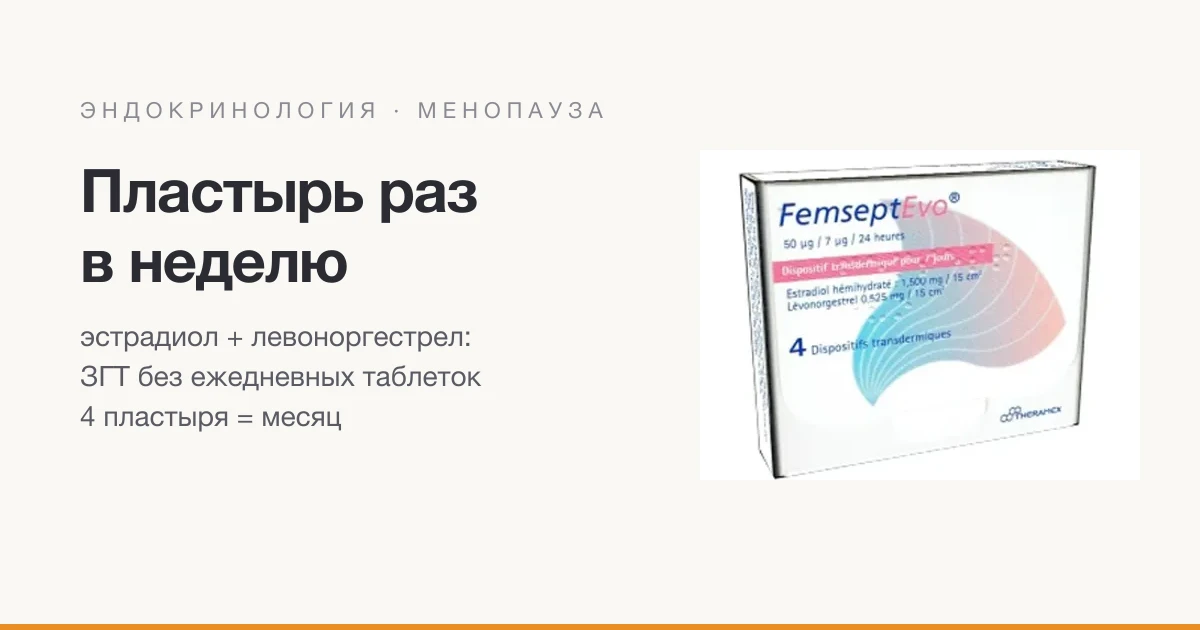
On 20 October 2026 the FDA (US Food and Drug Administration) announced approval of the first generic of the Climara Pro patch, made by Zydus (FDA, press release 20.10.2026). In Europe a patch of the same type has been registered since 2002: in France it is called Femseptevo, in Italy Femity, in Germany Fem7 Conti and in the United Kingdom FemSeven Conti.
The main points
- One patch for 7 days. Four patches cover a month of hormone replacement therapy (HRT) without daily tablets.
- Hot flushes ease quickly. According to the label, relief comes in the first weeks; in a randomised trial of the US equivalent (293 women) — within 2 weeks (Shulman LP Menopause 2002. PMID 11973443[1]).
- The womb is protected. Levonorgestrel markedly lowers the risk of hyperplasia of the womb lining. In a one-year study of the equivalent (estradiol 45 µg + levonorgestrel 15–40 µg/day) — 0 % versus 12.8 % on estradiol alone.
- No extra risk of thrombosis. In an analysis of 80,396 cases of VTE (venous thromboembolism), oestrogen through the skin did not raise the risk: odds ratio 0.93 (Vinogradova Y BMJ 2019. PMID 30626577[2]).
- Stronger bones. On the equivalent (estradiol 45 µg + levonorgestrel 30–40 µg/day), in women with osteopenia over 2 years spine density rose by 8 % and hip density by 6 % compared with placebo (Warming L Maturitas 2005. PMID 15653003[3]).
- Convenient in hypothyroidism. The patch barely changes TBG (thyroxine-binding globulin): +0.4 % versus +39.9 % on conjugated oestrogen tablets (Shifren JL Menopause 2007. PMID 17507833[4]).
- Reimbursed by insurance. In France health insurance reimburses 65 % of the cost of a monthly pack; in Italy the patch is a class A medicine.
What this patch is
A transparent 15 cm² patch contains 1.5 mg of estradiol and 0.525 mg of levonorgestrel. Over 24 hours, 50 µg of estradiol and 7 µg of levonorgestrel pass through the skin (Theramex, FemSeven Conti label, 2025).
- Estradiol — the same hormone the ovaries used to produce. It relieves hot flushes and night sweats and protects the bones.
- Levonorgestrel — a progestogen that protects the endometrium (the womb lining). Oestrogen alone without a progestogen raises the risk of hyperplasia at any dose, so women who have a womb are given the combination (Furness S Cochrane Database Syst Rev 2012. PMID 22895916[5]).
- The skin route. The hormone enters the blood bypassing the first pass through the liver, so it barely changes the proteins that carry hormones.
The regimen is continuous: take off the old patch and put on a new one straight away, with no break. In the first 3 months spotting occurs in 28–39 % of women; by months 10–12, 59–68 % have no bleeding.
The sequential version (Femseptcombi, Combiseven, FemSeven Sequi) is a 2+2 pack for 28 days: weeks 1–2 — a patch with estradiol 50 µg/day only, weeks 3–4 — estradiol 50 µg + levonorgestrel 10 µg/day. At the end of the cycle there is a withdrawal bleed, similar to a period.
The US Climara Pro works the same way, but the dose is different: 45 µg of estradiol + 15 µg of levonorgestrel a day. In the USA it is also approved for the prevention of osteoporosis after the menopause.
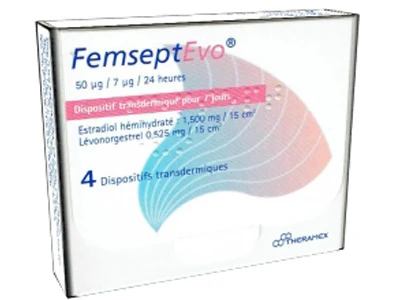
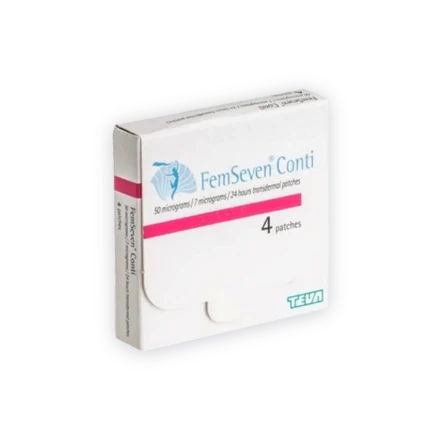
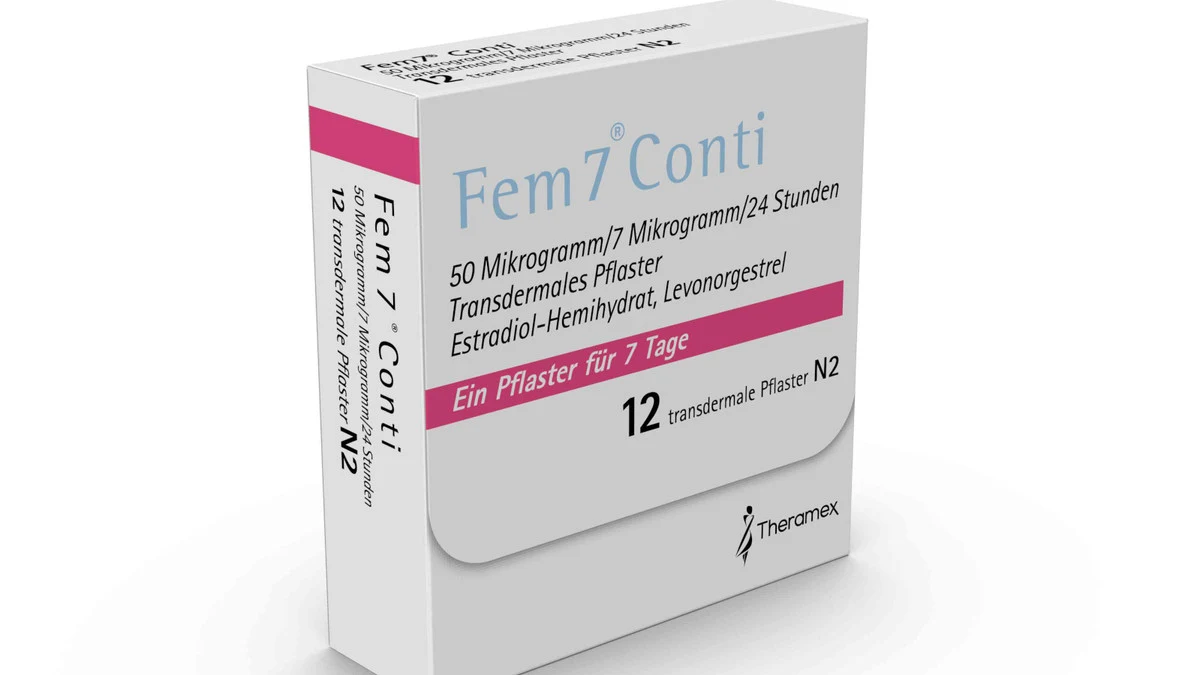
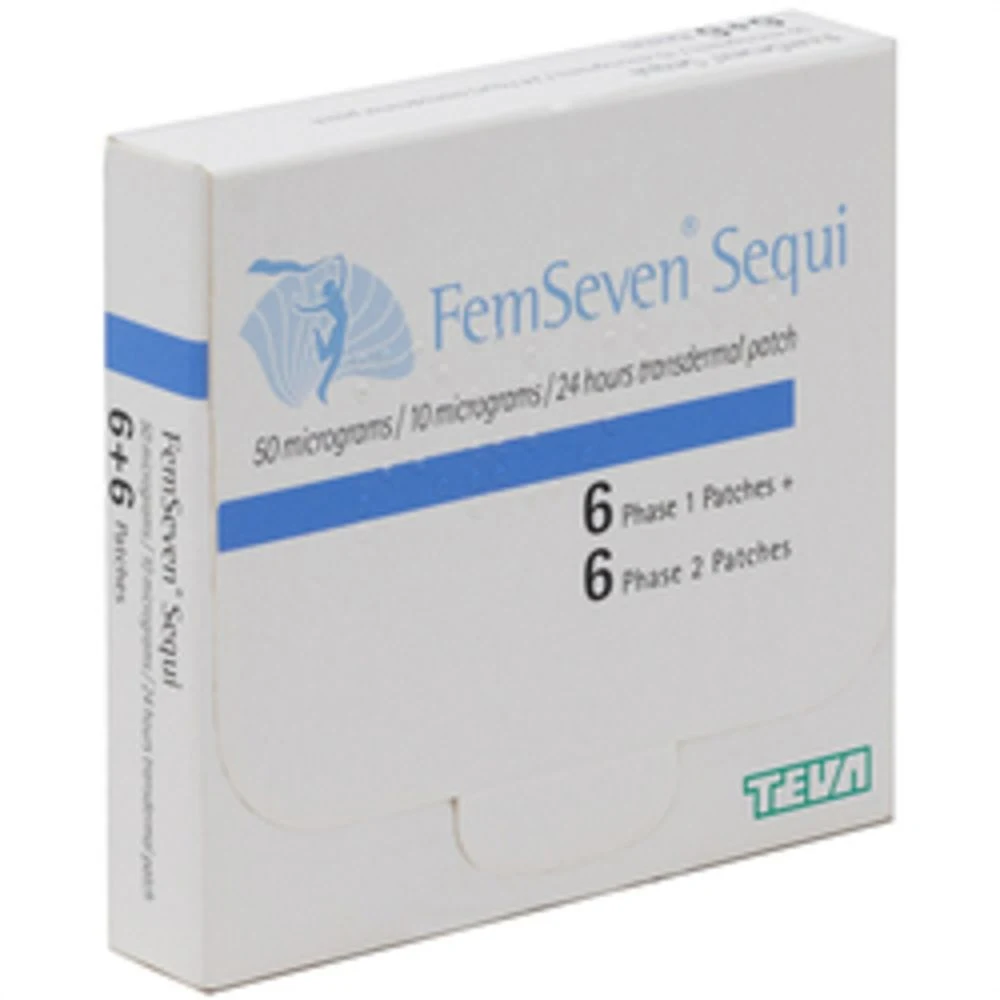
The Italian Femity and Combiseven are sold in white Theramex boxes; no photographs of the packaging are publicly available.
Who suits which option
The reference points are the NICE (National Institute for Health and Care Excellence) NG23 guideline (2026), the British Menopause Society (BMS) (Hamoda H Post Reprod Health 2020. PMID 33045914[6]) and The Menopause Society (Menopause 2022. PMID 35797481[7]).
| Situation | Option | Why |
|---|---|---|
| Womb present, periods still coming or less than 12 months since the last one | Sequential: Femseptcombi, Combiseven, FemSeven Sequi | A progestogen for 12–14 days per cycle protects the endometrium and gives a predictable monthly bleed |
| Womb present, more than 12 months without periods | Continuous: Femseptevo, Femity, Fem7 Conti, FemSeven Conti | The licensed indication is more than a year after the menopause; the aim is no bleeding |
| Womb completely removed | Estradiol only: patch, gel or spray | No progestogen is needed to protect the endometrium |
| Raised risk of VTE: BMI (body mass index) above 30, older age, prolonged immobility | Patch instead of tablets | Through the skin the VTE risk does not rise; with tablets it does |
| Migraine, including with aura | Patch at the lowest effective dose; after a year without periods — continuous | A steady oestrogen level; cyclical progestogen can worsen migraine, so continuous is preferred (MacGregor EA Post Reprod Health 2018. PMID 28994639[8]) |
| Hypothyroidism, taking levothyroxine | Patch | Oestrogen tablets raise TBG and can increase the levothyroxine requirement (Arafah BM N Engl J Med 2001. PMID 11396440[9]); the patch barely changes TBG |
| An estradiol dose below 50 µg/day is needed | Estradot Conti 30/95 or 40/130 | The only combined patch in Europe with a lower dose |
In hypothyroidism, after switching from oestrogen tablets to the patch, TSH (thyroid-stimulating hormone) should be rechecked: the levothyroxine requirement may fall. All forms, doses and regimens of HRT are collected in the overview All types of HRT for the menopause.
What the studies showed
| Study | Participants | Result |
|---|---|---|
| Shulman LP, Menopause 2002 (PMID 11973443[1]): estradiol 45 µg + levonorgestrel 15–40 µg/day | 1138 postmenopausal women, 2 trials | Fewer hot flushes within 2 weeks; hyperplasia 0 % versus 12.8 % on estradiol alone |
| Warming L, Maturitas 2005 (PMID 15653003[3]): estradiol 45 µg + levonorgestrel 30–40 µg/day | 212 women with osteopenia, 2 years | Spine +8 %, hip +6 % versus placebo; no cases of hyperplasia or cancer |
| Vinogradova Y, BMJ 2019 (PMID 30626577[2]) | 80,396 women with VTE, 391,494 controls | Oestrogen through the skin: 0.93 (risk not raised); tablets: 1.58 |
| Renoux C, BMJ 2010 (PMID 20525678[10]) | 15,710 cases of stroke | Patches up to 50 µg/day: 0.81 (risk not raised) |
| Shifren JL, Menopause 2007 (PMID 17507833[4]): 50 µg/day patch versus tablets | 25 postmenopausal women | TBG +0.4 % on the patch versus +39.9 % on conjugated oestrogen tablets |
How to use it
- Where to apply: buttocks or thighs, on clean, dry skin without cream or oil. Not on the waist, not on or near the breasts.
- Rotating the site: the same spot no more than once a week.
- How to apply: press with the palm for at least 30 seconds, especially the edges.
- Showers and baths are no problem; cover the patch with clothing against direct sun.
- Starting: with no HRT or after another continuous regimen — on any day; after a sequential regimen — straight after the withdrawal bleed ends.
- If it comes off before day 7 — apply a new one, but keep changing it on your usual day of the week. A missed change can cause spotting.
- Storage: at temperatures up to 30 °C.
Bleeding in the first 6 months is a common and expected reaction. If it continues for longer, an examination is needed. The first check-up with the doctor is at 3 months, then once a year.
Where to buy
The patch is prescription-only in every country. Availability as of 22.10.2026.
| Country | Continuous | Sequential | Reimbursement | Availability |
|---|---|---|---|---|
| France | Femseptevo 50/7 | Femseptcombi 50/10 | 65 % reimbursed by health insurance | On sale, no shortage |
| Italy | Femity | Combiseven 2+2 | Class A — paid for by the national health service | Not on the AIFA (Italian medicines regulator) shortage list |
| Germany | Fem7 Conti | Fem7 Sequi / Fem7 Combi | Prescription | Availability not confirmed |
| United Kingdom | FemSeven Conti | FemSeven Sequi | NHS prescription | Conti out of stock until the end of November 2026 |
| USA | Climara Pro 45/15 | — | Private insurance | Zydus generic approved, launch date not announced |
Sources for availability and reimbursement: Vidal and Le Moniteur des Pharmacies (France, 09–10.2026), the AIFA shortage list of 20.10.2026 (Italy), Stiftung Warentest 02.2026 (Germany), DHSC Medicine Supply Notification MSN/2026/048 of 12.10.2026 (United Kingdom).
How it differs from other patches
- Evorel Conti and Evorel Sequi (United Kingdom, Ireland): estradiol 50 µg + NETA (norethisterone acetate) 170 µg/day, changed twice a week.
- Estradot Conti (United Kingdom): estradiol 30 or 40 µg + NETA 95 or 130 µg/day, twice a week — the option for a lower dose.
- Estalis Sequi 50/140 (Italy): sequential, with NETA, twice a week.
The main advantage of the levonorgestrel range is one change a week instead of two.
Who should not use it
Breast cancer now, in the past or suspected; oestrogen-dependent tumours, including endometrial cancer; genital bleeding without an established cause; untreated endometrial hyperplasia; VTE now or unprovoked VTE in the past; known thrombophilias (inherited or acquired); recent heart attack or angina; acute liver disease or liver tests that have not returned to normal; porphyria; allergy to the components.
Reasons to remove the patch and see a doctor: jaundice, a sharp rise in blood pressure, a first-ever migraine-type headache.
Combined HRT raises the risk of breast cancer. The excess grows with the duration of use; after a short course (less than a year) almost no extra risk remains (Collaborative Group on Hormonal Factors in Breast Cancer Lancet 2019. PMID 31474332[11]).
Before starting
- Medical history: blood clots in the woman herself and in close relatives, stroke, heart attack, migraine.
- Blood pressure.
- Breast examination and mammography according to the screening schedule.
- Gynaecological examination, PAP test (cervical smear) according to the screening schedule.
- Pelvic ultrasound — when indicated: fibroids, unexpected bleeding.
- In hypothyroidism — TSH.
Questions for your doctor
Which regimen suits — sequential or continuous? What estradiol dose is needed? After how many weeks should TSH be rechecked? The balance of benefit and risk of HRT is most favourable in women under 60 or within the first 10 years after the menopause (The Menopause Society Menopause 2022. PMID 35797481[7]; Stuenkel CA J Clin Endocrinol Metab 2015. PMID 26444994[12]). The decision about HRT and the choice of regimen and dose are made by a doctor after an examination.
References
- Shulman LP Menopause 2002. PMID 11973443
- Vinogradova Y BMJ 2019. PMID 30626577
- Warming L Maturitas 2005. PMID 15653003
- Shifren JL Menopause 2007. PMID 17507833
- Furness S Cochrane Database Syst Rev 2012. PMID 22895916
- Hamoda H Post Reprod Health 2020. PMID 33045914
- Menopause 2022. PMID 35797481
- MacGregor EA Post Reprod Health 2018. PMID 28994639
- Arafah BM N Engl J Med 2001. PMID 11396440
- PMID 20525678
- Collaborative Group on Hormonal Factors in Breast Cancer Lancet 2019. PMID 31474332
- Stuenkel CA J Clin Endocrinol Metab 2015. PMID 26444994
Key facts
- One patch for 7 days: four patches cover a month of hormone replacement therapy (HRT) without daily tablets; over 24 hours 50 µg of estradiol and 7 µg of levonorgestrel pass through the skin.
- Hot flushes ease quickly: in a randomised trial of the US equivalent (293 women) relief came within 2 weeks (Shulman LP, Menopause 2002).
- The womb is protected: levonorgestrel lowers the risk of endometrial hyperplasia — in a one-year study of the equivalent, 0 % versus 12.8 % on estradiol alone.
- No extra risk of thrombosis: in an analysis of 80,396 cases of venous thromboembolism, oestrogen through the skin did not raise the risk — odds ratio 0.93 versus 1.58 for tablets (Vinogradova Y, BMJ 2019).
- Convenient in hypothyroidism: the patch barely changes thyroxine-binding globulin (+0.4 % versus +39.9 % on conjugated oestrogen tablets), so the levothyroxine requirement does not rise.
- In France health insurance reimburses 65 % of the cost of Femseptevo; in Italy Femity is a class A medicine paid for by the national health service.