In brief
Sertraline (Zoloft) and escitalopram (Cipralex) are the two most prescribed antidepressants. They belong to one group and work the same way.
How they work
Serotonin carries a signal between nerve cells. Once released it is not used up: a pump takes it back. Both drugs partly close that pump, so serotonin stays in play longer.
Picture a sink draining too fast. You can open the tap wider, or you can plug the drain. These drugs are the plug.
The main difference: heart and gut
If you remember one thing from this piece, let it be this.
Escitalopram has a slightly clearer effect on heart rhythm. It shows dose-dependent lengthening of the QT interval, the measure cardiologists watch. So in older patients, in heart disease and alongside other rhythm-affecting drugs, its dose is capped. No such effect was found for sertraline.
Hence a simple rule: heart — sertraline; stomach — escitalopram.
Doses
Their milligrams are not comparable — rather like comparing grams of salt with grams of sugar in a recipe.
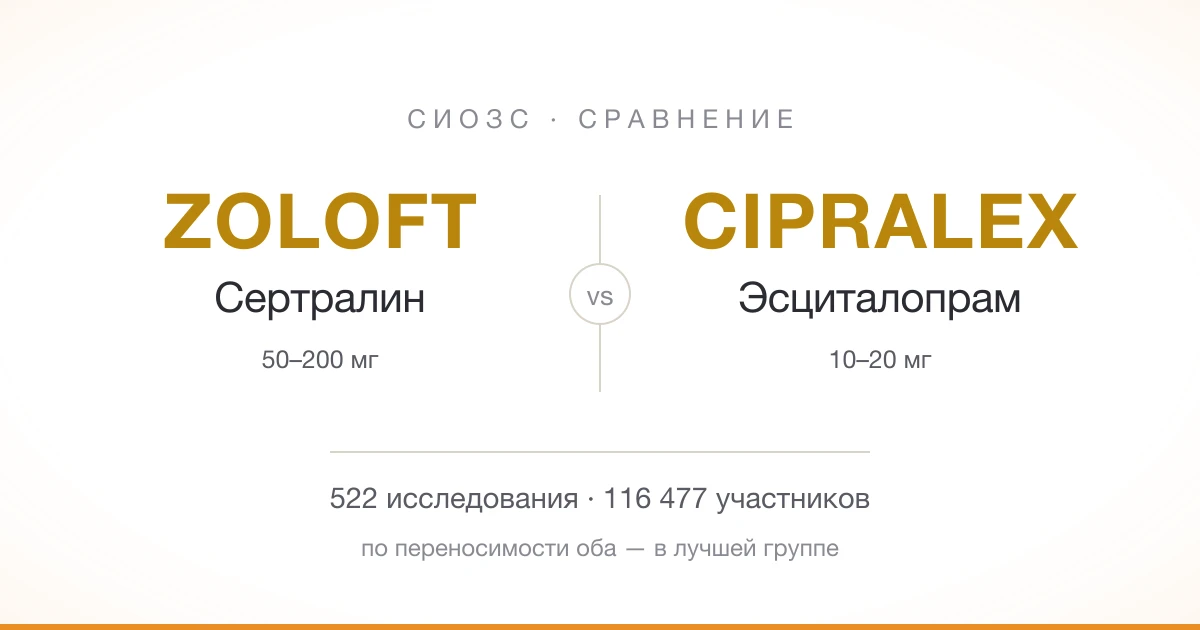
▸Sertraline: usually starts at 50 mg, working range 50–200 mg a day. ▸Escitalopram: starts at 10 mg, working range 10–20 mg a day. ▸The effect is judged after 4–6 weeks at the dose reached — for both.
The practical difference is headroom: sertraline has somewhere to grow, escitalopram has a lower ceiling set by cardiac safety.
In anxiety, treatment starts at half the dose: the first days on any of these drugs can briefly increase anxiety. That is an expected phase, not a sign the drug is wrong.
📄 The comparison in tables — efficacy, doses and side effects side by side on a single page: download the PDF. Easy to print and take to an appointment.
How the choice is made
Sertraline is the likelier choice with heart disease or QT prolongation, when depression developed on top of another illness, when treatment is planned for the long term, or when dose headroom matters.
Escitalopram is the likelier choice when a simple regimen matters, when gastrointestinal effects are poorly tolerated, or after an unsuccessful trial of sertraline.
About stopping — the most important part
If only one paragraph stays with you, let it be this one.
What to tell your doctor
▸Sexual difficulties — lower desire, delayed orgasm. They occur with both drugs and are solved by changing the drug, the dose or the schedule. Silence usually ends in stopping without warning. ▸Emotional blunting — when the capacity for joy left along with the sadness. Also worth raising. ▸Every other medicine you take, painkillers and herbal remedies included: this group interacts more often than people expect.
Who they are not for
▸Anyone taking MAO inhibitors — a washout period is needed between courses. ▸Bipolar disorder without a mood stabiliser in place. ▸Adolescents and young adults — only under close monitoring in the first weeks. ▸In pregnancy and breastfeeding the decision is made separately.
The short version
▸Both drugs are well tolerated — the key point for anyone afraid to start. ▸Heart — sertraline; stomach — escitalopram. ▸Judge the effect after a month, not after three days. ▸Never stop abruptly — the tapering plan is the doctor’s to write. ▸A doctor makes the choice, not a table: these are prescription drugs and the fit depends on your health as a whole.
Sources
1. Cipriani A, et al. Comparative efficacy and acceptability of 21 antidepressant drugs for the acute treatment of adults with major depressive disorder. Lancet. 2018;391(10128):1357–1366. PMID 29477251
2. Cipriani A, et al. Sertraline versus other antidepressive agents for depression. Cochrane Database Syst Rev. 2009;(2):CD006117. PMID 19370626
3. Castro VM, et al. QT interval and antidepressant use: a cross sectional study of electronic health records. BMJ. 2013;346:f288. PMID 23360890
4. Henssler J, et al. Incidence of antidepressant discontinuation symptoms: a systematic review and meta-analysis. Lancet Psychiatry. 2024;11(7):526–535. PMID 38851198
5. Kishi T, et al. Antidepressants for the treatment of adults with major depressive disorder in the maintenance phase. Mol Psychiatry. 2023;28(1):402–409. PMID 36253442
Key facts
- Sertraline (Zoloft) and escitalopram (Cipralex) are drugs of one group and work the same way: they partly close serotonin reuptake.
- In the largest comparison escitalopram came out slightly ahead, but both are in the best-tolerated group and the gap between them is small.
- Escitalopram lengthens the QT interval dose-dependently, so its dose is capped in older patients and in heart disease; no such effect was found for sertraline.
- Sertraline causes diarrhoea and nausea more often — the clearest difference in tolerability.
- Doses are not directly comparable: sertraline 50–200 mg a day, escitalopram 10–20 mg; sertraline has more headroom.
- The effect of a dose is judged after 4–6 weeks, not after a few days.
- In anxiety treatment starts at half the dose, because the first days can briefly increase anxiety.
- Abrupt withdrawal is not acceptable: about a third get dizziness, «brain zaps», nausea and disturbed sleep.
- Discontinuation symptoms are not addiction: these drugs create no craving, no dose escalation and no high.
- Both are prescription-only; the choice and the tapering schedule are decided by a physician.