In plain words: what the dill study showed
What a nodule is
A lump in the thyroid tissue.
- the doctor sees it on ultrasound
- most are benign and cause no pain
- often found by chance
What dill is
Ordinary garden dill.
- greens in cold soup and new potatoes
- umbels in the jar with pickles
How it was tested
Two groups of people with nodules, three months.
- one group got dill in capsules
- the other got placebo capsules
- doctors compared the results on ultrasound and in the tests
What ultrasound showed
Nodules in the dill group became smaller.
- compared with the placebo group
- nodules were measured on ultrasound at the start and the end
What the tests showed
Lower thyroid antibodies and a lower inflammation marker.
- the inflammation marker in the blood was lower
- thyroid hormones fell too: a course only with a doctor and with blood tests
What it means
An encouraging first result.
- it is one small study
- dill supplements follow-up with a doctor
Dill on the plate
Fresh dill can be eaten freely.
- in salad, soup, kefir, with fish
- the study used capsules, not garden greens
When to see a doctor
See a doctor first if:
- the nodule is new or has grown
- hoarse voice, trouble swallowing or breathing
- you are pregnant, breastfeeding or take thyroid hormone
Important. Important: every nodule is first shown to a doctor on ultrasound. Dill does not replace follow-up or prescribed treatment.
Key points
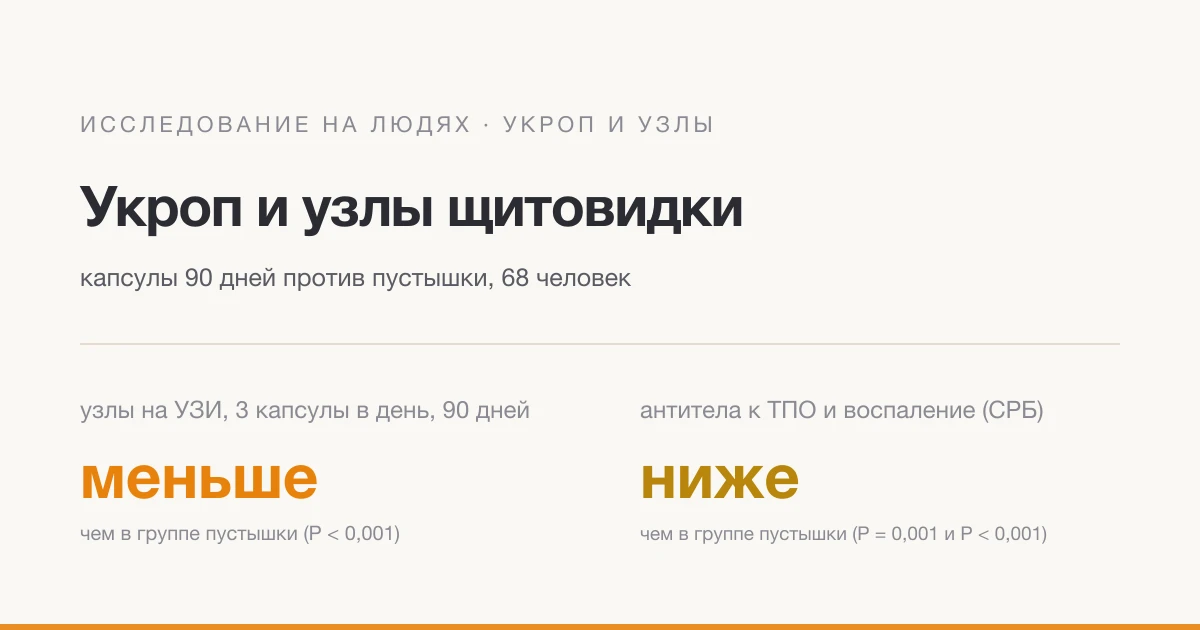
Everyone knows dill: fresh in cold soups and new potatoes, the umbels in the jar with pickles. In 2025 dried, ground dill was tested in a clinical trial in people with benign thyroid nodules. It is one small study: 68 people took dill in capsules (3 capsules a day) for 90 days. By the end the nodules on ultrasound were smaller than in the placebo group (P < 0.001), and anti-TPO antibodies and the inflammation marker (CRP) were lower. Thyroid hormones, TSH and free T4, also fell in the dill group, so with nodules and when taking thyroid hormones the capsules are taken only with a doctor and with blood test monitoring. Dill supplements follow-up with a doctor but does not replace it, and every nodule is first shown to a doctor on ultrasound.
| What | How much | Why it helps | What studies showed |
|---|---|---|---|
| Dried ground dill in capsules | 3 capsules a day, 90 days | Smaller nodules on ultrasound | 68 people (dill 33, placebo 35): nodule size smaller than in the placebo group, P < 0.001 |
| Dried ground dill in capsules | 3 capsules a day, 90 days | Lower anti-TPO antibodies | anti-TPO antibodies lower than in the placebo group, P = 0.001 |
| Dried ground dill in capsules | 3 capsules a day, 90 days | Lower inflammation marker | CRP (C-reactive protein) lower than in the placebo group, P < 0.001 |
| Dried ground dill in capsules | 3 capsules a day, 90 days | Thyroid hormones change: blood tests are needed | TSH lower (P = 0.009) and free T4 lower (P < 0.001) than in the placebo group |
What thyroid nodules are
A thyroid nodule is a lump or focus in the gland tissue that a doctor sees on ultrasound or feels in the neck. Nodules are very common: by age 60 they are found in about every second person (as the authors write in the introduction to the study, Destek S J Med Food 2025. PMID 40329862[1]). Most nodules are benign, a person does not feel them, and they are found by chance, for example on a neck ultrasound done for another reason.
What is done about such a nodule? The doctor assesses it on ultrasound, orders further tests if needed and repeat ultrasounds to see whether the size changes. This is called follow-up. Of course, people with a nodule wonder whether there is something simple to add to follow-up. That is why a study of a familiar garden plant drew interest.
How the study was done
It was a placebo-controlled study: 68 people with benign nodules were randomly split into two groups. The dill group had 33 people, the placebo group 35. The dill was dried and ground and put into capsules, and participants took 3 capsules a day for 90 days. The title of the paper: a randomized placebo-controlled clinical study in people with thyroiditis and nodular goiter (Destek S J Med Food 2025. PMID 40329862[1]).
At the start and the end of the course blood tests and ultrasound were done: TSH (the pituitary hormone that controls the thyroid), free T3 and T4 (the gland's own hormones), antibodies to TPO and to thyroglobulin (markers of an autoimmune process in the gland), CRP (a marker of inflammation in the body). Nodule size was measured on ultrasound. Then the change in the two groups was compared.
Why a placebo matters
A placebo is needed because people often feel better, and even their numbers improve, simply from attention, follow-up and expectation. If one group gets dill and the other gets capsules without it, the difference between the groups shows the contribution of the dill itself. That is why it matters that the result here is described as a difference from the placebo group, not just "before and after".
What happened after 90 days
Compared with the placebo group, the dill group had smaller nodules on ultrasound (P < 0.001), lower anti-TPO antibodies (P = 0.001) and a lower inflammation marker, CRP (P < 0.001). TSH (P = 0.009) and free T4 (P < 0.001) were also lower. The authors conclude that dill suppressed inflammation of the thyroid gland, reduced nodule size and normalised TSH (Destek S J Med Food 2025. PMID 40329862[1]).
What is P? It is the probability of seeing such a difference by chance if dill in fact does nothing. P below 0.001 means that such a chance happens less than once in a thousand. But P does not say how much the nodules shrank. How many millimetres or percent is not given in the available description of the study, so no such figures are given here.
One more detail that matters for safety. Both hormone markers fell in the dill group: TSH and free T4. By itself this is neither a benefit nor a harm, but it means that thyroid hormones change during the course. So with nodules, and all the more when taking thyroid hormones, dill capsules are taken only with a doctor and with blood test monitoring (TSH and free T4).
What this means in plain words
Imagine two groups of people with similar small nodules. One takes dill capsules for three months, the other placebo capsules. After 90 days on ultrasound the nodules in the first group are on the whole smaller than in the second, and the blood tests show lower anti-TPO antibodies and a lower inflammation marker. Thyroid hormones in the first group also shifted down, and that is a reason to follow the blood tests together with a doctor.
The participants had thyroiditis and nodular goiter, so not only nodule size but also antibodies and inflammation were measured. Why this happened the study does not explain, and there is no need to invent a mechanism. It is enough to know that nodules, anti-TPO antibodies and the inflammation marker changed for the better in the dill group, while thyroid hormones need monitoring.
Dill on the plate and dill in capsules
The capsules with dried ground dill were tested, three a day. Fresh dill from the garden in a salad, soup or kefir is a different story: how much of it you would have to eat to match the capsule dose, the study does not say. Still, dill is a familiar food, added to potatoes, cold soup, fish, cottage cheese and vegetable salads. Greens in the diet are pleasant in themselves, but you cannot yet expect from them the same as from a course of capsules.
Another action of dill, on insulin and cholesterol, has its own article: Dill: insulin and cholesterol.
What to do if you have a nodule
- Show the nodule to an endocrinologist and have a thyroid ultrasound if it has not been done yet.
- Come for repeat ultrasounds at the intervals the doctor set: follow-up remains the basis.
- If you want to try dill in capsules, discuss it at the visit: the course is done only with a doctor and with TSH and free T4 monitoring, especially if you take thyroid hormone.
- Have the tests (TSH, free T4, anti-TPO antibodies) done on your doctor's schedule and bring the results to the visit.
- Add fresh dill to food freely: in salads, soups, kefir and with fish. It is simply a tasty habit.
Who should see a doctor first
See a doctor without delay for a new nodule, a nodule that has grown, or a nodule with a hoarse voice, difficulty swallowing or breathing, or enlarged lymph nodes in the neck. If you are pregnant or breastfeeding, take thyroid hormone, or have repeated TSH abnormalities, start a course of dill capsules only after talking to an endocrinologist.
Dill does not replace ultrasound, further tests ordered by a doctor, or treatment that has already been prescribed. Do not change prescribed treatment on your own.
Bottom line
In a placebo-controlled clinical trial in 68 people with benign thyroid nodules, after 90 days of dried ground dill in capsules the nodules on ultrasound were smaller and anti-TPO antibodies and the inflammation marker were lower than with placebo; TSH and free T4 also fell (Destek S J Med Food 2025. PMID 40329862[1]). The result is encouraging, but the study is single and small. The best order of action: follow-up with a doctor and ultrasound remain the basis, dill capsules are taken only with an endocrinologist and with blood test monitoring, and fresh dill on the plate can be eaten with pleasure.
References
- Destek S J Med Food 2025. PMID 40329862
Key facts
- Dill in capsules (dried ground, 3 a day, 90 days) in 68 people with benign thyroid nodules: smaller nodules on ultrasound than in the placebo group, P < 0.001 (randomized placebo-controlled study, dill 33 people, placebo 35) (Destek S J Med Food 2025. PMID 40329862).
- Anti-TPO antibodies lower than in the placebo group, P = 0.001, and CRP (an inflammation marker) lower, P < 0.001 (68 people, 90 days) (Destek S J Med Food 2025. PMID 40329862).
- TSH lower (P = 0.009) and free T4 lower (P < 0.001) than in the placebo group (68 people, 90 days): thyroid hormones change, so with nodules and when taking thyroid hormones dill capsules are taken only with a doctor and with blood test monitoring (Destek S J Med Food 2025. PMID 40329862).
- Thyroid nodules are found in every second person by age 60 (background statement in the introduction to the study) (Destek S J Med Food 2025. PMID 40329862).
- It is a single small study: dill supplements follow-up with a doctor but does not replace it; every nodule is first shown to a doctor on ultrasound.