In Brief
Seventy Years of One Idea
In the 1950s it emerged that the substances easing psychosis blocked dopamine D2 receptors. The dopamine hypothesis of schizophrenia grew out of that observation, and with it every generation of antipsychotics from the first agents to the modern ones.
The approach works. But dopamine is involved in far more than psychosis, and blockade hits all of its functions at once. Hence the familiar catalogue: movement disorders (rigidity, tremor, akathisia), raised prolactin, weight gain and metabolic shifts, sedation and blunted emotion.
It is the side effects, not a lack of efficacy, that most often make a patient abandon treatment. And abandoned treatment in schizophrenia means relapse.
A Different Way Into the Same System
Xanomeline acts on the muscarinic acetylcholine receptors, primarily the M1 and M4 subtypes. They sit in the same brain circuits involved in psychosis, but they govern those circuits from another side.
Simplified: activating M4 indirectly reduces excessive dopamine transmission where it is excessive, instead of blocking receptors outright everywhere. The difference is roughly that between muffling a loudspeaker and turning the signal down at the input.
Why This Drug Sat on a Shelf for Thirty Years
The striking part of the story is that xanomeline is not a new molecule. It was tested back in the 1990s in Alzheimer's disease. It worked: patients' psychotic symptoms eased. But muscarinic receptors exist throughout the body, and the drug activated all of them — nausea, vomiting, sweating, salivation, cramps. Tolerability proved unacceptable and development was halted.
The solution found two decades later was not chemical but engineering. Trospium was added: a substance that blocks the very same muscarinic receptors but barely crosses the blood-brain barrier.
The result is a construction in which two components work against each other — but in different places: xanomeline activates receptors in the brain, trospium quenches them in the body and never reaches the brain.
| Xanomeline | Trospium | |
|---|---|---|
| What it does | Activates muscarinic receptors | Blocks muscarinic receptors |
| Where it acts | Brain and body | Essentially body only |
| What it is for | The therapeutic effect | Quenching the other's side effects |
| Crosses into the brain | Yes | Essentially no |
What the Trial Showed
▸EMERGENT-2 (Lancet, 2024) — 252 participants in an acute exacerbation of schizophrenia, 5 weeks. The PANSS total score fell by 21.2 versus 11.6 points on placebo (difference −9.6; 95% CI −13.9 to −5.2; p<0.0001). The effect size was 0.61 — moderate by convention. All secondary endpoints also favoured the drug [1].
But the genuinely telling part is not the efficacy — it is the tolerability table.
| Adverse event | Cobenfy | Placebo |
|---|---|---|
| Extrapyramidal symptoms | 0% | 0% |
| Akathisia | 1% | 1% |
| Weight gain | 0% | 1% |
| Somnolence | 5% | 4% |
| Nausea | *19%* | 6% |
| Vomiting | *14%* | 1% |
| Constipation | *21%* | 10% |
| Dyspepsia | *19%* | 8% |
| Raised blood pressure | *10%* | 1% |
The upper half of the table is what the drug was built for: the movement and metabolic effects typical of the class are essentially absent. The lower half is the price: gastrointestinal effects occur several times more often than on placebo.
The right conclusion is not a drug without side effects but a drug whose side effects have moved — out of neurology and metabolism, into the digestive system.
▸52-week open-label extension (Am J Psychiatry, 2026) — efficacy and the safety profile hold across a year of treatment [2]. ▸Pooled analysis of the five-week trials (J Clin Psychiatry, 2025) — gastrointestinal effects were mostly mild to moderate, arose early in treatment and eased over time [3].
What This Changes In Practice
For a patient who has lived for years with an antipsychotic and paid for it in rigidity, extra weight and constant drowsiness, a drug with a different set of problems is not a cosmetic improvement. Intolerance is what destroys treatment most often.
But replacing working therapy carries its own risk of relapse, so the reason to discuss a switch is intolerance of the current regimen, not novelty as such.
What Cannot Be Claimed Yet
▸That it is more effective than modern antipsychotics — no head-to-head trials were run; the comparator was placebo. ▸That it is safer overall: it is safer on some measures and worse on others. ▸What happens over years: 52 weeks is the longest follow-up available, and schizophrenia is treated over decades. ▸That it helps in treatment-resistant disease — there is no separate indication for that.
Who It Is Not For
▸Patients with significant gastrointestinal problems: that is the system carrying the load. ▸In urinary retention, certain forms of glaucoma and other states where an anticholinergic component is contraindicated. ▸Anyone whose current therapy works and is well tolerated: changing it without cause is risk without gain. ▸As self-medication or a self-directed switch — changing an antipsychotic is done only under supervision.
Bottom Line
▸The first mechanism in ~70 years in schizophrenia that does not rest on dopamine blockade. ▸An engineering solution: an old molecule was rescued by a second one that quenches its side effects without entering the brain. ▸Efficacy confirmed: PANSS −21.2 versus −11.6 on placebo, effect size 0.61. ▸Movement disorders and weight gain are essentially absent — the key clinical distinction. ▸The price — nausea, vomiting, constipation and raised blood pressure markedly more often than on placebo.
Treatment can be discussed at a consultation; the drug can be ordered here.
References
1. Kaul I, et al. Efficacy and safety of the muscarinic receptor agonist KarXT (xanomeline-trospium) in schizophrenia (EMERGENT-2) in the USA: results from a randomised, double-blind, placebo-controlled, flexible-dose phase 3 trial. Lancet. 2024;403(10422):160–170. PMID 38104575
2. Kaul I, et al. Long-Term Safety and Efficacy of Xanomeline and Trospium Chloride in Schizophrenia: A 52-Week Open-Label Extension Trial. Am J Psychiatry. 2026;183(3):183–192. PMID 41634905
3. Kaul I, et al. Safety and Tolerability of Xanomeline and Trospium Chloride in Schizophrenia: Pooled Results From the 5-Week, Randomized, Double-Blind, Placebo-Controlled EMERGENT Trials. J Clin Psychiatry. 2025;86(1). PMID 40047530
4. COBENFY (xanomeline and trospium chloride) — US Prescribing Information, Bristol Myers Squibb.
Key facts
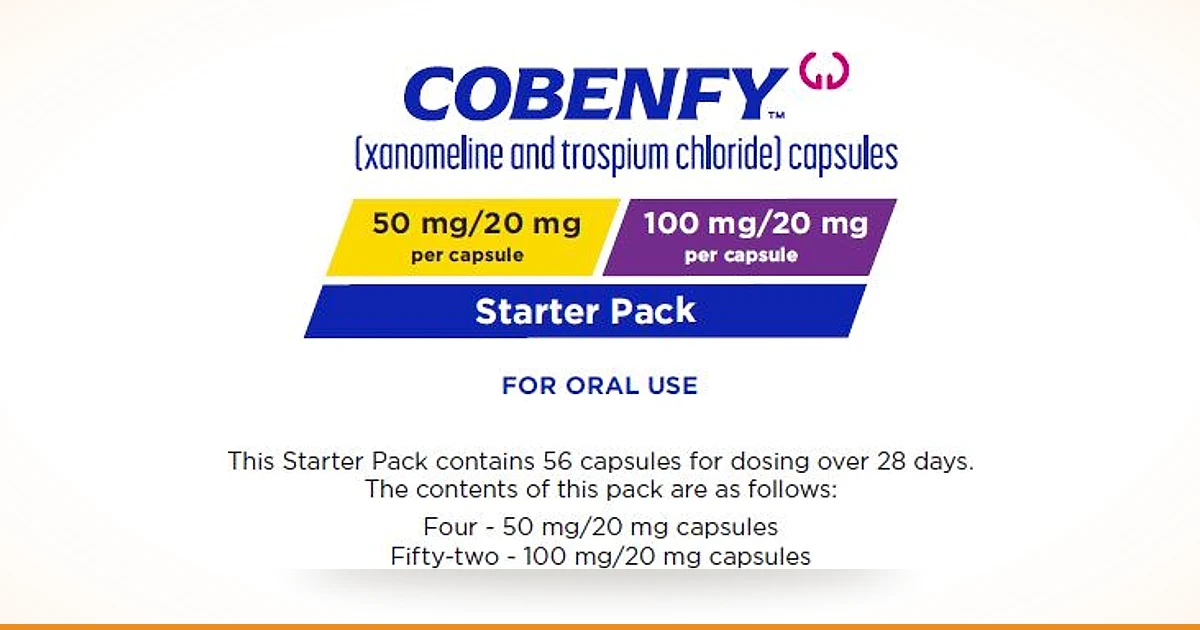
- The combination of xanomeline and trospium (brand name Cobenfy, Bristol Myers Squibb) was approved by the FDA in September 2024 for schizophrenia in adults.
- It is the first fundamentally new mechanism in schizophrenia in roughly 70 years: the drug does not block dopamine receptors but activates muscarinic M1 and M4 receptors.
- Xanomeline has been known since the 1990s and was tested in Alzheimer's disease, then abandoned: it worked, but produced too many cholinergic effects throughout the body.
- Trospium was added for no therapeutic purpose of its own: it blocks the same receptors but barely crosses into the brain — quenching side effects in the body while leaving xanomeline's central action intact.
- EMERGENT-2 (Lancet, 2024): 252 participants; the PANSS total score fell by 21.2 points versus 11.6 on placebo over 5 weeks (difference −9.6; 95% CI −13.9 to −5.2; p<0.0001; effect size 0.61).
- The decisive difference shows in tolerability: extrapyramidal symptoms 0% in both arms, akathisia 1% versus 1%, weight gain 0% versus 1%, somnolence 5% versus 4%.
- The price is gastrointestinal: nausea 19% versus 6%, vomiting 14% versus 1%, constipation 21% versus 10%, dyspepsia 19% versus 8%.
- Raised blood pressure is noted separately: 10% versus 1% on placebo — blood pressure monitoring is part of follow-up.
- A 52-week open-label extension (Am J Psychiatry, 2026) confirmed that efficacy and the safety profile hold over a year of treatment.
- There are no head-to-head trials against modern antipsychotics — the comparator was placebo, so no claim that the drug is stronger can be made.