In Brief
The Problem It Was Built For
A steroid ointment works quickly and predictably. The problem is not efficacy — it is the built-in counter: prolonged use thins the skin, leaves striae and visible vessels, and on the face readily produces perioral dermatitis.
So the physician always draws a line: two weeks, no longer; not on the face; not over a large area. Yet psoriasis and atopic dermatitis are chronic, and treatment runs for years. That gap produced both patient steroid phobia and the biggest unfilled niche in dermatology: a non-steroidal topical that can be used for a long time and everywhere.
Where the Molecule Came From
Tapinarof is a synthetic analogue of a stilbene produced by bacteria of the genus Photorhabdus, which live in symbiosis with nematodes. The molecule was not designed at a chemist's bench — it was found in natural material and developed into a drug.
Its target is the aryl hydrocarbon receptor (AhR), a sensor inside the cell. It evolved to read chemical signals from the environment: tryptophan breakdown products, compounds from plant food, metabolites of the skin microbiome. Through it the skin tunes two things at once — barrier strength and the level of inflammation. In psoriasis and eczema that tuning is off.
How It Works
A steroid ointment acts like the main light switch: it shuts inflammation down wholesale, useful activity included. And the longer you keep it off, the more the room itself fades — that fading is skin atrophy.
Tapinarof is not a switch but a dial that restores the skin's own factory programme. By activating AhR it upregulates the barrier proteins filaggrin and loricrin — precisely the ones genetically in short supply in atopic dermatitis — while damping the inflammatory signal: interleukin-17 in psoriasis, interleukins 4 and 13 in eczema. An antioxidant response is switched on alongside.
Hence the logic of two indications at once: the barrier is repaired in both diseases, and the inflammatory pathway that dominates each one is the one turned down.
| Tapinarof | Topical steroids | Calcineurin inhibitors | PDE-4 inhibitors | |
|---|---|---|---|---|
| Steroid | No | Yes | No | No |
| Skin atrophy with long-term use | No | Yes | No | No |
| Duration limit | None | Yes | None | None |
| Face and folds | Permitted | Restricted | Permitted | Permitted |
| Burning on application | Uncommon | No | Common early on | Sometimes |
| Applications per day | Once | One to two | Twice | One to two |
| Indications | Psoriasis and atopic dermatitis | Both | Mainly atopic dermatitis | Mainly atopic dermatitis |
What the Psoriasis Trials Showed
▸PSOARING 1 and 2 (NEJM, 2021) — two identical phase 3 trials, 1,025 adults with mild-to-severe plaque psoriasis affecting 3–20% of body surface, 12 weeks. The primary endpoint — clear or almost clear skin with at least a 2-grade improvement — was reached by 35.4% and 40.2% of patients versus 6.0% and 6.3% on vehicle cream [1]. ▸PSOARING 3 (JAAD, 2022) — 40 weeks of open-label continuation, 763 patients. Completely clear skin was reached by 40.9%; among those entering with moderate-to-severe disease, 58.2% reached clear or almost clear skin [2].
The most interesting number is not about efficacy but about carry-over. Patients who reached completely clear skin were taken off treatment and simply observed. The mean interval with no therapy at all before lesions returned was 130 days — close to four months. For a topical agent that is atypical: disease usually returns within weeks of stopping.
What the Eczema Trials Showed
▸ADORING 1 and 2 (JAAD, 2024) — two phase 3 trials, 813 patients including children from age 2, 8 weeks. The vIGA-AD response (clear or almost clear skin with at least a 2-grade improvement) was reached by 45.4% and 46.4% versus 13.9% and 18.0% on vehicle. A 75% or greater improvement in EASI was reached by 55.8% and 59.1% versus 22.9% and 21.2%. Itch improved rapidly [3]. ▸ADORING 3 (JAAD, 2025) — 48 weeks, 728 patients. Completely clear skin was reached by 51.9%, and 81.6% reached clear or almost clear skin at least once. The mean first treatment-free interval after complete clearance was 79.8 days [4].
How It Is Used
| Parameter | Detail |
|---|---|
| Formulation | 1% cream |
| Frequency | Once daily |
| Treated area | No formal limit |
| Body sites | Face, neck and folds included |
| Duration | No limit |
| Age | Psoriasis from 18, atopic dermatitis from 2 |
The pattern is not continuous application but intermittent: treat to clear skin → stop → observe → restart if lesions return. That is exactly how the long-term trials were built, and it is the schedule on which the off-therapy remission figures were obtained.
Adverse Effects, Honestly
▸Folliculitis is the main and most frequent reaction: 22.7% over a year in psoriasis and 12.1% over 48 weeks in atopic dermatitis. It appears as small inflamed papules at hair follicle openings, most often on covered skin. Usually mild to moderate and rarely a reason to stop — but it affects one patient in five, and the warning belongs before the first application. ▸Contact dermatitis — 5.5% in psoriasis. ▸Headache, nasopharyngitis, upper respiratory infections — within a few percent each.
One fact worth knowing: in the atopic dermatitis trials, discontinuations due to adverse events were fewer on tapinarof than in the group receiving vehicle cream.
What Cannot Be Claimed Yet
▸No head-to-head data against potent steroid ointments or systemic drugs such as dupilumab. The comparator was vehicle cream — which proves the molecule works but does not support any claim of being stronger or weaker. ▸Little data beyond a year: the longest trials run 48 weeks in eczema and one year in psoriasis. ▸Not studied below age 2. ▸No effect on joints: in psoriatic arthritis a topical agent does not address the disease. ▸Long-range safety of sustained AhR activation — a receptor through which dioxins also act — has been measured over years, not decades. No warning signals appeared in the trials, but those are two different statements.
Who It Is Not For
▸Patients with substantially more than 20% of body surface involved: the issue is not safety but that topical therapy stops being practical. ▸Psoriatic arthritis, pustular and erythrodermic psoriasis — systemic therapy is required. ▸Anyone expecting that non-steroidal automatically means gentle and free of side effects: folliculitis is common, and that has to be accepted upfront.
Where It Sits in Treatment
| Situation | Treatment |
|---|---|
| Limited psoriasis | Topical steroids, vitamin D analogues, *tapinarof* |
| Moderate-to-severe psoriasis | Phototherapy, methotrexate, apremilast, deucravacitinib, biologics |
| Mild-to-moderate atopic dermatitis | Emollients, short steroid courses, calcineurin inhibitors, *tapinarof* |
| Severe atopic dermatitis | Dupilumab and other systemic agents |
The niche for tapinarof is long-term topical treatment without steroids — where a steroid can no longer be used because the limit is spent, or could never be used because the site is the face, a fold, or a child.
Bottom Line
▸A different mechanism: AhR activation repairs the skin barrier and damps inflammation, rather than suppressing the immune response wholesale. ▸No skin atrophy — hence no limits on duration, area or body site. ▸Two indications: plaque psoriasis in adults and atopic dermatitis from age 2. ▸Carry-over after stopping — a mean of 130 days in psoriasis and 80 days in eczema, unusual for a topical drug. ▸The price for it — folliculitis in one psoriasis patient in five; usually mild, but common.
Treatment can be discussed at a consultation; the drug can be ordered here.
References
1. Lebwohl MG, et al. Phase 3 Trials of Tapinarof Cream for Plaque Psoriasis. N Engl J Med. 2021;385(24):2219–2229. PMID 34879448
2. Strober B, et al. One-year safety and efficacy of tapinarof cream for the treatment of plaque psoriasis: Results from the PSOARING 3 trial. J Am Acad Dermatol. 2022;87(4):800–806. PMID 35772599
3. Silverberg JI, et al. Tapinarof cream 1% once daily: Significant efficacy in the treatment of moderate to severe atopic dermatitis in adults and children down to 2 years of age in the pivotal phase 3 ADORING trials. J Am Acad Dermatol. 2024;91(3):457–465. PMID 38777187
4. Bissonnette R, et al. Skin clearance, duration of treatment-free interval, and safety of tapinarof cream 1% once daily: Results from ADORING 3, a 48-week phase 3 open-label extension trial. J Am Acad Dermatol. 2025;93(3):601–610. PMID 40383273
5. VTAMA (tapinarof) — US Prescribing Information, Organon.
Key facts
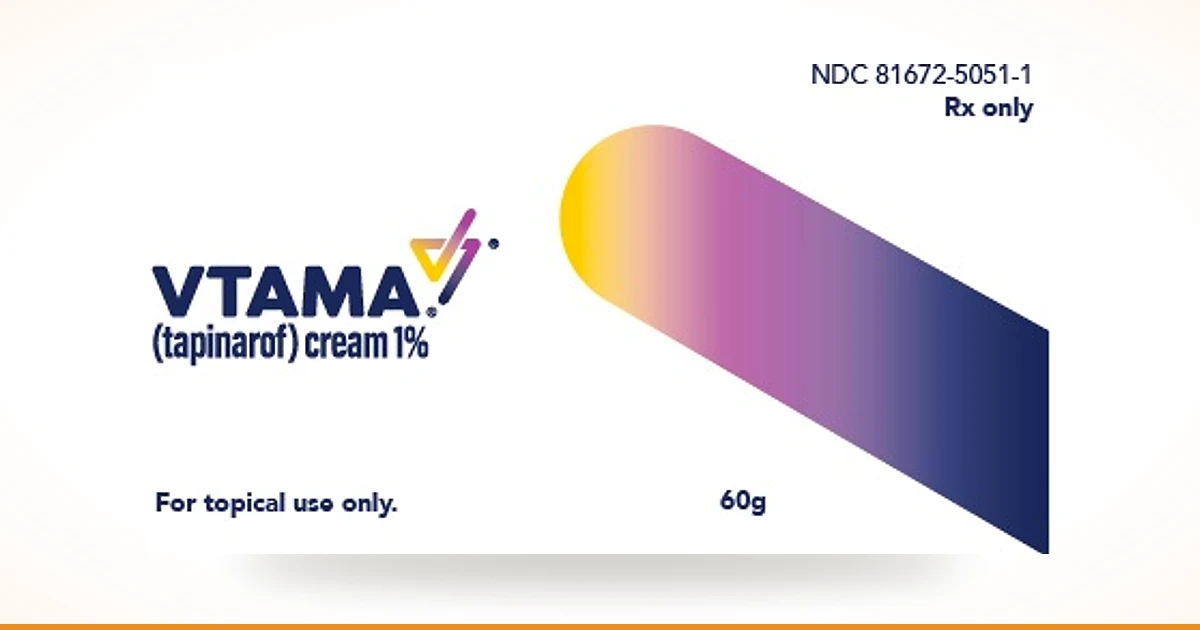
- Tapinarof (brand name VTAMA, Dermavant/Organon) is a 1% cream applied once daily and the first member of a new class: aryl hydrocarbon receptor (AhR) modulating agents.
- The FDA approved it in May 2022 for plaque psoriasis in adults and extended the indication in December 2024 to atopic dermatitis in adults and children down to 2 years of age.
- It is neither a corticosteroid nor a calcineurin inhibitor: it does not cause skin atrophy, so it carries no limit on treated area, duration of use, or body site — the face and skin folds included.
- Mechanism: activating AhR in skin cells upregulates the barrier proteins filaggrin and loricrin while downregulating interleukin-17 in psoriasis and Th2 cytokines (interleukins 4 and 13) in eczema.
- PSOARING 1 and 2 (NEJM, 2021): clear or almost clear skin with at least a 2-grade improvement at week 12 in 35.4% and 40.2% of patients versus 6.0% and 6.3% on vehicle cream.
- PSOARING 3 (JAAD, 2022): over 40 weeks, 40.9% reached completely clear skin, and after stopping treatment at complete clearance the mean off-therapy remittive interval was 130 days — close to four months.
- ADORING 1 and 2 (JAAD, 2024): in atopic dermatitis across 813 patients including children from age 2, the week-8 response was reached by 45.4% and 46.4% versus 13.9% and 18.0% on vehicle.
- ADORING 3 (JAAD, 2025): over 48 weeks, 51.9% reached completely clear skin and the mean first treatment-free interval was 79.8 days.
- The main adverse event is folliculitis: 22.7% over a year in psoriasis and 12.1% in atopic dermatitis; usually mild, but common enough that patients must be warned before the first application.
- The dosing pattern is intermittent by design: treat to clear skin, then stop and watch, and restart if lesions return — not continuous application.