In Brief
What Breaks in IgA Nephropathy
Immunoglobulin A normally guards the mucous membranes. In this disease it is produced with a structural defect: part of the molecule lacks the sugars it should carry. The body reads such immunoglobulin as foreign and raises antibodies against it.
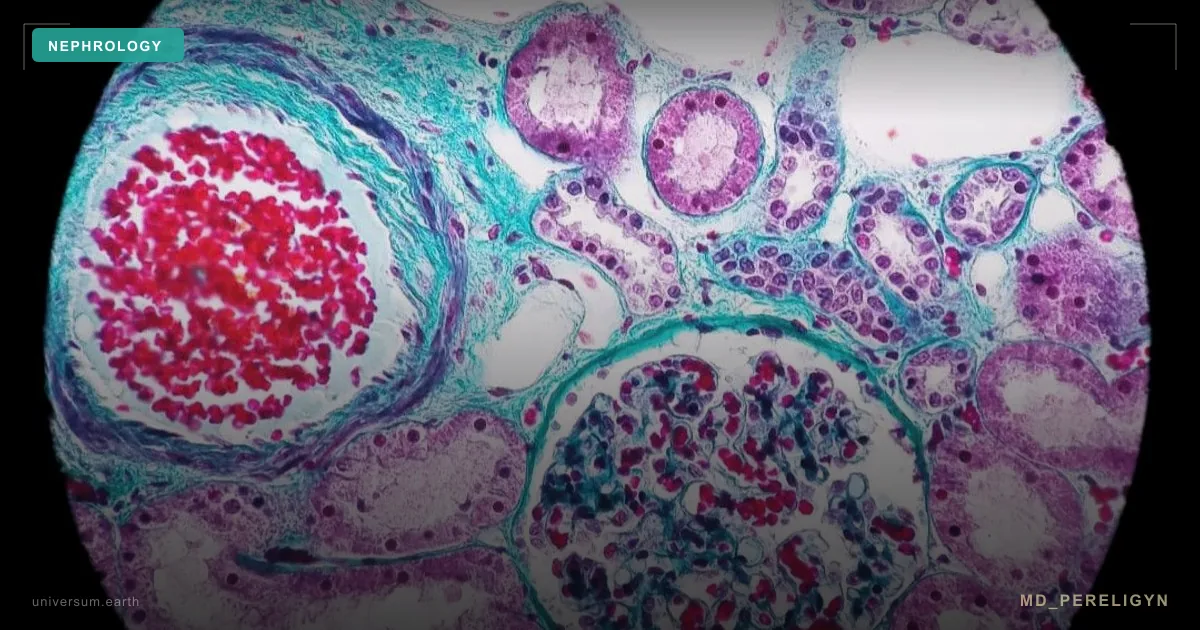
The resulting complexes settle in the glomeruli — the microscopic filters through which blood passes. Chronic inflammation begins, the filter is damaged, and protein that should stay in the blood escapes into the urine.
The key cell of that filter is the podocyte. It wraps around the capillary with foot processes, leaving slits of a strictly defined width between them. Damage to the podocyte means the slits widen and the barrier stops holding protein back. A full account of how the filter is built is in the separate guide on the podocyte.
Why There Are Two Targets in One Molecule
For decades kidney protection has been built on suppressing the angiotensin system — the job of ACE inhibitors and ARBs. This lowers pressure inside the glomerulus and reduces protein loss.
But there is a second route of damage: endothelin, the most powerful vasoconstrictor peptide known. In glomerular disease it amplifies inflammation and damages podocytes directly.
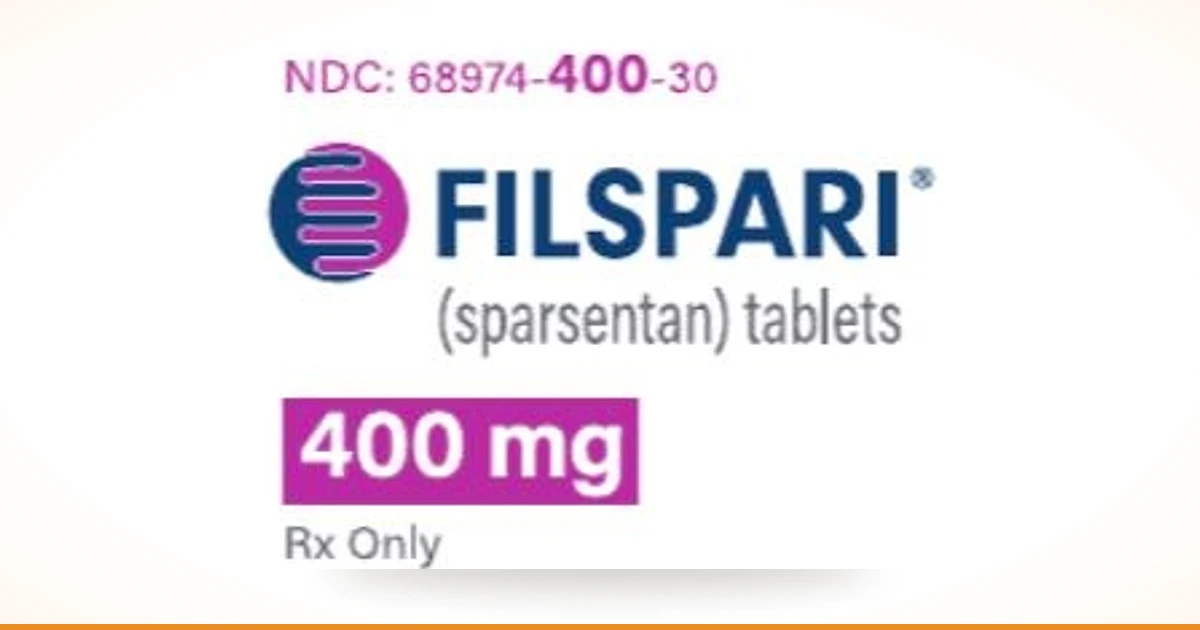
Sparsentan closes both routes with one molecule: one part binds the angiotensin receptor, the other the endothelin A receptor.
| ARB (e.g. irbesartan) | Sparsentan | |
|---|---|---|
| Angiotensin II receptor | Blocked | Blocked |
| Endothelin A receptor | No | Blocked |
| Number of drugs | One pathway, one drug | Two pathways, one drug |
| Restricted programme in the US | No | Yes (REMS) |
The Core Story: Two Diseases, One Drug, Two Outcomes
Sparsentan was tested in two large trials — in IgA nephropathy and in focal segmental glomerulosclerosis (FSGS). In both the comparator was irbesartan, an ordinary ARB rather than placebo: an honest bar.
▸PROTECT (Lancet, 2023) — 404 patients with IgA nephropathy. At week 110 urine protein was 40% lower than in the irbesartan group (−42.8% versus −4.4%). And crucially: the rate of eGFR decline was −2.7 versus −3.8 mL/min/1.73 m² per year (difference 1.1; p=0.037). The composite kidney failure endpoint was reached by 9% versus 13% — numerically favouring sparsentan, but not statistically significant [1]. ▸DUPLEX (NEJM, 2023) — 371 patients with FSGS. Partial remission of proteinuria at week 36 was reached by 42.0% versus 26.0% (p=0.009) and held to week 108. But there was no difference in eGFR slope at week 108 [2].
| PROTECT (IgA nephropathy) | DUPLEX (FSGS) | |
|---|---|---|
| Patients | 404 | 371 |
| Comparator | Irbesartan | Irbesartan |
| Greater fall in urine protein | Yes | Yes |
| Slower loss of kidney function | *Yes* (p=0.037) | *No* |
| Indication granted | Yes | No |
What Follows From This
This is a rare case where a clinical programme demonstrates, without any outside explanation, the difference between a surrogate marker and the actual goal of treatment.
Protein in the urine is a marker. It is convenient: quick to measure, responsive to treatment within weeks rather than years. The goal is something else — preserving kidney function and postponing dialysis — and that takes years of follow-up to show.
Usually one brings the other. But not automatically: in two diseases the same drug produced the same fall in protein and a different outcome for function. That is exactly why the regulator first granted accelerated approval on proteinuria and full approval only eighteen months later, once the two-year eGFR data arrived.
The converse statement matters just as much: the absence of benefit in DUPLEX is unproven benefit in FSGS, not proven uselessness. FSGS gathers together conditions of differing cause, genetic forms included, and an effect is harder to demonstrate in so heterogeneous a group.
How It Is Used
| Parameter | Detail |
|---|---|
| Formulation | Tablets |
| Who | Adults with primary IgA nephropathy at high risk of progression |
| Starting therapy | After biopsy and assessment of kidney function, by nephrologist decision |
| Monitoring | Liver enzymes, potassium, blood pressure, kidney function |
| Compatibility | Not combined with ACE inhibitors, ARBs or other endothelin antagonists |
Precautions
▸Liver. The drug can cause hepatic injury. Enzymes are checked before starting and regularly during treatment. ▸Pregnancy. Acting on both the angiotensin system and endothelin is toxic to the fetus. Pregnancy is excluded before the start and reliably prevented during therapy. ▸Restricted programme. Because of these two risks the drug is distributed in the US through REMS: an ordinary prescription is not enough — prescriber and pharmacy must both be enrolled. ▸Blood pressure and potassium. Dual blockade affects blood pressure more than a single ARB; potassium is monitored.
What Cannot Be Claimed Yet
▸That the drug works in FSGS — the trial did not show it. ▸That it beats an ARB combined with something else — the comparator was irbesartan monotherapy, not a modern combination regimen. ▸That it removes the need for everything else: blood pressure control, salt restriction and stopping smoking remain part of kidney care. ▸Data beyond roughly two years are still limited.
Who It Is Not For
▸Anyone pregnant or planning pregnancy. ▸Patients with pre-existing liver disease — decided case by case and requiring monitoring. ▸Anyone already on an ACE inhibitor or ARB who is not prepared to stop it: these drugs are substituted, not stacked. ▸Patients with FSGS, under the current indication.
Bottom Line
▸Dual blockade of endothelin and angiotensin in one molecule is a new way of protecting the kidney filter. ▸PROTECT: urine protein 40% lower than on irbesartan, and kidney function lost more slowly. ▸DUPLEX: protein fell just as much, but no benefit for function — no indication in FSGS. ▸The lesson beyond these diseases: a surrogate marker is not the goal, and the link has to be proven separately in each disease. ▸The constraints are serious: liver monitoring, excluded pregnancy, a REMS programme in the US.
Treatment can be discussed at a consultation; the drug can be ordered here.
References
1. Rovin BH, et al. Efficacy and safety of sparsentan versus irbesartan in patients with IgA nephropathy (PROTECT): 2-year results from a randomised, active-controlled, phase 3 trial. Lancet. 2023;402(10417):2077–2090. PMID 37931634
2. Rheault MN, et al. Sparsentan versus Irbesartan in Focal Segmental Glomerulosclerosis. N Engl J Med. 2023;389(26):2436–2445. PMID 37921461
3. Heerspink HJL, et al. Sparsentan in patients with IgA nephropathy: a prespecified interim analysis from a randomised, double-blind, active-controlled clinical trial. Lancet. 2023;401(10388):1584–1594. PMID 37015244
4. FILSPARI (sparsentan) — US Prescribing Information, Travere Therapeutics.
Key facts
- Sparsentan (brand name Filspari, Travere Therapeutics) is a tablet that blocks the endothelin A receptor and the angiotensin II type 1 receptor at once: two targets in one molecule.
- The FDA granted accelerated approval in February 2023 on the basis of proteinuria reduction, and full approval in September 2024, once an effect on the rate of kidney function loss was confirmed.
- The indication is primary IgA nephropathy in adults at risk of rapid progression. There is no indication for focal segmental glomerulosclerosis (FSGS).
- PROTECT (Lancet, 2023): 404 patients with IgA nephropathy; at week 110 urine protein was 40% lower than on irbesartan (−42.8% versus −4.4%).
- In the same trial the rate of eGFR decline was −2.7 versus −3.8 mL/min/1.73 m² per year (difference 1.1; p=0.037) — kidney function was being lost more slowly.
- DUPLEX (NEJM, 2023): 371 patients with FSGS; partial remission of proteinuria at week 36 was reached by 42.0% versus 26.0% on irbesartan (p=0.009).
- Yet by week 108 there was no between-group difference in eGFR slope in DUPLEX — the fall in protein did not translate into preserved function.
- Hence a practical lesson that reaches beyond these two diseases: proteinuria is a surrogate marker, not the goal itself, and the link between them is not automatic.
- In the US the drug is dispensed under a restricted REMS programme because of hepatotoxicity and embryo-fetal toxicity: liver enzyme monitoring is mandatory and pregnancy must be excluded.
- Sparsentan is not combined with ACE inhibitors, ARBs or other endothelin antagonists — it already occupies both of those positions.