In brief
Why this is an event
Fatty liver disease is the most common liver condition in the world. For a long time the patient pathway looked like this: ultrasound finds a "fatty liver", the advice is to lose weight, and medicine stops there. Meanwhile a proportion of those patients progress to steatohepatitis — inflammation with cell injury — and from there to fibrosis and cirrhosis.
Attempts to create a drug ran for twenty years and kept failing in phase 3. Resmetirom was the first to reach approval.
Mechanism: a hormone that works only in the liver
Thyroid hormones make cells burn fat faster, the liver included. Treating the liver with them is impossible: excess hormone races the heart, causes arrhythmia and leaches calcium from bone.
The solution lay in receptor biology. Thyroid hormone receptors come in two types:
| Receptor type | Where it dominates | What activation produces |
|---|---|---|
| *THR-α* | Heart, bone | Tachycardia, arrhythmia, bone loss |
| *THR-β* | Liver | Accelerated fat metabolism in the liver cell |
Resmetirom selectively activates the beta type and is additionally taken up preferentially by the liver. The result is a hormonal effect delivered to an address: the liver burns its stored fat while heart and bone barely receive the message.
What the trial showed
▸MAESTRO-NASH (NEJM, 2024; n=966) — a phase 3 trial with liver biopsy before and after treatment. Resmetirom significantly more often than placebo produced resolution of steatohepatitis and fibrosis improvement of at least one stage [1].
The value lies in the biopsy: this is not an improvement in blood tests or less fat on a scan, but a change in the tissue itself — inflammation clearing and scar regressing. No drug before it had shown improvement on both endpoints simultaneously in a randomised trial [2].
Who it is for
▸adults with MASH (metabolic dysfunction-associated steatohepatitis); ▸with fibrosis stage F2 or F3 — moderate or advanced; ▸in addition to diet and physical activity.
Not indicated: in cirrhosis (F4), in simple steatosis without inflammation and fibrosis, or where the fibrosis stage has not been established.
Dosing and monitoring
| Body weight | Dose |
|---|---|
| Below 100 kg | 80 mg daily |
| 100 kg and above | 100 mg daily |
Taken orally once daily, with or without food.
What to monitor:
▸liver enzymes — before starting and then on the clinician's schedule; the drug is stopped if they rise significantly; ▸tolerance in the first weeks: diarrhoea and nausea are the commonest complaints, usually transient; ▸the statin regimen — resmetirom alters statin metabolism, so the dose is reviewed in advance; ▸concomitant drugs — there are significant interactions through hepatic enzymes.
What it does not do
▸It does not replace weight loss. A 7–10% reduction remains the best-evidenced intervention; the drug is added to it. ▸It does not treat cirrhosis. At F4 it has not been studied. ▸It is not a general "liver drug" — there is no indication in hepatitis, drug-induced liver injury or alcohol-related liver disease. ▸It does not cancel work on the cause: insulin resistance, obesity, dyslipidaemia, blood pressure.
Summary
▸The first approved medicine for steatohepatitis with fibrosis — before 2024 there were none. ▸The mechanism is elegant: a thyroid hormone redirected to act only through the hepatic beta receptor. ▸The evidence is strong: biopsy before and after, two histological endpoints, 966 patients. ▸The indication is narrow: MASH with F2–F3 fibrosis, not cirrhosis and not simple steatosis. ▸Weight-based dosing, liver enzyme monitoring, attention to statins. ▸Alongside lifestyle change, not instead of it.
Indications can be discussed at a consultation; the product can be ordered here.
References
1. Harrison SA, et al. A phase 3, randomized, controlled trial of resmetirom in NASH with liver fibrosis (MAESTRO-NASH). N Engl J Med. 2024;390(6):497–509. PMID 38324483
2. Mironova M, et al. In NASH with liver fibrosis, resmetirom improved NASH resolution and reduced fibrosis at 1 year. Ann Intern Med. 2024. PMID 38830210
3. REZDIFFRA (resmetirom) US Prescribing Information, Madrigal Pharmaceuticals.
Key facts
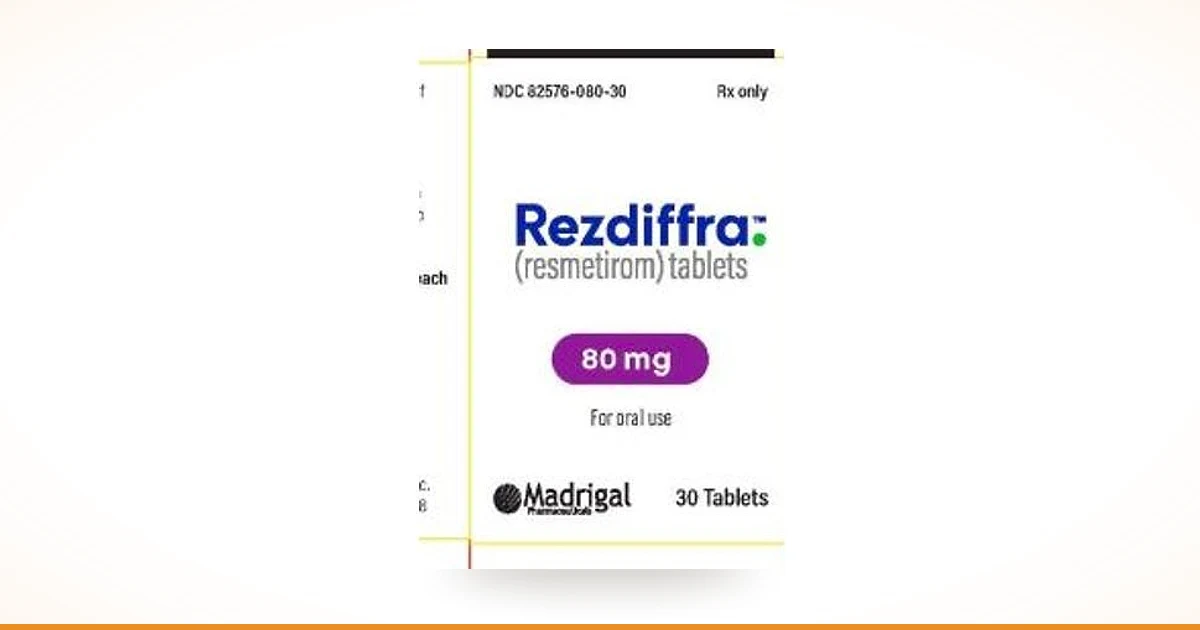
- Resmetirom (brand name Rezdiffra, Madrigal Pharmaceuticals) is the first drug ever approved for metabolic dysfunction-associated steatohepatitis (MASH, formerly NASH) with liver fibrosis. FDA approval came on 14 March 2024.
- Mechanism: a selective agonist of the beta thyroid hormone receptor (THR-β). The liver is dominated by the beta receptor, while heart and bone carry the alpha type. The drug therefore accelerates fat metabolism inside the liver cell without the tachycardia, arrhythmia and bone loss that excess thyroid hormone produces.
- Indication: MASH with moderate to advanced fibrosis (stages F2–F3) in adults, in addition to diet and exercise. It is not indicated in cirrhosis (F4).
- MAESTRO-NASH (NEJM, 2024): in a phase 3 trial with liver biopsy in 966 patients, resmetirom achieved both resolution of steatohepatitis and fibrosis improvement of at least one stage significantly more often than placebo.
- This is the first medicine to demonstrate improvement on both key histological endpoints — inflammation and fibrosis — in a randomised biopsy-controlled trial.
- Dosing is by body weight: 80 mg daily below 100 kg and 100 mg daily at 100 kg or above. Taken orally once a day, with or without food.
- The fibrosis stage must be established before prescribing — by biopsy or non-invasively (elastography, calculated indices). "Fat on ultrasound" is not by itself an indication.
- Common adverse events are diarrhoea and nausea, usually early in treatment. Liver enzymes are monitored, and the drug is stopped if they rise significantly.
- Interactions matter: the drug alters statin metabolism, so the statin dose is reviewed in advance, and it is incompatible with several strong hepatic enzyme inhibitors and inducers.
- Resmetirom does not replace weight loss and metabolic risk correction — it is prescribed in addition to them, not instead.