In short
What it is
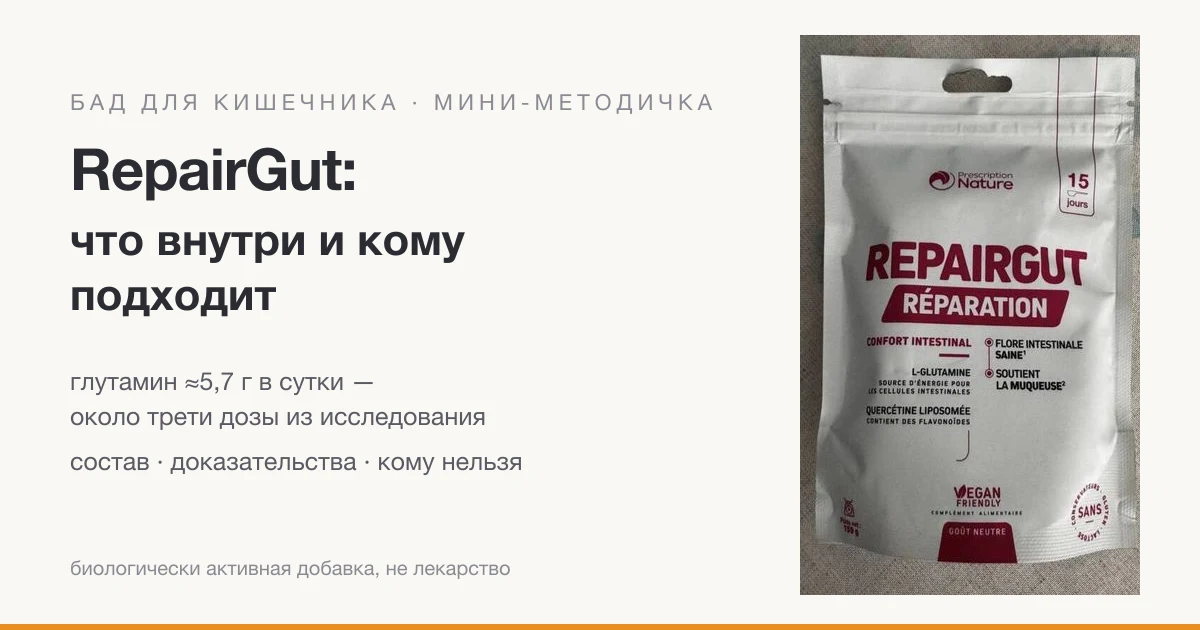
RepairGut is a food supplement, not a medicine. According to the manufacturer's page, one measuring scoop of powder (5.3 g) is dissolved in a glass of water and taken in the morning and in the evening, between meals. The recommended duration is 15 days.
The manufacturer states that the product is vegan, gluten-free and lactose-free. It contains no live bacteria (probiotics), even though the manufacturer's website lists it in its probiotics section.
Daily composition
A daily serving is two scoops, 10.6 g. Doses are taken from the manufacturer's page.
| Ingredient | Daily dose | What it is, in plain words | What is known about the evidence |
|---|---|---|---|
| L-glutamine + L-alanyl-L-glutamine | 5 g + 1 g (≈5.7 g glutamine) | an amino acid; it has been studied in increased intestinal permeability | two randomised controlled trials (RCTs) in irritable bowel syndrome (IBS) at 15 g a day were positive (one in post-infectious IBS with diarrhoea, the other as an add-on to a low-FODMAP diet); a meta-analysis found no significant overall effect on permeability |
| Acacia fibre | 2 g | soluble dietary fibre | not assessed in this guide |
| 2'-fucosyllactose (2'-FL) | 1 g | an oligosaccharide of the same type as in human milk | in IBS, 5–10 g of a mix with LNnT was studied; symptoms no different from placebo |
| N-acetylglucosamine | 600 mg | an amino sugar | not assessed in this guide |
| TYQUC®: quercetin 320 mg; rutin, hesperidin, Sophora japonica 20 mg each | 400 mg | plant flavonoids | barrier: cell experiments only (Caco-2); we found no human RCTs with gut outcomes |
| PEAinMAX®: PEA 340 mg, β-caryophyllene 1.6 mg | 400 mg | palmitoylethanolamide (PEA), a lipid molecule | in the RCTs found in IBS — only together with polydatin |
| Chicory extract | 200 mg | a plant extract | an EU-authorised claim exists only for chicory inulin (stool frequency) and requires ≥12 g of native inulin a day; it does not apply to 200 mg of extract |
| Vitamin B2 | 1.4 mg (100% of the reference intake) | a vitamin | the only EU-authorised claim we found that applies to the product: normal mucous membranes |
The 5.7 g figure is our calculation: 5 g of L-glutamine plus about 0.67 g of glutamine in 1 g of the dipeptide L-alanyl-L-glutamine (by molar mass).
What the research says
Glutamine: under half of the studied dose
The most notable positive result for glutamine comes from a single placebo-controlled RCT in people with diarrhoea-predominant irritable bowel syndrome (IBS-D) that began after a gut infection, and with increased intestinal permeability (Zhou Q, Gut 2019). The dose was 5 g three times a day (15 g a day) for 8 weeks. A response (a drop of at least 50 points on the IBS severity score, IBS-SSS) was seen in 79.6% of the glutamine group versus 5.8% on placebo. Increased permeability normalised only in the glutamine group. The trial was completed by 54 people in the glutamine group and 52 in the placebo group; the authors themselves call for confirmation in larger RCTs.
In a second trial, glutamine (15 g a day) was added for 6 weeks to a low-FODMAP diet in 50 patients with IBS: the IBS-SSS symptom severity score fell by more than 45% in 88% of the glutamine group versus 60% on the same diet with placebo (Rastgoo S, Front Nutr 2021). The abstract has an inconsistency: 22 people per group completed the trial, but the proportions are calculated out of 25.
For intestinal permeability itself, the pooled data look different. A meta-analysis of 10 RCTs (352 participants, studies from 1998–2014 in various conditions) found that, overall, glutamine supplementation did not significantly affect intestinal permeability (Abbasi F, Amino Acids 2024). The Zhou trial was not included in this meta-analysis.
Quercetin: barrier data come from cell experiments
Quercetin increased the electrical resistance of a cell layer — a laboratory measure of barrier tightness — in the human intestinal cell line Caco-2 (Amasheh M, J Nutr 2008; Suzuki T, J Nutr 2009). We found no randomised trials in humans with gut outcomes.
PEA: in the RCTs found, only together with polydatin
In a pilot 12-week RCT in 54 patients with IBS, PEA 200 mg plus polydatin 20 mg twice a day (400 mg of PEA a day) was compared with placebo. Abdominal pain decreased more than on placebo, but mast cell counts and other biological markers in biopsies did not change (Cremon C, Aliment Pharmacol Ther 2017); the authors include an employee of Epitech Group, a PEA manufacturer. RepairGut contains 340 mg of PEA a day, without polydatin.
2'-FL: studied in a mix and at doses several times higher
In IBS, 5–10 g a day of a mix of 2'-FL with another oligosaccharide, LNnT, in a 4:1 ratio was studied. In the RCT, bifidobacteria increased only at 10 g, and symptoms did not differ from placebo; the authors include employees of the company Glycom (Iribarren C, Neurogastroenterol Motil 2020). RepairGut contains 1 g of 2'-FL alone.
Vitamin B2 and what may be claimed about benefits
We found only one EU-authorised health claim that applies to RepairGut — for riboflavin (vitamin B2): “Riboflavin (vitamin B2) contributes to the maintenance of normal mucous membranes” (Regulation (EU) 432/2012). The 1.4 mg in the product (100% of the reference intake) meets the condition of being a “source of riboflavin”. This claim concerns mucous membranes in general and does not mean that RepairGut repairs the gut or the gut barrier.
The manufacturer's website also uses other wording — about “healthy intestinal flora” (for chicory) and about glutamine as an “energy source for gut cells”. These are not authorised health claims. For the chicory phrase, the manufacturer refers to the transitional Article 28 of Regulation (EC) 1924/2006: the EU has not yet decided on such claims, and EFSA has not assessed this phrase. The authorised claim for chicory inulin (stool frequency, from 12 g of native inulin a day, Regulation (EU) 2015/2314) does not apply to 200 mg of extract.
What cannot be said yet
All the data above concern the ingredients separately. It cannot yet be claimed:
- that RepairGut as a ready-made blend repairs the gut or treats IBS: among the studies reviewed, there are none of the blend itself;
- that about 5.7 g of glutamine over 15 days does the same as 15 g over 8 weeks;
- that quercetin strengthens the gut barrier in humans: the studies reviewed include only cell experiments;
- that PEA without polydatin reduces pain in IBS;
- that 1 g of 2'-FL noticeably changes the gut flora or how you feel;
- whether RepairGut helps anyone and, if so, whom: the closest studies are in adults with IBS, but at other doses and in other forms; so we can only say whom the product does not suit (below).
Who it does not suit
According to the manufacturer
The manufacturer states that the product is for adults only and does not recommend it:
- during pregnancy and breastfeeding;
- in prediabetes and diabetes;
- in asthma;
- during treatment with vitamin K antagonists (for example, warfarin);
- in allergy to crustaceans or insects, or known cross-allergy, especially to plants of the Asteraceae (daisy) family;
- on a diet restricted in sodium, potassium or calcium.
The manufacturer does not explain where these points come from. Our assumption: crustaceans, asthma, diabetes and warfarin repeat the cautions for glucosamine (Dahmer S, Am Fam Physician 2008) and apparently relate to N-acetylglucosamine, while the Asteraceae point relates to chicory. We found no direct data on N-acetylglucosamine and crustacean allergy. The manufacturer's recommendation is still worth following.
Medical caution
- Liver cirrhosis, especially if hepatic encephalopathy has already occurred — only after discussing it with a hepatologist. A glutamine load raises blood ammonia, and a diagnostic test is built on this (Ditisheim S, BMC Gastroenterol 2011; Ampuero J, Liver Int 2020). The test uses 20 g; we found no data on a dose of about 5.7 g in cirrhosis. Level of evidence: physiological studies; we found no guidelines.
- Severe chronic kidney disease — only with a doctor's approval. This is medical caution, not a conclusion from studies; the indirect basis is the manufacturer's warning about diets restricted in sodium, potassium and calcium.
- Ciclosporin, digoxin — only with a doctor's approval, because of the quercetin. Quercetin lowered ciclosporin levels in rats (Yu CP, J Agric Food Chem 2011) and sharply raised digoxin levels in pigs (Wang YH, Life Sci 2004); in the pig study the dose was 40 mg/kg, many times more than 320 mg a day. In humans, clinically significant quercetin interactions have been shown for only a few drugs — mainly those broken down by certain liver enzymes or pumped out of cells by a transporter protein (Sulaiman SH, Eur J Clin Pharmacol 2026). Level of evidence: animal experiments and a review of human studies.
If you decide to try it
- If you take medicines regularly or have a chronic illness, discuss the supplement with your doctor first.
- Take it as the manufacturer directs and do not exceed the dose.
- Watch for bloating and gas. If they do not settle within the first few days or get worse, stop taking it and discuss this with your doctor.
- If you develop a rash, itching, swelling or difficulty breathing, stop taking it and seek medical help immediately.
- Blood in the stool, unexplained weight loss, night-time abdominal pain or fever are a reason to get examined first, not to start a supplement.
For background, see the broader article on intestinal permeability (leaky gut); the glutamine data are summarised above.
RepairGut is a food supplement, not a medicine, and it does not replace a varied, balanced diet. It is not intended to diagnose, treat or prevent disease and does not replace treatment prescribed by a doctor. This material is for information only.
References
- Zhou Q, Gut 2019. PMID 30108163
- Rastgoo S, Front Nutr 2021. PMID 34977110
- Abbasi F, Amino Acids 2024. PMID 39397201
- Amasheh M, J Nutr 2008. PMID 18492835
- Suzuki T, J Nutr 2009. PMID 19297429
- Cremon C, Aliment Pharmacol Ther 2017. PMID 28164346
- Iribarren C, Neurogastroenterol Motil 2020. PMID 32536023
- Dahmer S, Am Fam Physician 2008. PMID 18756654
- Ditisheim S, BMC Gastroenterol 2011. PMID 22151412
- Ampuero J, Liver Int 2020. PMID 31729816
- Yu CP, J Agric Food Chem 2011. PMID 21466223
- Wang YH, Life Sci 2004. PMID 14697403
- Sulaiman SH, Eur J Clin Pharmacol 2026. PMID 42827146
- Palsson OS, Clin Transl Gastroenterol 2020. PMID 33512807
Key facts
- RepairGut Réparation (Prescription Nature, France) is a powdered food supplement: according to the manufacturer, one measuring scoop (5.3 g) in a glass of water in the morning and in the evening between meals, for a 15-day course; the daily serving (10.6 g) contains eight groups of ingredients.
- RepairGut's daily serving contains about 5.7 g of glutamine — roughly 38% of the 15 g a day that gave a positive result in a randomised trial in post-infectious irritable bowel syndrome with diarrhoea and increased intestinal permeability (Zhou, Gut 2019); that trial did not test RepairGut, it lasted 8 weeks versus the product's 15 days.
- A meta-analysis of 10 randomised trials (352 participants, studies from 1998–2014 in various conditions; Abbasi, Amino Acids 2024) found no significant overall effect of glutamine on intestinal permeability.
- In the studies reviewed, quercetin's effect on the gut barrier was shown in a human intestinal cell culture (Caco-2); we found no randomised trials in humans with gut outcomes. A daily serving of RepairGut contains 320 mg of quercetin.
- In the randomised trials found in irritable bowel syndrome, palmitoylethanolamide (PEA) was studied only together with polydatin, and the oligosaccharide 2'-FL only in a mix with another human milk oligosaccharide (LNnT) at 5–10 g a day; RepairGut contains 340 mg of PEA without polydatin and 1 g of 2'-FL alone.
- The only EU-authorised health claim we found applicable to RepairGut is for vitamin B2: riboflavin contributes to the maintenance of normal mucous membranes. This is a general claim about the vitamin, not about repairing the gut.