In brief
What kind of drug this is
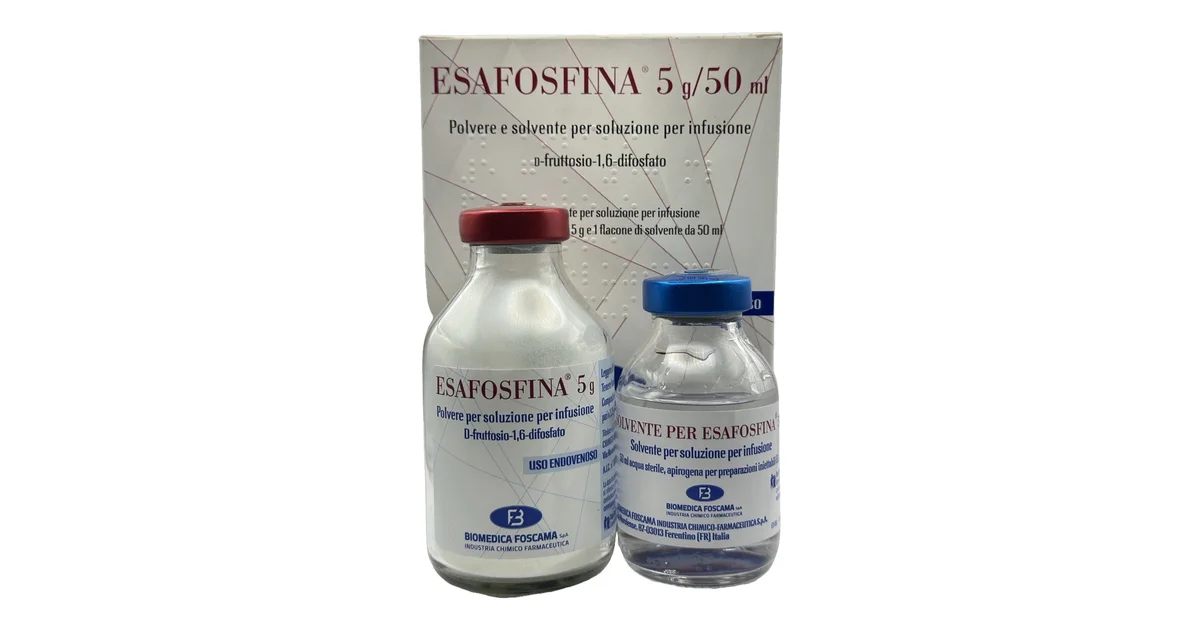
Esafosfina is a product of the Italian company Biomedica Foscama; in Cyrillic it is written «Эзафосфина», and the spelling «Эсафосфина» also occurs. The active substance is D-fructose-1,6-diphosphate as the sodium salt. The powder vial contains nothing but the active substance, and the solvent is water for injections; once dissolved, the 5 g/50 mL vial gives a 100 mg/mL solution for intravenous use.
In Italy the drug has been registered since 1957, the 5 g vial since 1963. In the official prescribing information (RCP) of the Italian Medicines Agency (AIFA) it has one indication — established hypophosphataemia, that is, a low level of phosphate in the blood. In the Anatomical Therapeutic Chemical (ATC) classification it is placed among «other cardiac preparations», code C01EB07 (AIFA RCP, 2021; AIFA, 2026).
Fructose-1,6-diphosphate is also used outside Italy. In China, by 2006 several dozen manufacturers held approval for injectable sodium fructose-1,6-diphosphate, and the State Food and Drug Administration (SFDA) issued a single unified label for them: indication — hypophosphataemia, dose 5–10 g per day, rate about 10 mL per minute, that is, 1 g per minute (SFDA, 2006).
Why it is an «energy drip»
Almost all the energy a cell uses passes through one molecule — ATP. It contains 3 phosphoric acid residues, and the energy is stored in the bonds between them. When a muscle contracts and the heart pumps blood, ATP gives up one phosphate and becomes ADP (adenosine diphosphate); to become ATP again, the molecule needs free phosphate and energy from fuel.
The main fast route from glucose to ATP is glycolysis, a chain of 10 enzymatic steps. At the start the cell invests 2 ATP molecules: it attaches two phosphates to glucose and gets fructose-1,6-diphosphate. This molecule then splits into two halves — triose phosphates — and from them the cell gets back 4 ATP. In other words, FDP is a glycolysis «semi-finished product» into which the charge has already been invested.
The second recipient of phosphate is the red blood cell. Red cells have no mitochondria of their own and get all their energy from glycolysis. From this same chain the red cell makes 2,3-DPG (2,3-diphosphoglycerate) — a substance that helps haemoglobin release oxygen to the tissues: the more of it there is, the more easily oxygen is «let go» where it is needed. So the phosphate supply determines not only the muscle's charge but also its oxygen supply.
How this looks in humans was tested in 45 healthy adults. They were given a rapid intravenous injection of 5 g of FDP as a 10 % solution — nominally the same dose and concentration as in the 5 g/50 mL vial. Afterwards, serum inorganic phosphate rose (p<0.0001, that is, the difference is statistically significant), and so did ATP in red blood cells (p<0.01). Indirect calorimetry — calculating metabolism from the gases in exhaled air — showed a shift in fuel: the respiratory quotient, the ratio of exhaled carbon dioxide to oxygen taken up, rose, the share of energy from carbohydrates increased and the share from fats decreased; heart rate and breathing rate fell slightly but significantly. In 10 participants 5 g of ordinary glucose changed none of this (Markov AK Metabolism 2000. PMID 10877192[1]).
Football: a drip before the match in 1990s Serie A
Esafosfina's best-known sporting story is Italian. In Italian football Esafosfina drips were given before matches, and the players themselves talked about it. Former Roma and Genoa libero Gianluca Signorini recalled in an interview with Panorama magazine that he was given many injections of Voltaren (diclofenac) for constant ankle pain, «and then Neoton [phosphocreatine] and Esafosfina straight into the vein before matches» (la Repubblica, 11.01.2001). The article does not specify at which club or in which years this happened. It does say, however, that Juventus players told the Turin prosecutor about mysterious drips before matches, and the prosecutor's consultants established that these were intravenous Esafosfina and Neoton (la Repubblica, 11.01.2001).
The second account was given in court. From January 2002 a trial was under way in Turin in which the Juventus club doctor and chief executive were charged with sporting fraud — the use of drugs on players in 1994–1998. At the hearing on 27 October 2003 Gianluca Vialli testified as the first witness and confirmed that he had received Esafosfina drips (la Repubblica, 29.10.2003); as reported by the Swiss newspaper Le Temps, they were given before matches (Le Temps, 20.01.2004).
The scale was described in the investigation files: as reported by la Repubblica, at least 12 of the club's players received Esafosfina drips, and a member of the medical staff admitted that the drug had never been given to them for the indications approved by the Ministry of Health (la Repubblica, 04.07.2001). The court-appointed expert, pharmacologist Eugenio Müller, criticised Neoton and Esafosfina drips given «immediately before matches» to healthy players «without any therapeutic need» (la Repubblica, 29.06.2004). The defence replied that these were legal drugs and that other clubs, too, listed Esafosfina in their declarations for doping control (la Repubblica, 10.12.2003).
The Italian Court of Cassation closed the matter in 2007: it ruled that in 1994–1998 Juventus players had been illegally given drugs, but that the offence was time-barred; the report on the ruling does not list specific drugs, and Esafosfina is not named there (Quotidiano Nazionale, 31.05.2007). For today's reader, 2 details matter: an explicit ban on drips without a medical purpose appeared in the WADA List only from 1 January 2005 (World Triathlon, 25.09.2004), and fructose-1,6-diphosphate itself is still not on the Prohibited List.
Sport in the 2020s: a survey of national-team athletes
The 2020–2021 data come from the journal Frontiers in Sports and Active Living (2026). The authors ran an anonymous online survey of 138 elite national-team track and field athletes — race walking, middle- and long-distance running; responses were collected from October 2020 to January 2021. The subject of the study was how often top-level athletes receive intravenous therapy (Bezuglov E Front Sports Act Living 2026. PMID 42440853[2]).
Esafosfina was listed in the questionnaire as a ready-made option. It was ticked by 22 of the 93 participants who listed their intravenous drugs — 23.6 %, almost one in four: 14 men and 8 women. In the same table Actovegin was ticked by 77.4 %, phosphocreatine by 64.5 %, L-carnitine by 39.8 %. These are endurance athletes: during a race the muscles spend ATP non-stop — from a few minutes in middle-distance events to several hours in race walking.
Doping or not: the 100 mL in 12 hours rule
Fructose-1,6-diphosphate is not on the WADA 2026 Prohibited List, in force since 1 January 2026: section S4.4 «Metabolic modulators» names other substances — for example, meldonium and trimetazidine (WADA, 2026). In AIFA's Italian medicines database Esafosfina has flagDopante = 0, meaning there is no «doping» mark; for comparison, for furosemide (Lasix) and clostebol (Trofodermin) this flag equals 1 (AIFA, 2026).
What is restricted is the route of administration. Rule M2.2 prohibits athletes at all times — in and out of competition — from receiving intravenous infusions and injections totalling more than 100 mL in 12 hours, except those legitimately received in the course of hospital treatment, surgical procedures or clinical diagnostic investigations (WADA, 2026). The ban is tied to volume, so it applies even if the substance itself is permitted. A doctor's office, a hotel room, a home or an intravenous drip clinic (IV clinic) outside a hospital do not count as exceptions, and an infusion above the limit requires a Therapeutic Use Exemption (TUE) (WADA, 2025). In the 2027 List, which comes into force on 1 January 2027, the text of M2.2 has not changed (WADA, 2026).
What this means in vials. One 5 g/50 mL vial fits within the limit if nothing else has been given intravenously in the same 12 hours. Two 50 mL vials or one 10 g/100 mL vial come to exactly 100 mL: not yet «more than 100 mL», but any line flush or other infusion in those 12 hours takes it over the threshold. Doses from sports studies — 15 g or 250 mg per kg of body weight — take up 150–190 mL as a 10 % solution at a body weight of 60–76 kg (calculation), so outside hospital without a TUE they are prohibited today.
Italy has an even stricter national rule. In the Ministry of Health decree of 1 July 2026, published in the official gazette Gazzetta Ufficiale No. 210 of 10.09.2026, the national list prohibits intravenous infusions of more than 50 mL in 6 hours, except those received during hospitalisation and in clinical trials; the annex with the translation of the WADA List in the same decree gives the threshold as 100 mL in 12 hours (Gazzetta Ufficiale, 2026). The 50 mL vial sits exactly at the Italian threshold.
From 2018 WADA replaced the rule «no more than 50 mL per 6 hours» with «no more than 100 mL in total per 12 hours», so that non-prohibited medicines, such as iron, could be given safely (WADA, 2017).
What studies in humans have shown
Of the 11 studies in the table, 8 were carried out in patients — with blood transfusions, heart and lung surgery, severe lung disease and angina — and 3 in healthy people, 2 of them with exercise.
| Where it was tested | Who took part | What was given | Main result |
|---|---|---|---|
| Healthy adults, 2000 | 45 people | 5 g FDP intravenously | Blood phosphate and red-cell ATP rose; more energy from carbohydrates, less from fats |
| Massive blood transfusions, 1984 | 18 patients (9 + 9) | FDP vs inorganic phosphate | 2,3-DPG rose quickly on FDP; on inorganic phosphate a significant rise only by day 3 |
| Transfusions in neurosurgery, 1980 | 28 patients | FDP | 2,3-DPG above baseline as early as 8 hours later |
| Heart valve replacement, 2024 | 40 patients, double-blind study | FDP vs saline | Lower markers of heart-muscle injury (primary endpoint); the ST segment on the electrocardiogram returned to normal in 34.6 vs 50.3 minutes |
| Coronary heart disease, catheterisation, 1997 | 30 patients with raised filling pressure | Intravenous FDP | Left ventricular filling pressure 22 → 16.7 mmHg; cardiac index 2.50 → 2.81 |
| Lung surgery, 2008 | 106 patients (53 + 53) | FDP 200 mg/kg before anaesthesia vs glucose | Arrhythmia episodes over 72 hours: 35 vs 67 |
| Coronary artery bypass grafting, 2004 | 120 patients, 5 regimens | FDP vs placebo | Regimen of 250 mg/kg + FDP in the cardioplegic solution: lower marker of heart injury, fewer infarctions during and after surgery |
| Malnutrition in chronic lung disease, 2000 | 45 patients, FDP or placebo | Intravenous FDP | Maximal inspiratory pressure in the FDP group 43.0 → 49.8 cmH2O |
| Angina, 1988 | 10 patients, crossover with glucose | 1 FDP drip | Pain and signs of ischaemia during exercise came later, amount of work greater |
| Healthy men, cycle ergometer, 1988 | 12 people | 15 g FDP before the test | Work +25 %, maximal oxygen uptake +12 % |
| Trained men, 1990 | 10 people, double-blind study | 250 mg/kg FDP vs placebo | An hour of exercise at 70 % of maximum and a test to exhaustion: no differences from placebo found |
In coronary artery bypass grafting in 120 patients, 5 dosing regimens were tested, and one turned out to work: 250 mg/kg intravenously before surgery plus FDP in the cardioplegic solution that protects the heart while it is stopped. In these 15 patients, 2, 4 and 6 hours after blood flow was restored, the heart-muscle injury marker CK-MB (the cardiac fraction of creatine phosphokinase) was lower, and there were fewer infarctions during and after surgery (Riedel BJ Anesth Analg 2004. PMID 14693576[7]). In a cardiac catheterisation study of 30 patients with coronary heart disease and raised left ventricular filling pressure, after intravenous FDP this pressure fell from 22 to 16.7 mmHg, the cardiac index — the volume of blood the heart pumps out per minute adjusted for body surface area — rose from 2.50 to 2.81 L/min/m², and heart rate and aortic pressure did not change significantly (Markov AK Am Heart J 1997. PMID 9141376[8]).
In stable angina, a single FDP drip in 10 people, in a single-blind crossover comparison with glucose, increased exercise tolerance and total work and significantly delayed the onset of pain and ST-segment depression during the exercise test; the authors suggest this may be due to a better oxygen supply to skeletal muscles (Marchionni N J Clin Pharmacol 1988. PMID 3230148[9]). In mild to moderate heart failure, 4 infusions of 125 mg/kg every 12 hours raised the left ventricular ejection fraction by 7 %, while blood pressure and heart rate did not change (Munger MA Pharmacotherapy 1994. PMID 7997386[10]).
In a double-blind randomised crossover study, where the order of drug and placebo was chosen at random, in 10 trained men aged 34 ± 7 years the task was different: an hour of steady exercise at 70 % of VO2max, then a graded test to exhaustion. With an FDP infusion of 250 mg/kg no differences from placebo were found — neither in heart rate, blood pressure and gas exchange, nor in perceived exertion, glucose, lactate and hormones (Myers J Med Sci Sports Exerc 1990. PMID 2406538[13]). How muscle and mitochondria themselves respond to exercise is covered in MOTS-c: a peptide from the mitochondrion's own DNA that responds to exertion.
Where Esafosfina works
If the studies are put together, a common line emerges: results were obtained where phosphate or oxygen is lacking; the authors of the 1990 study write that the energy effect of FDP has been described in acidosis, lack of oxygen and ischaemia — insufficient blood flow (Myers J Med Sci Sports Exerc 1990. PMID 2406538[13]). After massive transfusions 2,3-DPG rose faster on FDP than on inorganic phosphate; in malnutrition, inspiratory strength in the FDP group rose by about 16 %; in heart valve replacement the ST segment returned to normal 15.7 minutes faster (calculation: 50.3 − 34.6), and markers of heart-muscle injury were lower. In the catheterisation study, filling pressure fell in the 30 patients in whom it was initially raised, while in 17 patients with normal filling pressure it did not change (Markov AK Am Heart J 1997. PMID 9141376[8]).
In 12 healthy men in a graded test after 15 g of FDP, work increased by 25 % and VO2max by 12 %; in 10 trained men after 250 mg/kg, neither during an hour at 70 % of VO2max nor in the test to exhaustion did heart rate, gas exchange, lactate and hormones differ from placebo. The practical conclusion: Esafosfina is a means of replenishment, not an everyday «energy booster» for a body with full stores. Its official place is confirmed phosphate deficiency; transfusions, heart and lung surgery and malnutrition in lung disease are the areas where FDP has been studied in patients, and the decision about it is made by a doctor. If you lack energy for no obvious reason, start with tests: what to check is covered in Stress axis: sleep, energy, and which tests to discuss.
The official indication: low blood phosphorus
Hypophosphataemia is a serum phosphorus concentration below 0.8 mmol/L (2.5 mg/dL) — this is how a 2010 review defines it (Liamis G QJM 2010. PMID 20356849[14]). Phosphate is needed to build every molecule of ATP and 2,3-DPG, so when it is lacking it is harder for the cell to charge its battery and for the red cell to release oxygen. Established hypophosphataemia is the only indication both in the Italian AIFA label and in the Chinese unified label of 2006 (AIFA RCP, 2021; SFDA, 2006).
«Energy drip» is an image that describes the mechanism: according to biochemical studies cited in the AIFA label, FDP at pharmacological doses stimulates replenishment of the cells' store of high-energy phosphates and of 2,3-DPG, and it is prescribed to replenish phosphate (AIFA RCP, 2021). In hospitals FDP also serves as a source of phosphate for intravenous nutrition. In 2022 the Italian Society of Hospital Pharmacy (SIFO) announced that the 5 g/50 mL vial was again available for hospital use and compared it with sodium glycerophosphate — another source of organic phosphorus for total parenteral (intravenous) nutrition mixtures (SIFO, 2022). In trauma patients on intravenous nutrition, phosphate given as FDP — 1 mmol per kg per day — gave a better nitrogen balance, that is, a smaller net protein loss, than nutrition with the same calories and inorganic phosphate (Radrizzani D Surg Gynecol Obstet 1986. PMID 3088741[15]).
How it is given
Esafosfina is given as an intravenous drip. Before administration the powder is dissolved in the 50 mL of solvent supplied, and the 5 g/50 mL vial gives a 100 mg/mL solution. The recommended daily dose is 70 to 160 mg per kg of body weight depending on the severity of the condition and the degree of hypophosphataemia; for an adult this is usually 1–2 vials of 5 g a day or 1 vial of 10 g, with high doses split into 2 administrations (AIFA RCP, 2021). Dose, frequency and duration — only as prescribed by a doctor.
The rate is about 10 mL per minute, that is, a 50 mL vial is given over no less than 5 minutes (calculation). It must not be rushed: at a rate above 10 mL/min, facial flushing, palpitations and tingling in the hands and feet may occur, and with too rapid administration — pain and irritation at the injection site (AIFA RCP, 2021).
The drug leaves the blood quickly. In healthy volunteers, 5 minutes after an infusion of 250 mg/kg the plasma concentration is 770 mg/L, the half-life is 10–15 minutes, and 80 minutes after the end of the drip FDP is no longer detectable in plasma: it passes into the tissues and is broken down to monophosphates, triose phosphates and inorganic phosphate (AIFA RCP, 2021).
What to consider in the composition. A 5 g/50 mL vial contains 30 mmol of sodium — about 0.7 g (calculation), which matters if sodium intake is restricted. The ready solution provides about 0.47 mEq (milliequivalents) of phosphorus per mL, that is, about 23.5 mEq per vial (calculation). With creatinine clearance — a measure of how much blood the kidneys clear per minute — below 50 mL/min, the label recommends monitoring blood phosphorus and reducing the dose if necessary (AIFA RCP, 2021).
Who should not have it and what to know
According to the AIFA label, Esafosfina is contraindicated in 4 cases: hereditary fructose intolerance, hyperphosphataemia (high blood phosphorus), renal failure and hypersensitivity to the active substance or excipients (AIFA RCP, 2021).
Section 4.4 of the label separately warns about children: if agitation or sweating appears during the infusion, especially in a newborn or infant, and all the more so with confirmed hypoglycaemia, hereditary fructose intolerance should be suspected, the drip stopped immediately and metabolic balance restored.
Adverse reactions per the label: at a rate above 10 mL/min — facial flushing, palpitations and tingling in the hands and feet; rarely — allergic reactions of varying severity, up to anaphylactic shock. No cases of overdose have been described; theoretically, doses that are too large or too frequent may raise blood phosphorus, and this in turn may lower calcium (AIFA RCP, 2021). In the bypass study, one of the 5 dosing regimens had to be adjusted because of metabolic acidosis — acidification of the blood (Riedel BJ Anesth Analg 2004. PMID 14693576[7]).
The bottom line
Esafosfina is a drip of fructose-1,6-diphosphate, a molecule from the middle of the cell's energy chain with 2 phosphates already invested. In healthy adults a 5 g dose raises blood phosphate and ATP in red blood cells; after massive transfusions 2,3-DPG rises faster on it than on inorganic phosphate; in heart valve replacement the ST segment returns to normal 15.7 minutes faster, and in lung surgery there are almost half as many arrhythmia episodes; in malnourished patients with COPD, inspiratory strength in the FDP group rose by about 16 %.
In football its story is linked with 1990s Serie A, and in a 2020–2021 survey it was named by almost one in four of the national-team track and field athletes who listed their intravenous drugs (22 of 93). The substance itself is not on the WADA Prohibited List; outside hospital the volume is limited — 100 mL in 12 hours, with a 50 mL vial. Results have been obtained where phosphate and oxygen are lacking; the drug is used only as prescribed by a doctor.
This material is for information only and does not replace a medical consultation. Esafosfina 5 g/50 mL is a prescription drug; the decision to prescribe it and the dose are made by a doctor on the basis of test results.
References
- Markov AK Metabolism 2000. PMID 10877192
- Bezuglov E Front Sports Act Living 2026. PMID 42440853
- Iapichino G Int Surg 1984. PMID 6500874
- Urciuoli R Minerva Anestesiol 1980. PMID 6894327
- Xu H Eur J Cardiothorac Surg 2024. PMID 39120890
- Xu XH Zhong Nan Da Xue Xue Bao Yi Xue Ban 2008. PMID 19001742
- Riedel BJ Anesth Analg 2004. PMID 14693576
- Markov AK Am Heart J 1997. PMID 9141376
- Marchionni N J Clin Pharmacol 1988. PMID 3230148
- Munger MA Pharmacotherapy 1994. PMID 7997386
- Marchesani F Respiration 2000. PMID 10773790
- Ripari P Pharmatherapeutica 1988. PMID 3174724
- Myers J Med Sci Sports Exerc 1990. PMID 2406538
- Liamis G QJM 2010. PMID 20356849
- Radrizzani D Surg Gynecol Obstet 1986. PMID 3088741
Key facts
- Esafosfina (Biomedica Foscama, Italy) is intravenous D-fructose-1,6-diphosphate: a vial of 5 g of powder and 50 mL of solvent. Its only official indication is established hypophosphataemia; hypophosphataemia is defined as serum phosphorus below 0.8 mmol/L (2.5 mg/dL). The dose is 70–160 mg/kg per day, usually 1–2 vials, at a rate of about 10 mL per minute.
- In 45 healthy adults a single infusion of 5 g of fructose-1,6-diphosphate raised serum inorganic phosphate and ATP (adenosine triphosphate, the cell's main energy molecule) in red blood cells and shifted metabolism towards burning carbohydrates; 5 g of glucose did not do this in 10 of them (Markov AK, Metabolism 2000).
- At Juventus in 1994–1998 Esafosfina drips were given before matches — this was established by the Turin prosecutor's consultants; Gianluca Vialli confirmed in court (2003) that he had received Esafosfina drips. Former Roma and Genoa libero Gianluca Signorini told Panorama magazine (2001) that Esafosfina had been injected into his vein before matches.
- In a survey of 138 elite national-team track and field athletes (Frontiers in Sports and Active Living, 2026), Esafosfina was ticked by 22 of the 93 participants who listed intravenous drugs — 23.6 %; Actovegin by 77.4 %, phosphocreatine by 64.5 %.
- Fructose-1,6-diphosphate is not on the World Anti-Doping Agency's 2026 Prohibited List; rule M2.2 limits the volume — outside hospital no more than 100 mL intravenously in 12 hours, and one vial is 50 mL. Italy's national rule is stricter: no more than 50 mL in 6 hours.