A plain-language checklist: what you can add and why
What a checkup is
A regular checkup covers the basics. Extra tests refine the picture.
- total cholesterol and sugar
- creatinine for the kidneys
- questions remain: five tests help clear them up
ApoB: the particle count
Cholesterol is the cargo, ApoB is the number of vehicles carrying it.
- can be drawn without fasting
- useful with high triglycerides and excess weight
- adds to regular cholesterol, does not replace it
Lipoprotein(a): inherited
This marker is set in your genes and is tested once in a lifetime.
- usually no need to repeat
- especially important if relatives have it high
- good heart-health measures are linked with lower risk
Omega-3 index
Shows how much omega-3 fat is in your blood cells.
- eat fish twice a week
- no preparation needed
Homocysteine
A signal of how the body uses B vitamins.
- drawn in the morning on an empty stomach
- read together with vitamin B12 and folate
- a high result is a reason to check diet
Cystatin C: kidneys
Helps see kidney function more precisely when creatinine is unclear.
- less dependent on muscle than creatinine
- drawn in the morning
- the estimate is calculated together with creatinine
Who needs it
Not everyone needs the whole set, only by question.
- lipoprotein(a): every adult once
- the others: on a doctor’s advice
- relatives with early heart disease are a reason to test
How to read a result
One test is not a diagnosis.
- the doctor looks at all markers together
- considers age, pressure, weight, smoking
- repeats if the result is unexpected
When to see a doctor
Discuss results with a doctor if:
- a value is outside the report range
- heart attacks or strokes came early in the family
- you take medicines
Important. Important: do not change prescribed treatment on your own.
The main point
A standard checkup looks well at total cholesterol, glucose and creatinine. Five extra tests help see what it cannot: how many “harmful” particles are in the blood, what your inherited risk is, how the kidneys work when creatinine is unclear. This is not a set for everyone but a map of questions for a conversation with your doctor.
| Test | How to take it | Why it helps | What studies showed |
|---|---|---|---|
| 1. ApoB | Any time, fasting not required | Shows the number of cholesterol-carrying particles | 389,529 people not on cholesterol treatment, 11.1 years: of three markers only ApoB kept its link with heart attack (risk 1.27 times higher per standard deviation) |
| 2. Lipoprotein(a) | Once in a lifetime, no preparation | Reveals inherited risk | 443,180 people without heart and vascular disease: at 150 nmol/L or more (12.2%) events in 6.1% versus 4.3% |
| 3. Omega-3 index | Blood, no preparation | Shows how much omega-3 is in blood cells | 17 cohorts, 42,466 people: top fifth had a 16% lower risk of death than the bottom fifth |
| 4. Homocysteine | Morning, fasting | Shows vitamin B metabolism | 10 trials, 44,224 people: after lowering with vitamins, stroke in 4.3% versus 5.1% |
| 5. Cystatin C | Morning; creatinine — not after a meat meal | Another way to assess the kidneys, less dependent on muscle mass | 11 cohorts, 90,750 people: reduced kidney function found in 13.7% versus 9.7% by creatinine |
1. ApoB: the number of “cars”, not the weight of the cargo
Cholesterol in blood is carried by particles. Each particle carries one ApoB molecule, so ApoB shows the total number of particles that can settle in vessel walls. Think of cholesterol as cargo and ApoB as the number of vehicles. It can be drawn without fasting (Sniderman A D JAMA Cardiol 2019. PMID 31642874[1]).
In 389,529 people not on cholesterol treatment (11.1 years of follow-up) heart attack was more frequent with higher ApoB; when ApoB, non-HDL cholesterol and triglycerides were entered together, only ApoB stayed significant (risk 1.27 times higher per standard deviation; Marston N A JAMA Cardiol 2022. PMID 34773460[2]). But cholesterol is not obsolete: in 94,398 people (13.2 years, 2,462 first heart attacks), high ApoB with lower non-HDL cholesterol carried a risk 1.32 times higher, high non-HDL cholesterol with lower ApoB 1.30 times higher, and both high 1.69 times higher (Johannesen C D L JAMA Cardiol 2026. PMID 42126847[3]). So ApoB complements the lipid panel rather than replacing it.
When it is especially useful: with high triglycerides, excess weight and insulin resistance, LDL cholesterol may be low while ApoB is high (Soffer D E J Clin Lipidol 2024. PMID 39256087[4]). A reference from the distribution: among untreated adults (12,696 people) the middle ApoB is about 90 mg/dL (0.9 g/L), and one in ten has 130 mg/dL (1.3 g/L) or more: a reason to discuss risk with a doctor. Estimate your non-HDL cholesterol with the calculator.
2. Lipoprotein(a): inherited risk checked once
Lipoprotein(a) is determined almost entirely (over 90%) by genes. Experts advise measuring it in every adult at least once; repeating is usually unnecessary because the level is stable: in 16,017 people remeasured after 4.4 years the results almost matched (rho 0.96; Trinder M J Am Coll Cardiol 2022. PMID 35177190[5]). It can be drawn at any time. Hypothyroidism is among the things that shift it (higher level, 5–20% lower on replacement therapy) (Kronenberg F Eur Heart J 2022. PMID 36036785[6]).
Experts use reference points: below 30 mg/dL or 75 nmol/L the contribution to risk is considered small, above 50 mg/dL or 125 nmol/L meaningful, with a grey zone between. The units are not converted directly, so go by the units on your own report. Importantly, risk rises smoothly, and being under a cut-off does not guarantee “zero risk”.
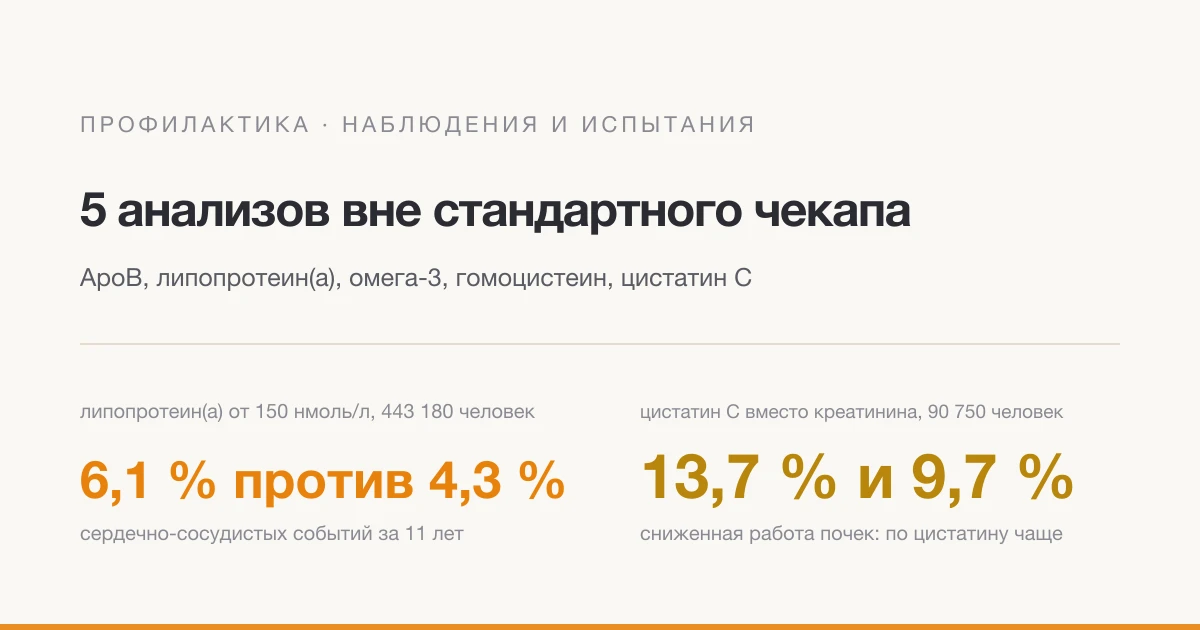
How common a high level is: among 443,180 people without heart and vascular disease, 53,905 (12.2%) had 150 nmol/L or more; over 11.2 years events (heart attack, coronary procedure, ischaemic stroke) occurred in 6.1% versus 4.3% of the rest (Patel A P Arterioscler Thromb Vasc Biol 2021. PMID 33115266[7]). The best heart-health measures (blood pressure, weight, diet, activity, smoking, sugar, cholesterol) are linked with lower risk. Among 1,540 people with a level of 50 mg/dL or more, those with the best measures had a 67% lower risk of heart and vascular disease than those with the worst (Perrot N Atherosclerosis 2017. PMID 27998826[8]).
New in November 2026: in a trial of 8,322 people with heart disease and lipoprotein(a) of 70 mg/dL or more, a drug lowered it from 236 to 64 nmol/L in a year, but the number of cardiovascular events over 4.7 years did not fall (12.3% versus 12.1%; Cho L N Engl J Med 2026. PMID 43001734[9]). The test remains useful as a pointer to inherited risk and a reason to work harder on everything else; “lowering the number” does not yet mean “lowering the risk”.
3. Omega-3 index: what is in the blood
The omega-3 index shows the share of omega-3 fats (EPA and DHA) in red-cell membranes. The method’s authors consider that 8% or more is linked with the greatest protection against death from heart disease and 4% or less with the least (Harris W S Prev Med 2004. PMID 15208005[10]): this is an association and the authors’ proposal, not a threshold from clinical guidelines. No special preparation is needed.
In 17 cohorts (42,466 people, 15,720 deaths, 16 years of follow-up) the fifth with the highest blood omega-3 had a 16% lower risk of death than the lowest fifth, and a 20% lower risk of death from heart and vascular disease (15 cohorts, 4,571 deaths) (Harris W S Nat Commun 2021. PMID 33888689[11]). In these studies the source of omega-3 was food: fish twice a week is a healthy-diet criterion of the American Heart Association.
4. Homocysteine: a metabolic marker, not a verdict
Homocysteine is an amino acid whose level depends on vitamins B12, B9 (folate) and B6. In the review a normal level is about 10 µmol/L (1.35 mg/L); from 12 µmol/L (1.6 mg/L) to 30 µmol/L (4.1 mg/L) the rise is called moderate. A raised level occurs in 5–10% of adults and 30–40% of older people (Martí-Carvajal A J Cochrane Database Syst Rev 2017. PMID 28816346[12]). In a review of 117 observational studies (504,469 people) the risk of heart and vascular disease began to rise from about 10 µmol/L (Huang Z J Evid Based Med 2025. PMID 41028985[13]).
What trials that lowered homocysteine with B vitamins showed: stroke was 10% less frequent (4.3% versus 5.1%; 10 trials, 44,224 people), with no difference from placebo for heart attack and overall mortality (Martí-Carvajal A J Cochrane Database Syst Rev 2017. PMID 28816346[12]). In 13 trials of 14,539 people with coronary disease, homocysteine fell by 2.36 µmol/L but there was no significant difference in events (Guo L Ann Med 2026. PMID 41615824[14]). Takeaway: the test is useful as a signal about diet and vitamin metabolism, not as a target in itself. It is drawn in the morning on an empty stomach together with B12 and folate.
5. Cystatin C: a second look at the kidneys
Creatinine depends on muscle mass, diet and a meat meal the day before. Cystatin C is another protein also used to estimate the filtration rate (eGFR). In 11 cohorts (90,750 people) eGFR below 60 mL/min/1.73 m² was found in 13.7% by cystatin C, 9.7% by creatinine and 10.0% by the combined formula. Among 6,358 people with “borderline” creatinine (45–59 mL/min/1.73 m²), in 42% cystatin C put eGFR at 60 or more, and their risk of death was 34% lower than in those whose estimate did not change (Shlipak M G N Engl J Med 2013. PMID 24004120[15]).
The reverse also happens: when eGFR by cystatin C is at least 30% lower than by creatinine (11% of 821,327 outpatients), the risk of death is higher: 28.4 versus 16.8 per 1,000 person-years (Estrella M M JAMA 2025. PMID 41202182[16]). The KDIGO 2024 guideline recommends calculating eGFR from both when creatinine is unreliable (PMID 38490803[17]). Cystatin C is also influenced by excess weight, smoking, the thyroid, adrenal hormones and inflammation. Chronic kidney disease is confirmed if changes last at least 3 months. You can calculate eGFR with the calculator.
Who should discuss this with a doctor
Lipoprotein(a): every adult once, especially if a parent or sibling has a markedly high level. ApoB: with high triglycerides, excess weight, insulin resistance, when cholesterol and the overall picture do not match. Cystatin C: with unusual muscle mass, a special diet, or doubts about creatinine. Omega-3 index and homocysteine: at a doctor’s discretion, with questions about diet or suspected vitamin deficiency.
Bottom line
The five tests do not replace the standard checkup but add to it. The most valuable for most people is lipoprotein(a), taken once. The others help when there is a specific question. The result is always judged as a whole, with age, blood pressure, weight, smoking and family history.
References
- Sniderman A D JAMA Cardiol 2019. PMID 31642874
- Marston N A JAMA Cardiol 2022. PMID 34773460
- Johannesen C D L JAMA Cardiol 2026. PMID 42126847
- Soffer D E J Clin Lipidol 2024. PMID 39256087
- Trinder M J Am Coll Cardiol 2022. PMID 35177190
- Kronenberg F Eur Heart J 2022. PMID 36036785
- Patel A P Arterioscler Thromb Vasc Biol 2021. PMID 33115266
- Perrot N Atherosclerosis 2017. PMID 27998826
- Cho L N Engl J Med 2026. PMID 43001734
- Harris W S Prev Med 2004. PMID 15208005
- Harris W S Nat Commun 2021. PMID 33888689
- Martí-Carvajal A J Cochrane Database Syst Rev 2017. PMID 28816346
- Huang Z J Evid Based Med 2025. PMID 41028985
- Guo L Ann Med 2026. PMID 41615824
- Shlipak M G N Engl J Med 2013. PMID 24004120
- Estrella M M JAMA 2025. PMID 41202182
- PMID 38490803
Key facts
- ApoB: when cholesterol and triglycerides were counted together, only ApoB kept its link with heart attack: 389,529 people not on cholesterol treatment, 11.1 years, risk 1.27 times higher per standard deviation of ApoB (Marston N A JAMA Cardiol 2022. PMID 34773460).
- Lipoprotein(a) is almost entirely set by genes and one measurement at least once in a lifetime is enough (expert consensus, Kronenberg F Eur Heart J 2022. PMID 36036785).
- High lipoprotein(a), 150 nmol/L or more, in 12.2% of 443,180 people without heart and vascular disease: events over 11.2 years in 6.1% versus 4.3% (Patel A P Arterioscler Thromb Vasc Biol 2021. PMID 33115266).
- A high blood omega-3 level is linked with a 16% reduction in the risk of death (17 cohorts, 42,466 people) and 20% in death from heart and vascular disease (15 cohorts, 4,571 deaths) (Harris W S Nat Commun 2021. PMID 33888689).
- B vitamins lowered homocysteine: stroke 10% less frequent (4.3% versus 5.1%), no difference from placebo for heart attack and overall mortality: 10 trials, 44,224 people (Martí-Carvajal A J Cochrane Database Syst Rev 2017. PMID 28816346).
- Reduced kidney function is found in 13.7% of people by cystatin C and 9.7% by creatinine: 11 cohorts, 90,750 people (Shlipak M G N Engl J Med 2013. PMID 24004120).