A plain-language checklist: what each test shows
Why the tests
The liver rarely hurts. So it is judged by tests.
- they show cell injury
- bile flow
- how the liver “factory” works
- hidden causes: iron and viruses
Cells: ALT and AST
These enzymes leak into the blood when liver cells are injured.
- ALT is more specific to the liver
- AST is also in muscle and heart
- a small rise is often from fatty liver
Bile: GGT and ALP
These rise when bile has trouble leaving.
- GGT helps find where ALP comes from
- GGT also reacts to alcohol
- after 50 ALP is a little higher because of bones
Bilirubin
A pigment from old blood cells. The liver clears it in bile.
- slightly high is often harmless Gilbert syndrome
- fasting and illness can raise it
- the doctor looks at direct and indirect bilirubin
The factory: albumin and INR
They show how the liver copes with making proteins.
- albumin is made only by the liver
- INR shows blood clotting
- low albumin can come from any serious illness
Iron
Extra iron builds up quietly and harms the liver.
- ferritin also rises with inflammation
- saturation changes first
- thresholds differ for women and men
Important. Important: bloodletting is a medical procedure prescribed by a doctor.
Viruses
Hepatitis B and C can be silent for a long time.
- one check in life for adults
- hepatitis C is treated with tablets
- for hepatitis B three tests are used
Elastography
A painless measurement of liver stiffness.
- low stiffness is a good sign
- a high result is repeated fasting
- the doctor may add the FIB-4 index
What you can do yourself
It is not all about tests.
- weight loss reduces liver fat
- discuss alcohol and medicines with a doctor
- repeat tests on your doctor’s plan
When to see a doctor
See a doctor if:
- liver values are repeatedly above normal
- skin or eye whites turn yellow
- heaviness or pain under the right ribs
- ferritin and iron saturation are high
Important. Important: do not change prescribed treatment on your own.
The main point
The liver rarely hurts, so we judge it by tests. The good news: a small set of simple tests gives a fairly complete picture. Ten tests answer four questions: are the cells intact, does bile flow freely, is the liver coping with its work, and are there hidden causes such as iron and viruses.
| Test | Reference | Why it helps | What studies showed |
|---|---|---|---|
| 1. ALT | Healthy limits 30 U/L in men, 19 U/L in women; laboratory norm 40 | Earliest to notice liver cell injury | 6,835 donors: healthy limits lower than former laboratory ones (40 and 30 U/L) |
| 2. AST | Compared with ALT | Present in muscle and heart too, so it hints at the cause | AST without a rise in ALT more often points to muscle or heart (ACG guideline) |
| 3. GGT | Judged together with ALP | Confirms the liver origin of ALP | Rises in conditions other than liver disease, not a stand-alone screen (ACG guideline) |
| 4. ALP | Judged together with GGT | Rises when bile outflow is obstructed | Also found in bone, higher in women over 50 (ACG guideline) |
| 5. Bilirubin | Total usually below 19 µmol/L (1.1 mg/dL) | Shows how the liver clears the pigment | Gilbert syndrome is a common, hereditary and harmless trait, total usually below 51 µmol/L (3 mg/dL) |
| 6. Albumin | From 35 g/L (3.5 g/dL) | A protein made only by the liver | A fall more often means disease lasting over 3 weeks |
| 7. INR | Interpreted by the doctor | Quickly shows a failure of liver function | Lengthens when clotting factors fall below 10% of normal |
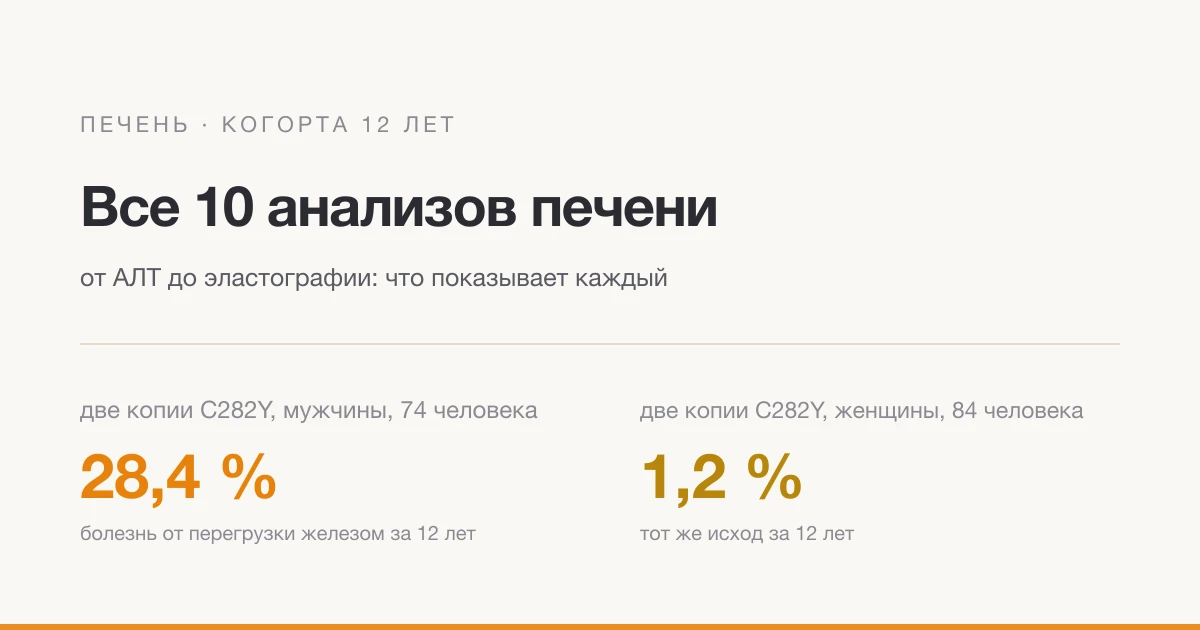
| 8. Ferritin and transferrin saturation | Saturation above 45% in women, above 50% in men | Looks for hidden iron overload | 203 C282Y homozygotes, 12 years: disease in 28.4% of men (21 of 74) and 1.2% of women (1 of 84) |
| 9. Hepatitis B and C | Once in life from age 18 (for hepatitis C, except settings with prevalence below 0.1%) | Finds viruses before symptoms | CDC recommendations |
| 10. Elastography | Below 10 kPa with no other signs: no advanced disease | Measures liver stiffness | Below 10 kPa the 3-year risk of complications is no more than 1% (Baveno VII) |
Cell injury: ALT and AST
ALT (alanine aminotransferase) is found mainly in the liver and leaks into the blood when cells are injured. Laboratories often print an upper limit of 40 U/L. In a study of 6,835 donors, limits were calculated from the subgroup at lowest risk of liver disease; healthy limits turned out lower: 30 U/L in men and 19 U/L in women (Prati D Ann Intern Med 2002. PMID 12093239[1]). The AASLD 2023 guidance advises attention if ALT or AST is above 30 U/L intermittently or for 6–12 months in a row: this may point to chronic liver injury (Rinella M E Hepatology 2023. PMID 36727674[2]). With a small rise, fatty liver is checked first.
AST (aspartate aminotransferase) is also found in muscle, heart and kidney, so a rise in AST without ALT more often points to muscle or heart, and a hard workout raises mainly AST (Kwo P Y Am J Gastroenterol 2017. PMID 27995906[3]). An AST to ALT ratio of 2:1 or more is linked with alcohol-related injury, and above 3:1 it is more likely. A doctor asks about alcohol in anyone with abnormal values.
Bile flow: GGT, ALP, bilirubin
ALP (alkaline phosphatase) rises when bile outflow is obstructed, even slightly. It is also found in bone, placenta and intestine: in people over 50, especially women, the level is higher because of bone turnover. GGT (gamma-glutamyltransferase) helps establish where ALP comes from: if GGT is also up, the source is the liver. But GGT is non-specific and is not used as a stand-alone screen (Kwo P Y Am J Gastroenterol 2017. PMID 27995906[3]).
Bilirubin forms when old red cells break down; the liver binds it and removes it in bile. Total bilirubin is usually below 19 µmol/L (1.1 mg/dL). The commonest cause of raised unconjugated bilirubin is Gilbert syndrome (a common, hereditary and harmless trait): total bilirubin is usually below 51 µmol/L (3 mg/dL) and almost never above 103 µmol/L (6 mg/dL); fasting or illness can raise it 2–3 times, and it falls after eating.
The liver as a factory: albumin and INR
Albumin is made only by the liver, stays in the blood for about 3 weeks, and a normal level is from 35 g/L (3.5 g/dL). A fall usually means liver disease lasting more than 3 weeks, but any serious illness can lower it. Prothrombin time and INR (international normalised ratio) react faster: they change within a day. They lengthen when clotting factors fall below 10% of normal; without liver disease the cause is more often vitamin K deficiency or blood-thinning medication (Kwo P Y Am J Gastroenterol 2017. PMID 27995906[3]).
Iron: ferritin and transferrin saturation
Hidden iron overload is a common cause of liver damage. The first thing to change is transferrin saturation (TSAT): it is considered high above 45% in women and above 50% in men, and after menopause the male thresholds apply. High TSAT and ferritin are a reason to discuss testing the HFE gene with a doctor. Blood for saturation is drawn in the morning; fasting does not improve diagnosis (EASL. J Hepatol 2022. PMID 35662478[4]). You can calculate saturation with the calculator.
“One in 200” is the frequency of people with two copies of C282Y (in people of Northern European ancestry), not of carriers. But the disease does not develop in everyone: over 12 years documented iron-overload disease occurred in 28.4% of men (21 of 74) and 1.2% of women (1 of 84) with two copies of C282Y (Allen K J N Engl J Med 2008. PMID 18199861[5]). Early diagnosis and treatment by phlebotomy can prevent cirrhosis, liver cancer, diabetes and arthropathy. Ferritin is an acute-phase protein: it rises with inflammation, alcohol and fatty liver, so a single high result is read together with TSAT.
Viruses and stiffness: hepatitis and elastography
Hepatitis C is checked at least once in life in all adults aged 18 and over (except settings with prevalence below 0.1%): antibodies first, then viral RNA from the same sample if positive. Antiviral tablets cure most people in 8–12 weeks (Schillie S MMWR 2020. PMID 32271723[6]). Hepatitis B is checked with three tests (HBsAg, anti-HBs, total anti-HBc): they show current infection, past infection, or whether vaccination is needed. By CDC estimate, up to two thirds of people with hepatitis B may be unaware of it (Conners E E MMWR 2023. PMID 36893044[7]).
Elastography measures liver stiffness. A result below 10 kPa with no other signs rules out advanced chronic liver disease, and the 3-year risk of complications is then no more than 1%; 10–15 kPa is suspicious, above 15 kPa highly likely. A result of 10 kPa or more is repeated fasting or supplemented with the FIB-4 index (Baveno VII. de Franchis R J Hepatol 2022. PMID 35120736[8]). For fatty liver disease the cut-off to rule out advanced fibrosis is 8 kPa (Rinella M E Hepatology 2023. PMID 36727674[2]).
What to do with the result
FIB-4 is calculated from age, ALT, AST and platelets: below 1.3 low risk, 1.3 to 2.67 intermediate, above 2.67 high. At 1.3 or more the next step is elastography. Calculate it with the FIB-4 calculator. If the cause is fatty liver disease, weight loss helps: 3–5% reduces liver fat, while improving inflammation and fibrosis usually takes more than 10% (Rinella M E Hepatology 2023. PMID 36727674[2]).
See a doctor if ALT is repeatedly above 30 U/L in men or 19 U/L in women, transferrin saturation is high together with high ferritin, elastography is 10 kPa or more, or you have yellowing of the skin, pain or heaviness under the right ribs. Prescribed treatment is not changed on your own.
Bottom line
Together the ten tests give a picture no single marker can. Start with ALT, AST, GGT and bilirubin, check hepatitis B and C once, and add iron and elastography as your doctor asks. A normal ALT does not exclude liver disease, and a small deviation is more often fatty liver than something frightening.
References
- Prati D Ann Intern Med 2002. PMID 12093239
- Rinella M E Hepatology 2023. PMID 36727674
- Kwo P Y Am J Gastroenterol 2017. PMID 27995906
- EASL. J Hepatol 2022. PMID 35662478
- Allen K J N Engl J Med 2008. PMID 18199861
- Schillie S MMWR 2020. PMID 32271723
- Conners E E MMWR 2023. PMID 36893044
- Baveno VII. de Franchis R J Hepatol 2022. PMID 35120736
Key facts
- Healthy upper limits for ALT: 30 U/L in men and 19 U/L in women, versus former laboratory limits of 40 and 30 U/L; in a study of 6,835 donors; limits were calculated from the lowest-risk subgroup (Prati D Ann Intern Med 2002. PMID 12093239).
- ALT or AST above 30 U/L, persisting or returning over 6–12 months, may point to chronic liver injury (Rinella M E Hepatology 2023. PMID 36727674).
- Transferrin saturation is considered high above 45% in women and above 50% in men; after menopause the male thresholds are used (EASL. J Hepatol 2022. PMID 35662478).
- In people with two copies of C282Y, iron-overload disease was documented over 12 years in 28.4% of men (21 of 74) and 1.2% of women (1 of 84) (Allen K J N Engl J Med 2008. PMID 18199861).
- Hepatitis C and hepatitis B are checked at least once in life in all adults aged 18 and over (for hepatitis C, except settings with prevalence below 0.1%) (CDC, Schillie S MMWR 2020. PMID 32271723; Conners E E MMWR 2023. PMID 36893044).
- Elastography below 10 kPa with no other signs rules out advanced chronic liver disease; the 3-year risk of complications at that stiffness is no more than 1% (Baveno VII. de Franchis R J Hepatol 2022. PMID 35120736).