in pictures and a few words
What it is and why
A glass of water before a meal is a simple habit. It costs nothing; it was tested in people when weight and blood sugar were studied.
- Drunk half an hour before eating
- Tested in people
How water helps you feel full
Water is thought to fill the stomach, so fullness arrives before the plate is empty.
- A little less is eaten at one meal
- Fullness after water is higher
You drank — what happens next
The suggested path is three steps.
- Water takes up room in the stomach
- A feeling of fullness arrives
- The portion ends up smaller
Blood sugar
In one small study in people with type 2 diabetes, fasting sugar fell after water before meals.
- A glass before breakfast, more before lunch, and a glass again before dinner
- Weight and waist went down along with it
Weight
Water before main meals added to weight loss.
- In the studies, people were also following a diet
- People drank it daily for months in the tests
- Water worked best in people who followed a diet at the same time
Water instead of sweet drinks
Water carries no calories, while sweet drinks do.
- Swapping a sweet drink for a glass of water is a simple step
How to drink through the day
A simple plan: morning, day, evening.
- Morning — water before breakfast
- Day — before lunch, the biggest portion
- Evening — before dinner
For steady sugar on the menu
Water is a helper, not the whole program.
- Vegetables, legumes, fish, eggs, cottage cheese, nuts
- Sweet drinks are better replaced with water
Who should see a doctor first
With heart failure or kidney disease, low blood sodium, or a doctor-set limit on fluids, the doctor decides how much to drink.
- Prescribed diabetes treatment is not changed on one's own
- Water complements treatment, it does not replace it
Important. Important: if there is no diabetes — repeatedly below 3.0 mmol/L (54 mg/dL) or above 8.9 mmol/L (160 mg/dL) — see a doctor. In diabetes, targets are individual per the doctor's plan; below 3.0 mmol/L (54 mg/dL) is always a reason to see a doctor.
In one sentence
Water half an hour before a meal, according to tests in people, helps you feel full sooner and lose slightly more weight.
Key points
A glass of water before a meal is a habit that costs nothing and has been tested in human trials. After water, fullness is felt sooner, and fewer calories are eaten per meal. In the trials this went together with greater weight loss and, in one small trial in type 2 diabetes, lower fasting glucose. Water can help in three ways: fullness comes sooner, calorie-containing drinks are replaced, and on a diet it helps lose more weight. Separate trials in people on a diet showed greater weight loss with water. A pooled analysis of 8 trials in people with overweight found no significant weight difference from adding water (−0.33 kg), so water is a helper to eating habits, not a stand-alone way to lose weight (Chen QY Nutrients 2024. PMID 38612997[1]).
| Plan | How much | Why it helps | What human studies showed |
|---|---|---|---|
| Before main meals | 500 mL 30 minutes before eating | Fullness is felt sooner (mechanism not established), less is eaten per meal | In 24 people with overweight and obesity, 74 kcal (about 13%) less was eaten after 500 mL of water (Davy BM J Am Diet Assoc 2008. PMID 18589036[2]) |
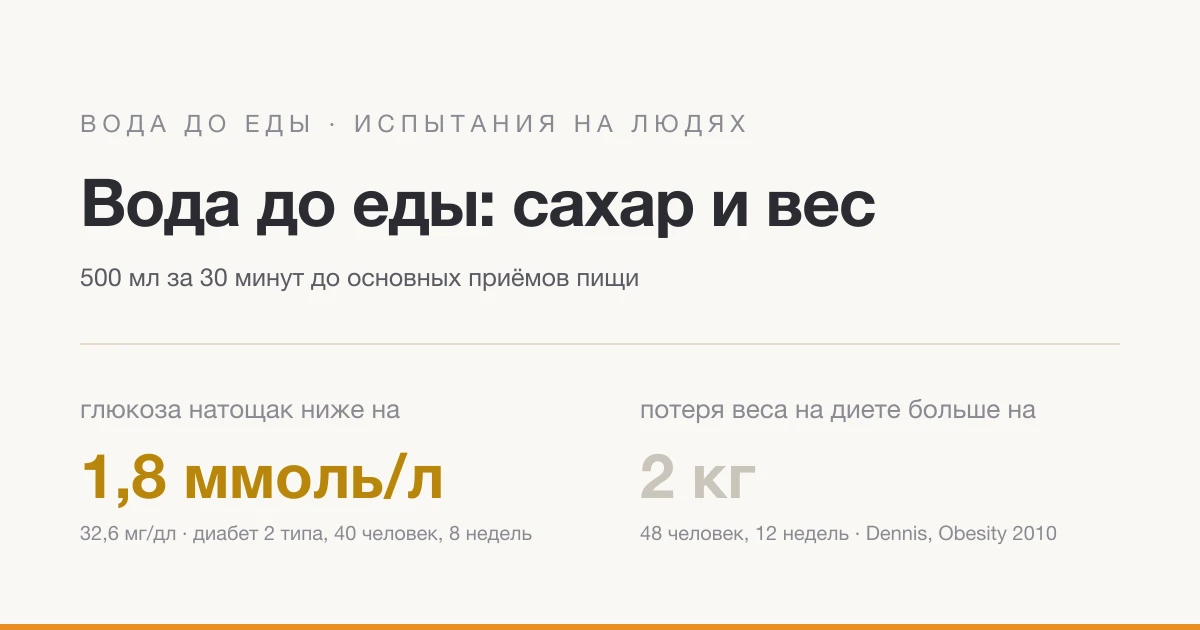
| For weight | 500 mL before each of the three main meals, 12 weeks | Helps lose more weight on a diet | 2 kg more in 48 people aged 55–75 (Dennis EA Obesity 2010. PMID 19661958[3]); 1.3 kg more in 84 adults with obesity (Parretti HM Obesity 2015. PMID 26237305[4]) |
| For blood sugar (one small trial in type 2 diabetes) | 250 mL before breakfast, 500 mL before lunch, 250 mL before dinner, 8 weeks | In one small trial in type 2 diabetes, fasting glucose fell | Fall of 1.8 mmol/L (32.6 mg/dL) on average from baseline, versus a rise of 0.3 mmol/L (5.3 mg/dL) from baseline in controls; 40 adults (Sedaghat G J Diabetes Metab Disord 2021. PMID 34178828[5]) |
| After age 60 | 375 mL for women, 500 mL for men, 30 minutes before lunch | Helps eat less at lunch | In 21 healthy people aged 60–80, 58 kcal less was eaten: 624 versus 682 kcal, mainly in men (Van Walleghen EL Obesity 2007. PMID 17228036[6]) |
| Instead of sweet and diet drinks | Water instead of calorie-containing drinks, 6 months and 24 weeks | Fewer calories from drinks, more weight lost on a diet | In 89 women with overweight on a diet: −8.8 kg with water after lunch versus −7.6 kg with a diet drink, P = 0.015 (Madjd A Am J Clin Nutr 2015. PMID 26537940[7]); when calorie-containing drinks were replaced with water or diet drinks, the odds of losing 5% of weight were about twice as high, odds ratio 2.07 for both replacement groups together; for water alone versus control 1.87, not significant (Tate DF Am J Clin Nutr 2012. PMID 22301929[8]) |
How it works
The exact mechanism is not established; it is suggested that water fills the stomach and slows its emptying, so fullness is felt sooner. In 24 people with overweight and obesity, mean age 61, 500 mL of water 30 minutes before breakfast reduced intake from 574 to 500 kcal — 74 kcal, about 13% (Davy BM J Am Diet Assoc 2008. PMID 18589036[2]). Fullness after water was higher on average across all participants, but food intake fell only in people aged 60–80, mainly in men: by 58 kcal, 624 versus 682 kcal; in people aged 21–35 no significant difference was found (913 versus 892 kcal, P = 0.65) (Van Walleghen EL Obesity 2007. PMID 17228036[6]). In 14 healthy men without obesity, mean age 27, 568 mL of water immediately before breakfast (less than a minute before eating) reduced intake from 610 to 470 kcal — about 140 kcal (P < 0.001); fullness was higher and hunger lower (Corney RA Eur J Nutr 2016. PMID 25893719[9]). This adds to the data above: 30 minutes before a meal no significant difference was found in young men, while immediately before eating a difference was found. Water also slightly raises energy expenditure: after 500 mL in 14 healthy normal-weight people it rose by 30% within the first 10 minutes, peaking at 30–40 minutes, about 100 kJ in total (about 24 kcal) (Boschmann M J Clin Endocrinol Metab 2003. PMID 14671205[10]).
Water and blood sugar
The data on blood sugar come from one small trial in type 2 diabetes. The trial included 40 adults diagnosed less than 5 years earlier. One group drank water before meals for 8 weeks: 250 mL before breakfast, 500 mL before lunch and 250 mL before dinner, 1 liter a day in total. The other group received no advice about water. Fasting glucose in the water group fell by 1.8 mmol/L (32.6 mg/dL) on average from baseline, while in the control group it rose by 0.3 mmol/L (5.3 mg/dL) from baseline. Baseline fasting glucose was high — about 12.5 mmol/L (225 mg/dL). The water group also had lower calorie intake, weight, waist circumference, triglycerides and LDL cholesterol (Sedaghat G J Diabetes Metab Disord 2021. PMID 34178828[5]).
Water and weight
A systematic review of 18 randomized human trials (from 1464 records, lasting from 4 days to 5 years) found that in three trials adults with overweight or obesity drank 1500 mL of water a day before meals for 12 weeks to 12 months. They lost about 100%, 87% and 44% more weight than control groups. The authors note that water is cheap and carries a low risk of side effects (Hakam N JAMA Netw Open 2024. PMID 39585691[11]).
In a 12-week trial, 48 people aged 55–75 with a BMI of 25–40 followed a low-calorie diet: 1200 kcal for women, 1500 kcal for men. The group drinking 500 mL of water before each of the three main meals lost about 2 kg more, and the rate of weight loss was 44% higher. Men lost 7.7 kg with water and 6.7 kg without; women lost 7.0 kg with water and 5.0 kg without (Dennis EA Obesity 2010. PMID 19661958[3]). In 84 adults with obesity, 500 mL of water 30 minutes before main meals produced 1.3 kg more weight loss over 12 weeks than in the comparison group (95% confidence interval 0.1–2.4 kg; P = 0.028) (Parretti HM Obesity 2015. PMID 26237305[4]). In a secondary analysis of a 12-month trial in 173 women aged 25–50 with overweight on a diet, who initially drank less than 1 liter of water a day, increased water intake was associated with significant loss of weight and fat independent of diet and physical activity (Stookey JD Obesity 2008. PMID 18787524[12]).
What the reviews say
A systematic review of 6 randomized trials lasting 12 weeks or longer compared three strategies: more water per day, replacing calorie-containing drinks with water, and water before meals. In all six trials weight fell: from 0.4 to 8.8 kg, on average by 5.15% of body weight. The most effective strategy was replacing calorie-containing drinks with water; the authors rate the quality of evidence as low to moderate, follow-up was short, and data are not yet sufficient for recommendations (Bracamontes-Castelo G Nutr Hosp 2019. PMID 31657610[14]).
Another systematic review (11 studies and 2 reviews included from 4963 records, adults) found that in people on a weight-loss or weight-maintenance program, additional water lowered weight at 3–12 months more than the program alone. This was seen in one randomized, one non-randomized and one observational study (Muckelbauer R Am J Clin Nutr 2013. PMID 23803882[15]).
A meta-analysis of 8 randomized trials in people with overweight and obesity, where the intervention was “more water” or “water instead of other drinks”, gave a pooled weight difference of −0.33 kg (95% CI −1.75 to 1.08), which is not statistically significant. The authors conclude that water may not significantly affect weight in people with overweight and obesity, while replacing sweet drinks with water may give a modest benefit (Chen QY Nutrients 2024. PMID 38612997[1]).
Water instead of sweet drinks
In the CHOICE trial, 318 adults with overweight and obesity replaced calorie-containing drinks (from 200 kcal a day) with water or diet drinks for 6 months; the control group changed their diet as they chose. Weight loss was 2.03% in the water group, 2.5% in the diet-drink group and 1.76% in controls. In the pooled analysis, those who replaced drinks had about twice the odds of losing 5% of weight (odds ratio 2.07; 95% CI 1.02–4.22). This is a pooled analysis of both replacement groups, water and diet drinks; for the water group alone versus control the odds ratio was 1.87 (95% CI 0.84–4.14), not statistically significant. In the water group, fasting glucose at 6 months fell by 0.18 mmol/L (3.2 mg/dL) versus a rise of 0.03 mmol/L (0.6 mg/dL) in controls, P = 0.019 (Tate DF Am J Clin Nutr 2012. PMID 22301929[8]).
In 89 women aged 18–50 with overweight and obesity (BMI 27–40) who usually drank diet drinks, during a 24-week weight-loss program one group drank water after lunch instead of a diet drink while the other kept drinking a diet drink 5 times a week; 62 women completed it. Weight fell by 8.8 kg with water versus 7.6 kg (P = 0.015). Glucose 2 hours after a meal fell by 1.02 mmol/L (18.4 mg/dL) with water versus 0.72 mmol/L (13.0 mg/dL) (P < 0.001). Fasting insulin and the insulin resistance index HOMA-IR fell more in the water group (P < 0.001) (Madjd A Am J Clin Nutr 2015. PMID 26537940[7]).
In three observational cohorts (124,988 people without obesity or chronic disease, assessed every 4 years), each additional cup of water a day was associated with 0.13 kg less weight gain over 4 years (95% CI 0.08–0.17). Replacing one daily serving of a sweet drink with a cup of water was associated with 0.49 kg less gain over 4 years (95% CI 0.32–0.65), and replacing juice with 0.35 kg less (95% CI 0.23–0.46) (Pan A Int J Obes 2013. PMID 23318721[16]).
How to use it
- For weight: 500 mL of water before main meals; in the Parretti trial, 30 minutes before eating.
- In type 2 diabetes: 250 mL before breakfast, 500 mL before lunch and 250 mL before dinner — the trial schedule; agree it with the treating doctor.
- On a menu for steady blood sugar: vegetables, legumes, fish, eggs, cottage cheese, nuts; replace sweet drinks with water.
- Instead of sweet drinks: replace sweet drinks and juices with water.
Who should check with a doctor first
In heart failure, kidney disease, low blood sodium or a prescribed fluid restriction, the doctor sets the drinking amount.
When to see a doctor about glucose readings: if there is no diabetes — repeatedly below 3.0 mmol/L (54 mg/dL) or above 8.9 mmol/L (160 mg/dL). In diabetes, targets are individual per the doctor's plan; below 3.0 mmol/L (54 mg/dL) is always a reason to see a doctor.
Prescribed diabetes treatment is not changed independently: water complements it and does not replace it.
Summary
Water before a meal is a free habit tested in human trials: fullness is felt sooner, weight loss in 12-week trials was 1.3–2 kg greater, and in one small trial in type 2 diabetes fasting glucose over 8 weeks fell by 1.8 mmol/L (32.6 mg/dL) on average from baseline. A pooled analysis of 8 trials in people with overweight found no significant weight difference from adding water (−0.33 kg), so water is a helper to eating habits, not a stand-alone way to lose weight (Chen QY Nutrients 2024. PMID 38612997[1]). A plan can be chosen and test results reviewed at a consultation.
References
- Chen QY Nutrients 2024. PMID 38612997
- Davy BM J Am Diet Assoc 2008. PMID 18589036
- Dennis EA Obesity 2010. PMID 19661958
- Parretti HM Obesity 2015. PMID 26237305
- Sedaghat G J Diabetes Metab Disord 2021. PMID 34178828
- Van Walleghen EL Obesity 2007. PMID 17228036
- Madjd A Am J Clin Nutr 2015. PMID 26537940
- Tate DF Am J Clin Nutr 2012. PMID 22301929
- Corney RA Eur J Nutr 2016. PMID 25893719
- Boschmann M J Clin Endocrinol Metab 2003. PMID 14671205
- Hakam N JAMA Netw Open 2024. PMID 39585691
- Stookey JD Obesity 2008. PMID 18787524
- Akers JD J Acad Nutr Diet 2012. PMID 22709772
- Bracamontes-Castelo G Nutr Hosp 2019. PMID 31657610
- Muckelbauer R Am J Clin Nutr 2013. PMID 23803882
- Pan A Int J Obes 2013. PMID 23318721
Key facts
- Water before meals and weight: a systematic review of 18 randomized human trials — in three of them adults with overweight or obesity drank 1500 mL of water a day before meals for 12 weeks to 12 months and lost about 100%, 87% and 44% more weight than control groups (Hakam N JAMA Netw Open 2024. PMID 39585691).
- Water before meals and blood sugar: one small trial in 40 adults with type 2 diabetes, 8 weeks, 1 liter of water a day before meals — fasting glucose in the water group fell by 1.8 mmol/L (32.6 mg/dL) on average from baseline, while in the control group it rose by 0.3 mmol/L (5.3 mg/dL) from baseline (Sedaghat G J Diabetes Metab Disord 2021. PMID 34178828).
- Water and weight loss on a low-calorie diet: 48 people aged 55–75, 12 weeks, 500 mL of water before each of the three main meals — about 2 kg more weight lost than on the same diet without water (Dennis EA Obesity 2010. PMID 19661958).
- Water and obesity: 84 adults with obesity, 500 mL of water 30 minutes before main meals for 12 weeks — the water group lost 1.3 kg more than the comparison group (Parretti HM Obesity 2015. PMID 26237305).
- Water and fullness in people with overweight and obesity: 24 people, mean age 61, 500 mL of water 30 minutes before breakfast — 500 kcal eaten versus 574 kcal without water, which is 74 kcal (about 13%) less (Davy BM J Am Diet Assoc 2008. PMID 18589036).
- Water and age: in healthy people aged 60–80 without obesity, water 30 minutes before lunch reduced intake by 58 kcal (624 versus 682 kcal), mainly in men; in people aged 21–35 no significant difference was found (913 versus 892 kcal, P = 0.65) (Van Walleghen EL Obesity 2007. PMID 17228036).
- Review of six trials: a systematic review of 6 randomized trials lasting 12 weeks or longer — weight fell in all six, from 0.4 to 8.8 kg, on average by 5.15% of body weight; the most effective strategy was replacing calorie-containing drinks with water; the authors rate the quality of evidence as low to moderate, follow-up was short, and data are not yet sufficient for recommendations (Bracamontes-Castelo G Nutr Hosp 2019. PMID 31657610).
- Water instead of a diet drink: 89 women aged 18–50 with overweight and obesity, 24 weeks of a weight-loss program — in the 62 who completed out of 89 who started, weight fell by 8.8 kg with water after lunch versus 7.6 kg when continuing a diet drink (P = 0.015) (Madjd A Am J Clin Nutr 2015. PMID 26537940).