In Brief
What Breaks in This Disease
The muscle fibre has a shock-absorbing protein: dystrophin. It holds the fibre's membrane intact during contraction. In Duchenne muscular dystrophy the dystrophin gene is damaged and the protein is not made.
The result: every contraction damages the muscle a little. Fibres die and are replaced by fat and connective tissue. First the child loses the ability to run, then to walk; later the respiratory muscles and the heart are affected. Almost only boys are affected.
Why Steroids Cannot Be Avoided
Glucocorticoids do not repair the gene or restore dystrophin. But they damp the inflammation that accompanies fibre breakdown, and thereby slow the destruction. They are proven to extend the ability to walk by years.
So they are not abandoned, though the cost is high — and highest for a growing child:
▸growth delay; ▸fragile bones, vertebral fractures; ▸weight gain; ▸cataract; ▸changes in behaviour and mood; ▸adrenal suppression.
The Idea: Separate What Usually Comes Together
An ordinary glucocorticoid entering the cell binds its receptor — and switches on a whole set of programmes at once. Some damp inflammation, others slow bone growth, others alter metabolism. It all arrives as one package.
Vamorolone binds the same receptor but does not activate the entire set: the anti-inflammatory part is kept, while some of the pathways leading to growth delay and bone loss are engaged less. It additionally blocks the mineralocorticoid receptor, associated with fluid retention.
Hence the name of the class — dissociative steroids: they separate what is inseparable in ordinary hormones.
| Prednisone | Vamorolone | |
|---|---|---|
| Anti-inflammatory action | Yes | Yes |
| Effect on growth | Delays it | Markedly weaker |
| Bone turnover | Suppressed | Not suppressed in the trial |
| Fluid retention | Yes | Attenuated (mineralocorticoid receptor blockade) |
| Adrenal suppression | Yes | *Also yes* |
| Weight gain | Yes | *Also yes* |
What the Trial Showed
▸VISION-DMD (JAMA Neurology, 2022) — 121 boys, mean age 5.4 years, 24 weeks [1].
The primary measure was time-to-stand velocity, an ability that deteriorates earlier than many others in this disease. On 6 mg/kg per day it was 0.05 m/s versus −0.01 m/s on placebo (95% CI 0.02–0.10; p=0.002). The first four secondary endpoints were also met, the six-minute walk test among them.
But the most striking part is the comparison with prednisone:
| Measure | Prednisone | Vamorolone 6 mg/kg |
|---|---|---|
| Change in growth percentile | *−1.88* | *+3.86* (p=0.02) |
| Bone turnover markers | Declined | Did not decline |
The difference is not one of degree but of direction: one group fell further behind their peers, the other did not.
▸48-week extension (Neurology, 2024) — motor improvement was maintained. In children switched from prednisone to vamorolone, growth improved and disturbed bone measures returned toward normal. Body mass index rose over the first 24 weeks and then stabilised [2].
What the Drug Did Not Achieve
Honesty requires stating this too: adrenal suppression developed in all three groups, vamorolone included [3]. It is a class property and it was not circumvented.
The practical consequence is the same as for any steroid: the drug must not be stopped abruptly, and during illness, injury or surgery the dose has to be adjusted. Families are told this before treatment starts, not after the fact.
What Cannot Be Claimed Yet
▸That it is more effective than prednisone for muscle — the trial was designed against placebo, not for superiority over prednisone. ▸That it removes every side effect: adrenal function is suppressed and weight rises. ▸What happens over years — the longest follow-up is 48 weeks, while treatment in this disease is lifelong. ▸That it affects the cardiac course — there is no separate evidence here on Duchenne cardiomyopathy.
Who It Is Not For
▸As an addition to a conventional glucocorticoid: it is a replacement, not an add-on — two steroids are not prescribed together. ▸During active infection and in other situations where any glucocorticoid is contraindicated. ▸As grounds for stopping the previous hormone abruptly: the switch is planned by a physician, accounting for suppressed adrenal function. ▸As a substitute for the rest of care: physiotherapy, cardiac and respiratory monitoring and orthopaedic follow-up all remain.
Bottom Line
▸The same receptor, a different set of programmes: anti-inflammatory action preserved, impact on growth and bone attenuated. ▸The motor effect is proven against placebo: time-to-stand velocity 0.05 versus −0.01 m/s. ▸The key difference from prednisone is the direction of growth change: −1.88 versus +3.86 percentile. ▸Switching from prednisone returned growth and bone measures toward normal. ▸Not a panacea: adrenal function is suppressed, weight rises, and long-term data do not yet exist.
Treatment can be discussed at a consultation; the drug can be ordered here.
References
1. Guglieri M, et al. Efficacy and Safety of Vamorolone vs Placebo and Prednisone Among Boys With Duchenne Muscular Dystrophy: A Randomized Clinical Trial. JAMA Neurol. 2022;79(10):1005–1014. PMID 36036925
2. Dang UJ, et al. Efficacy and Safety of Vamorolone Over 48 Weeks in Boys With Duchenne Muscular Dystrophy: A Randomized Controlled Trial. Neurology. 2024;102(5):e208112. PMID 38335499
3. Ahmet A, et al. Adrenal Suppression From Vamorolone and Prednisone in Duchenne Muscular Dystrophy. J Clin Endocrinol Metab. 2025;110(2):334–344. PMID 39097643
4. AGAMREE (vamorolone) — US Prescribing Information, Catalyst Pharmaceuticals.
Key facts
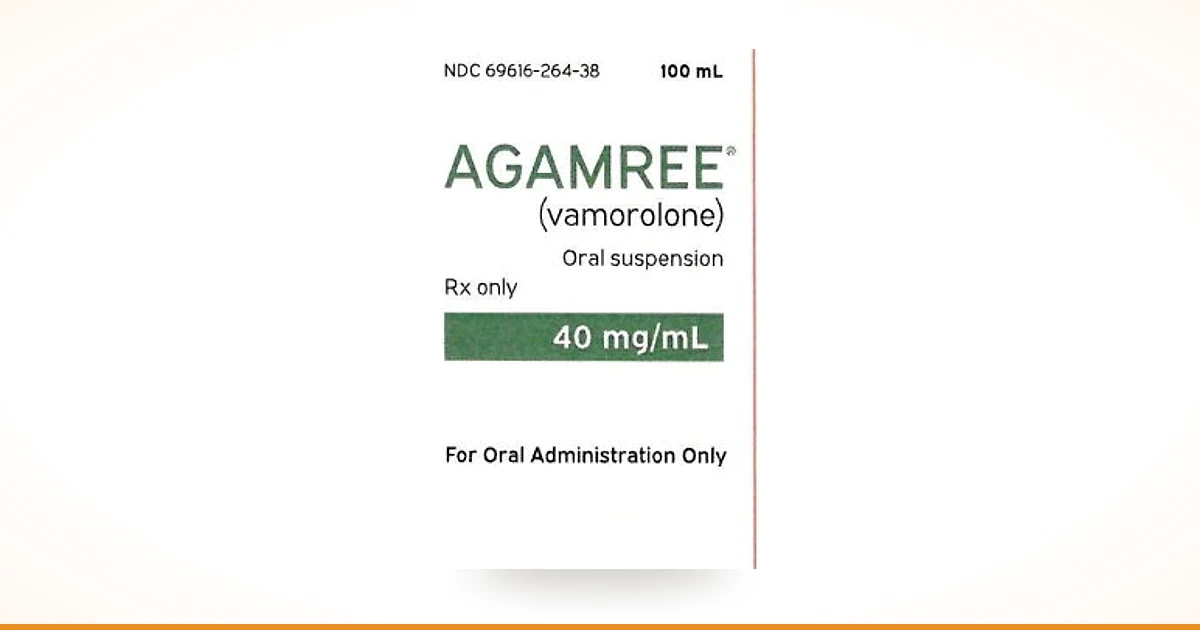
- Vamorolone (brand name Agamree, Catalyst Pharmaceuticals) is a dissociative steroid approved by the FDA in October 2023 for Duchenne muscular dystrophy in patients from 2 years of age.
- Duchenne muscular dystrophy is an inherited disease in which a broken gene leaves the muscle without dystrophin, the shock-absorbing protein of the muscle fibre, so muscles are destroyed by their own contractions.
- Glucocorticoids have been the backbone of treatment for decades: they extend the ability to walk by years, but the price is growth delay, fragile bones, weight gain, cataract and behavioural change.
- Vamorolone binds the same glucocorticoid receptor but does not trigger its full set of programmes — keeping the anti-inflammatory action while touching growth and bone metabolism less.
- VISION-DMD (JAMA Neurology, 2022): 121 boys, mean age 5.4 years; time-to-stand velocity improved on 6 mg/kg/day — 0.05 m/s versus −0.01 m/s on placebo (p=0.002).
- The key comparison: growth percentile fell by 1.88 in children on prednisone and rose by 3.86 on vamorolone (p=0.02) — the direction itself is opposite.
- Bone turnover markers declined on prednisone and did not decline on vamorolone.
- The 48-week extension (Neurology, 2024): motor improvement was maintained, and in children switched from prednisone to vamorolone growth and bone measures recovered.
- An important caveat: adrenal suppression developed in every group, vamorolone included — that class property was not escaped.
- Body mass index also rose on vamorolone during the first 24 weeks, then stabilised.