In brief
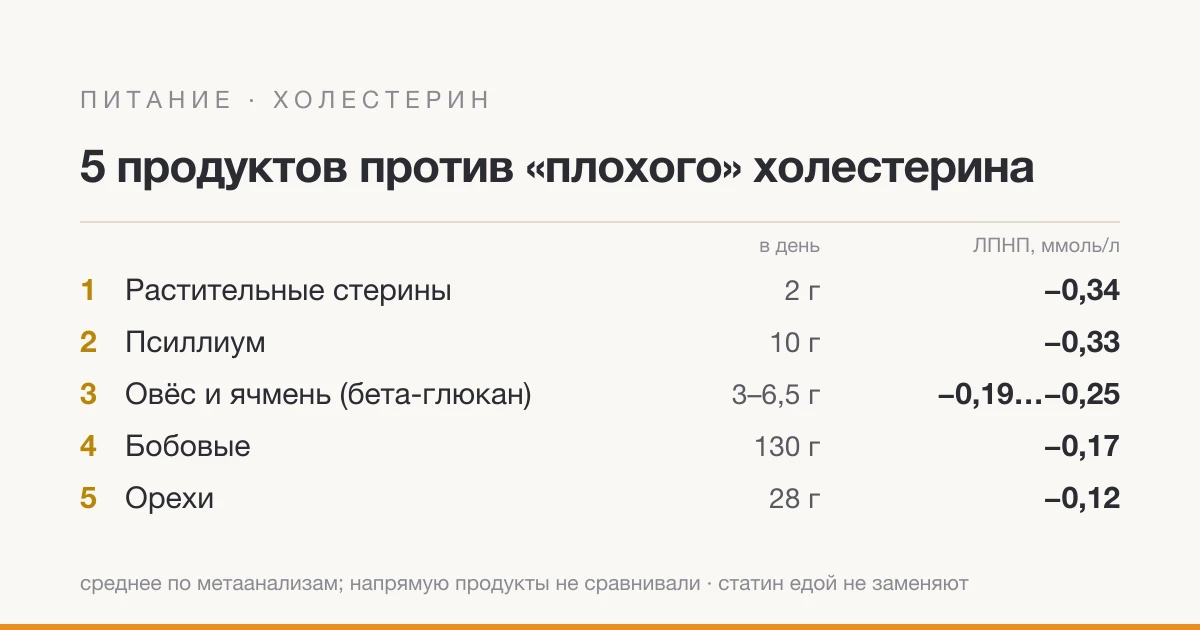
| Rank | What and how much a day | Reduction in "bad" cholesterol — LDL cholesterol (low-density lipoprotein) |
|---|---|---|
| 1 | Plant sterols and stanols in foods with added sterols, about 2 g | −0.34 mmol/L (−13 mg/dL; −8.8%) |
| 2 | Psyllium, about 10 g | −0.33 mmol/L (−13 mg/dL) |
| 3 | Oats or barley: at least 3 g of beta-glucan (about 75–80 g of dry rolled oats, weight before cooking) | oats −0.19 mmol/L (−7 mg/dL; −4.2%) at a median of 3.5 g of beta-glucan; barley −0.25 mmol/L (−10 mg/dL) at a median of 6.5 g — more than double 3 g |
| 4 | Legumes: beans, chickpeas, lentils, peas — about 130 g cooked (roughly 47 g dry), one serving | −0.17 mmol/L (−7 mg/dL; about −5%) |
| 5 | Nuts, about 28 g — a handful | about −0.12 mmol/L (−5 mg/dL; recalculated per serving) |
This is a ranking of five foods by how much, on average, they lower "bad" cholesterol — LDL cholesterol (low-density lipoprotein). The figures come from meta-analyses of controlled trials in adults, many of whom had raised cholesterol. Below: where each figure comes from, who a food does not suit, and why the ranking should not be read as a contest — the foods have not been compared with each other directly.
How to read the figures
The reduction is given in millimoles per litre (mmol/L), with milligrams per decilitre (mg/dL) in brackets. If your lab report gives LDL in mg/dL, 1 mmol/L of LDL is about 38.7 mg/dL. Almost all the figures come from randomised controlled trials (RCTs), in which participants are assigned to groups at random; the exception is nuts: in their meta-analysis, 19 of the 61 trials were non-randomised. Next to a figure is the 95% confidence interval (CI) — the range in which the true average reduction most likely lies.
A fall in LDL is a lab figure, not heart attacks themselves. LDL is a surrogate marker: the food trials measured blood, they did not count heart attacks and strokes. There are no randomised trials that counted heart attacks and strokes for the first four places — that means "not shown", not "does not work". For legumes there are observational data: in people who ate them more often, coronary heart disease was less common, but such data show an association and do not prove a cause (Afshin A, Am J Clin Nutr 2014). Randomised data on events exist only for fifth place, and they concern the whole diet.
1. Plant sterols and stanols: −0.34 mmol/L (−13 mg/dL)
Plant sterols (also called phytosterols) and stanols interfere with the absorption of cholesterol, as the consensus of the European Atherosclerosis Society (EAS) states (Gylling H, Atherosclerosis 2014). They are added to foods; the opinion of the European Food Safety Authority (EFSA) on LDL reduction (more on it below) covers fat spreads, dairy products, mayonnaise and salad dressings. In a meta-analysis of 84 RCTs (141 intervention arms) in adults, an average dose of 2.15 g a day lowered LDL by 0.34 mmol/L (13 mg/dL; 95% CI 0.31–0.36 mmol/L), that is, by 8.8% (Demonty I, J Nutr 2009). The same EAS consensus puts the effect of 2 g a day at 8–10%.
In 2012, EFSA concluded: 3 g a day (2.6–3.4 g) in foods with added sterols lowers LDL by 11.3% (95% CI 10.0–12.5), and the maximum effect is reached within 2–3 weeks (EFSA, EFSA Journal 2012). Sterols and stanols at 1.5–3 g a day act similarly. Two caveats. The 11.3% figure comes from an unpublished meta-analysis by the applicant company — a manufacturer of such products; the first author of the meta-analysis, Demonty, also worked in the manufacturer's research division. And the figure applies to foods with added sterols, not to tablets and not to ordinary food.
What else the Demonty meta-analysis shows. The higher the baseline LDL, the larger the reduction in mmol/L. No significant difference was found between sterols and stanols, fat-based and non-fat-based foods, or dairy and non-dairy products. Solid foods worked better than liquid ones, but only at doses above 2 g a day. Taking the whole day's amount at once may be slightly less effective than taking it several times a day, but this difference is borderline (P = 0.054), not proven.
According to the EAS, at 2 g a day the effect of sterols adds to that of statins in people with lipid disorders and equals doubling the statin dose. Higher blood levels of plant sterols at this dose have not been linked to harm to health in long-term human studies — that is, no harm has been found, which is not the same as proof that there is none. But, as the same consensus states, there are no data from randomised controlled trials with "hard" endpoints that would confirm a clinical benefit of sterols and stanols (Gylling H, Atherosclerosis 2014). A benefit for the heart has not been shown — that is not the same as "sterols do not work".
Foods with added sterols are not used in sitosterolaemia. This is a rare inherited disease: because of variants in the ABCG5 or ABCG8 genes, plant sterols are absorbed more and excreted less, their blood levels are high and atherosclerosis develops early; it is treated with a diet that restricts plant sterols and with ezetimibe (Rocha VZ, Curr Atheroscler Rep 2023). It often goes unrecognised: it can look like familial hypercholesterolaemia. If your cholesterol is very high, as in familial hypercholesterolaemia, or you have xanthomas — yellow deposits on the skin and tendons — then before using foods with added sterols, discuss with your doctor whether sitosterolaemia needs to be ruled out. Children are given foods with added sterols only when a doctor prescribes them: the EAS allows them in children over 6 with familial hypercholesterolaemia, inherited high cholesterol (Gylling H, Atherosclerosis 2014).
2. Psyllium: −0.33 mmol/L (−13 mg/dL)
Psyllium is the husk of the seeds of a plantain plant (Plantago, a weed-like herb, not the banana-like fruit), a soluble fibre. In a meta-analysis of 28 RCTs (1,924 participants with and without raised cholesterol, each trial lasting at least 3 weeks), psyllium at a median dose of about 10.2 g a day lowered LDL by 0.33 mmol/L (13 mg/dL; 95% CI 0.27–0.38 mmol/L). Non-HDL cholesterol — all cholesterol except HDL (high-density lipoprotein) cholesterol — also fell, by 0.39 mmol/L (15 mg/dL), and so did ApoB (apolipoprotein B), by 0.05 g/L (Jovanovski E, Am J Clin Nutr 2018). The authors rated the quality of the evidence as moderate for LDL and high for ApoB.
In an earlier meta-analysis of 8 trials in people with mildly to moderately raised cholesterol who were already following a low-fat diet, 10.2 g of psyllium a day for at least 8 weeks lowered LDL by a further 7% compared with placebo (Anderson JW, Am J Clin Nutr 2000). So the 7% is an extra on top of the diet.
3. Oats and barley: −0.19 and −0.25 mmol/L (−7 and −10 mg/dL)
What works is beta-glucan — the soluble fibre of oats and barley. In a meta-analysis of 58 RCTs (3,974 participants; in two thirds of the trials cholesterol was raised), oat beta-glucan at a median dose of 3.5 g a day over a median of 6 weeks lowered LDL by 0.19 mmol/L (7 mg/dL; 95% CI 0.14–0.23 mmol/L) — about 4.2%; non-HDL cholesterol fell by 4.8% and ApoB by 2.3% (Ho HV, Br J Nutr 2016). The variation between trials is large and unexplained, and the authors urge caution.
In trials with at least 3 g of beta-glucan a day, the LDL reduction was almost twice as large as at a lower dose — but this is a trend (P = 0.051), not a proven difference; and the higher the baseline LDL, the more it fell (Ho HV, Br J Nutr 2016). The 3 g a day threshold is recognised by regulators: EFSA for oats (EFSA, EFSA Journal 2010) and for barley (EFSA, EFSA Journal 2011) in adults who want to lower their cholesterol; the FDA for beta-glucan from whole oats or barley (21 CFR 101.81). 3 g of beta-glucan is about 75–80 g of dry rolled oats (weight before cooking): by the FDA definition, rolled oats contain at least 4% beta-glucan on a dry-weight basis, and 3 g ÷ 4% = 75 g of dry matter (21 CFR 101.81). Allowing for the moisture in the oats, that is slightly more than 75 g, and if they contain more beta-glucan than the minimum, less.
Barley. In a meta-analysis of 14 RCTs (615 participants), barley beta-glucan at a median dose of 6.5 g a day over a median of 4 weeks lowered LDL by 0.25 mmol/L (10 mg/dL; 95% CI 0.20–0.30 mmol/L) and non-HDL cholesterol by 0.31 mmol/L (12 mg/dL) (in this analysis the median dose was 6.9 g); no significant change in ApoB was shown (Ho HV, Eur J Clin Nutr 2016). It cannot be said that "barley is stronger than oats": the dose in the barley trials was almost twice as high (6.5 versus 3.5 g), and the duration shorter (4 weeks versus 6).
4. Legumes: −0.17 mmol/L (−7 mg/dL)
Beans, chickpeas, lentils, peas. In a meta-analysis of 26 RCTs (1,037 participants, trials lasting at least 3 weeks), a diet with legumes at a median dose of 130 g a day cooked — about one serving (the authors converted dry weight to cooked weight by multiplying by 2.75, so this is roughly 47 g dry) — lowered LDL by 0.17 mmol/L (7 mg/dL; 95% CI 0.09–0.25 mmol/L), about 5% of baseline, compared with a diet of the same calorie content without legumes (Ha V, CMAJ 2014). No effect on ApoB or non-HDL cholesterol was found in this meta-analysis — that means "not shown", not "no effect". The authors themselves write that longer, higher-quality trials are needed to confirm the results.
5. Nuts: −0.12 mmol/L (−5 mg/dL) — and data on heart attacks
In a meta-analysis of 61 controlled trials (42 randomised and 19 non-randomised; 2,582 adults without cardiovascular disease, from 3 to 26 weeks), nuts were given at a median dose of 56 g a day. The authors recalculated the result per serving of 28.4 g a day — roughly a handful: on this basis LDL fell by 4.8 mg/dL, which is about 0.12 mmol/L (in the randomised trials alone, by 4.2 mg/dL, about 0.11 mmol/L); ApoB also fell (Del Gobbo LC, Am J Clin Nutr 2015). This is a calculated figure: the dose–response relationship is non-linear, and at 60 g a day or more the effect was noticeably stronger; no difference between types of nuts was found. This is about tree nuts — walnuts, almonds, hazelnuts, cashews, pecans, pistachios, macadamias and Brazil nuts; peanuts were not included in this meta-analysis. In a pooled analysis of 25 trials (583 people with normal or raised cholesterol, not taking cholesterol-lowering medication), 67 g of nuts a day lowered LDL by 7.4% — about 0.26 mmol/L (10 mg/dL); the effect depended on the dose and was stronger at high baseline LDL (Sabaté J, Arch Intern Med 2010). Fifth place is the figure for one serving, not the limit. If you are allergic to nuts or peanuts, this item is excluded: both nuts and peanuts are on the mandatory list of allergens on food labels in the EU (EU Regulation 1169/2011, Annex II).
Yet of these five, only nuts have a randomised trial that counted heart attacks and strokes — and even then as part of a diet. In the Spanish PREDIMED trial, 7,447 people aged 55–80 at high cardiovascular risk but without cardiovascular disease were divided into three groups: a Mediterranean diet with nuts, a Mediterranean diet with extra virgin olive oil, and a control group — advice to reduce fat in the diet. The combined outcome — heart attack, stroke or death from cardiovascular causes — occurred over a median of 4.8 years in 3.4% of the nut group and in 4.4% of the control group. Hazard ratio (HR) 0.72 (95% CI 0.54–0.95), that is, a 28% lower risk. In absolute terms, that is about 1 fewer case for every 100 people over 4.8 years (4.4% versus 3.4%) (Estruch R, N Engl J Med 2018). In the olive oil group, the figure was 3.8% (HR 0.69). The trial was stopped early on the basis of a pre-planned interim analysis. RCTs stopped early for benefit show, on average, a larger effect than those run to completion, and the difference is greatest when there are fewer than 500 events (Bassler D, JAMA 2010); PREDIMED had 288.
This is the effect of the whole diet, not of nuts alone: the nuts came together with a Mediterranean diet. And about the trial itself: the first publication, from 2013, was retracted. Randomisation problems were found: family members of participants were enrolled without random assignment, at one of the 11 centres some participants were assigned non-randomly, and at another the randomisation tables were apparently used inconsistently. The data were re-analysed with adjustment and republished in 2018 (retraction notice, N Engl J Med 2018); after excluding 1,588 participants with protocol deviations, the results were similar. The figures above are from the republished version.
The ranking, honestly
The places are ranked by average LDL reduction, but this is not a contest in the same people. The figures come from different meta-analyses with different control groups: for legumes — a diet of the same calorie content without legumes, for the portfolio diet (more on it below) — the NCEP Step II diet (from the US National Cholesterol Education Program), and for nuts in most trials — the same diet without nuts: they were added on top. Participants' baseline LDL also differed, and the higher it is, the larger the reduction in mmol/L: this is seen with both sterols and oats. The foods have not been compared with each other directly. Where the duration is stated, the trials lasted from 3 weeks to a year (for legumes — from 3 to 52 weeks, median 6). There is also the question of interests. The first author of the meta-analysis on sterols worked for a manufacturer of fortified spreads, and the EFSA figure of 11.3% is based on an unpublished meta-analysis by the same applicant. In the meta-analysis on soy protein (more on it below), one of the authors is linked to a soy industry institute. This does not make the figures wrong, but they are worth reading with this in mind. The confidence intervals of neighbouring places overlap:
| Rank | LDL reduction, mmol/L (95% CI); mg/dL | Trials | Duration |
|---|---|---|---|
| 1. Sterols and stanols | 0.34 (0.31–0.36); 13 mg/dL | 84 RCTs | — |
| 2. Psyllium | 0.33 (0.27–0.38); 13 mg/dL | 28 RCTs | at least 3 weeks |
| 3. Oats | 0.19 (0.14–0.23); 7 mg/dL | 58 RCTs | 3–12 weeks, median 6 |
| 3. Barley | 0.25 (0.20–0.30); 10 mg/dL | 14 RCTs | at least 3 weeks, median 4 |
| 4. Legumes | 0.17 (0.09–0.25); 7 mg/dL | 26 RCTs | 3–52 weeks, median 6 |
| 5. Nuts | about 0.12 (0.11–0.14), recalculated per serving; about 5 mg/dL | 61 trials, 42 of them RCTs | 3–26 weeks, median 4 |
And about heart attacks. For sterols, psyllium, oats and barley, and legumes, the outcomes in these meta-analyses are blood tests, not heart attacks and strokes. An effect on heart attacks has not been shown for them — that does not mean they do not work. EFSA accepted a link between oats and LDL reduction and proposed cautious wording about risk: "blood cholesterol lowering may reduce the risk of (coronary) heart disease" (EFSA, EFSA Journal 2010). The wording permitted in the EU is even more cautious — it does not directly mention a reduction in risk: "oat beta-glucan has been shown to lower/reduce blood cholesterol. High cholesterol is a risk factor in the development of coronary heart disease" (EU Regulation 1160/2011, Annex I).
All together: the portfolio diet
The combination was tested separately. The "portfolio" diet combines nuts, plant protein, viscous fibre and plant sterols. In a meta-analysis of 7 comparisons (439 people with raised blood lipids), it lowered LDL by about 17% — by 0.73 mmol/L (28 mg/dL; 95% CI 0.56–0.89 mmol/L) — more than the NCEP Step II diet alone, a cholesterol-lowering diet from the US National Cholesterol Education Program (Chiavaroli L, Prog Cardiovasc Dis 2018). The comparison was not with ordinary eating but with a diet that already lowers cholesterol — so the 17% is an extra on top of it. The authors rated their certainty in the LDL result as high.
Non-HDL cholesterol, ApoB, total cholesterol, triglycerides, blood pressure, C-reactive protein and the estimated 10-year risk of coronary heart disease also fell; HDL cholesterol and body weight did not change significantly. The estimated risk is calculated with a formula; it is not a count of heart attacks: there are no event data for the portfolio diet in the meta-analysis. One more thing: the figures for the five places cannot simply be added up — they were obtained in different studies; the tested estimate for the combination is exactly this 17%.
Why soy is not in the top five
For LDL, soy protein is on a par with nuts. Of the 46 trials selected by the FDA, 41 provided data on LDL: in adults with a baseline LDL of 110–201 mg/dL, a median dose of 25 g of soy protein a day over a median of 6 weeks lowered LDL by 4.76 mg/dL — about 0.12 mmol/L, or 3–4% — compared with non-soy protein; no dose–response relationship was found (Blanco Mejia S, J Nutr 2019). But EFSA did not accept a cause-and-effect relationship between soy protein and LDL reduction (EFSA, EFSA Journal 2010), and in 2017 the FDA proposed revoking the claim about the benefit of soy protein for the heart (Federal Register, 31 Oct 2017). There is no final decision: in 2024 the FDA confirmed that the rule is still in effect for now (Federal Register, 6 Jun 2024). With the same figure as nuts, the regulators disagree in their assessment of soy, which is why it did not make the top five.
How to fit it into a day
An example day for an adult with raised cholesterol whose doctor has not advised against these foods. The amounts come from the studies above. Legumes are better eaten instead of part of your usual food rather than added on top: in most legume trials (20 of 26) they replaced bread and other carbohydrates or animal protein while the calorie content of the diet stayed the same. Nuts, by contrast, were added to the usual diet in most trials (47 of 61), and psyllium was given as a supplement. All five foods at once on top of a usual menu have not been tested, and the diet will become higher in calories. You do not have to take everything at once: the combination as a whole has only been tested as the portfolio diet. If you take thyroid medication (levothyroxine), tell your doctor that you are changing your diet: according to the prescribing information, fibre, walnuts and soybean flour can reduce its absorption, and the dose sometimes has to be reviewed (levothyroxine prescribing information, DailyMed).
| When | What | How much |
|---|---|---|
| Breakfast | Rolled oats or whole-grain barley | 75–80 g of dry flakes (before cooking) — about 3 g of beta-glucan |
| Breakfast or snack | Yoghurt or spread with added sterols | As on the label: about 2 g of sterols a day, no more than 3 g; pregnant and breastfeeding women — only after talking to a doctor; on cholesterol-lowering medication — only under medical supervision |
| Lunch or dinner | Beans, chickpeas, lentils or peas | About 130 g cooked (roughly 47 g dry) — one serving |
| Snack | Nuts, if you have no allergy | About 28 g — a handful |
| Between doses of medicines, if you chose psyllium | Psyllium | About 10 g a day — three servings of about 3.4 g, each with a full glass of water (at least 240 mL); tablets — no closer than 2 hours before or 2 hours after |
If your doctor has prescribed a statin
The bottom line
Five foods really do lower "bad" cholesterol — LDL: sterols and stanols in foods with added sterols, psyllium, oats and barley, legumes and nuts. The figures are modest — from 0.12 to 0.34 mmol/L (5 to 13 mg/dL) on average, and together, in the portfolio diet, about 17% on top of a cholesterol-lowering diet. The places are provisional: the foods were not compared directly, and the intervals overlap. Of the five, only nuts have randomised data on heart attacks and strokes — and even then for a Mediterranean diet with nuts as a whole. The steps to take away: choose what you will eat every day → follow the safety rules (sterols no more than 3 g and with your doctor's knowledge, psyllium with a glass of water and no closer than 2 hours to tablets, nuts only if you have no allergy) → do not stop a prescribed statin.
This material is for information only. Foods do not replace a prescribed statin; foods with added sterols during pregnancy or breastfeeding, for children and for people on cholesterol-lowering medication — only after talking to a doctor.
References
- Afshin A, Am J Clin Nutr 2014. PMID 24898241
- Gylling H, Atherosclerosis 2014. PMID 24468148
- Demonty I, J Nutr 2009. PMID 19091798
- EFSA, EFSA Journal 2012. PMID 42112199
- Rocha VZ, Curr Atheroscler Rep 2023. PMID 36897412
- Jovanovski E, Am J Clin Nutr 2018. PMID 30239559
- Anderson JW, Am J Clin Nutr 2000. PMID 10648260
- Ho HV, Br J Nutr 2016. PMID 27724985
- Ho HV, Eur J Clin Nutr 2016. PMID 27273067
- Ha V, CMAJ 2014. PMID 24710915
- Del Gobbo LC, Am J Clin Nutr 2015. PMID 26561616
- Sabaté J, Arch Intern Med 2010. PMID 20458092
- Estruch R, N Engl J Med 2018. PMID 29897866
- Bassler D, JAMA 2010. PMID 20332404
- retraction notice, N Engl J Med 2018. PMID 29897867
- Chiavaroli L, Prog Cardiovasc Dis 2018. PMID 29807048
- Blanco Mejia S, J Nutr 2019. PMID 31006811
Key facts
- "Bad" cholesterol is LDL cholesterol (low-density lipoprotein). The five foods are ranked by the average reduction in LDL in meta-analyses of controlled trials in adults; they have not been compared with each other directly.
- Plant sterols and stanols in foods with added sterols: on average 2.15 g a day lowered LDL in adults by 0.34 mmol/L (13 mg/dL), or 8.8%, across 84 randomised trials. EU labelling says no more than 3 g a day; for pregnant and breastfeeding women and children under 5 such foods may not be nutritionally appropriate, so they are not used without a doctor; people on cholesterol-lowering medication should use them only under medical supervision.
- Psyllium at about 10 g a day lowered LDL by 0.33 mmol/L (13 mg/dL) across 28 randomised trials in people with and without raised cholesterol. Dry psyllium is taken with a full glass of liquid, at least 240 mL: without water it can cause choking. People who have difficulty swallowing do not take it; medicines are taken no closer than 2 hours before or 2 hours after it.
- Oats and barley work through beta-glucan. The threshold of the European Food Safety Authority (EFSA, for adults) and the US Food and Drug Administration (FDA) is at least 3 g of beta-glucan a day, which is about 75–80 g of dry rolled oats (weight before cooking). Oats lowered LDL by 0.19 mmol/L (7 mg/dL) at a median dose of 3.5 g of beta-glucan, barley by 0.25 mmol/L (10 mg/dL) at 6.5 g.
- Legumes at about 130 g a day cooked (one serving) lowered LDL by 0.17 mmol/L (7 mg/dL), about 5%; nuts, recalculated to a 28 g serving a day (if you have no nut allergy), lowered it by about 0.12 mmol/L (5 mg/dL) in adults without cardiovascular disease. For legumes an effect on ApoB (apolipoprotein B) was not shown; with nuts ApoB fell.
- Of the five foods, only nuts have randomised data on heart attacks and strokes — as part of a Mediterranean diet (PREDIMED, 7,447 people aged 55–80 at high risk): the combined outcome occurred in 3.4% versus 4.4% in the control group over 4.8 years, a 28% lower risk — about 1 fewer case per 100 people over 4.8 years. This is the effect of the whole diet. For sterols, psyllium, oats and legumes there are no such trials — that means "not shown", not "they do not work".
- Foods do not replace a prescribed statin. In sitosterolaemia — a rare inherited build-up of plant sterols — foods with added sterols are not used.