hair loss spray in pictures and a few words
What it is and why
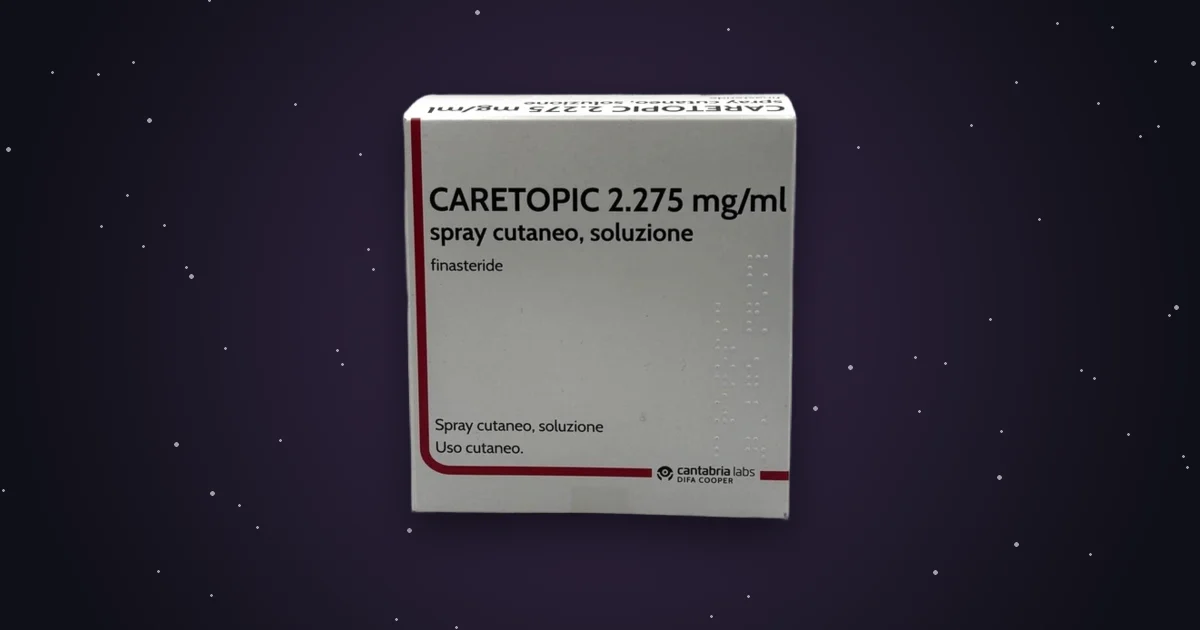
A finasteride scalp spray against male pattern hair loss. It is applied straight onto the thinning areas once a day.
- For men aged 18–41
- For mild to moderate hair loss
- Dispensed on a doctor's prescription
Why hair falls out
Every hair has a "bulb" at its root. In male pattern hair loss, one of the male hormones gradually shrinks it, and the hair becomes thinner and shorter.
- The hormone weakens the root
- Hair gets thinner and shorter
- The areas thin out
How it works
Finasteride blocks the enzyme that makes this hormone. The spray acts right on the scalp, at the roots.
- Less hormone at the root
- The root shrinks more slowly
- Hair loss may slow down
How to apply
Once a day on the balding areas. Do not rub it in with fingers: the spray goes on through a cone pressed against the scalp.
- 1–4 sprays on separate spots
- Hair and scalp dry
- Leave it on the scalp for at least 6 hours
How long to wait
Hair grows slowly. Usually 3 to 6 months of daily use are needed before a result appears.
- Use it every day
- After opening the bottle — no longer than 6 months
- The doctor assesses the result
How it differs from the tablet
The tablet is swallowed and acts on the whole body. The spray goes on the scalp — much less of the drug reaches the blood.
- The effect on hair was similar to the tablet
- Much less drug in the blood
- Side effects were no more frequent than with a dummy
Who must not use it
Women and children. Pregnant women and those who may become pregnant must not touch the product or the treated scalp: it is dangerous for a male fetus.
- Not intended for women
- No contact for pregnant women
- Not used in children and adolescents under 18
Important. If the product gets on the skin by accident, wash the area thoroughly.
Who should see a doctor first
When in doubt, see a doctor first — they will help find the cause of the hair loss and choose treatment.
- Wounds or irritation on the scalp: the alcohol may burn
- The hair loss does not look like male pattern baldness
- Anxiety, low mood or breast changes — tell your doctor
Important. The decision to use it, the dose and monitoring are made by a doctor.
In one sentence
A finasteride spray is a way to act on hair loss right on the scalp: once a day, patiently, on a doctor's prescription.
Key points
CARETOPIC is a finasteride scalp spray: it acts on follicles locally, and noticeably less of the drug enters the body than with the tablet.
| Substance | How much | What it helps with | What studies showed |
|---|---|---|---|
| Finasteride (CARETOPIC) | 114 µg (micrograms) per spray; 1–4 sprays a day | Blocks the enzyme that weakens hair roots | 458 men, 24 weeks: on average +20.2 hairs vs +6.7 with placebo per cm², baseline ≈ 200 (Piraccini 2022) |
| Same: in the body | Same | Less drug in the blood | Peak plasma level more than 100 times lower; serum dihydrotestosterone (DHT) −34.5% vs −55.6% with the tablet (Piraccini 2022) |
| 0.25% solution (as in CARETOPIC) | 100–200 µL (microlitres), 1 week | Lowers DHT at the roots | Scalp DHT −47% and −52%, serum −24% and −26% (Caserini 2016) |
| Topical finasteride in general | — | Less hair loss (preliminary) | 7 studies: hair loss decreased and hair counts rose (Lee 2018) |
What it is and how it works
Male pattern hair loss (androgenetic alopecia) is linked to dihydrotestosterone (DHT), which the enzyme 5-alpha-reductase type 2 makes from testosterone. Balding areas contain more DHT, and the hair follicles shrink: the hair grows thinner and shorter. Finasteride blocks this enzyme and inhibits the shrinking of follicles, which may reverse the hair loss (CARETOPIC leaflet, Italian regulator AIFA).
Each mL of solution contains 2.275 mg of finasteride; one spray delivers 50 µL, that is 114 µg; the 18 mL bottle holds 180 sprays. Vehicle: ethanol 96%, propylene glycol, hydroxypropyl chitosan, water. Dispensed on prescription.
What the studies showed
A randomised phase 3 trial: 458 men, 45 sites in Europe, 24 weeks, spray vs placebo; the 1 mg tablet was included for comparison. Hair count in the 1 cm² target area rose by an average of 20.2 with the spray and 6.7 with placebo (baseline about 200 in the spray group). The advantage was significant as early as week 12. Adverse events did not differ meaningfully between spray and placebo, and no serious treatment-related events occurred (Piraccini BM, J Eur Acad Dermatol Venereol 2022. PMID 34634163[1]).
In an early study, 32 men were split into five groups (about 6 each): 100, 200, 300 or 400 µL of a 0.25% solution (the same as in CARETOPIC: 2.275 mg per mL) or a vehicle without the drug, once daily for 1 week. At 100 and 200 µL, scalp DHT fell on average by 47% and 52%, serum DHT by 24% and 26%; with the vehicle by 5.6%. Blood testosterone did not change notably (Caserini M, Int J Clin Pharmacol Ther 2016. PMID 26636418[2]). A review of 7 studies of various forms of topical finasteride (CARETOPIC is not singled out): hair loss decreased and hair counts rose; the data are preliminary and limited (Lee SW, J Drugs Dermatol 2018. PMID 29601622[3]).
How to use it
- Preparation. Assemble the pump spray and cone. Before first use, press 4 sprays into the sink (then rinse the sink).
- Application. Once a day to the balding areas — 1–4 sprays (50–200 µL) on separate, non-overlapping spots, no more than 4; hair and scalp dry. Press the cone firmly against the scalp; for 2–4 sprays, move it to a neighbouring spot. Do not spray towards the face and do not apply with fingers; if it gets on other body parts, wash it off. Until the solution dries, avoid contact with pillows and hats; it should stay on the scalp for at least 6 hours.
- How long to wait. Usually 3–6 months of daily use before hair growth appears; continuous use is recommended. There is no clinical experience beyond 6 months.
- The bottle. 180 sprays; after opening, use for no longer than 6 months and no more than 180 sprays, otherwise the dose may be insufficient.
Who it suits
Men aged 18–41 with mild to moderate androgenetic alopecia; the product is indicated only for it (CARETOPIC leaflet). Long-term tablet therapy does not suit everyone; the spray was created so that less of the drug reaches the body (Piraccini BM, J Eur Acad Dermatol Venereol 2022. PMID 34634163[1]). If the cause is unclear, first rule out iron deficiency and thyroid problems: “Hair falling out and nails breaking: which tests to get”. CARETOPIC is available in our shop; the prescription and regimen are agreed at a consultation.
How it differs from the tablet
The 1 mg tablet acts through the blood on the whole body, the spray on the scalp. Peak plasma finasteride with the spray was more than 100 times lower, and serum DHT fell by 34.5% vs 55.6% (Piraccini BM, J Eur Acad Dermatol Venereol 2022. PMID 34634163[1]). DHT dropped below normal by week 24 in 15.3% on the spray and 55.2% on the tablet (CARETOPIC leaflet). In effect on hair the spray is numerically similar to the tablet, but the tablet was compared only descriptively, without statistical testing. The leaflet calls the fall in blood DHT clinically significant with the spray too: systemic adverse effects are possible, though less likely. Sexual adverse events occurred in 2.8% on the spray, 3.3% on placebo (at placebo level) and 4.8% on the tablet (leaflet); a 2026 systematic review gives the same figures from the phase 3 trial (Złotowska A, Front Med (Lausanne) 2026. PMID 42396141[4]). Other options tested in people are in the article “Eastern Remedies for Hair Loss”.
Who must not use it and who should see a doctor first
- Who must not use it. The product is not intended for women; it is contraindicated in pregnant women, those who may become pregnant, and anyone allergic to the ingredients. Pregnant women, those who may become pregnant and children under 18 must not touch the product or the treated scalp (risk to a male fetus); after accidental contact the area is washed. Safety and efficacy in children have not been established (CARETOPIC leaflet).
- See a doctor first. If the scalp is damaged: the alcohol may cause burning, and the low absorption was shown for intact skin (CARETOPIC leaflet); if the hair loss does not look androgenetic; if other scalp products are needed — their combined use has not been studied, and the leaflet advises not to apply them to the treated areas; the result is best assessed with a doctor after 3–6 months.
- PSA test. There are no data on the effect of the spray on PSA (prostate-specific antigen); this is taken into account when interpreting the test. Any breast changes — lumps, pain, nipple discharge — should be reported to a doctor at once (CARETOPIC leaflet).
References
- J Eur Acad Dermatol Venereol 2022. PMID 34634163
- Int J Clin Pharmacol Ther 2016. PMID 26636418
- J Drugs Dermatol 2018. PMID 29601622
- Lausanne) 2026. PMID 42396141
Key facts
- In the phase 3 trial of finasteride spray (458 men, 24 weeks), hair count in the 1 cm² target area rose on average by 20.2 vs 6.7 with placebo (baseline about 200); the 1 mg tablet was compared only descriptively, with a numerically similar result (Piraccini BM, J Eur Acad Dermatol Venereol 2022).
- Peak plasma finasteride concentration with the spray was more than 100 times lower than with the tablet; serum dihydrotestosterone (DHT) fell by 34.5% vs 55.6% with the tablet (Piraccini BM, J Eur Acad Dermatol Venereol 2022).
- In an early study (32 men, 5 groups, 1 week), a 0.25% solution, the same as in CARETOPIC, at 100 and 200 µL once a day lowered scalp DHT by 47% and 52%, and serum DHT by 24% and 26% (Caserini M, Int J Clin Pharmacol Ther 2016).
- A systematic review of 7 studies of various topical finasteride forms (CARETOPIC is not singled out in it): hair loss decreased and hair counts rose in all of them; the authors call the results preliminary (Lee SW, J Drugs Dermatol 2018).
- Indicated for men aged 18–41 with mild to moderate androgenetic alopecia. Not intended for women and contraindicated in pregnant women and those who may become pregnant; they and children under 18 must not touch the product or the treated scalp (CARETOPIC leaflet, Italian regulator AIFA).