Key points
What alpha-lipoic acid is
Alpha-lipoic (thioctic) acid works in mitochondria, the cell’s “power stations”: it is needed by the enzymes pyruvate dehydrogenase and alpha-ketoglutarate dehydrogenase, which take part in getting energy from food. It is also an antioxidant that acts both in membranes and in the fluids of the cell and serves as a “go-between” for vitamins E and C (Burgerstein, Handbuch Nährstoffe 2015, p. 170–171). Nerve damage in diabetes is linked, among other things, to oxidative stress — hence the idea of using an antioxidant for neuropathy.
Drips: 600 mg for 3 weeks
Tablets: 600 mg a day
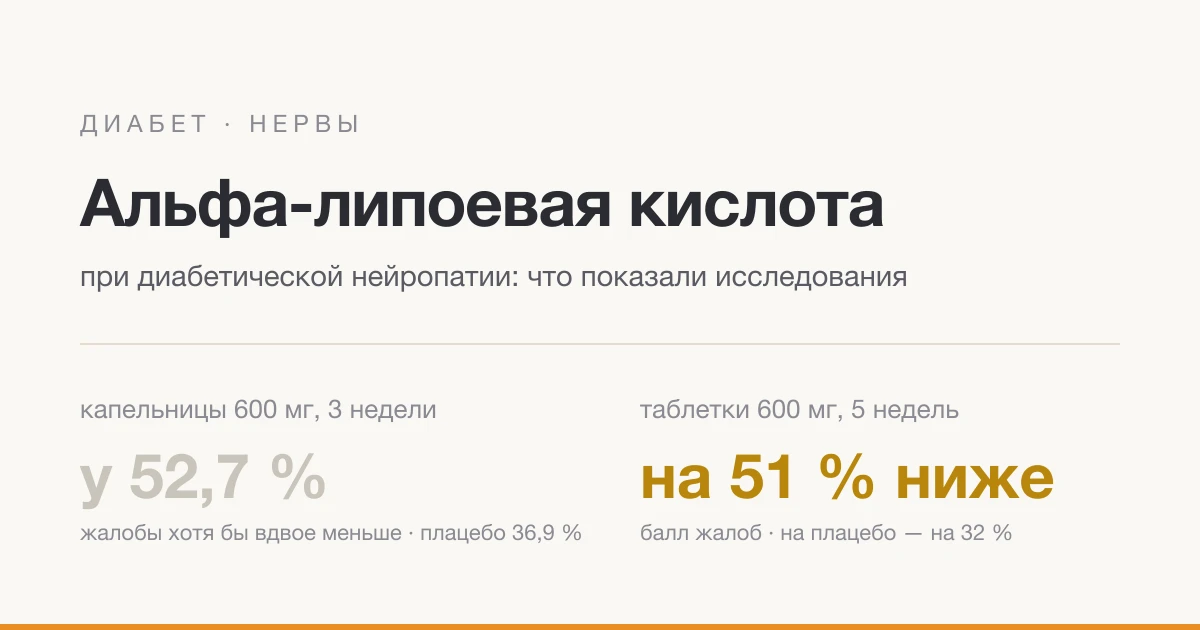
In the SYDNEY 2 study, 181 people took 600, 1200 or 1800 mg of ALA once a day or placebo for 5 weeks. The symptom score fell by 51, 48 and 52% versus 32% on placebo. Nausea, vomiting and dizziness became more frequent with dose, so the authors consider 600 mg the optimal dose (Ziegler D Diabetes Care 2006. PMID 17065669[2]). The authors of a meta-analysis by another group considered it unclear whether improvements after 3–5 weeks of oral intake at doses above 600 mg a day are clinically significant (Mijnhout GS Int J Endocrinol 2012. PMID 22331979[6]).
Long-term use: what is not yet proven
Burgerstein’s handbook gives the usual dose of 0.2–1.0 g a day, and for neuropathy a course of at least 4 months (Burgerstein, Handbuch Nährstoffe 2015, p. 171). Current data are more cautious: benefit has been shown for short courses, but not for long ones.
What the studies showed
| What was tested | Who took part | Result |
|---|---|---|
| ALADIN, drips for 3 weeks, 1995 | 328 people with type 2 diabetes | 600 mg: symptoms −63.5% versus −38.4% on placebo |
| SYDNEY, 14 drips of 600 mg, 2003 | 120 people | Symptom score −5.7 versus −1.8 points |
| Meta-analysis of drips, 2004 | 4 studies, 1258 people | Symptoms decreased at least by half in 52.7% versus 36.9% |
| SYDNEY 2, tablets for 5 weeks, 2006 | 181 people | 600 mg: symptoms −51% versus −32% |
| ALADIN III, drips and tablets, 7 months, 1999 | 509 people with type 2 diabetes | At 7 months symptoms did not differ from placebo |
| NATHAN 1, 600 mg by mouth for 4 years, 2011 | 460 people | Main measure did not differ; some doctor assessments were better |
| Cochrane review, courses of 6 months or longer, 2024 | 3 studies, 816 people; assessment at 6 months — 1 study, 330 people | Symptoms: probably little or no effect; examination: possibly the same (low certainty), benefit cannot be ruled out |
For symptoms at 6 months, a clinically noticeable effect is probably absent; slowing of nerve damage has not been shown: in the NATHAN 1 study the main composite score did not worsen significantly on placebo, so there was nothing to test slowing against (Ziegler D Diabetes Care 2011. PMID 21775755[3]), and in the Cochrane review all studies lost many participants (Baicus C Cochrane Database Syst Rev 2024. PMID 38205823[8]).
Safety and Hirata disease
Short courses were well tolerated: in the meta-analysis of drips, adverse events were no more frequent than on placebo (Ziegler D Diabet Med 2004. PMID 14984445[1]). The handbook says no side effects are expected even at large amounts (Burgerstein, Handbuch Nährstoffe 2015, p. 172). Studies are more cautious: with oral intake, nausea and vomiting became more frequent with dose (Ziegler D Diabetes Care 2006. PMID 17065669[2]), and over 4 years serious adverse events — any severe health events, not necessarily caused by the drug — occurred in 38.1% on ALA versus 28.0% on placebo, with similar tolerability (Ziegler D Diabetes Care 2011. PMID 21775755[3]).
Who should be more careful
- If you develop weakness, sweating, trembling or confusion while taking ALA, check your glucose. Repeated readings below 3.0 mmol/L (54 mg/dL) or above 8.9 mmol/L (160 mg/dL) are a reason to see a doctor and mention that you take ALA.
- If you are on insulin or glucose-lowering tablets, low blood sugar is easy to blame on them — tell your doctor about the supplement.
- Hirata disease has been described in Europeans and in people of East Asian origin; in Europeans, ALA is a common trigger (Yao D Diabetes Metab Syndr Obes 2024. PMID 39309309[10]). Anyone taking ALA should know about it.
- If ALA makes you nauseous, do not increase the dose: 1200 and 1800 mg a day gave no more benefit than 600 mg.
Bottom line
Short courses of alpha-lipoic acid — 600 mg drips for 3 weeks and 600 mg tablets for 5 weeks — reduced burning, pain and numbness in the feet in diabetes. Slowing of neuropathy has not been proven, and there is a rare risk — Hirata disease with episodes of low blood sugar. How to avoid glucose dips is covered in the article No Sugar Swings. Whether ALA is right for you can be decided at a consultation.
This material is for information only and does not replace a doctor’s consultation. The decision on taking alpha-lipoic acid, the dose and the form is made by a doctor.
References
- Ziegler D Diabet Med 2004. PMID 14984445
- Ziegler D Diabetes Care 2006. PMID 17065669
- Ziegler D Diabetes Care 2011. PMID 21775755
- Ziegler D Diabetologia 1995. PMID 8786016
- Ametov AS Diabetes Care 2003. PMID 12610036
- Mijnhout GS Int J Endocrinol 2012. PMID 22331979
- Ziegler D Diabetes Care 1999. PMID 10480774
- Baicus C Cochrane Database Syst Rev 2024. PMID 38205823
- Gullo D Clin Endocrinol 2014. PMID 24111525
- Yao D Diabetes Metab Syndr Obes 2024. PMID 39309309
Key facts
- Drips of 600 mg of alpha-lipoic acid for 3 weeks reduced foot symptoms: in the ALADIN study the symptom score fell by 63.5% versus 38.4% on placebo (Ziegler D, Diabetologia 1995).
- In a pooled analysis of 4 drip studies (1258 people), symptoms decreased at least by half in 52.7% versus 36.9% on placebo (Ziegler D, Diabet Med 2004).
- Tablets of 600 mg once a day for 5 weeks lowered the symptom score by 51% versus 32% on placebo; doses of 1200 and 1800 mg added no benefit, but did add nausea (Ziegler D, Diabetes Care 2006).
- Over 4 years of 600 mg a day, the main neuropathy measure did not differ from placebo: slowing of the disease has not been proven (Ziegler D, Diabetes Care 2011).
- A rare complication is insulin autoimmune syndrome (Hirata disease): antibodies to one’s own insulin and episodes of low blood sugar; in 6 Europeans it began 30–120 days into taking 600 mg a day (Gullo D, Clin Endocrinol 2014).