The Essentials
What Happens at Night
With a real fall in glucose, the adrenaline surge is part of the normal defence. Hence the racing heart, anxiety, inner shakiness; sweating comes with them. In a study, a fall in glucose during sleep to 2.2 mmol/L (40 mg/dL) woke 10 of 16 healthy volunteers, and waking went in parallel with the adrenaline surge (Schultes B PLoS Med 2007. PMID 17326710[2]; Towler DA Diabetes 1993. PMID 8243825[3]).
Chronic overload, lack of sleep, anxiety and constant readiness for a fight make the picture less stable. That is why the nervous system needs to be taken out of this mode regularly — see the sections on sleep and the evening.
Eleven Pillars of Stability
You cannot work only with the number on the sensor. If you want fewer sugar swings, the foundation is 11 down-to-earth pillars:
- Proper meals instead of snacks
- Protein at every meal
- Vegetables and fibre
- Moderate quality carbohydrates instead of «bombs»
- Movement after meals
- Strength training
- Normal sleep
- Less alcohol
- Coffee in moderation
- Morning light
- Less stimulation in the evening
Exercise: Yes and No
Sleep, Coffee, Alcohol
Morning and Evening
The Plate Formula
The task is not to remove carbohydrates but to build a plate after which glucose arrives gradually: half vegetables and fibre, a quarter protein (about 150 g), a quarter slow carbohydrate. A little avocado, olive oil or tahini for taste and satiety.
Seven Dinners in Grams
| Dinner | Protein | Carbohydrate | Vegetables and fat |
|---|---|---|---|
| Turkey, sweet potato, broccoli | turkey 150–170 g | sweet potato 120–150 g | broccoli 150 g, courgette 100–150 g, avocado ¼–½ |
| Salmon, quinoa, green vegetables | salmon 140–160 g | cooked quinoa 100–120 g | broccoli, green beans, courgette 100 g each |
| Beef with vegetables and a small potato | beef 150–170 g | potato 120–150 g | aubergine, courgette, tomatoes, pepper |
| Asian-style chicken with basmati | chicken 150 g | cooked basmati 80–120 g | broccoli, mushrooms, pepper, carrot, sesame |
| White fish with a warm salad | hake or cod 170–180 g | cooked quinoa 100 g | courgette, green beans, pepper, avocado ¼–½ |
| Turkey, pumpkin, lentils, tahini | turkey 140–160 g | lentils 80–100 g, pumpkin 120–150 g | cucumber, rocket, tahini 1 tsp |
| Build-your-own dinner | meat or poultry 150 g | sweet potato 120–150 g | vegetables 100 g each, avocado ¼ |
The recipes, the mechanism of each dinner and what to expect from the curve are in the guide «No Sugar Swings» (PDF, in Russian). We expect not a perfect straight line on the sensor but a physiological picture: ate → glucose rose moderately, not above 8.9 mmol/L (160 mg/dL) → gradually returned → no dip, no ravenous hunger, no constant snacking.
When to See a Doctor
Summary
A rise after a night dip is not the enemy but a defence; the cause of the dip is what needs work. The main rule: enough food → proper protein → plenty of fibre → moderate carbohydrate → quality fat. Plus movement after meals, sleep, less alcohol and evening coffee, morning light. Two thresholds — below 3.0 mmol/L (54 mg/dL) and above 8.9 mmol/L (160 mg/dL) — are a reason to see a doctor.
This material is for information only and does not replace a consultation with a doctor. On insulin or a sulfonylurea, doses are changed only with a doctor. The draft was prepared with the help of a language model; author and reviewing physician — Vladimir Pereligyn, endocrinologist.
References
- Reynolds AN Diabetologia 2016. PMID 27747394
- Schultes B PLoS Med 2007. PMID 17326710
- Towler DA Diabetes 1993. PMID 8243825
- Engeroff T Sports Med 2023. PMID 36715875
- ADA Diabetes Care 2026. PMID 41358898
- Donga E J Clin Endocrinol Metab 2010. PMID 20371664
- Sondrup N Sleep Med Rev 2022. PMID 35189549
- Drake C J Clin Sleep Med 2013. PMID 24235903
- Siler SQ Am J Physiol 1998. PMID 9815011
- López-Velasco C J Pineal Res 2026. PMID 41832758
- Saldarriaga-Callejas LM Acta Diabetol 2026. PMID 41081830
- Cryer PE J Clin Endocrinol Metab 2009. PMID 19088155
- Elghobashy M Diagnostics 2023. PMID 37892096
Key facts
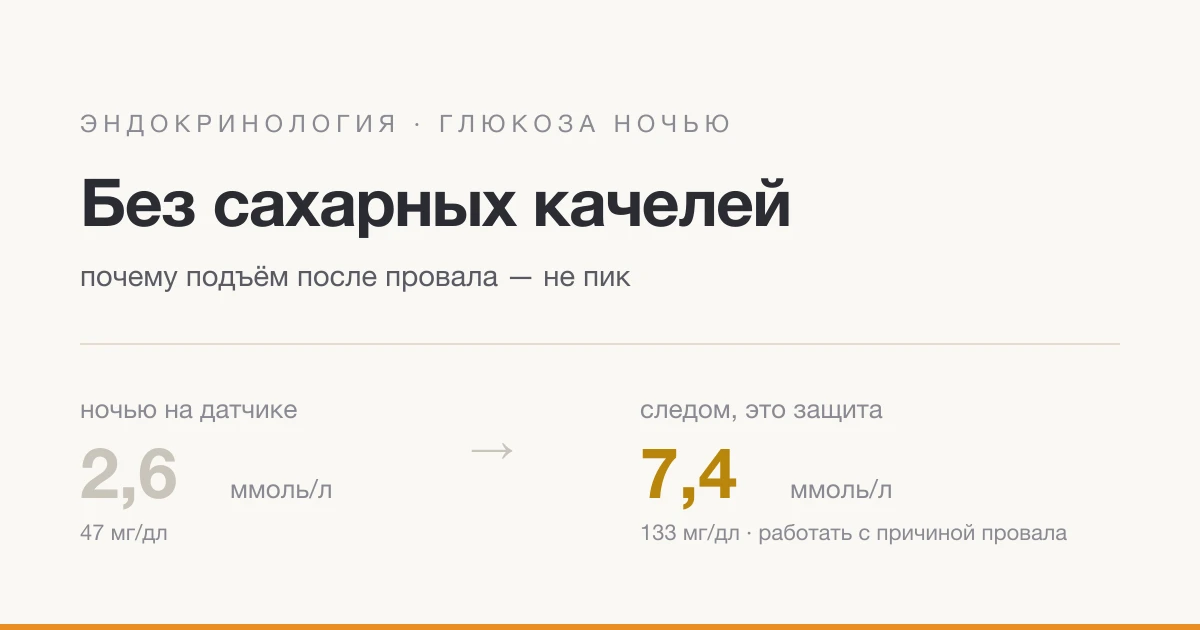
- A rise to 7.4 mmol/L (133 mg/dL) after a night dip to 2.6 mmol/L (47 mg/dL) is not a spike: the body switched on its defence and returned glucose to the blood; the cause of the dip is what needs work.
- Two thresholds: glucose repeatedly below 3.0 mmol/L (54 mg/dL) or above 8.9 mmol/L (160 mg/dL) is a reason to see a doctor; 7.4 mmol/L (133 mg/dL) is within the limits.
- A fall in glucose during sleep to 2.2 mmol/L (40 mg/dL) woke 10 of 16 healthy volunteers, and waking went together with an adrenaline surge (Schultes B, PLoS Med 2007).
- Walking for 10 minutes after each meal in people with type 2 diabetes lowered the glucose rise more than a single 30-minute walk a day, after dinner by 22% (Reynolds AN, Diabetologia 2016).
- The dinner formula: half the plate vegetables, a quarter protein (about 150 g), a quarter slow carbohydrate, a little fat; eat the carbohydrate last.