In plain words: what is known about turmeric in type 2 diabetes
What turmeric is
A yellow spice from a root.
- its main yellow compound is called curcumin
- ordinary food contains very little of it
What was tested
Curcumin was given and blood sugar was measured.
- adults with type 2 diabetes took part
- some got curcumin, others a dummy pill
Morning sugar
Morning sugar was lower in those taking it.
- this is an average for the group
- each person's result is their own
Sugar over three months
Average sugar over three months was lower too.
- the HbA1c test shows it
- it is built from every single day
How it was taken
Most often as curcumin capsules.
- courses lasted from a few weeks to a year
- a pinch in a dish does not give that much
Turmeric in the kitchen
A tasty addition to simple food.
- vegetables, eggs, fish, chicken, lentils
- golden milk without sugar
An addition, not a replacement
Curcumin does not replace a treatment plan.
- it is discussed with a doctor
- sugar is tracked according to your plan
When to see a doctor first
Some cases need a doctor first.
- you already have a diabetes treatment plan
- pregnancy and breastfeeding, gallstones
- medicines affecting blood clotting, or upcoming surgery
Important. Important: do not change prescribed treatment on your own. If you do not have diabetes, see a doctor if sugar is repeatedly below 3.0 mmol/L (54 mg/dL) or above 8.9 mmol/L (160 mg/dL); with diabetes, targets are individual and set in your doctor's plan; below 3.0 mmol/L (54 mg/dL) always means seeing a doctor.
What to remember
Curcumin can be an addition.
- alongside diet and your doctor's plan
- the decision about a course is made at a consultation
Key points
Turmeric is a yellow spice and curcumin is its main active compound. A review pooled 18 placebo-controlled trials in 1,382 adults with type 2 diabetes. In a pooled analysis of 16 of them, fasting blood sugar in those taking curcumin was on average lower than with placebo, and in an analysis of 14 trials glycated hemoglobin was lower too. The authors concluded that curcumin is suitable as a supplement to the diet of people with type 2 diabetes. It adds to a plan made with your doctor and does not replace it.
| What | How much | Why it helps | What studies showed |
|---|---|---|---|
| Fasting blood sugar | Usually curcumin in capsules, 300–1,500 mg a day | Lower morning sugar | 16 trials, 1,266 people: on average 0.64 mmol/L (11.5 mg/dL) lower than placebo |
| HbA1c (average sugar over 3 months) | Courses from 8 weeks to 12 months | Lower three-month average sugar | 14 trials, 1,185 people: on average 0.54 percentage points (5.9 mmol/mol) lower than placebo |
| C-reactive protein (a marker of inflammation) | The same curcumin | Lower inflammation marker | 10 trials, 702 people: on average lower than with placebo |
Turmeric and curcumin: what is the difference
Turmeric is the root that is ground into the yellow powder used in vegetable dishes, soups and golden milk. Curcumin is the main yellow compound in that root. Turmeric powder contains only a little of it, so the trials most often gave curcumin itself, usually in capsules. The numbers on this page refer to what was given in the trials, not to a pinch on a plate. This difference matters: when you read that "turmeric lowers sugar", it is worth asking what exactly the person took and in what amount, because the result depends on it.
The review was published in Nutrients in 2024 (Mokgalaboni K Nutrients 2024. PMID 39683570[1]). The authors gathered 18 trials in which people with type 2 diabetes were randomly given curcumin or placebo. In total they included 1,382 adults: 693 received curcumin and 689 placebo. The average age was about 56 years, and people were followed from 8 weeks to 12 months.
Fasting blood sugar: what the trials showed
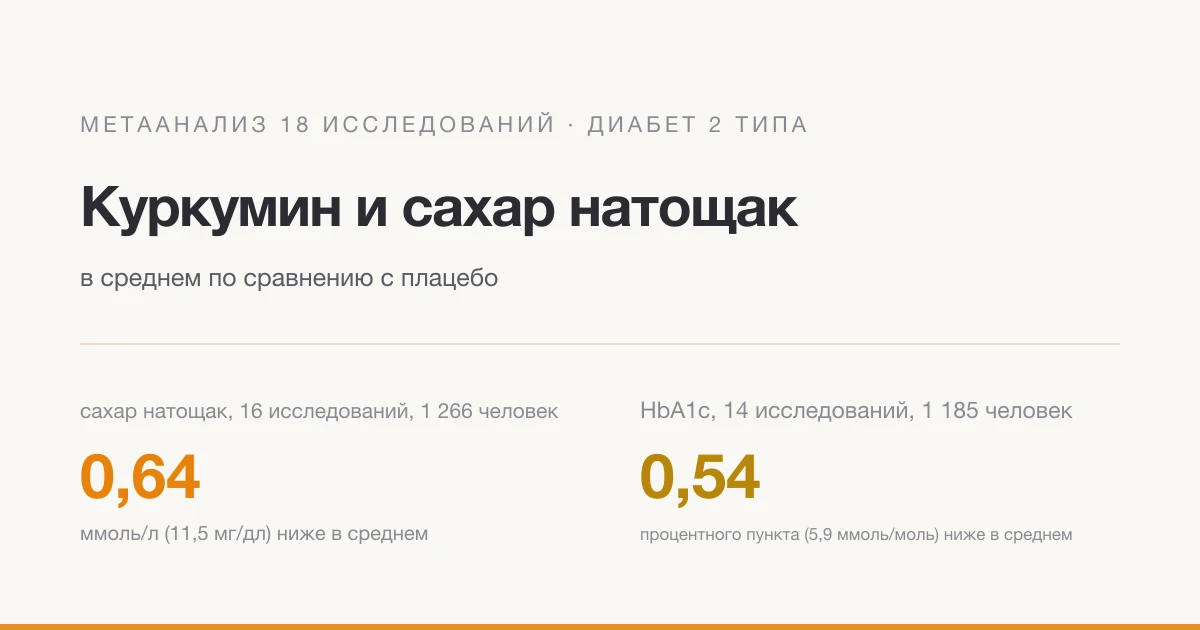
Fasting sugar shows how the body handles glucose without food. When the authors pooled 16 trials with 1,266 participants, those taking curcumin had fasting sugar that was on average 0.64 mmol/L (11.5 mg/dL) lower than with placebo (Mokgalaboni K Nutrients 2024. PMID 39683570[1]). This is an average across the group, and each person's result is their own.
What does it mean in practice? The average figure shows the scale, not a promise: for one person the change will be larger, for another smaller. That is why results should be judged by your own tests together with your doctor. It helps to measure fasting sugar at the same time each day, with the same meter or sensor, and note the readings: after a few weeks they show where your morning sugar is heading. Take the course at the same time each day and tie it to breakfast: a habit makes it easier not to skip days. Write down your morning sugar, and after the period you agreed with your doctor, come to the appointment with these results: they show how the course has fitted into your ordinary day and your plan.
HbA1c and inflammation
HbA1c, or glycated hemoglobin, shows your average sugar over the past three months. In 14 trials with 1,185 participants it was on average 0.54 percentage points (5.9 mmol/mol) lower than with placebo (Mokgalaboni K Nutrients 2024. PMID 39683570[1]). The three-month figure is built from every day, so it is less changeable than a single morning reading.
C-reactive protein is a marker of inflammation in the body. In a pooled analysis of 10 trials (702 people) it was on average lower than with placebo (Mokgalaboni K Nutrients 2024. PMID 39683570[1]). Both markers, sugar and C-reactive protein, were lower than with placebo.
How curcumin was taken in the trials
Most trials gave curcumin itself, mostly in capsules, every day: from 300 to 1,500 mg a day. Four trials used a nano form at 80 mg a day. In three trials turmeric itself was given, up to 2,100 mg a day. In three trials curcumin was given together with piperine, a compound from black pepper.
The authors found no link between the result and the dose or length of the course, so an optimal dose cannot be named. They note that the suitable dose and duration remain to be clarified in future trials. It is sensible to choose the form, dose and length at a consultation, so that the course fits your treatment plan and your tests. What to bring: your latest fasting sugar and HbA1c results, and a list of everything you take, including supplements and vitamins. With that set, the conversation stays concrete, and it is easier for the doctor to suggest a clear plan.
Turmeric in the kitchen
An ordinary kitchen is a good place for turmeric, and its taste is mild, warm and slightly earthy. It goes into stewed vegetables, lentil soup, omelets and eggs, baked fish and chicken, cauliflower stew, and golden milk without sugar. Try it in an egg salad with herbs, in roasted cauliflower, in a thick lentil soup, or in chicken slowly cooked with onion and garlic. It is easy to cook with: just add turmeric to the vegetables at the start, and the dish takes on a warm golden color. It is a pleasant habit that makes simple food brighter.
It is important not to promise yourself too much: the trials gave capsules and powder in grams, and a pinch in a dish does not give that much. So treat kitchen turmeric as a tasty part of the diet, not a replacement for the course used in the studies. For steady sugar, what matters most is still on the plate. If you like order, plan a simple set of turmeric dishes for the week: vegetables and eggs on some days, fish or chicken on others, and lentil soup kept in reserve. That way a tasty habit builds itself, without strain.
An example menu with no grains or bread. Breakfast: a two-egg omelet with herbs and a pinch of turmeric, cucumber and avocado. Lunch: lentil soup with turmeric and a cabbage salad with olive oil. Dinner: baked fish or chicken with stewed vegetables. Snack: a handful of nuts. In such a menu the base is protein, vegetables and healthy fats. You can estimate your insulin sensitivity in the HOMA-IR calculator or by taking the insulin resistance test.
Who should see a doctor first
Discuss curcumin with your doctor first if you already have a diabetes treatment plan, because your sugar needs to be tracked according to that plan. The same applies to pregnancy and breastfeeding, gallstones, being prescribed medicines that affect blood clotting, and preparing for surgery. Do not change prescribed treatment on your own.
If you do not have diabetes, see a doctor if your sugar is repeatedly below 3.0 mmol/L (54 mg/dL) or above 8.9 mmol/L (160 mg/dL). With diabetes, targets are individual and set in your doctor's plan; below 3.0 mmol/L (54 mg/dL) always means seeing a doctor.
Bottom line
In a pooled analysis of 16 trials (1,266 people with type 2 diabetes), fasting sugar in those taking curcumin was on average 0.64 mmol/L (11.5 mg/dL) lower than with placebo; in a pooled analysis of 14 trials (1,185 people), HbA1c was on average 0.54 percentage points (5.9 mmol/mol) lower. Turmeric in the kitchen makes food tastier, while a curcumin course should be built with your doctor as a supplement to your diet and treatment plan. Want to go through this with your own tests? Book a consultation.
References
- Mokgalaboni K Nutrients 2024. PMID 39683570
Key facts
- Curcumin in a pooled analysis of 16 placebo-controlled trials (1,266 people with type 2 diabetes): fasting blood sugar on average 0.64 mmol/L (11.5 mg/dL) lower compared with placebo (Mokgalaboni K Nutrients 2024. PMID 39683570).
- HbA1c in a pooled analysis of 14 trials (1,185 people) was on average 0.54 percentage points (5.9 mmol/mol) lower than with placebo (Mokgalaboni K Nutrients 2024. PMID 39683570).
- Most trials gave curcumin itself, mostly in capsules, 300–1,500 mg a day, for 8 weeks to 12 months; the authors found no link between effect and dose or duration. A pinch of turmeric in food does not give that much.
- Curcumin supplements a plan made with your doctor and does not replace it. If you do not have diabetes, see a doctor if sugar is repeatedly below 3.0 mmol/L (54 mg/dL) or above 8.9 mmol/L (160 mg/dL); with diabetes, targets are individual and set in your doctor's plan; below 3.0 mmol/L (54 mg/dL) always means seeing a doctor.