In plain words: what half an hour with weights gives and how to start
Two short sessions
No need for an evening at the gym.
- half an hour with dumbbells, a band or your own weight
- twice a week with a rest day between
- suitable for adults and older people
How much is enough
You do not need a lot for a longer life.
- in observations 30-60 minutes a week looked best
- more is not always better
- start with 20 minutes per session
Blood pressure
Strength work helps the heart.
- upper pressure falls about as much as with walking or running
- it works with regular sessions
Sugar
In diabetes strength work adds a benefit.
- average sugar over 2-3 months falls a little
- the effect is modest, but it is there
- best together with walking and the diet plan from your doctor
Bones after menopause
Heavy work with weights strengthened bone.
- sessions were supervised by a coach
- spine bone became denser, while with light home exercise it thinned
- do not start heavy weights on your own
How to start
A simple scheme for the first weeks.
- squats, standing from a chair, band rows, wall push-ups
- 8-12 repetitions, 2-3 sets
- technique first, then weight
Keep walking
Strength work and walking complement each other.
- walking stays every day
- strength work is added twice a week
When to see a doctor
Talk to a doctor first if you have:
- heart disease or chest pain on exertion
- osteoporosis, fractures, joint or spine problems
- with diabetes: glucose repeatedly below 3.0 mmol/L (54 mg/dL) or above 8.9 mmol/L (160 mg/dL)
Important. Important: do not change prescribed treatment on your own. In diabetes targets are individual; below 3.0 mmol/L (54 mg/dL) always means a doctor.
Key points
Two short strength sessions a week are already linked with longer life, better blood pressure and steadier sugar. You do not need an evening in the gym: half an hour with dumbbells, a resistance band or your own body weight, twice a week, gives a noticeable benefit. For postmenopausal women, supervised strength work can strengthen bone where light exercise does not.
| What | How much | Why it helps | What studies showed |
|---|---|---|---|
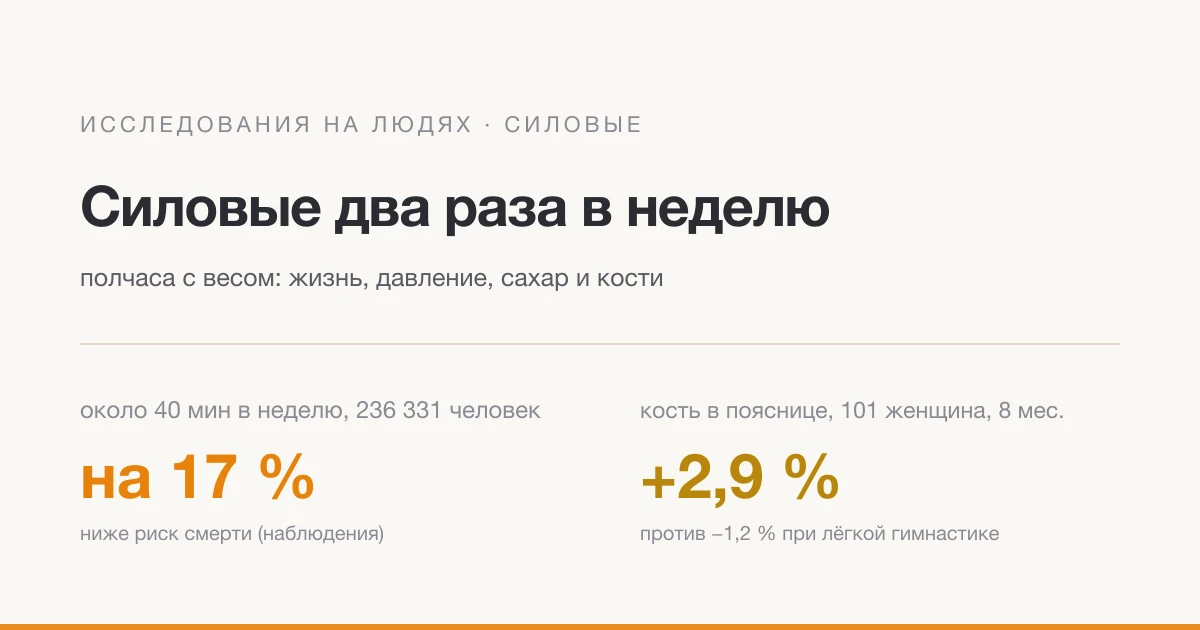
| Longer life | 30-60 min a week, about 40 min peak | Lower risk of death from any cause | linked with a 15% reduction (7 cohorts, 263,058 people); about 40 min a week 17% (6 cohorts, 236,331 people); observational |
| Blood pressure | Regular training for 2 weeks or more | Lower systolic pressure | Dynamic resistance training: minus 4.55 mm Hg systolic and minus 3.04 diastolic (pooled analysis of 270 trials of different exercise types, 15,827 people) |
| Sugar in type 2 diabetes | Structured training from 12 weeks | Lower HbA1c | Resistance training: minus 0.57 percentage points (confidence interval minus 1.14 to minus 0.01) |
| Bones | Twice a week, 30 minutes, supervised, 8 months | Higher lumbar spine bone density | 101 postmenopausal women: plus 2.9% versus minus 1.2% with light home exercise |
Half an hour a week and a longer life
In a review of prospective cohort studies (16 studies overall), strength training was linked with a 15% reduction in all-cause mortality risk (comparison of any versus no strength work: relative risk 0.85, 7 cohorts, 263,058 people). The largest reduction, 17% (relative risk 0.83), was at about 40 minutes a week: this is a dose-based estimate from 6 cohorts and 236,331 people. Good benefit came at 30-60 minutes of strength work a week (Momma H Br J Sports Med 2022. PMID 35228201[1]).
The relationship is J-shaped: beyond this dose any extra benefit is unclear. In other words, more is not always better, and a modest start is enough. An important caveat: these are observations of people who train on their own, not a trial in which some were assigned strength work and others were not. The certainty of this estimate is rated very low on the GRADE scale (a system that grades quality of evidence).
Blood pressure and sugar
In a pooled analysis of 270 randomised trials (15,827 people, different exercise types), dynamic resistance training lowered systolic pressure by 4.55 and diastolic by 3.04 mm Hg. For comparison, aerobic training gave minus 4.49 and minus 2.53 mm Hg, so strength work is as good as walking or running here (Edwards J J Br J Sports Med 2023. PMID 37491419[2]). The 270 trials and 15,827 people cover all exercise types; for resistance training it is 57 comparisons of strength work with a control.
In type 2 diabetes, a review of 47 trials (8,538 people) found that structured training lowered HbA1c (average sugar over 2-3 months). For resistance training (a subgroup within 23 trials of structured training) it is minus 0.57 percentage points (about 6 mmol/mol), but the confidence interval almost touches zero (minus 1.14 to minus 0.01). The honest summary: the effect is modest and varies between studies. For all structured training together, programmes longer than 150 minutes a week lowered it by 0.89 points, and 150 minutes or less by 0.36 (Umpierre D JAMA 2011. PMID 21540423[3]).
Bones after menopause
In the LIFTMOR trial, 101 postmenopausal women with low bone mass (average age 65) were split into two groups. One did heavy lifting (5 sets of 5 repetitions at over 85% of maximum) and jumping for 30 minutes twice a week under a coach for 8 months; the other did light exercise at home. Lumbar spine bone density rose by 2.9% in the first group and fell by 1.2% in the second; at the femoral neck it was plus 0.3% versus minus 1.9%. Only one adverse event was reported: a mild lower back spasm, after which the participant missed 2 of 70 sessions; attendance was 92% (Watson S L J Bone Miner Res 2018. PMID 28975661[4]).
This does not mean you should start with heavy weights alone. The programme was set by a coach after medical screening.
How to start
- Two sessions a week of 20-30 minutes, with a rest day between.
- Main muscle groups: legs (squats, standing up from a chair), back (band rows), chest and arms (wall or floor push-ups), core.
- Choose a weight where the last repetitions are hard but technique holds. Technique first, weight second.
- 8-12 repetitions, 2-3 sets. After 2-4 weeks add weight or repetitions gradually.
- Keep your ordinary walks: strength work and walking complement each other.
Who should see a doctor first
Talk to a doctor before starting if you have heart disease, blood pressure above 160/100 mm Hg, chest pain on exertion, recent surgery, osteoporosis or fractures, or joint or spine problems. With osteoporosis, heavy lifts and jumps only under a trained coach.
If you have diabetes and take medicines that can lower sugar, check glucose before and after sessions. If a repeat result is below 3.0 mmol/L (54 mg/dL) or above 8.9 mmol/L (160 mg/dL), see a doctor. In diabetes targets are individual, and below 3.0 mmol/L (54 mg/dL) always means a doctor. Do not change prescribed treatment on your own.
Bottom line
Two short weight sessions a week are linked with longer life, help blood pressure, slightly improve sugar and, under supervision, strengthen bone. Start with 20 minutes, add gradually and keep walking. An example week for someone who has never trained: Tuesday and Friday, 20 minutes at home, three exercises (chair squats, band rows, wall push-ups) in two sets. A month later it is a habit, and you can add a third set or a little more weight. What matters is not a record but regularity: regular sessions, not a one-off feat, were what the studies looked at.
References
- Momma H Br J Sports Med 2022. PMID 35228201
- Edwards J J Br J Sports Med 2023. PMID 37491419
- Umpierre D JAMA 2011. PMID 21540423
- Watson S L J Bone Miner Res 2018. PMID 28975661
Key facts
- Strength training is linked with a 15% reduction in all-cause mortality risk (7 cohorts, 263,058 people); the largest, 17%, was at about 40 minutes a week (6 cohorts, 236,331 people; Momma H Br J Sports Med 2022. PMID 35228201). These are observations, not a trial that assigned training.
- Strength training lowers systolic blood pressure by 4.55 mm Hg on average (Edwards J J Br J Sports Med 2023. PMID 37491419).
- Structured resistance training in type 2 diabetes lowers HbA1c by 0.57 percentage points on average (Umpierre D JAMA 2011. PMID 21540423).
- In 101 postmenopausal women with low bone mass, 8 months of supervised heavy training raised lumbar spine bone density by 2.9% versus a 1.2% loss with light home exercise (Watson S L J Bone Miner Res 2018. PMID 28975661).