What the lungs, heart and mood gain, and how to get through the first weeks
It is not too late
After 45, quitting still pays off.
- lungs
- heart
- mood and years of life
Lungs
Within the first year breathing gets better.
- exhaled volume grows
- after that the lungs decline much more slowly
- the lungs weaken as slowly as in non-smokers
Heart and vessels
Protection arrives in the first years.
- clearly fewer heart and vessel diseases
- over time the risk approaches that of non-smokers
- the earlier the better
Mood
Less anxiety and stress.
- the first weeks can be hard
- later calmer than those who kept smoking
- general well-being is better too
Years of life
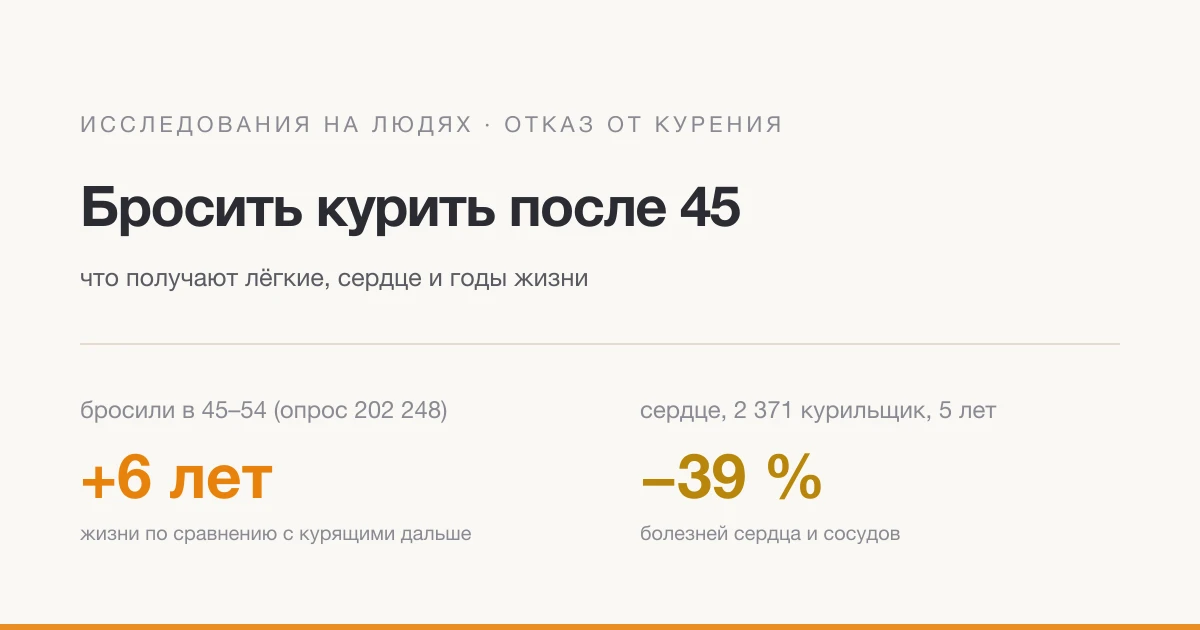
Those who quit at 45 to 54 gain years of life.
- about six years on average
- the earlier you quit the bigger the gain
- but starting later is still worth it
What about weight
Weight may rise, by a few kilos on average.
- a few kilos a year on average
- mostly in the first months
- in many people weight does not rise at all
The first weeks
Prepare in advance.
- pick a date and tell those close to you
- remove ashtrays and lighters
- replace the smoke break with a walk or water
- discuss support with your doctor
When to see a doctor
Some signs must not be put down to smoking.
- cough for over three weeks, coughing blood
- breathlessness and chest pain
- a sharp drop in mood
Important. Important: with such signs, get examined first. The choice of support for quitting is the doctor's.
The main points
It is not too late to quit smoking after 45, and the benefits come from several directions. The lungs lose capacity more slowly, the heart gets protection within the first years, anxiety and stress are lower, and years of life are in reserve. The earlier the better, but starting later is still worth it.
| What | When | Why it helps | What studies showed |
|---|---|---|---|
| Lungs | Over the first year and after | Exhaled volume rises, decline slows | Among 3,818 smokers with early lung disease, mean age 48.5, quitters gained 47 mL (2%) over a year, then decline 31 versus 62 mL a year (how many is not stated in the abstract) (Scanlon P D Am J Respir Crit Care Med 2000. PMID 10673175[1]) |
| Heart and vessels | First 5 years | Fewer diseases | 2,371 heavy smokers, 26 years of follow-up: 39% less often than in those who kept smoking (Duncan M S JAMA 2019. PMID 31429895[2]) |
| Mood | From several weeks | Less anxiety and stress | Anxiety: 4 studies, stress: 3 studies; anxiety −0.37, stress −0.27 standard deviations (Taylor G BMJ 2014. PMID 24524926[3]) |
| Years of life | Quit at 45 to 54 | About 6 years of life in reserve | 202,248 adults in a US national survey (Jha P N Engl J Med 2013. PMID 23343063[4]) |
How to use it: the first weeks
Pick a date and tell those close to you: support helps you hold on. Talk with your doctor about the methods that suit you; the choice of method and dose is up to the doctor. Remove ashtrays and lighters from the house and think ahead about what replaces a smoke break: a short walk, a glass of water, a call to a friend.
Watch how you feel: in the first weeks irritability and anxiety happen, but they pass. Weigh yourself once a week and walk more. If you also want to check heart risk, start with cholesterol: the non-HDL cholesterol calculator is handy.
What the studies showed
Who should see a doctor first
A cough lasting more than three weeks, coughing blood, breathlessness on ordinary walking, chest pain, unexplained weight loss: get examined first. Such signs should not be put down to smoking or to quitting.
If you take medicines or are treated for anxiety or depression, tell your doctor you plan to quit: monitoring is needed during the change. If mood drops sharply or thoughts of self-harm appear, seek help at once. In pregnancy and with heart disease the choice of support is the doctor's.
Summary
After 45, quitting gives the lungs a slower decline, the heart protection in the first 5 years, the mood less anxiety, and about 6 years of life in reserve. Pick a date, tell those close to you and discuss support with your doctor.
References
- Scanlon P D Am J Respir Crit Care Med 2000. PMID 10673175
- Duncan M S JAMA 2019. PMID 31429895
- Taylor G BMJ 2014. PMID 24524926
- Jha P N Engl J Med 2013. PMID 23343063
- Aubin H J BMJ 2012. PMID 22782848
Key facts
- Lungs: among 3,818 smokers with early lung disease (mean age 48.5), those who quit gained on average 47 mL (2%) of volume exhaled in the first second in the year after quitting; it then declined half as fast as in those who kept smoking: 31 versus 62 mL a year (how many quit is not stated in the abstract) (Scanlon P D Am J Respir Crit Care Med 2000. PMID 10673175).
- Heart: in 2,371 heavy smokers (20 pack-years or more), heart and blood vessel disease was 39% less frequent in the first 5 years after quitting than in those who kept smoking, hazard ratio 0.61 (Duncan M S JAMA 2019. PMID 31429895).
- Mood: in quitters anxiety and stress fell more than in those who kept smoking (anxiety: 4 studies, stress: 3 studies) (Taylor G BMJ 2014. PMID 24524926).
- Years of life: those who quit at 45 to 54 gained about 6 years of life compared with those who kept smoking; the national survey included 202,248 adults (Jha P N Engl J Med 2013. PMID 23343063).
- Weight: on average plus 4.7 kg in a year, most of it in the first 3 months, but in about one in six weight does not rise (Aubin H J BMJ 2012. PMID 22782848).