in pictures and a few words
What it is and why
Ryeqo is one tablet for uterine fibroids and endometriosis: relugolix 40 mg, estradiol 1 mg and norethisterone acetate 0.5 mg.
- One tablet a day
- Treatment is prescribed by a doctor
How it works
Relugolix turns down the signal from the pituitary to the ovaries. There is less oestrogen, and fibroids and endometriosis settle.
- A small dose of estradiol eases hot flushes
- A progestin protects the womb lining
Fibroids: less bleeding
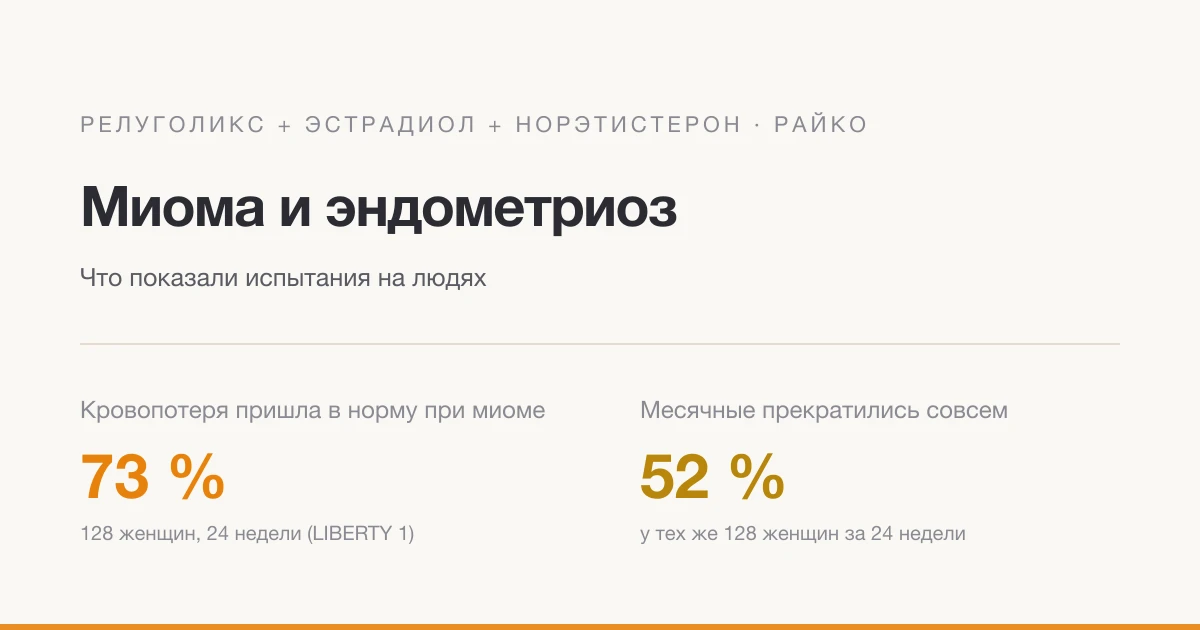
In two studies, blood loss returned to normal (under 80 mL) in 73% and 71% of women on the tablet versus 19% and 15% on placebo.
- Blood loss −84.3% on average
- Periods stopped in half
Endometriosis: less pain
In two studies, period pain eased in 75% of women on the tablet versus 27% and 30% on placebo.
- Pelvic pain: 58% and 66% versus 40% and 43%
- Strong painkillers needed less often
What about bones?
Over 24 weeks, bone density on the tablet changed the same way as on placebo. Without estradiol, relugolix lowered it.
- Bone scan after 1 year
- With osteoporosis risk — before starting too
How to take it
1 tablet once a day. Take the first within 5 days of the start of your period.
- Missed one — take it as soon as possible
- Ovulation returns quickly after stopping
What can happen
Most common: hot flushes and headache; blood pressure sometimes rises. Periods get lighter or stop.
- A doctor checks blood pressure
- Pregnancy is harder to notice — test if unsure
Important. Important: swelling and pain in one leg, shortness of breath, chest pain — call an ambulance.
Who should see a doctor first
Do not start the tablet without a doctor if you have:
- past blood clots, heart attack or stroke
- migraine with aura, osteoporosis
- depression, liver disease
Important. Important: the tablet is not used in pregnancy or while breastfeeding.
In one sentence
One tablet a day reduces bleeding from fibroids and pain from endometriosis.
- Periods stopped in half
- Bones — as on placebo
- Decision made with a doctor
Key points
3 in 4 women with fibroids — far less bleeding. In the two LIBERTY trials, blood loss fell below 80 mL per cycle and to at most half the starting amount in 73% and 71% of women versus 19% and 15% on placebo (Al-Hendy A NEJM 2021. PMID 33596357[1]).
3 in 4 women with endometriosis — less pain. In the SPIRIT trials, period pain eased in 75% of women on the tablet versus 27% and 30% on placebo (Giudice LC Lancet 2022. PMID 35717987[2]).
| Substance | How much | Benefit | What studies showed |
|---|---|---|---|
| Relugolix + estradiol + norethisterone acetate (Ryeqo) | relugolix 40 mg + estradiol 1 mg + norethisterone acetate 0.5 mg, 1 tablet once a day | less bleeding with uterine fibroids, less pain with endometriosis | fibroids: bleeding response 73% and 71% versus 19% and 15% on placebo; endometriosis: period pain eased in 75% versus 27% and 30% |
How it works
Relugolix blocks GnRH receptors in the pituitary. The pituitary releases less LH and FSH, the ovaries make less oestrogen and progesterone, and there is no ovulation. Fibroids and endometriosis lesions grow under these hormones, so bleeding and pain settle (Ryeqo, EMA product information, section 5.1).
The estradiol in the tablet is the same as the body's own. It eases hot flushes and protects bone. Norethisterone acetate is a progestin: it protects the lining of the womb from overgrowth caused by oestrogen. On the tablet, estradiol stays at about 33–38 pg/mL — as at the start of a normal cycle (section 5.1).
What studies showed
| Study | Who took part | Comparison | Result |
|---|---|---|---|
| LIBERTY 1, double-blind randomised trial, 24 weeks (PMID 33596357[1]) | 388 women with fibroids and heavy periods; 128 on the tablet, 127 on placebo | placebo | bleeding response 73% versus 19%; periods stopped in 52% versus 6% |
| LIBERTY 2, same design (PMID 33596357[1]) | 382 women; 125 on the tablet, 129 on placebo | placebo | response 71% versus 15%; periods stopped in 50% versus 3% |
| SPIRIT 1, double-blind randomised trial, 24 weeks (PMID 35717987[2]) | 638 women with endometriosis; 212 on the tablet and 212 on placebo analysed | placebo | period pain eased in 75% versus 27%; pelvic pain outside periods in 58% versus 40% |
| SPIRIT 2, same design (PMID 35717987[2]) | 623 women; 206 on the tablet and 204 on placebo analysed | placebo | period pain eased in 75% versus 30%; pelvic pain in 66% versus 43% |
Uterine fibroids: LIBERTY 1 and 2
The trials enrolled women aged 18–50 with fibroids on ultrasound and blood loss of 80 mL or more per cycle. They were randomly split into three groups: the tablet, placebo, or 12 weeks of relugolix without hormones followed by the tablet (Al-Hendy A NEJM 2021. PMID 33596357[1]).
- Blood loss: fell by 84.3% on average in both trials versus 23.2% and 15.1% on placebo. The effect was visible by week 4.
- Anaemia: in women with a starting haemoglobin up to 10.5 g/dL, it rose by more than 2 g/dL in 50% and 61% versus 22% and 5% on placebo (EMA product information, section 5.1).
Endometriosis: SPIRIT 1 and 2
The trials enrolled women aged 18–50 with confirmed endometriosis and moderate or severe pain, at 219 centres on five continents. A response meant less pain on a 0–10 scale without more painkillers (Giudice LC Lancet 2022. PMID 35717987[2]).
- Period pain: eased in 158 of 212 (75%) versus 57 of 212 (27%) in SPIRIT 1 and in 155 of 206 (75%) versus 62 of 204 (30%) in SPIRIT 2.
- Pelvic pain outside periods: eased in 58% versus 40% and in 66% versus 43%.
- Bones: over 24 weeks, lumbar spine density changed by −0.70% and −0.78% versus +0.21% and +0.02% on placebo.
Indications
According to the EMA product information (section 4.1), Ryeqo is used in adult women of reproductive age:
- for uterine fibroids — to treat moderate to severe symptoms;
- for endometriosis — to treat symptoms in women who have already had medical or surgical treatment for it.
How it is used
- Who prescribes: treatment is started and supervised by a doctor experienced in treating fibroids and endometriosis. Pregnancy is ruled out before starting (Ryeqo, EMA product information, section 4.2).
- Regimen: 1 tablet once a day, at about the same time, with or without food. The first is taken within 5 days of the start of a period.
- Contraception: hormonal contraceptives are stopped before starting. For the first month a condom is also needed; after that the tablet suppresses ovulation and protects reliably. After stopping, another method is started at once.
- Missed tablet: take it as soon as possible and the next one at the usual time. Missed 2 or more in a row — also use a non-hormonal method for 7 days.
- Bones: a bone density scan (DXA) is done after 1 year of use, and before starting if there are risk factors for osteoporosis (sections 4.2 and 4.4).
Safety
- In LIBERTY the most common were hot flushes (11% and 6% versus 8% and 4% on placebo) and headache (11% and 9% versus 15% and 12%); blood pressure rose in 5% and 4% versus 0% and 3% (128 and 126 women on the tablet; PMID 33596357[1]).
- Medicines with oestrogen and progestin raise the risk of blood clots. For Ryeqo this risk has not been established; its hormone doses are lower than in combined contraceptives (section 4.4).
- Carbamazepine, rifampicin and St John's wort weaken relugolix, while erythromycin, clarithromycin and ketoconazole boost it — using them together is not recommended (section 4.5).
Who should see a doctor first
Swelling and pain in one leg, shortness of breath, chest pain, weakness or numbness on one side of the body, trouble speaking or seeing — call an ambulance at once.
According to the EMA product information (section 4.3), the tablet is not used:
- with a blood clot or thromboembolism now or in the past, after a heart attack or stroke, with coronary heart disease, an inherited tendency to clotting, or known osteoporosis;
- with migraine with aura or headache with focal neurological symptoms;
- with hormone-dependent tumours of the genital organs or breast, liver tumours, or severe liver disease until tests return to normal;
- in pregnancy or suspected pregnancy, or with genital bleeding of unknown cause;
- together with hormonal contraceptives, or with allergy to the ingredients.
Also discuss it with a doctor in these cases (sections 4.4 and 4.6):
- smoking, age over 35, body mass index over 30, blood clots in parents, brothers or sisters before 50;
- high blood pressure, migraine, diabetes, lupus, Crohn's disease or ulcerative colitis;
- past depression; mood changes on the tablet — see a doctor at once;
- submucosal fibroid: on the tablet it may come out through the cervix, sometimes with a temporary increase in bleeding;
- breastfeeding — the tablet is not used; planning a pregnancy — discuss with a doctor when to stop;
- planned surgery or long immobility: the tablet is stopped at least 4 weeks before.
Summary
Ryeqo is one tablet a day for uterine fibroids and endometriosis. In fibroids, blood loss fell by 84.3% on average; in endometriosis, period pain eased in 3 in 4 women, and bone density over 24 weeks changed as on placebo. The decision to treat is made with a doctor.
References
- Al-Hendy A NEJM 2021. PMID 33596357
- Giudice LC Lancet 2022. PMID 35717987
Key facts
- Ryeqo is a combination in one tablet: relugolix blocks GnRH receptors in the pituitary, so the ovaries make less oestrogen; small doses of estradiol and norethisterone acetate give the body back a little hormone (Ryeqo, EMA product information, section 5.1).
- EMA indications are moderate to severe symptoms of uterine fibroids and symptoms of endometriosis in women who have already had medical or surgical treatment for it (section 4.1).
- In the LIBERTY 1 and 2 trials in women with fibroids, 73% and 71% on the tablet had a bleeding response versus 19% and 15% on placebo; periods stopped in 52% and 50% (Al-Hendy A NEJM 2021. PMID 33596357).
- In the SPIRIT 1 and 2 trials in women with endometriosis, period pain eased in 75% on the tablet versus 27% and 30% on placebo (Giudice LC Lancet 2022. PMID 35717987).
- Regimen: 1 tablet once a day; after the first month the tablet suppresses ovulation and protects against pregnancy (section 4.2).