A simple step: swap the sweet glass for water
One sugary glass
Start with one serving a day, the most automatic one.
- soda at lunch
- sweet tea or coffee
- an energy drink on the way
Water instead of sweet
A simple swap that has been tested in people.
- keep water always close
- water with lemon or mint
- tea without sugar
Weight
Swapping drinks helps with weight loss.
- better odds of losing weight
- start with one serving
- then remove the second
Blood pressure
Fewer sugary servings go with lower blood pressure.
- the link shows with each serving removed
- especially if you drink several
- the effect builds over months
Teeth
Sugary drinks like to stay on the teeth.
- people who skip sugary drinks have fewer new tooth problems (association)
- water after a meal helps
- brushing is still needed
Diabetes risk
More sugary servings a day go with a higher risk.
- fewer servings go with a lower risk
- water is the best swap
- juice is not the best choice
How to stay on track
A habit of the hands changes with small steps.
- drop one serving a week
- carry a bottle of water
- choose fizz without sugar
When to see a doctor
With diabetes, discuss the swap plan with your doctor.
- do not drop a sugary drink used for low glucose without a plan
- repeated glucose below 3.0 mmol/L (54 mg/dL)
- or above 8.9 mmol/L (160 mg/dL)
Important. Important: prescribed treatment is not changed on your own.
The main point
Sugary drinks are the easiest item of the diet to change in a single day. Swapping drinks raises the odds of losing weight, and observations in people show associations: fewer sugary servings go with lower blood pressure, fewer new tooth problems and a lower risk of type 2 diabetes. You can start with one serving: for example, swap the lunchtime soda for a glass of water.
| what | how much | why it helps | what studies showed |
|---|---|---|---|
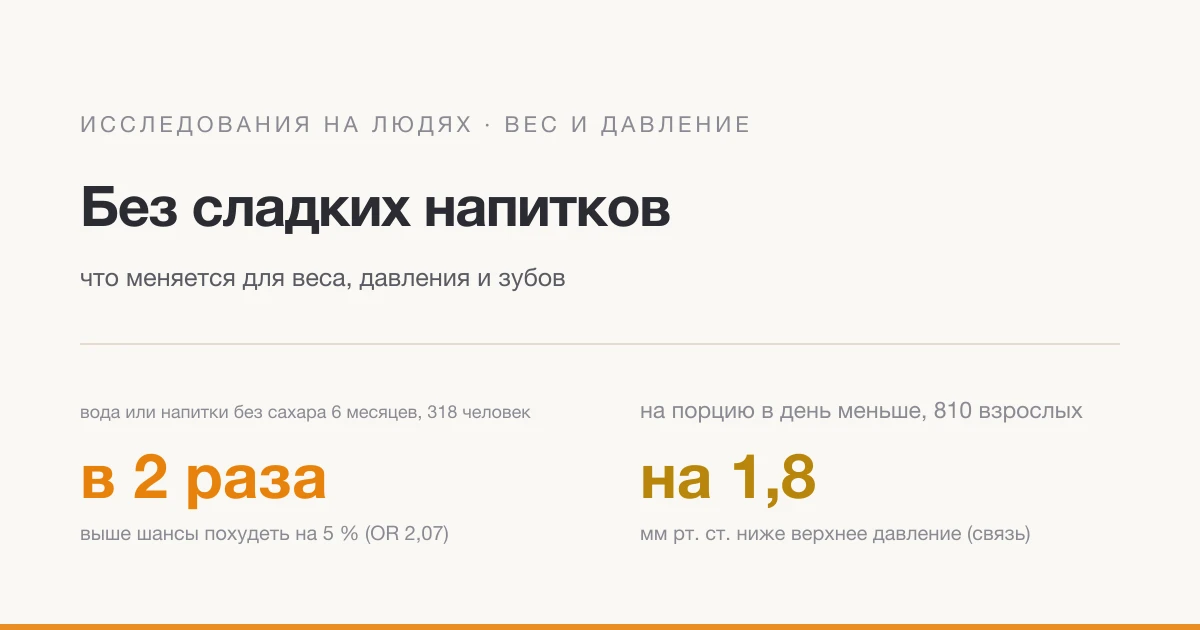
| Water or sugar-free drinks instead of sugary ones | 6 months | Better odds of losing 5% of weight | 318 people with overweight: odds about twice as high (OR 2.07), average weight loss 2-2.5% |
| One serving less a day | 18 months | Lower blood pressure | 810 adults: systolic 1.8 mm Hg lower, diastolic 1.1 mm Hg lower |
| No sugary drinks at all | 4 years | Healthier teeth | 939 adults: about a quarter less new tooth damage than those drinking 1-2 servings a day |
| One serving less a day | years of follow-up | Lower risk of type 2 diabetes | 17 studies: each serving a day linked to an 18% higher risk (13% after adjusting for weight) |
Weight: what the CHOICE trial showed
In the CHOICE trial, 318 adults with overweight (mean body mass index 36.3 kg/m2) replaced drinks supplying at least 200 kcal a day with water or sugar-free drinks for 6 months. The comparison group made any dietary changes of its own choice (Tate D F Am J Clin Nutr 2012. PMID 22301929[1]).
Everyone lost weight: 2.5% in the sugar-free drink group, 2.03% in the water group and 1.76% in the comparison group, and differences in average weight between groups were not significant. But the odds of losing 5% of weight were higher: 2.29 times in the sugar-free drink group (95% CI 1.05-5.01) and 2.07 times in the combined replacement group (95% CI 1.02-4.22): 19.5% of participants lost 5% of weight versus 10.5% in the comparison group. In the water group fasting glucose fell more and hydration improved. The result: swapping drinks is a simple, clear step that works alongside any other.
Blood pressure: the association in 810 adults
The PREMIER study followed 810 adults with prehypertension or stage 1 hypertension for 18 months. For each sugary serving a day less, systolic pressure was 1.8 mm Hg lower (95% CI 1.2-2.4) and diastolic 1.1 mm Hg lower (0.7-1.4). The association remained significant after adjusting for weight change (Chen L Circulation 2010. PMID 20497980[2]). No association with blood pressure was found for diet drinks or caffeine.
Teeth: fewer new cavities
Finnish researchers followed 939 adults with their own teeth for 4 years. Those who drank 1-2 sugary servings a day gained 31% more new tooth damage than those who drank none (incidence rate ratio 1.31; 95% CI 1.02-1.67), and 33% more at 3 or more servings (Bernabé E J Dent 2014. PMID 24813370[3]). Flipped, people who skip sugary drinks have about a quarter less damage. The association did not depend on whether people used fluoride toothpaste.
Type 2 diabetes: fewer servings, lower risk
A review of 17 cohort studies (38,253 cases of diabetes) found that each sugary serving a day was linked to an 18% higher risk of type 2 diabetes (95% CI 9-28%), and 13% (6-21%) after adjusting for excess weight (Imamura F BMJ 2015. PMID 26199070[4]). These are observations of people, so they show an association, not a cause. Flipped: one serving a day less goes with a risk of diabetes about 15% lower (1 - 1/1.18).
How to use it
A simple ladder: first remove the one sugary serving you drink most automatically, then a second. Replace with water, water with lemon or mint, or unsweetened tea. Keep water in sight and carry a bottle: the sugary drink habit is often just a habit of the hands. If you want fizz, choose a sugar-free one. If you want something sweet, let it be a berry or a piece of fruit, not a glass of juice.
Example: someone drinks two cans of soda a day. In a month they drop one, a month later the other. For teeth, blood pressure and weight, each serving removed adds a small gain.
Who should see a doctor first
If you have diabetes and are treated, do not drop the sugary drink you use to raise glucose when it is low without a plan from your doctor. See a doctor for repeated glucose below 3.0 mmol/L (54 mg/dL) or above 8.9 mmol/L (160 mg/dL). If you do not have diabetes, the same limits apply; with diabetes targets are individual per the doctor's plan, and below 3.0 mmol/L (54 mg/dL) always means see a doctor.
A real-life example: how it looks through the day
In the morning, tea or coffee without sugar instead of a sweet coffee. At lunch, a glass of water instead of soda. After lunch, when you want something sweet, a handful of berries or a piece of fruit. In the evening, water with lemon. Nothing is banned forever: it is just a different "habit of the hands". If one day you did drink a sugary drink, it is not a failure; carry on the next day. In the studies the effect built up over months and years, not from one perfect day.
Summary
Remove one sugary serving a day and replace it with water. Within months the benefit shows in weight, blood pressure and teeth.
References
- Tate D F Am J Clin Nutr 2012. PMID 22301929
- Chen L Circulation 2010. PMID 20497980
- Bernabé E J Dent 2014. PMID 24813370
- Imamura F BMJ 2015. PMID 26199070
Key facts
- Swapping sugary drinks for water or sugar-free drinks for 6 months: in 318 people with overweight the odds of losing 5% of weight were about twice as high as in the comparison group (OR 2.07; Tate D F Am J Clin Nutr 2012. PMID 22301929).
- One sugary serving less a day: in 810 adults over 18 months systolic pressure was 1.8 mm Hg lower and diastolic 1.1 mm Hg lower (an association) (Chen L Circulation 2010. PMID 20497980).
- No sugary drinks at all: in 939 Finnish adults over 4 years new tooth damage was about a quarter lower than in those drinking 1-2 servings a day (Bernabé E J Dent 2014. PMID 24813370).
- Each sugary serving a day is linked to an 18% higher risk of type 2 diabetes, 13% after adjusting for body weight (17 studies, Imamura F BMJ 2015. PMID 26199070).
- See a doctor: if you have diabetes and use a sugary drink to treat low glucose, do not drop it without a plan. Repeated glucose below 3.0 mmol/L (54 mg/dL) or above 8.9 mmol/L (160 mg/dL) means see a doctor.